How to Become a Teaching Assistant in Australia Your Complete Guide
Discover exactly how to become a teaching assistant in Australia. This guide covers qualifications, experience, and interview tips for your new career.
To become a teaching assistant in Australia, you'll need a mix of formal training, essential safety clearances, and some real-world classroom experience. It’s a straightforward pathway that sets you up to effectively support both teachers and students from day one.
Why a Teaching Assistant Career Is a Smart Move

Before we jump into the "how-to," let's talk about the "why." Becoming a teaching assistant isn't just about finding a job; it’s about choosing a path that offers stability, flexibility, and a genuine sense of fulfilment. You get to make a real, tangible difference in a child's life, every single day.
For many, the biggest draw is the strong demand and hands-on nature of the work. The Australian education sector is always on the lookout for dedicated support staff to help build inclusive and effective learning environments.
The Demand for Education Support
The job market for education aides in Australia is not just stable; it's growing. Right now, there are 136,700 education aides working across the country, with around 7,000 new jobs opening up each year. What's more, a huge 69% of these roles are part-time, making it an excellent fit if you need flexible work arrangements. You can dig into these numbers yourself over at the latest Jobs and Skills Australia data.
This high demand isn't a fluke. It's fuelled by a few key trends:
- School enrolments are consistently on the rise across the nation.
- There's a much greater focus now on providing one-on-one support for students with diverse learning needs.
- Aides are absolutely crucial in helping teachers manage the dynamics of a modern classroom.
The role of a teaching assistant has evolved so much. It's no longer just about handing out worksheets and cleaning up. It’s about being an active participant in a child's educational journey, helping them overcome challenges and build the confidence they need to succeed.
A Career with Flexibility and Purpose
The flexible hours make this career a perfect fit for so many different people. Whether you're a parent wanting to get back into the workforce, someone looking for a more meaningful career change, or just passionate about helping kids learn, this role can slide right into your life.
The skills you gain are invaluable in schools but are also highly transferable to other fields. If you're exploring your options for stable and rewarding work, you might want to check out our guide on the 10 best careers in Australia.
This guide is your roadmap. We’ll walk you through every step of the process, from picking the right course to absolutely nailing your first interview. Let’s get you started on this incredibly rewarding journey.
Choosing the Right Teaching Assistant Qualification
When you start looking into qualifications, it can feel like a maze. But for anyone wanting to become a teaching assistant in Australia, the path is actually quite direct. Unlike a lot of jobs that require a university degree, schools are far more interested in practical, classroom-ready skills. This is where vocational training really comes into its own, giving you the specific abilities you'll be using from day one.
The absolute gold standard is a nationally recognised qualification in education support. These courses are built from the ground up to give you the exact skills and confidence that principals and hiring managers are looking for.
The Power of a Certificate III or IV
The two most common and highly-regarded starting points are the Certificate III in Education Support and the Certificate IV in Education Support.
Think of the Certificate III as the perfect launchpad. It’s designed for those new to the education sector, covering all the essential skills you'll need to effectively assist teachers and support your students' learning.
The Certificate IV takes things a step further. It builds on that foundation and prepares you for more specialised or senior roles. You'll often cover topics like supporting students with additional needs, like disabilities or learning difficulties. This makes you a more versatile and valuable asset to any school. Your choice really just depends on where you're at in your career and where you want to go.
Deciding on a qualification is the most crucial step in your journey to become a teaching assistant. It's not just a piece of paper; it’s your toolkit. It’s what transforms your passion for helping students into a professional skill set that schools can rely on.
These qualifications are so vital because they match what the job actually involves. In Australia, vocational training is king for this role. The numbers don't lie: 36.3% of all education aides hold a Certificate III or IV. That figure blows the national average of 19.5% for all other occupations out of the water, which just shows how non-negotiable this kind of certificate is if you want to stand out.
What You Will Actually Learn
So what do you really get out of these courses? It’s not just abstract theory. A quality teaching assistant course is all about learning the hands-on techniques you need to navigate real classroom situations.
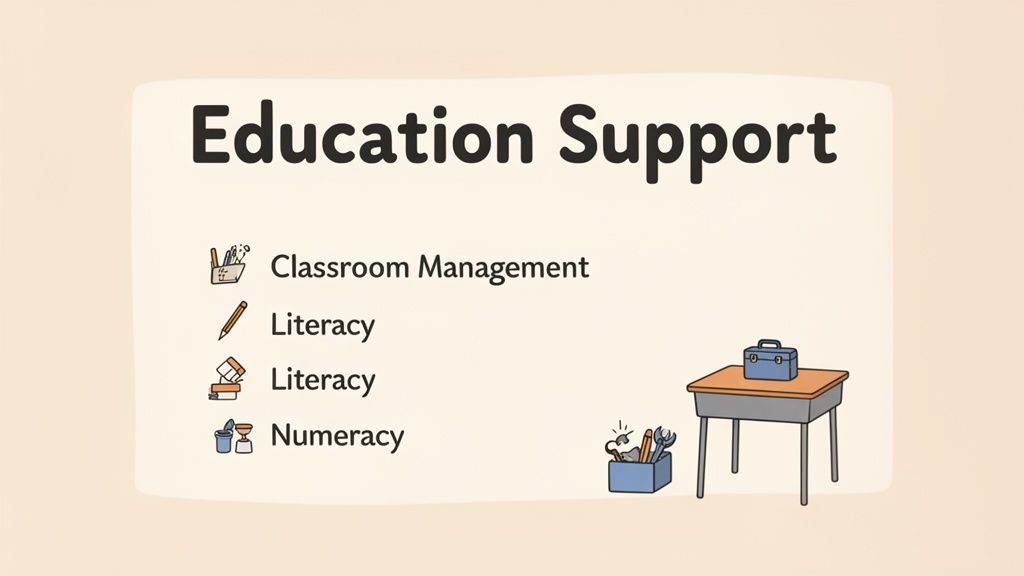
You can expect to get skilled up in key areas like:
- Supporting Literacy and Numeracy: Learning practical strategies to help students with reading, writing, and maths, usually by working with small groups to build on what the teacher has taught.
- Managing Classroom Behaviour: This is a big one. You’ll learn positive reinforcement techniques and how to de-escalate situations to help keep the classroom a calm and productive space for everyone.
- Assisting with Curriculum Implementation: Understanding how to help the teacher deliver lesson plans, get materials ready, and use classroom technology effectively.
- Supporting Students with Diverse Needs: Gaining the skills to work with students who have disabilities, learning difficulties, or come from different cultural backgrounds.
A core part of this training involves learning effective teaching methods. For instance, you’ll likely cover concepts like scaffolding in child development, which is a technique for giving students temporary support as they grasp a new idea. This is exactly the kind of practical knowledge that makes a qualified TA so valuable.
Translating Training into Classroom Confidence
Picture this: the teacher is explaining a new maths concept to the class, but you spot a few kids at the back starting to look lost. With the right training, you don't just stand there waiting for instructions. You know exactly how to step in.
You might grab some visual aids you helped prepare, re-explain the concept in a different way you learned in your course, or sit with them to guide them through the first few problems. This isn’t just ‘helping out’—it’s targeted support that genuinely moves the needle on student learning.
This is what a proper qualification gives you: the confidence to walk into any classroom and make a meaningful contribution from your very first day. You'll have the frameworks to not only follow a teacher's lead but also to take initiative, spot where a student needs help, and provide the right kind of support at the right time. That practical readiness is what makes you the candidate schools want to hire.
Getting Your Clearances and Hands-On Experience
Once you’ve locked in your qualification pathway, it’s time to focus on two things that will make or break your application: official clearances and real-world experience. You simply can't step into a classroom without them.
Think of it this way: the qualification shows you know the theory, but the clearances and experience prove you're ready, safe, and capable of handling the dynamic environment of a real school. They are non-negotiable.
First Things First: The Working With Children Check
Before you do anything else, you need to get your Working With Children Check (WWCC). This is a mandatory background screening for anyone who works with children in Australia. It’s a fundamental safety measure, and no school will even look at your application without it.
Depending on your state, it might be called a Blue Card or a Working with Vulnerable People registration, but the purpose is the same. The process is usually straightforward, but it can take a few weeks to come through, so I always advise people to get this sorted as early as possible.
The application process varies slightly from state to state:
- NSW: Apply via the Office of the Children's Guardian.
- VIC: You’ll need a check from the Department of Justice and Community Safety.
- QLD: This is the famous Blue Card, handled by Blue Card Services.
- WA: The WWC Check is managed by the Department of Communities.
- SA: Apply through the Department of Human Services Screening Unit.
- TAS: You'll need a Registration to Work with Vulnerable People (RWVP).
Make sure you visit the official government website for your specific state or territory. They’ll have the most current forms and instructions. Having this clearance ready to go shows schools you’re professional and prepared.
Getting Real-World Classroom Experience
Your certificate gives you the knowledge, but nothing teaches you more than being in a bustling classroom. Practical experience is where you’ll learn to manage group dynamics, assist students with different needs, and really see if this career is for you.
For most people, the first taste of this comes from the work placement built into their course. A lot of Certificate III and IV courses in Education Support include a mandatory placement of around 100 hours. This isn't just a box to tick; it's an invaluable chance to put what you've learned into practice under the watchful eye of an experienced teacher.
Treat your work placement like a months-long job interview. Show up early, be enthusiastic, and always look for ways to help. I've seen countless students get offered a job at the school where they did their placement simply because they made such a great impression.
Volunteering is another brilliant way to build up your experience. Reach out to local primary schools, after-school care programs, or even community reading groups. Offering a few hours a week not only strengthens your resume but also gives you fantastic real-life scenarios to talk about in an interview.
This is your chance to practise specific skills, like using effective strategies for struggling readers to give a child that 'lightbulb' moment.
When you're in the classroom, don't just stand back and wait for instructions. Be proactive. Watch what the teacher is doing, anticipate where help might be needed, and offer to jump in. This initiative is exactly what head teachers look for. It’s this hands-on experience that will ultimately make your application stand out from the rest.
Getting Your Foot in the Door: Applications and Interviews
You’ve got the qualifications and your clearances are sorted. Now comes the exciting part—landing the actual job. This is your moment to connect all the dots and show a school why you're the right person to support their students.
A common worry I hear from aspiring TAs is that they don't have enough direct classroom experience. Don't let that hold you back. Schools are actively looking for people with diverse life skills, as long as you can show them how that experience translates to the classroom.
Unpacking Your Transferable Skills
Forget job titles for a moment and think about what you’ve actually done in your previous roles. Whether you've been working in retail, an office, or raising a family, you’ve been building a toolkit of valuable skills without even realising it.
The trick is to make the connection obvious for the principal or hiring manager reading your application. Don't just list what you did; explain how it has perfectly prepared you for the realities of a school environment.
Let's look at a few examples:
- Retail or Customer Service: You’re a pro at staying calm under pressure, communicating clearly, and resolving conflicts on the spot.
- Admin or Office Work: This proves you’re organised, have a sharp eye for detail, and can juggle multiple tasks at once—all daily requirements in a busy classroom.
- Parenting or Caring for Others: This is a powerhouse of relevant experience! It shows you have endless patience, empathy, and a natural instinct for encouraging and supporting young people.
The applications that always stood out to me were from people who could tell a compelling story. They didn't just write 'good communication skills.' They'd give a real example, like: 'In my retail job, I regularly de-escalated situations with upset customers, which has given me the confidence to handle challenging classroom dynamics with patience and empathy.'
Your cover letter is the perfect place to do this. Pick one or two powerful examples from your past and explicitly connect them to what the school is looking for in their job description. Show them you’ve done your homework and understand what the role truly involves.
Nailing the Scenario-Based Interview
Once your fantastic application gets you in the door, be ready for an interview that’s less about your CV and more about your character. Schools love using scenario-based questions to see how you think on your feet.
There’s no single “correct” answer to these questions. What the interviewer is really looking for is your thought process, your values, and whether you have a student-first mindset.
You can expect questions like:
- “Tell me how you would manage a student who is being disruptive and distracting others.”
- “What would you do if you saw a child falling behind in a lesson?”
- “Can you describe a time you had to explain something complex to someone?”
A Framework for Great Answers
The key to answering these questions well is to show a clear, logical thought process. A simple but effective model is to show that you would Observe, Support, and Communicate.
Let’s use this framework on a classic interview question: “How would you handle a disruptive student?”
Observe & Assess: Start by explaining that your first step isn’t to react, but to understand. "I'd first try to figure out why the student is being disruptive. Are they bored, confused, or just need some attention? I’d start with a subtle, non-disruptive intervention, like moving closer to their desk or using a quiet visual cue to get them back on track."
Support & Engage: If that doesn't work, your next move is supportive, not punitive. "I'd then discreetly check in with the student. I might quietly ask if they're stuck or if they need the instructions explained in a different way. My goal is always to guide them back to the lesson."
Communicate & Collaborate: This final step shows you’re a team player. "After the lesson, I would make a point of sharing my observations with the classroom teacher. By working together, we can develop a consistent strategy to help that student thrive. It's all about collaboration."
This kind of structured answer demonstrates that you are proactive, thoughtful, and collaborative—precisely the qualities every school wants in a teaching assistant. For more great advice, check out these essential job interview tips and tricks.
At the end of the day, the interview is your chance to let your genuine enthusiasm for helping students shine. Bring that passion, combine it with a well-thought-out application, and you'll be well on your way to starting a rewarding new career.
So, What's Next? Salary and Career Pathways Explained
Alright, let's get down to the nitty-gritty. You’ve put in the work, earned your qualification, and landed your first gig as a teaching assistant. What does the future actually look like? This is more than just a job; it’s a real career with genuine opportunities to grow, specialise, and build a stable income.
A good place to start is understanding what you can expect to earn. Like most professions, your pay packet will depend on a few key things: where you are in Australia, whether you're in a public, private, or Catholic school, and of course, your level of experience.
What You Can Realistically Expect to Earn
As a teaching assistant in Australia, your pay is usually set by an award or enterprise agreement that’s specific to your state and school system. These agreements clearly lay out pay grades, which climb as your qualifications and years on the job stack up.
Straight out of the gate, a full-time, entry-level teaching assistant can generally expect to earn between $50,000 and $60,000 a year. With a few years of experience under your belt and maybe some extra responsibilities, that figure can easily climb to $65,000 or more. It’s worth remembering, though, that a lot of TA roles are part-time or casual—which is fantastic for flexibility but means your annual income will be based on the hours you work.
The career outlook right now is incredibly positive. Ongoing teacher shortages and a bigger national focus on inclusive classrooms mean that skilled TAs are more in demand than ever. The sector is booming, with 136,700 people currently employed and another 7,000 jobs being added each year. The average weekly earning sits around $1,098, and the flexible, part-time nature of the work is a huge draw for people juggling study or family commitments. If you love data, you can dive deeper into the stats on the Australian Bureau of Statistics website.
Where Your Career Can Take You
One of the best things about being a teaching assistant is that it's not a dead-end job. Far from it. Think of it as a launchpad. The experience you gain on the classroom floor opens up a surprising number of doors for your career.
Here are just a few common pathways people take as they grow in their role:
- Senior Teacher Aide: After a few years, you could step up into a leadership role. This might involve mentoring new TAs, coordinating support programs across different year levels, or managing all the resources for the school’s learning support team.
- Special Needs Specialisation: You might find your passion lies in supporting students with specific needs, like those on the autism spectrum, or students with hearing impairments or physical disabilities. This path often requires extra training, but it’s an incredibly rewarding and highly sought-after area of expertise.
- Student Liaison Officer: Some TAs find their calling in pastoral care. They transition into roles where they become a key support person for students' wellbeing, helping them navigate the challenges of school life and connecting them with the right services.
Think of your first teaching assistant role as your foundation. It gives you a priceless, ground-level view of how a school really operates and what students actually need to thrive. That insight is gold, no matter which direction your career heads.
A Smart Stepping Stone to Teaching
For many, working as a teaching assistant is the perfect stepping stone to becoming a fully qualified teacher. The hands-on, in-classroom experience you get is something uni graduates often miss out on, putting you miles ahead of the pack.
If you discover that you truly love the buzz of the classroom and want to lead one yourself, your Certificate IV in Education Support can often provide a direct pathway or even give you course credits towards a Bachelor of Education. This makes the journey to becoming a registered teacher smoother and more affordable. More importantly, you'll walk into your degree with a wealth of practical experience that will set you up for success from day one.
Ultimately, the skills you develop—patience, empathy, rock-solid communication, and a real understanding of how kids learn—are more than just job skills. They’re life skills. They’ll serve you well in any career you choose, making this a smart and strategic move from every angle.
A Few Final Questions You Might Have
As you get closer to starting this new career path, a few last-minute questions often pop up. It’s completely normal. Here, I’ll tackle some of the most common queries I hear from people who are right where you are now—thinking seriously about becoming a teaching assistant. Let’s clear up any final uncertainties so you can move forward with confidence.
Do I really need a university degree to become a teaching assistant?
This is easily the most common question, and I’m happy to say the answer is a straightforward no. You don't need a university degree to become a teaching assistant in Australia. What schools are really looking for are practical, classroom-ready skills.
The qualifications that will actually get you hired are vocational certificates. A Certificate III or IV in Education Support is the gold standard. These courses are designed from the ground up to give you the specific skills you’ll be using every day to support teachers and help students thrive.
How long will it actually take to get qualified?
There’s no single answer here, which is great because it means you can make it work for your life. The time it takes really depends on the specific course and your own study pace.
As a general guide, here’s what you can expect:
- A Certificate III in Education Support can be finished in as little as six months if you're really dedicated, but most people find 12 months is a comfortable timeframe.
- A Certificate IV in Education Support goes a little deeper, so it usually takes somewhere between 12 and 18 months to complete.
The best courses are offered online, allowing you to learn at your own pace. This flexibility is a game-changer. It means you can fit your studies around your job, family, and everything else life throws at you.
Can I get a job as a TA if I haven't worked with children before?
Yes, you absolutely can. While having prior experience with kids is a nice bonus, it's definitely not a deal-breaker. Many fantastic TAs I know came from totally unrelated careers, and there are a couple of key reasons why it works.
First, any nationally recognised qualification worth its salt will include a mandatory work placement. This is your golden ticket. It’s where you get that essential hands-on experience inside a real classroom, applying what you’ve learned and making connections with staff.
Second, you likely have more relevant experience than you give yourself credit for. Think about it—skills like clear communication, patience, being organised, and solving problems on the fly are incredibly valuable in a school. You can also boost your resume by volunteering at a local school, helping out with a youth group, or working in after-school care.
Don't underestimate your life experience. Managing a team, dealing with tricky customers, or even raising your own kids has equipped you with skills that are directly transferable to a classroom. The trick is to highlight these skills in your application and connect them to what a school needs.
What’s the difference between a Teacher Aide and a Teaching Assistant?
This is a source of a lot of confusion, but the answer is surprisingly simple: in Australia, there's basically no difference. The titles are used interchangeably to describe the very same role.
You'll see job ads for all sorts of titles:
- Teacher Aide
- Teaching Assistant
- Education Assistant
- Learning Support Officer (LSO)
The title might vary a bit depending on the state or the school system (public, Catholic, independent), but the job itself is the same. Your work will always be about supporting the teacher to create a positive and effective learning environment for students.
Here’s a practical tip: when you’re job hunting, search for all of these titles. Using them as keywords will open up way more opportunities, making sure you don't miss out on a great role just because it was listed under a different name.
Ready to find the perfect course and start your journey? At Get Course Australia, we connect you with flexible, nationally recognised qualifications from leading online providers. Explore your options and take the first step toward a rewarding new career today at https://getcourse.com.au.
Find Your Course
Compare courses across every field we write about, and enquire in under a minute.