Your Guide to Event Management Training Online in Australia
Discover the best event management training online in Australia. Learn about courses, essential skills, and career paths to launch your career in events.
Ever thought about launching a career in event management right from your own home? It’s not just a pipe dream. Event management training online is a flexible, smart way to break into Australia's booming events industry, giving you the practical, tech-savvy skills that today’s employers are searching for.
Consider this your guide to getting started. We’ll show you exactly how accessible and effective online study can be for building a career you'll love.
Starting Your Event Management Career From Home
The thought of organising a huge music festival, a sleek corporate conference, or a picture-perfect wedding is thrilling, but figuring out how to get there can feel a bit overwhelming. For years, the only real option was to enrol in on-campus classes with strict schedules that didn't work for everyone.
Thankfully, that’s all changed. A much more practical path has opened up, letting you build a professional skillset from anywhere in Australia. We're here to break down what that journey looks like, showing you how online learning can turn a knack for planning into a certified profession.
A Modern Approach to a Dynamic Industry
Forget dusty textbooks and outdated theories. The events world has moved way beyond clipboards and checklists; it’s now powered by technology, savvy digital marketing, and airtight logistics. The best event management training online gets this and centres its entire curriculum around what’s happening in the industry right now.
You’re not just learning concepts; you’re getting hands-on with the skills that matter.
Modern courses are built around four key pillars:
- Digital Marketing and Promotion: Getting to grips with social media, email marketing, and SEO to fill seats and create buzz.
- Sustainable Planning: Learning to run environmentally friendly events—a major focus for 80% of Australian event professionals.
- Hybrid Event Production: Mastering the tech to flawlessly manage events for both live and virtual audiences at the same time.
- Financial and Risk Management: Building the confidence to create solid budgets, land sponsorships, and have a plan B for anything that could go wrong.
Building Your Skills Flexibly
Let's be honest, life is busy. One of the biggest perks of studying online is the freedom it gives you. You can slot your learning around your job, family, or other commitments without ever compromising on the quality of your education.
Think of your online course as a personal event planning studio that’s open 24/7. You can dive into a marketing module on your lunch break or draft a mock event floor plan late at night—it all happens on your schedule.
This self-paced style does more than just offer convenience. It sharpens essential skills like time management, self-motivation, and digital communication, all of which are a huge plus for employers.
From foundational certificates to advanced diplomas, online training offers a clear, structured pathway. It proves you can earn a nationally recognised qualification and kickstart a fantastic career, all without leaving your home.
What Qualifications Do You Need for Event Management?
Jumping into the world of event management qualifications can feel a bit overwhelming at first, but it's actually quite straightforward once you see how the pieces fit together. Before you even think about which course to pick, it’s worth getting a clear picture of what event management entails as a profession. Knowing this helps make sense of why there are different training levels and which one is the right launchpad for you.
Think of it like building a career, one solid block at a time. You wouldn’t put the roof on a house before you've laid the foundation. In the same way, each qualification in event management builds on the last, giving you more advanced skills and opening up bigger and better career opportunities.
This diagram shows how the different parts of your training come together to build a strong career.
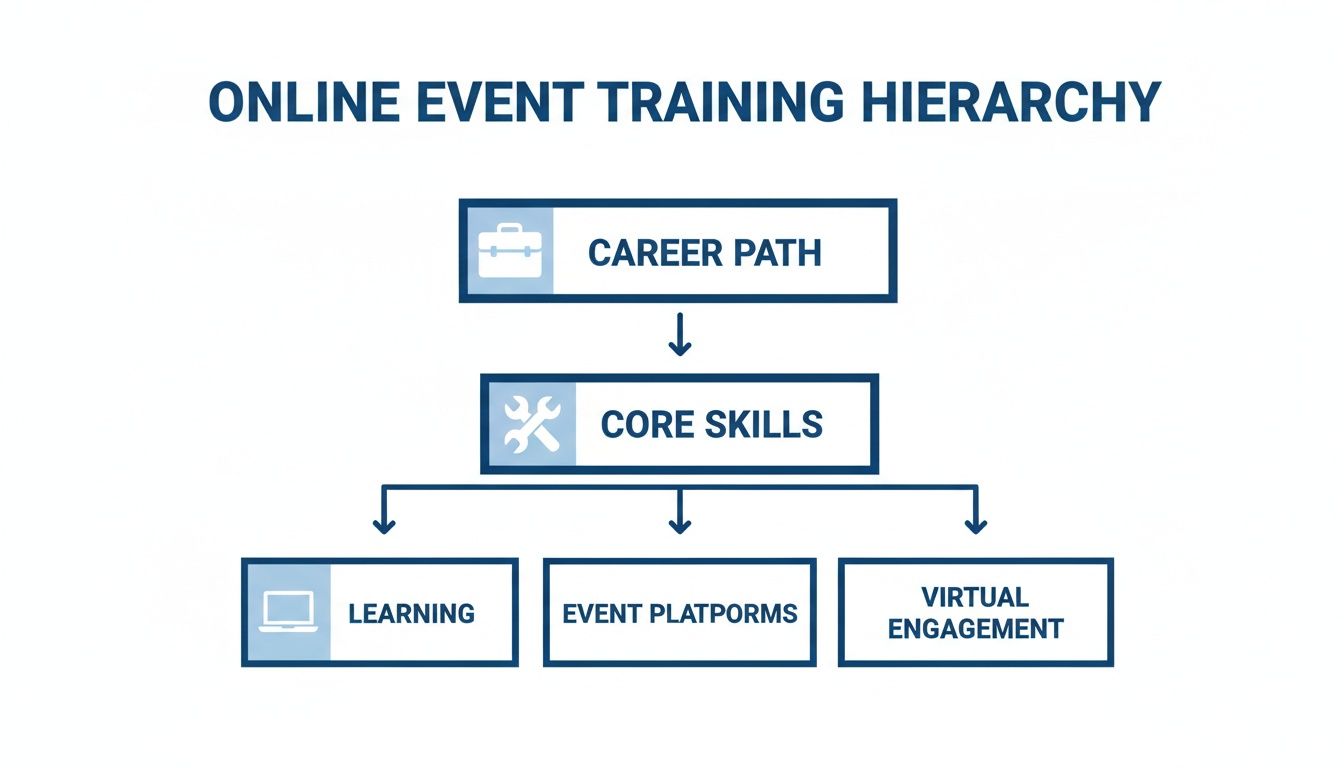
As you can see, the learning you do directly builds your core skills, which then unlocks different career paths within the exciting events industry.
To help you visualise the different pathways, here's a quick breakdown of the most common qualifications you'll find in Australia.
Comparing Online Event Management Qualifications
This table gives you a clear snapshot of the journey. You can start with the basics and work your way up, or if you have some experience, you might jump straight into a diploma.
Starting with Certificate Courses
A Certificate III or IV in Events is your entry ticket. These qualifications are perfect for anyone just starting out, giving you the practical, hands-on skills you need to be useful on day one.
You'll get to grips with the essentials, like processing event registrations, providing information to attendees, and helping things run smoothly on-site. Think of these courses as your apprenticeship—they’re all about making you job-ready for roles like an Event Assistant or Junior Coordinator.
A Certificate course proves you've got the foundational knowledge to be a reliable and confident member of any event team. It’s your foot in the door.
A Certificate III usually covers the absolute basics. A Certificate IV takes it a step further, introducing you to more complex tasks and giving you the skills to take on a bit more responsibility, maybe even overseeing a specific part of an event.
Advancing to a Diploma of Event Management
If a certificate gets your foot in the door, a Diploma of Event Management is what gives you the keys to the entire building. This is for people who want to be in charge—planning, leading, and pulling off incredible events from the initial idea to the final pack-down. The focus shifts from doing to managing.
A diploma dives much deeper into the 'why' and 'how' of running successful events. You'll cover big-picture topics like:
- Budgeting and Financial Management: Learning to create, track, and report on complex event budgets without breaking a sweat.
- Marketing and Promotion Strategy: Figuring out how to create buzz and get people excited to attend.
- Risk Management: Spotting potential problems before they happen and having a solid backup plan.
- Project Management: Juggling all the moving parts, from negotiating with suppliers to delivering the final event report.
This level of training is exactly what you need if you're aiming for senior roles like Event Manager or Conference Organiser, or even if you're dreaming of starting your own events business. It shows employers you have the strategic mind and practical skills to own a project from start to finish.
By exploring the different nationally recognised event management courses online, you can compare these qualifications side-by-side and find the one that perfectly matches your career goals.
The Core Skills You Will Actually Use
Knowing the theory is one thing, but great event management training online is all about building the practical, real-world skills that become your professional toolkit. This is where you graduate from abstract concepts and start mastering the day-to-day competencies that truly define a successful event manager.
Let's break down the skills you'll actually be using on the job.

These aren’t just topics in a textbook; they're the actions you'll take to make incredible events happen. A quality online course will throw you into realistic projects and scenarios, so you’re ready for the challenges that come with the territory.
Mastering Budgeting and Financial Planning
At its heart, every single event is a business project. It has a bottom line. Without a firm grip on the finances, even the most creative and brilliant ideas will fall flat. That’s why budgeting modules are absolutely fundamental.
You’ll learn to do far more than just track a few expenses. A proper course walks you through the entire financial lifecycle of an event, teaching you how to:
- Create Detailed Budgets: Learn to build a comprehensive budget from the ground up for a large-scale event, accounting for everything from venue hire and catering to marketing spend and staffing.
- Secure Sponsorships and Funding: Get the skills to write compelling proposals and pitch to potential sponsors—a critical revenue stream for countless events.
- Manage Cash Flow: Understand how to juggle payments to suppliers while tracking income from ticket sales, ensuring the event stays financially healthy from start to finish.
Think about it: you're tasked with planning a local music festival. Your financial planning skills will be what lets you accurately forecast costs, set ticket prices that actually turn a profit, and present a clear financial report to stakeholders when it's all over.
Developing Airtight Risk Management Strategies
What do you do if your keynote speaker cancels at the last minute? What if a freak storm rolls in and threatens an outdoor wedding? A professional event manager always has a Plan B (and C, and D). That's what risk management is all about.
This isn't about being negative; it's about being prepared. It’s about ensuring a seamless, positive experience for your attendees, no matter what’s going on behind the scenes.
Risk management is the art of expecting the unexpected. It’s about building a safety net of contingency plans that protects your event, your clients, and your reputation from potential disruptions.
In your training, you'll dig into case studies to spot potential hazards—from tech failures to health and safety issues. From there, you'll learn to develop structured contingency plans for each scenario, giving you the confidence to handle any crisis with a cool and steady hand.
Executing Flawless On-Site Logistics and Supplier Coordination
An event manager is like the conductor of an orchestra. You aren't playing every instrument yourself, but you're the one making sure every section—catering, security, audiovisuals, transport—works together in perfect harmony.
Supplier coordination is a massive part of this. You'll learn the delicate art of sourcing, negotiating with, and managing a whole host of different vendors. This means drafting clear contracts, setting expectations, and building strong professional relationships you can count on, event after event.
On-site logistics is all about managing the event in real-time. Your training will cover crucial tasks like:
- Developing a Master Run Sheet: Creating that minute-by-minute schedule that details every single action and responsibility on the event day.
- Managing Staff and Volunteers: Learning how to brief and deploy your team effectively so that all your bases are covered.
- Overseeing Bump-In and Bump-Out: Coordinating the setup and pack-down of the event space efficiently, safely, and on schedule.
To truly thrive in this field, mastering the essential skills for event planning success is paramount, encompassing everything from logistics to communication.
Driving Attendance with Modern Event Marketing
A brilliant event is pretty pointless if nobody shows up. This is where marketing and promotion come in, and modern training focuses heavily on the digital strategies that actually get results. You'll learn how to create integrated marketing campaigns that build buzz and, most importantly, drive ticket sales.
Your course will teach you how to pinpoint your target audience and reach them where they hang out online. This includes mastering social media promotion, building email marketing funnels, and even getting a handle on basic search engine optimisation (SEO) for your event website.
For example, a huge trend in the Australian events industry right now is sustainability. A Cvent ANZ survey found 80% of respondents reported having a sustainability target for their events, which has become a massive marketing advantage. Good training will equip you with knowledge on things like carbon accounting and sustainable procurement so you can meet client expectations and attract environmentally conscious attendees.
These practical, in-demand skills are what separate a hobbyist from a professional. By enrolling in the right training, you're not just getting a piece of paper; you're building a powerful professional toolkit. For more tips, check out our guide on what you need to know to put on a successful event.
Why Modern Event Training Is All About Tech
Think back to event management ten years ago. It was a world of clipboards, endless phone calls, and meticulously organised spreadsheets. Fast forward to today, and that world has been completely turned on its head by technology. An event manager who isn't fluent in digital tools is like a chef who doesn’t know how to use an oven—they're missing a fundamental part of their kit.
This is exactly why any worthwhile event management training online has to be built around technology. It's not just an add-on module or an afterthought anymore. Being proficient with software, data, and virtual platforms is now a non-negotiable, foundational skill. Employers aren’t just looking for great planners; they're hunting for tech-savvy project managers who can deliver seamless, data-driven experiences.

The change is impossible to ignore. From automated registration systems to immersive virtual reality conferences, tech is now at the very heart of how we plan, promote, and run modern events. This industry-wide evolution is precisely why your training needs to get you ready for the future, not the past.
The Rise of Event Management Software
The days of manually tracking every single registration, payment, and attendee detail are well and truly over. Today, the industry runs on sophisticated event management software that pulls everything into one streamlined dashboard. These platforms aren't just a nice-to-have; they are absolute powerhouses for efficiency and growth.
A good online course will give you hands-on experience with the kind of software the pros use every day. You'll learn to use these platforms for critical tasks, including:
- Automated Registration and Ticketing: Setting up custom registration forms, processing payments securely, and sending out digital tickets without breaking a sweat.
- Audience Engagement Tools: Using live polls, Q&A features, and mobile event apps to create interactive experiences that people actually remember.
- Data and Analytics Reporting: Tracking key metrics like attendance rates, session popularity, and return on investment (ROI) to prove an event's success with hard numbers.
This focus on tech is a direct response to what the industry is asking for. The Australian event management software market is booming. A Grand View Research report revealed it generated around USD 135.6 million in 2024 and is projected to skyrocket to USD 298.4 million by 2030. This massive growth, as detailed in an analysis of event management software development in Australia, shows just how much demand there is for professionals who get software, data, and platform integration.
Mastering Virtual and Hybrid Event Platforms
Being able to run a purely virtual or a hybrid event (one that combines in-person and online elements) is now a core skill for any event professional. The pandemic certainly pushed this trend into overdrive, but the flexibility and incredible reach of digital events mean they are definitely here to stay.
A modern event manager has to be a digital producer just as much as a physical coordinator. Knowing how to manage a livestream, engage a remote audience, and create a seamless experience for everyone—no matter where they are—is absolutely critical.
Your online training needs to reflect this new reality. The course modules should dig into both the technical and strategic sides of digital events, teaching you how to:
- Pick the right virtual event platform for different needs and budgets.
- Design genuinely engaging online content that keeps a remote audience hooked.
- Troubleshoot the common technical glitches that can pop up during a live broadcast.
This is about more than just knowing which buttons to press. It’s about understanding the unique psychology of an online audience and building an experience that feels just as valuable and exciting as being there in person.
Choosing an event management training online course that makes these tech-focused skills a priority is a direct investment in your career. It ensures you graduate not just with a piece of paper, but with the digital fluency you need to walk into a modern event management role and deliver brilliant results from day one.
Your Career Path After Graduation
Finishing your event management training online is a fantastic achievement, but it's really just the starting line. The big question is, what happens now? The great news is a qualification in this field doesn't railroad you into one single job. Instead, it throws open the doors to a huge range of dynamic and rewarding careers all over Australia.
Think of your new qualification as an all-access pass. It can get you into major corporations, buzzing creative agencies, dedicated non-profits, or even give you the confidence to go out on your own. The skills you'll have are in demand everywhere because pretty much every industry needs organised, creative people to make their events happen.
And the demand for skilled event professionals is really picking up steam. A recent report captured this perfectly, revealing that a massive 81% of event professionals in Australia and New Zealand are planning to run more events in 2025. On top of that, 77% intend to increase their event budgets, which is a clear sign of more opportunities for qualified planners and coordinators. You can read the full research about these exciting event trends to get the bigger picture.
Exploring Your Potential Career Roles
With a formal qualification under your belt, you’ll be ready to jump into all sorts of roles. Each one has a slightly different flavour, so you can find a career that genuinely clicks with your personality and what you’re good at.
Here are a few of the most popular paths people take:
- Event Coordinator: This is a classic starting point and the organisational backbone of any event team. You'll be the one juggling logistics, liaising with suppliers, and making sure everything is running like clockwork on the day.
- Conference Organiser: If you like the buzz of big, professional gatherings, this is for you. You'll manage large-scale conferences, trade shows, and conventions, which demands sharp project management skills and an eye for creating impressive experiences.
- Wedding Planner: For those who thrive on creativity and building personal connections, this is a dream job. You get to work one-on-one with couples to bring their vision to life, handling everything from the venue hunt to the final farewell.
- Corporate Event Manager: You'll work in-house for a large company, planning everything from new product launches and annual meetings to team-building retreats that reflect the company's brand and business goals.
Where You Could Work
The best part about a career in event management is the incredible variety of workplaces. You're definitely not stuck in one type of industry.
Your skills are your passport to work in almost any sector you're passionate about. Whether it's the high-energy world of sports, the glamour of fashion, or the impactful work of a charity, there's a place for a skilled event manager.
You could find yourself working for:
- Large Corporations: Planning slick product launches and global sales conferences for well-known brands.
- Event Management Agencies: Getting a taste of everything by working on diverse projects for different clients, from music festivals to charity balls.
- Non-Profit Organisations: Putting your skills to good use by organising fundraising events and community campaigns that truly make a difference.
- Hotels and Venues: Managing a venue's in-house events and helping clients plan their functions on-site.
- Your Own Business: Armed with the skills and confidence from your training, you could absolutely launch your own event planning consultancy.
Your online course gives you the solid foundation needed to chase these opportunities. By getting to know the full scope of the event management industry, you’ll see just how varied and exciting your future can be.
How to Choose the Right Online Course for You

Jumping into an event management course is a big move, and with so many options out there, it’s easy to get a bit lost. So, how do you pick the right one?
Think of it like you're planning a major event and need to hire a key supplier. You wouldn’t just go with the first name you find. You’d do your homework—check their reputation, look at what they’ve done before, and make sure they can actually deliver. You need to apply that same mindset when choosing a course to make sure you're investing in your own future wisely.
Look for National Accreditation
First things first, check if the course is nationally recognised. Here in Australia, that means you want a qualification from a Registered Training Organisation (RTO). An accredited course is your guarantee that your certificate or diploma actually means something to employers right across the country.
This isn’t just a box-ticking exercise. Accreditation confirms the curriculum is up-to-date, the assessments are fair, and the skills you learn meet a national standard. It's the difference between getting a genuine, industry-respected credential and just a piece of paper.
Evaluate the Course Content and Assessments
A good online course should feel like you're already on the job. Dive into the curriculum and make sure it’s packed with practical, hands-on skills—not just dusty old theories. You want to see modules that include:
- Real-World Case Studies: Breaking down what made actual events succeed or fail.
- Practical Assessments: Assignments where you're building real event budgets, drafting marketing plans, or creating risk management strategies.
- Industry Software Training: Getting you comfortable with the digital tools you’ll be using every day.
The best online assessments feel less like an exam and more like a real work project. They’ll challenge you to take what you've learned and solve a genuine problem, which is exactly what you'll be doing as an event coordinator.
Consider Support and Flexibility
The learning experience is about so much more than just the videos and reading materials. A quality provider will have a solid support system in place. See if they offer access to real tutors, a helpful student services team, and maybe even an online forum to connect with other students.
Finally, make sure the course fits your life. A self-paced structure is a must if you're juggling study with work or family. And don't forget to look into the payment options. Most reputable providers offer flexible payment plans, which takes the financial pressure off and lets you focus on learning.
Got Questions About Online Event Training?
Thinking about a new career is exciting, but it always brings up a few questions. That's completely normal. When it comes to event management training online, you want to feel sure you’re making a smart move for your future. So, let’s clear up some of the most common things people ask.
We’ve pulled together some straight-to-the-point answers to help you see exactly how online study works and what it could mean for you. Getting this clarity is the best way to move forward with confidence.
Do I Need Any Experience to Get Started?
For most entry-level courses, like a Certificate III in Events, the answer is no. You don't need any prior experience at all. These courses are built from the ground up, designed to give you all the foundational skills you need to walk into your first job feeling capable and ready.
While some of the more advanced diplomas might suggest you have a bit of industry exposure, the beauty of online training is that it’s a perfect launching pad for career changers. It’s a direct route into the industry, no matter what you were doing before.
How Do Assessments Work if It's All Online?
This is a great question, and one we hear a lot. Online course assessments are cleverly designed to be practical, mirroring the real-world tasks you'll actually be doing in an event management role. Forget stuffy, old-school exams; you’ll be assessed on projects that truly show what you can do.
You won't just learn the theory; you'll prove you can apply it. For example, an assessment might involve creating a full event proposal for a mock client, building a detailed budget for a music festival, or mapping out an entire marketing plan for a corporate product launch.
This hands-on approach means you’re not just memorising information—you’re proving you can put your knowledge into action, which is precisely what employers are looking for.
Will Employers in Australia Take an Online Qualification Seriously?
Absolutely. Here in Australia, a nationally recognised qualification from a Registered Training Organisation (RTO) carries the same weight whether you earn it online or in a classroom. What employers really care about are your skills and what you know, not how you learned it.
In fact, completing a course online can often be a plus. It shows a potential employer that you're self-motivated, disciplined, and have excellent time management skills—all essential traits in the fast-paced events world. Your qualification is proof that you’re ready to hit the ground running.
Ready to get clear answers and find the perfect course for your career goals? At Get Course Australia, we connect you with nationally recognised qualifications from leading providers. Explore online event management courses today and take the first step with confidence.
Find Your Course
Compare courses across every field we write about, and enquire in under a minute.