How to Write a Professional Resume That Gets You Hired
Learn how to write a professional resume that gets noticed. Our guide offers ATS-friendly tips, real examples, and expert advice to land your next interview.
Writing a truly professional resume is about crafting a sharp, focused, two-page document that sells your most relevant skills and achievements. It’s a targeted pitch, tailored specifically to the job you’re aiming for. To be effective, it needs to be built for both the software that scans it and the human who reads it, using clean formatting and strong language to make an instant impression.
Why Your Resume Is Your Most Important Career Tool
Staring at a blank page and wondering where on earth to begin? That’s a familiar feeling. In the current Australian job market, your resume is so much more than a simple record of your work history—it's your number one marketing tool. It’s what gets your foot in the door for an interview, so getting it right is non-negotiable.
A generic, "one-size-fits-all" resume is the fastest way to the 'no' pile. Most recruiters will only glance at a CV for a mere 6-8 seconds before making a snap judgment. That’s all the time you have to grab their attention and convince them you’re worth a closer look.
Navigating The Two Audiences
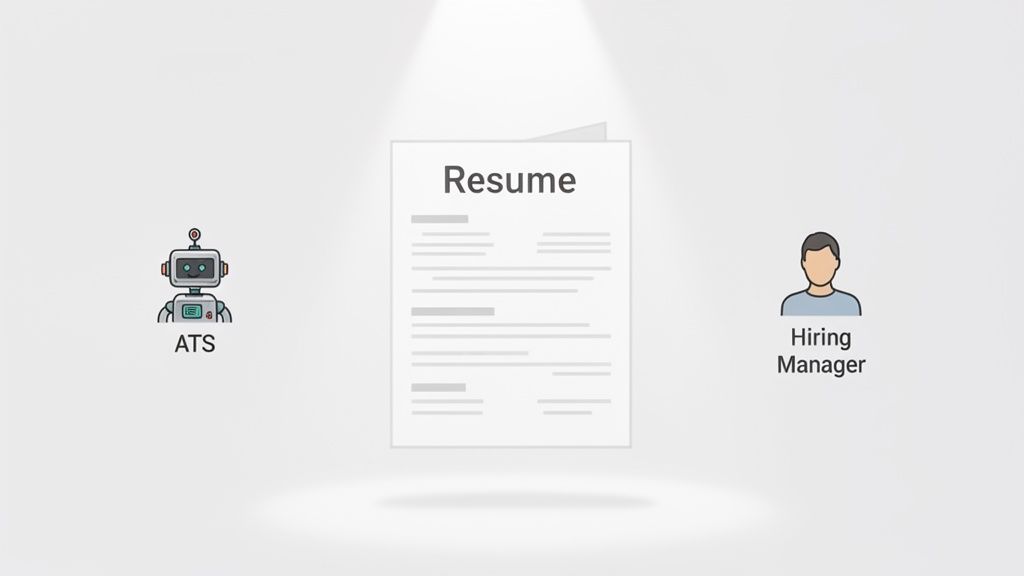
This guide goes beyond the basic advice you’ve heard before. We’re focusing on the two distinct audiences your resume must impress: the Applicant Tracking Systems (ATS) and the actual hiring managers.
Think of the ATS as a bouncer at the door. Its job is to scan your resume for keywords and filter out anyone who doesn't seem to match the job description. If your resume isn't formatted in a way the software can read or it’s missing those crucial terms, a real person will probably never even see it.
But once you’re past the digital gatekeeper, a human takes over. This is where your resume needs to tell a compelling story. It has to clearly articulate your value, showcase what you've actually accomplished, and make a strong case for why you are the perfect person for the role.
Your resume is a personal marketing document designed to sell one thing: an interview. Every section, every bullet point, and every word should work towards this single goal.
Standing Out In a Crowded Market
The challenge, especially for those just starting out, is huge. Competition for entry-level roles in Australia is fierce, with recent research showing there are roughly 26 job seekers for every single entry-level vacancy. When you’re up against dozens of other applicants, your resume absolutely has to stand out.
This is just as true if you’re changing careers or have recently upskilled. You have to connect the dots for the employer, translating your new qualifications and existing skills into a narrative that makes sense for your new field. It's all about showing them how your past experiences make you a uniquely valuable asset today.
To get a deeper understanding of how to make your CV work for you, it’s worth exploring how to write a professional resume for marketing success to ensure every detail is helping you land that interview.
Getting the Structure of Your Resume Right
Think of your resume as the blueprint for your career story. It’s not just a document; it’s your first handshake with a potential employer. Getting the structure right from the beginning is what separates a resume that gets a call-back from one that gets lost in the pile.
For the Australian market, clarity and a logical flow are everything. Hiring managers are busy, often spending just a few seconds on their first scan. A well-organised resume makes their job easy by guiding their eyes straight to your most impressive qualifications.
The Essential Sections Every Resume Needs
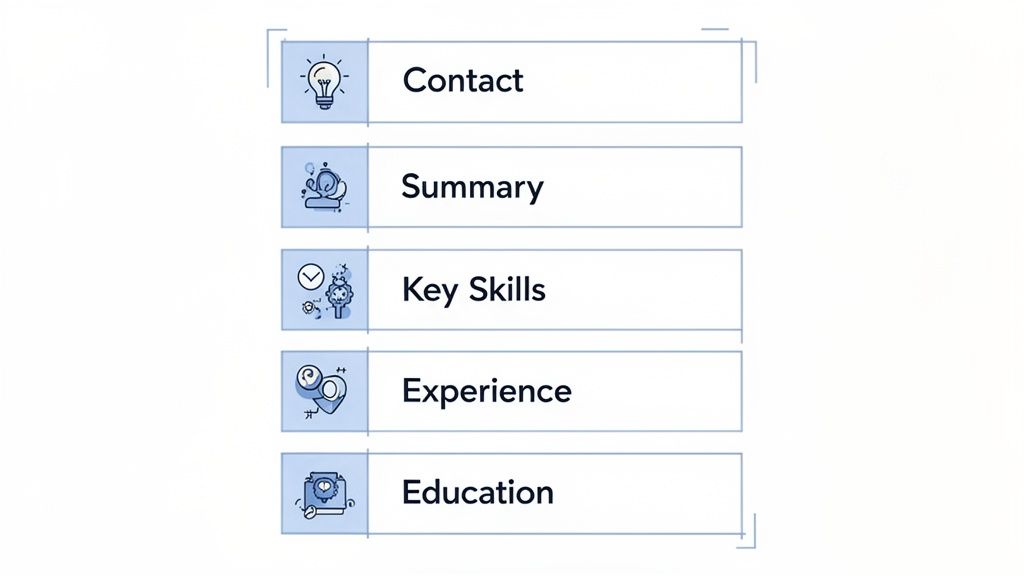
Every professional resume is built on a few core sections. These are the non-negotiables, and Australian recruiters expect to see them in a specific order to quickly assess your fit for the role.
Here are the key building blocks and the order they should appear in:
- Contact Information: Your name, phone number, a professional email address, and a link to your polished LinkedIn profile.
- Professional Summary (or Career Objective): A short, sharp introduction that sells you in a few sentences.
- Key Skills: A scannable, bulleted list showcasing your most relevant technical and soft skills.
- Work Experience: The heart of your resume, detailing your roles and, most importantly, your achievements.
- Education: A clear list of your formal qualifications, starting with the most recent.
Just as important is knowing what not to include. In Australia, adding a photo, your date of birth, or marital status is a thing of the past. It can introduce unconscious bias and takes up valuable space, so leave it off and keep the focus purely on your professional credentials.
Starting Strong: Professional Summary vs. Career Objective
That first paragraph under your name is prime real estate. It needs to grab the reader’s attention immediately, and the right approach depends on where you are in your career.
A Professional Summary is the go-to for anyone with a solid track record. It’s your 2-3 sentence elevator pitch, highlighting your key achievements, years of experience, and unique value. It’s all about proving what you’ve already done.
For instance, an experienced marketing manager might write:
A results-driven Marketing Manager with over eight years of experience developing and executing successful integrated campaigns for leading retail brands. Proven ability to increase brand awareness by 40% and drive a 25% growth in online sales through strategic digital marketing and data-driven insights.
On the other hand, a Career Objective is a better fit for recent graduates, people changing careers, or those with limited industry experience. It shifts the focus from past achievements to your future potential, highlighting your aspirations and transferable skills.
Choosing the Right Resume Format
How you lay out your information is just as crucial as what you say. The format of your resume shapes the narrative of your career journey, and there’s no one-size-fits-all answer. Picking the right one is a huge part of learning how to write a professional resume that gets results.
Let’s look at the three main formats you can choose from.
- Reverse-Chronological: This is the industry standard and what most recruiters prefer to see. You list your work experience starting with your most recent role and working backwards. It’s perfect for showing clear career progression.
- Functional: This format puts your skills front and centre, de-emphasising your work history. It can be an option if you have significant employment gaps or are making a major career pivot, but be warned—many recruiters find it confusing and may wonder what you're hiding.
- Combination: A hybrid of the two, this format kicks off with a detailed skills section followed by a more condensed work history. It’s a great way to balance a clear career timeline with a powerful showcase of your specific expertise.
Making the right choice comes down to which format best plays to your strengths.
Resume Format Selector Guide
Use this quick guide to figure out which layout will tell your professional story most effectively.
Ultimately, you want a format that makes it effortless for a hiring manager to see why you’re the best person for the job. For most people in Australia, the reverse-chronological format is the safest and most effective bet.
Crafting Content That Showcases Your Value
This is where the real work begins. A clean, well-structured resume might get you past the initial 6-second scan, but it's the content that convinces a hiring manager you're worth calling. It's time to stop just listing what you were told to do and start showing what you actually accomplished.
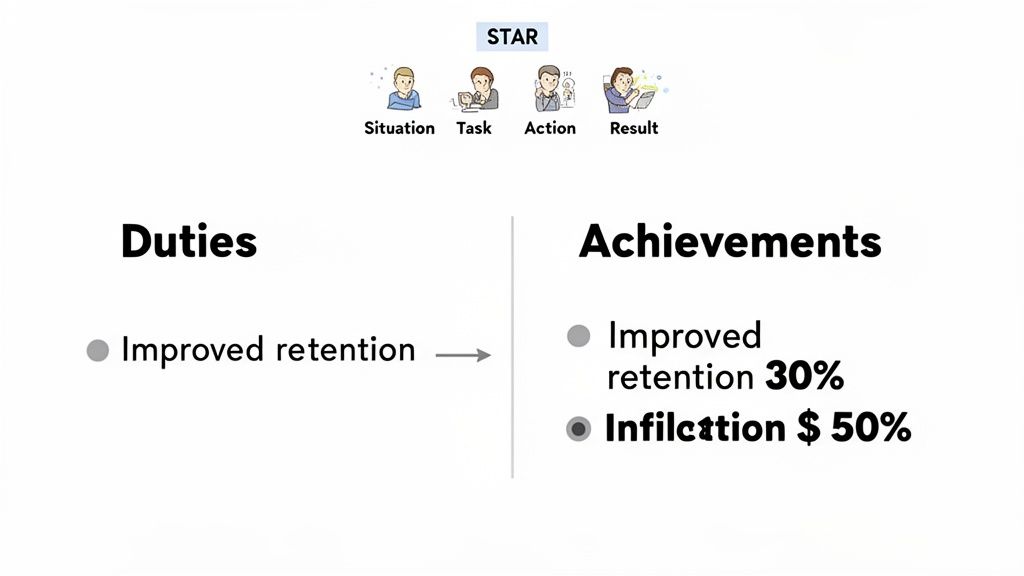
Think of it this way: anyone can say they were "responsible for customer service." But what did that look like? Did you improve satisfaction scores? Did you handle a high volume of calls? The goal is to move from a passive list of duties to an active, compelling story of your impact. This shift is the secret to writing a resume that genuinely sells your skills.
The Power of Quantification
Numbers are your best friend on a resume. They cut through the waffle and provide hard evidence of your capabilities. A recruiter can’t really gauge your effectiveness from a vague phrase like "improved team efficiency." It sounds nice, but it means nothing.
But what about "implemented a new workflow that reduced project turnaround time by 15%"? Now that tells a clear and impressive story.
Putting numbers to your achievements is called quantification. It's the proof that you don't just show up to work—you deliver tangible outcomes. Even if you're not in a sales role, you can find metrics everywhere.
Think about these areas:
- Time: Did you slash the time it took to do something? By what percentage?
- Volume: How many customers did you help each day? How many reports did you produce per month?
- Efficiency: Did you save the company money? By how much? Did you reduce waste?
- Scale: Did you manage a budget of $50,000? Did you lead a team of 10?
- Satisfaction: Did you help boost customer or employee survey scores?
Even a smart estimate is far better than a generic claim. It adds a sense of scale and reality to your contributions that a simple description just can't match.
Using the STAR Method to Tell Your Story
One of the best ways to frame these achievements is with the STAR method. It's a simple storytelling technique that gives your bullet points a logical and powerful structure, turning a boring duty into a compelling accomplishment.
The STAR acronym stands for:
- S - Situation: What was the context or challenge?
- T - Task: What was your specific goal or responsibility?
- A - Action: What specific steps did you take?
- R - Result: What was the measurable outcome of your actions?
You don't literally write "S, T, A, R" on your resume. Instead, you weave these elements into a single, punchy bullet point. It forces you to focus on the result, which is exactly what hiring managers are looking for.
The STAR method transforms a simple duty into a mini-case study of your success. It shows not just what you did, but how you did it and why it mattered.
Let's look at this in practice.
Before (Duty-Focused):
- Responsible for managing social media accounts.
After (Achievement-Focused using STAR):
- Revitalised the company's social media presence by developing and executing a new content strategy that increased Instagram engagement by 45% and grew our follower count by 20,000 in six months.
See the difference? The second example clearly outlines the situation (a tired social media presence), the action (developed a strategy), and the incredible, quantified result (huge growth). It's a story of success.
Speak the Language of Achievement with Action Verbs
The very first word of each bullet point sets the tone. Weak, passive phrases like "assisted with" or "responsible for" are resume killers. They don't convey any sense of ownership or impact.
You need to kick things off with a strong, dynamic action verb. These words paint a picture of you as a proactive, capable person who gets things done.
Choosing the right verb is key. Instead of saying you were "part of a team that launched a product," say you "Collaborated with a cross-functional team to launch..." It immediately sounds more professional and confident.
Here are a few powerful action verbs to get you started:
Mixing up your verbs makes your resume much more interesting to read and helps showcase the full range of your skills. It's also a fantastic way to zero in on your core abilities. For more help with this, you can learn how to figure out your strengths in our other guide.
Transforming Your Experience Section
Let's pull all this together with another real-world example. Imagine you're a support worker.
Before (A List of Duties):
- Assisted clients with daily tasks.
- Wrote client progress notes.
- Worked with a team of support staff.
- Followed individual support plans.
This is fine, but it’s completely generic. It describes any support worker role, not what you brought to it. Now let's inject some life into it with the STAR method, quantification, and strong verbs.
After (A Showcase of Achievements):
- Empowered 15+ clients weekly to achieve personal goals by developing individualised support plans, leading to a 30% improvement in reported wellbeing scores.
- Authored detailed, compliant progress notes for a caseload of 25 clients, maintaining 100% accuracy for all NDIS reporting deadlines.
- Collaborated with a multidisciplinary team of 5 healthcare professionals to coordinate holistic client care and streamline communication channels.
- Pioneered a new peer-mentoring initiative that boosted client social engagement by 50% within its first three months.
The difference is night and day. The "after" version tells a story of competence, initiative, and genuine impact. It proves your value.
As you build these storytelling skills, remember that specific certifications can make your resume even more compelling. To enhance your professional credibility, think about how you can Boost Your CV with Certified Payroll Training or similar qualifications that add another layer of verifiable expertise. This is how you make your resume content actively work for you.
Navigating Applicant Tracking Systems Like a Pro
Ever get that sinking feeling your perfectly polished resume just disappeared into a digital black hole? You’re not imagining things. The likely culprit is the invisible gatekeeper of modern recruitment: the Applicant Tracking System (ATS).
Most large Australian companies now use this software to sift through the mountain of applications they get for every open role. The ATS is programmed to scan your resume for specific keywords, skills, and even formatting, deciding in seconds if you’re a potential match. If it can't read your file or doesn't find what it’s looking for, your resume gets filtered out before a human ever sees it.
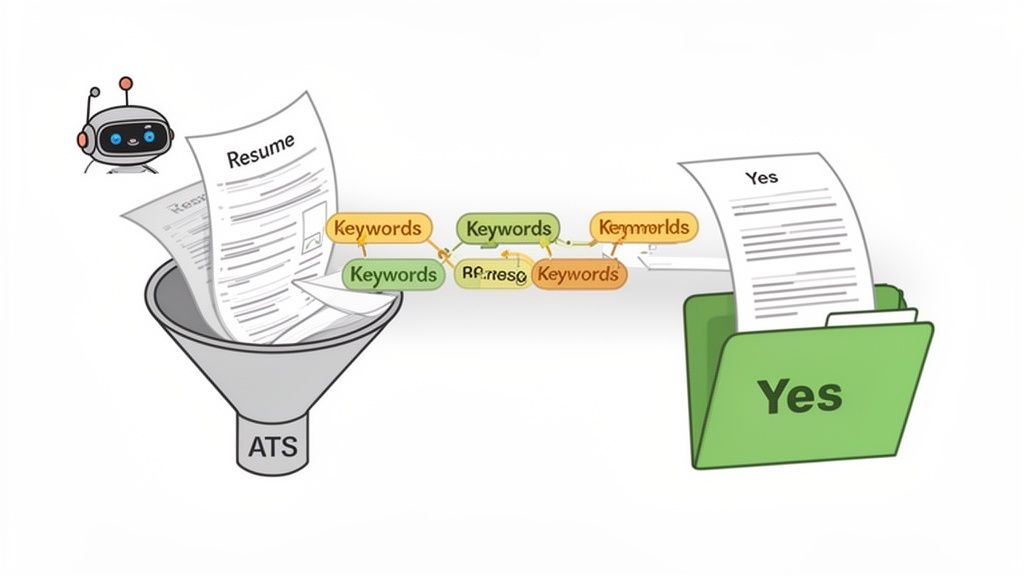
The numbers are pretty confronting. A shocking one in four resumes actually makes it past the ATS to a real person. For Aussie jobseekers, that statistic makes it clear: learning to write for the robot is no longer optional. It's a critical first step. For more on the hurdles of the modern job hunt, you can find some great insights at Standout Resume.
Weaving in the Right Keywords
At its core, an ATS is a matching game. It compares the words in your resume to the words in the job description. Your job is to make that match as obvious as possible by speaking its language.
The best place to start is with the job ad itself. I always tell people to print it out and grab a highlighter. Mark every key skill, qualification, piece of software, and core responsibility mentioned.
You're looking for recurring terms that fall into a few key buckets:
- Hard Skills: These are specific, teachable abilities. Think software like "MYOB" or "Salesforce," technical skills like "data analysis" and "project management," or qualifications like a "Certificate IV in Community Services."
- Soft Skills: These are the interpersonal qualities they're after. Look for phrases like "stakeholder engagement," "team leadership," or "problem-solving."
- Industry Jargon: Every field has its own language. This could be "agile methodology" for a tech role or "NDIS compliance" in the community services sector.
Once you’ve got your list, your goal is to weave these exact phrases into your professional summary, skills section, and work experience. The trick is to make it sound natural, not like you're just stuffing in keywords.
Think of the job description as your cheat sheet. The employer is literally giving you the exact words the ATS is programmed to look for. Use them.
For instance, if the job ad repeatedly asks for "client relationship management," make sure that exact phrase appears. Don't just write "customer service" and hope the software is smart enough to make the connection—it probably isn't.
Keeping Your Formatting Simple and Clean
A beautifully designed, creative resume might look fantastic to you, but it can completely baffle an ATS. These systems are built to read simple, straightforward text, and anything too complex can make your resume unreadable.
To make sure your document is ATS-friendly, stick to these ground rules:
- Avoid Tables and Columns: ATS software typically reads left-to-right, top-to-bottom. Columns can jumble your work history into a nonsensical mess.
- Stick to Standard Fonts: Play it safe with common, readable fonts like Arial, Calibri, or Times New Roman. Fancy or custom fonts can cause parsing errors.
- Use Standard Section Headings: This isn't the place to get clever. Use universally recognised titles like "Work Experience," "Education," and "Skills."
- No Graphics or Images: Logos, photos, and charts are roadblocks for an ATS. They can’t be read and may cause the system to reject your entire file. Keep it text-only.
- Use Simple Bullet Points: Standard round or square bullets are your best bet. Avoid arrows, checkmarks, or other complex symbols that might not register correctly.
Finally, always submit your resume in the format the employer requests—usually a .docx or PDF file. PDFs are great for preserving your layout, but some older ATS can still struggle with them. If you’re unsure, a Word document is often the safest option. Getting these simple things right is a huge part of learning how to write a professional resume that actually gets results.
Putting the Final Polish on Your Resume
You’ve poured all the hard work into getting the content right, focusing on achievements and tailoring it to the job. Now for the final, crucial step: making sure it looks as professional as it reads. Don't underestimate the power of presentation—a clean, sharp-looking document immediately signals professionalism and makes your best qualities jump off the page.
Think of this as the final quality check before your resume lands in a recruiter's hands. It's all about the small details that make a massive difference.
Designing for a Quick Scan
Let's be honest, recruiters are time-poor. Your resume's design needs to be clean, professional, and incredibly easy to scan. The goal isn't to be fancy; it's to be effective.
Here’s what to focus on for maximum readability:
- Fonts: Don't get creative here. Stick with the classics like Calibri, Arial, or Georgia. A font size between 10 and 12 points is perfect for on-screen reading.
- Margins: Give your content some breathing room. Margins of at least 1.5 cm all around create essential white space, preventing that dreaded cluttered look.
- Consistency: This is non-negotiable. Your headings must all be the same size and style. Your dates need to follow the same format (e.g., Jan 2022 – Present). Your bullet points should be uniform. Little inconsistencies can look sloppy and suggest a lack of attention to detail—a major red flag.
Choosing the Right File Format
The old PDF vs. Word document debate. It’s simpler than you think.
A PDF is almost always your best bet. It locks everything in place, so your carefully crafted formatting won’t get scrambled when a recruiter opens it on a different computer. It’s the professional standard.
The only exception? Some older Applicant Tracking Systems (ATS) still prefer a Word document (.docx). If the job application specifically asks for one, you must follow their instructions. But if they don't specify, send a PDF.
The Final Sanity Check
Before you hit that ‘submit’ button, take ten minutes to run through this checklist. A great tip is to read your entire resume out loud—it’s amazing how many awkward phrases and typos you’ll catch.
- Zero Typos: Have you meticulously checked for spelling and grammar errors?
- Dates Aligned: Are all your employment and education dates correct and consistent?
- Contact Info Perfect: Is your phone number and email address 100% correct? A single typo here could cost you the interview.
- Perfectly Tailored: Does the resume speak directly to this specific job ad?
- Clean Formatting: Is the layout consistent, with no weird spacing or formatting glitches?
This final review can genuinely be the difference between getting a call-back and being overlooked. To understand more about what can go wrong, check out our guide on the 7 reasons employers are rejecting your resume for some extra insight.
Answering Your Toughest Resume Questions
Even with the best template in hand, you’ll always hit a few tricky spots when you sit down to write. The job market has its own unwritten rules, and it’s easy to second-guess yourself.
Let's tackle some of the most common questions that pop up. Getting these details right is what separates a good resume from a great one.
Should My Resume Be One Page or Two?
This is the age-old resume debate, but thankfully, the Australian market is pretty clear on this. While our friends in the US swear by the one-page rule, a two-page resume is perfectly fine—and often preferred—in Australia, especially if you’ve been in the workforce for a few years.
Don't butcher your achievements just to fit onto a single page. Recruiters would much rather see a well-laid-out, readable two-page document than a wall of tiny text they have to squint at.
Of course, there are a couple of exceptions:
- For recent grads or early-career professionals: If you've got less than five years of experience under your belt, one solid page is usually all you need to make a strong impression without adding fluff.
- For senior execs or academics: In some rare cases, a three-page resume might be necessary if you have a long history of complex projects, publications, or board appointments. But for most of us, this is overkill.
The sweet spot for the majority of professionals? A clean, concise two pages. It’s enough room to tell your professional story without overwhelming the reader.
How Far Back Should My Work History Go?
Think of your resume as a highlights reel, not your entire life story. The golden rule here is relevance. As a general guide, you should only go back about 10-15 years.
Experience from the early 2000s is probably not what a hiring manager is looking for today. Plus, including roles from too far back can unintentionally date you.
If you have a massive, game-changing achievement from an older role that you just can't leave out, you can add a brief "Earlier Career" section at the bottom without any detailed bullet points.
Your most recent and relevant roles deserve the prime real estate. That’s where recruiters will focus their attention to see what you’re capable of right now.
Is a Cover Letter Still Necessary?
Yes. One hundred percent, yes.
Here’s why: your resume shows a recruiter what you've done and where you've done it. Your cover letter tells them why you’re the right person for this specific job. It’s your chance to connect the dots, show genuine enthusiasm, and explain how your skills solve their company's problems.
Honestly, many hiring managers will skip a resume that arrives without a cover letter. It’s a simple way to show you’ve put in the effort and aren't just spamming out generic applications. To get this crucial document right, check out our complete guide on how to write a cover letter.
How Do I Handle Employment Gaps?
First off, don't panic. Employment gaps happen to almost everyone, and there’s no need to feel like you have to hide them. The trick is to be upfront and frame the time positively.
Instead of leaving a mysterious blank on your timeline that makes recruiters wonder, just address it briefly and honestly. You don't need to write a novel about it.
Here are a couple of simple ways to list it in your experience section:
- 2022 – 2023: Professional Development & Carer Leave
- 2021 – 2022: Planned Career Break for International Travel
If you took courses, did volunteer work, or worked on personal projects during that time, mention it! It shows you were still proactive and developing your skills.
Find Your Course
Compare courses across every field we write about, and enquire in under a minute.