A Guide to Short Courses in Marketing
Explore top short courses in marketing in Australia. Our guide covers costs, career outcomes, and choosing the right program to fast-track your skills.
A short marketing course is your express ticket to getting job-ready skills. Whether you're aiming for a new career, looking to level up in your current role, or wanting to market your own business, these courses are designed to get you there fast.
Think of them as a practical alternative to a multi-year university degree, zeroing in on the real-world abilities that employers are desperate for right now.
Your Fast Track into the Marketing Industry
Marketing changes at lightning speed. By the time you finish a traditional degree, the industry has often moved on. This is where short marketing courses give you a serious edge. They skip the fluff and get straight to the practical, in-demand skills you need to hit the ground running.
It’s less of a scenic detour and more of a direct highway into the heart of the industry.
Consider this guide your complete roadmap. We'll walk through everything: what you’ll learn, who these courses are really for, what to budget, and what kind of career doors they can unlock. The goal is to give you total clarity so you can confidently pick a course that’s a perfect match for your goals.
Why Is Everyone Talking About Marketing Skills?
It's simple: the demand for talented marketers has never been higher. The Australian Government’s Job Outlook initiative shows that the number of people working in marketing roles has jumped by over 63% in the last 20 years. This massive growth is all thanks to businesses moving online. You can read more about this industry boom on training.com.au.
This explosion in demand has created a fantastic opportunity. Companies are actively hunting for people who understand the modern marketing playbook. A short, focused course gives you exactly the right skills to meet that need head-on.
At the end of the day, marketing is all about learning how to increase brand awareness and grow your business, and that’s what these short courses are built around. They teach you how to turn great ideas into real, measurable results.
Who Are These Courses Perfect For?
One of the best things about these courses is that they cater to people from all walks of life. They are especially helpful if you’re a:
- Career Changer: Ready to leave your old industry behind? A short course is the quickest way into a marketing role without signing up for a three-year degree.
- Skill-Builder: Already working in a role like sales or admin? Adding marketing skills to your resume can be just the ticket you need for a promotion or to expand your responsibilities.
- Business Owner: If you're an entrepreneur, you know you need to be your own marketing department. These courses teach you how to get it right and drive real growth.
- Future Specialist: Want to become the go-to expert in something specific like social media, content, or SEO? A focused course is the perfect place to start building that deep expertise.
Ultimately, these courses close the gap between where you are and where you want to be. They offer a structured, practical way to learn on your own terms, letting you fit your education around your life, not the other way around.
So, What Exactly Is a Short Marketing Course?
When people talk about “short courses in marketing,” they could be referring to a few different things. It’s not one specific qualification, but more of an umbrella term for a whole range of study options designed to get you skilled up quickly.
The easiest way to think about it is like building a professional toolkit for your career. Some tools give you a great all-purpose foundation, while others are highly specialised instruments for a very specific job. The right one for you really just depends on what you’re trying to build.
Let's break down the main types you'll come across in Australia.
VET Qualifications Like a Certificate IV
A nationally recognised VET (Vocational Education and Training) qualification, like a Certificate IV in Marketing and Communication, is your comprehensive starter toolkit. It’s built to give you a broad, practical grounding in all the essential areas of marketing.
This is a fantastic starting point if you’re new to the industry or you’ve been working in the field for a bit and want to get a formal qualification to back up your experience. These courses are designed to cover all the fundamentals, including:
- Marketing Principles: Getting a handle on the core ideas behind any successful campaign.
- Consumer Behaviour: Digging into the psychology of why customers buy what they buy.
- Market Research: Learning how to gather and make sense of data to spot opportunities.
- Digital Marketing Basics: An introduction to social media, email marketing, and online ads.
A Certificate IV isn’t about becoming a deep specialist in one niche. It’s about building a solid, well-rounded skill set that makes you job-ready for roles like a Marketing Assistant or Coordinator. It's the perfect launchpad for career changers needing a structured path into the marketing world.
University-Level Single Subjects
Now, imagine you’ve already got a pretty good toolkit, but you’re missing one specific, high-quality piece of equipment. That’s where single, undergraduate-level subjects from a university fit in. They give you a real taste of a bachelor's degree without the three-year commitment.
These are individual units of study, often available online, that let you dive deep into a particular academic topic. You could, for example, enrol in a single subject like "Marketing Analytics" or "Global Marketing Strategy" to get university-level insights into a very focused area.
This is a brilliant option for professionals who want to test the waters of higher education or add a specific, credit-bearing credential to their CV. The credits you earn can often be put towards a full degree later, making it a clever, stackable investment in your future.
These subjects are academically robust, giving you a strong theoretical framework that’s ideal if you’re aiming for roles that require more strategic thinking and deep analysis. It’s a powerful way to upskill with the credibility of a university behind you.
Specialised Industry Certificates
Finally, let’s talk about the high-precision power tools in your kit. Specialised industry certificates are short, sharp courses that are all about mastering one specific skill or platform. They are laser-focused on skills you can use immediately.
You’d take one of these courses when you need to become the go-to expert in a particular high-demand area, and you need to do it now. The curriculum is all about practical, hands-on learning, teaching you the exact techniques and software professionals are using on the job today. You can get a feel for the huge variety available in our guide to online short courses in Australia.
Some of the most popular specialisations include:
- Search Engine Optimisation (SEO): Learning the art and science of getting websites to the top of Google.
- Social Media Marketing: Mastering platforms like Instagram, TikTok, and LinkedIn to grow a business.
- Content Marketing: Creating blogs, videos, and guides that pull in and engage customers.
- Google Ads: Running paid advertising campaigns that drive immediate traffic and sales.
These short courses in marketing are perfect for business owners who need to run their own campaigns or for marketing professionals who want to become the undisputed specialist on their team. You walk away with a tangible, in-demand skill you can put to work the very next day.
What Will I Actually Learn? A Look at Core Subjects and Specialisations
Think of a short marketing course as a well-stocked toolkit. Some tools are the absolute essentials you'll use on every project - the foundational skills. Others are more specialised, designed for specific, high-demand tasks that really make you stand out. Getting a feel for what’s inside is the first step to choosing a course that lines up with where you want to go in your career.
Most good short courses in marketing are built to layer your knowledge logically. You'll start with the timeless principles that drive every great campaign before diving into the fast-moving world of digital marketing - the skills employers are looking for right now. This approach ensures you don't just learn what to do, but the crucial why behind modern marketing strategies.
Building Your Foundational Knowledge
Before you can nail a complex digital campaign, you need to get the basics down pat. In marketing, that means mastering the core ideas that have been shaping the industry for years. These foundational modules aren't about fleeting trends; they're about the timeless psychology of connecting with people.
For instance, 'Consumer Behaviour' isn't just some dry theory. It’s your key to figuring out why a customer loads up their online cart but never quite clicks 'buy'. It's about getting inside their head and understanding their journey. In the same way, 'Market Research' teaches you how to be a detective, digging through data to find out what people really want and where the best opportunities are hiding.
These core subjects usually cover:
- Marketing Principles: This is your crash course in the essentials, including the marketing mix (Product, Price, Place, Promotion) and how to put together a solid marketing plan.
- Consumer Behaviour: You'll dig into the psychological and social triggers that influence buying decisions, so you can build more persuasive campaigns.
- Market Research: This gives you the skills to gather, analyse, and use data to spot market trends, understand customer needs, and keep an eye on the competition.
Mastering High-Demand Digital Specialisations
Once you've got that solid foundation, it's time to add the high-impact digital skills that are non-negotiable in today's job market. This is where theory gets put into practice, focusing on the specific platforms and tactics that deliver real, measurable results. These are the skills that make a hiring manager stop scrolling and take a closer look at your resume.
A specialisation in Search Engine Optimisation (SEO), for example, is no longer just a "nice-to-have." It’s vital for any business that wants to be seen online. You’ll learn how to get a website ranking higher on Google, driving more traffic and boosting brand awareness.
Similarly, Content Marketing is all about becoming a great storyteller for a brand. It teaches you how to create valuable articles, videos, and social posts that attract and hold the attention of your target audience. It's about building genuine relationships, not just broadcasting sales messages. You can learn more about the different areas of study in our in-depth guide to digital marketing courses.
These specialised subjects are designed to make you immediately useful in a marketing role. They’re all about practical application, so you can walk in on day one and confidently contribute to a real campaign.
The Skills Employers Are Actively Hiring For
The demand for specific marketing skills is always evolving, but some clear patterns have emerged. Industry reports consistently show that digital marketing, data analytics, and customer experience are top of the list for Australian employers. Choosing a course with strong modules in these areas is a seriously smart career move.
To give yourself a real edge, it helps to know which specific skills are most valuable. Focusing on these ensures you’re learning things that are directly tied to what employers need right now. To get a better sense of what's currently hot, it's worth checking out guides on essential marketing skills for career growth.
Common Modules in Short Marketing Courses
Here’s a snapshot of the types of modules you'll likely encounter, from the foundational principles to the modern digital specialisations that will make you a highly valuable candidate.
By pairing a strong foundational knowledge with one or two of these in-demand specialisations, you position yourself as a well-rounded and effective marketing professional, ready for whatever challenges come your way.
Understanding Your Investment and Pathways
Investing in a short marketing course is a big decision, so it's only natural to wonder about the time and money involved. The cost and duration can vary quite a bit, but the best way to look at it isn't as an expense, but as a strategic investment in your future.
Think of each course as a single, solid building block. On its own, it gives you a valuable, specific skill you can use right away. But its real power comes from how you can stack it with other blocks, building a clear pathway to much bigger qualifications and career goals.
What's the Typical Cost and Duration?
The commitment for short courses in marketing really depends on what you're aiming for. A quick, non-accredited workshop on a specific tool like Google Analytics might just be a weekend and a few hundred dollars. On the other hand, a nationally recognised qualification that holds more weight will naturally require a bigger investment.
If you’re looking at university-level single subjects for a deeper academic dive, the numbers are pretty clear. Data from Open Universities Australia shows that popular undergraduate subjects in marketing strategy or communications usually run for 10–14 weeks. The cost for these credit-bearing units typically lands somewhere between $2,174 and $3,128, depending on which university is offering it. You can explore these university pathways and their specific costs to get a better feel for your options.
Visualising Your Learning Path
It can be helpful to see how these different skills fit together. This diagram breaks down how core marketing skills are built from both timeless foundations and modern, practical specialisations.
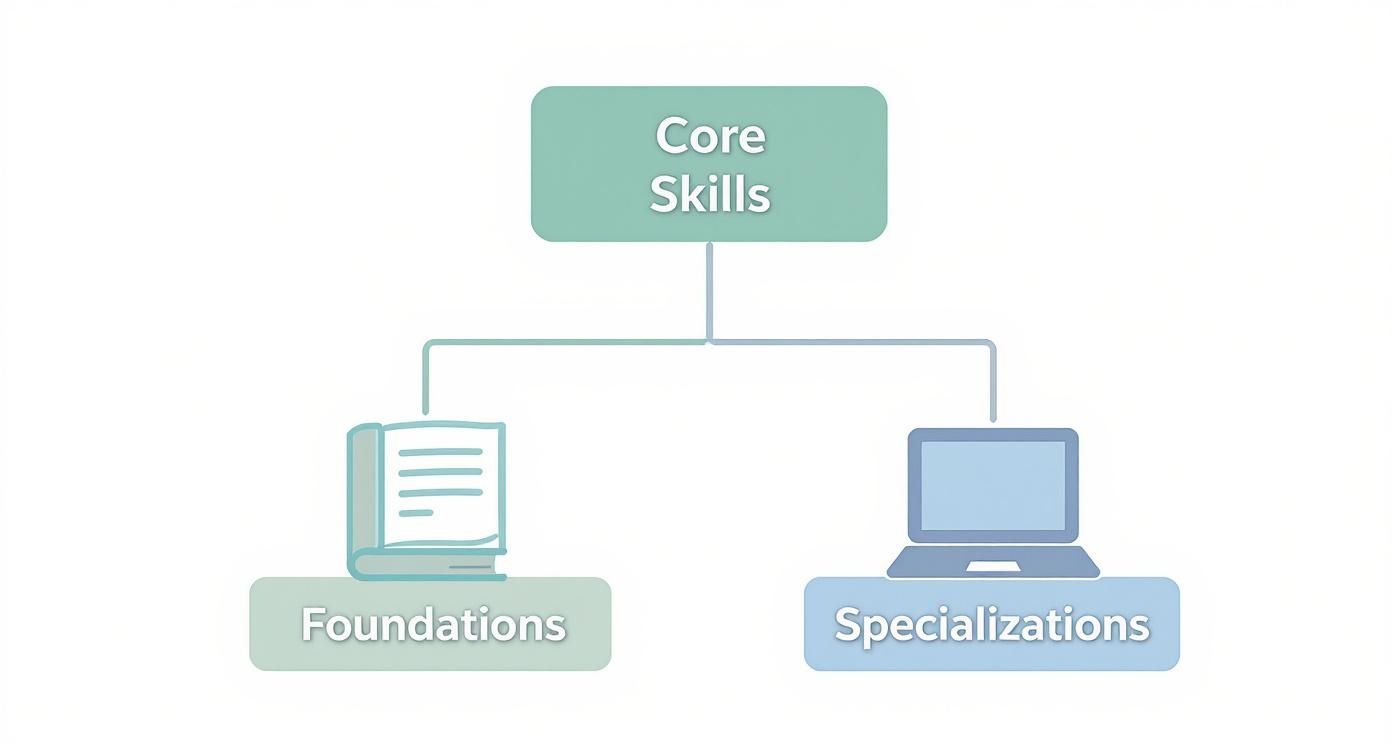
As you can see, a truly effective marketing skillset comes from combining those evergreen principles with the in-demand digital expertise that employers are looking for right now.
The Power of Stackable Qualifications
This is where that building block analogy really clicks into place. One of the best things about modern education is the idea of "stackable" qualifications. It means that an accredited short course you finish doesn't just stand alone - it can become a component of a much larger qualification.
So, that single, credit-bearing university subject you complete online could actually count towards a future diploma or even a full bachelor’s degree. It’s a super-efficient way to build your credentials over time, without the massive upfront commitment of a multi-year program.
By choosing credit-bearing short courses, you’re essentially making a down payment on your future education. You get skills you can use immediately, all while keeping the door open for higher qualifications later on.
This approach gives you incredible flexibility. You can learn and earn credentials at a pace that fits your life, not the other way around. Gain a practical skill now to land a better role, and then use that momentum to keep building your qualifications piece by piece. It puts you firmly in control of your career journey.
So, What Happens After the Course? Charting Your Career Path
Finishing a short marketing course is more than just getting a certificate; it’s about opening real doors in the job market. Think of it as adding a powerful new tool to your professional toolkit, one that employers are actively looking for.
This is where all that learning pays off. Whether you're aiming to land your very first marketing gig or climb the ladder in your current role, the skills you gain are designed for immediate, practical application.
Landing Your First Marketing Gig
If you're switching careers, a short course is your most direct route into an entry-level marketing position. These roles are the perfect place to start, giving you the chance to use your new knowledge in a hands-on environment while you find your feet.
You'll be well-prepared to jump into roles like these:
- Marketing Assistant: This is a brilliant all-rounder position where you’ll support the broader marketing team. The course content on marketing fundamentals and content creation means you’ll be ready to help run campaigns, schedule social media posts, and build email newsletters from day one.
- Social Media Coordinator: If you found your passion in the social media modules, this role is a perfect match. You'll take charge of a brand's presence on platforms like Instagram and LinkedIn, creating posts and engaging with the online community - exactly what you practised in your course.
- Digital Marketing Specialist: For those who enjoyed the more technical side of things, this role focuses on SEO, paid ads, and analytics. Your course provides the foundational skills to help manage Google Ads campaigns, interpret website traffic, and play a part in the company’s SEO strategy.
Climbing the Ladder in Your Current Career
But these courses aren't just for people starting from scratch. They're also an incredible asset for professionals looking to fast-track their career or specialise within their own company. Adding fresh marketing skills can make you the go-to expert on your team.
Take Sarah, a retail manager who saw that her store’s online game was weak. She enrolled in a digital marketing course focused on e-commerce. Fast forward a bit, and she’s not just managing the store anymore - she’s heading up the company's entire online sales strategy, boosting online revenue by 30%.
Sarah's story is a common one. When you blend marketing know-how with your existing industry experience, you become a prime candidate for promotions and leadership roles. A sales pro who learns data analytics can suddenly provide much deeper customer insights. An admin assistant who masters content creation can take on valuable new marketing tasks.
It all leads to a more strategic, influential, and rewarding role within your organisation.
A Game-Changer for Business Owners and Entrepreneurs
If you run your own business, marketing isn't just a "nice to have" - it's the engine for growth. A short course delivers the practical, no-fluff skills you need to take the driver's seat and steer your own success. You'll learn how to build your brand and find customers without the hefty price tag of an agency.
Instead of just winging it, you’ll know how to:
- Run your own social media ads with confidence.
- Get your website to actually show up in Google search results.
- Write email newsletters that people open and act on.
This self-sufficiency is liberating. It allows you to make smart, informed decisions that directly impact your sales and build a stronger business.
How to Choose the Right Marketing Course
With so many short courses in marketing out there, picking the right one can feel a bit like staring at a giant wall of options. The trick is to start by looking inward before you even glance at a single course brochure. It’s all about finding the perfect match for where you want to go in your career.
Think of it like planning a trip. You wouldn't just pick a random car; you'd first decide if you’re heading off for a quick weekend camping trip or embarking on a six-month trek across the outback. Your destination shapes your choice of vehicle, and the same logic applies here.
Start by Defining Your Goal
First up, what’s the end game? What are you really trying to accomplish with this course? Nailing this down will instantly cut through the noise and highlight the best path forward. Are you chasing a brand new career, or just trying to plug a gap in your current skill set?
Let’s look at a few common goals:
- Targeted Upskilling: Maybe you just need to get your head around Google Ads or sharpen your social media game. In this case, a short, specialised certificate (even a non-accredited one) is often the quickest and most affordable way to get there.
- Career Change: If your goal is to land that first junior marketing gig, a nationally recognised qualification like a Certificate IV will give you the solid, all-round knowledge that employers want to see in fresh talent.
- Promotion or Specialisation: Already in the industry but have your eye on a leadership position or a niche role? A single university-level subject can deliver that deeper, strategic thinking you need. For example, if you dream of becoming a social media guru, it pays to know about the social media manager qualifications you need to land the job.
Evaluate Your Course and Provider
Once you’re crystal clear on your goal, you can start sizing up specific courses and the places that offer them. Don't get swayed by a flashy course title - it's time to dig into the nitty-gritty to make sure you're making a smart investment.
I recommend making a little checklist. Here’s what should be on it:
- Accreditation and Recognition: Is the qualification nationally recognised? This is a big one. It means your new credential will be taken seriously by employers right across Australia.
- Instructor Experience: Find out who’s actually teaching. You want people with recent, hands-on experience in the marketing world, not just academics. Their real-world stories and insights are pure gold.
- Student Reviews and Outcomes: What are former students saying? Check out independent review sites to get the real scoop on their experience and, more importantly, where they ended up after finishing the course.
- Practical Application: Does the coursework involve getting your hands dirty with real projects, case studies, or portfolio pieces? Practical experience is essential - it's what will make you stand out to a hiring manager.
Compare Different Study Modes
Finally, think about how you learn best. Online study is incredibly flexible these days, but it comes in a couple of different flavours.
- Self-Paced Online Learning: This is the ultimate in freedom. You log in and study whenever it suits you, fitting it around your job, your family, and your life. It’s ideal if you’re a self-starter who needs that flexibility.
- Structured Virtual Classrooms: This model has scheduled live online lectures and tutorials. It offers more of a traditional classroom vibe, with deadlines and direct interaction with your tutors and classmates - perfect if you thrive on structure and community.
Before you sign up for anything, get on the phone with a course advisor and ask some pointed questions. "What kind of practical projects will I actually complete?" or "What's the support from instructors really like?" A reputable provider will have no problem giving you straight, detailed answers. A little homework now will ensure your time and money are well spent.
Got Questions About Marketing Courses? We've Got Answers
It's completely normal to have a few questions swirling around when you're thinking about diving into a short marketing course. To help you get some clarity, I've rounded up the most common queries we get from people just like you.
Think of this as the final check-in before you jump in, making sure you feel 100% confident about your next move.
Can I Really Get a Marketing Job Without a Degree?
You absolutely can. Not long ago, a university degree was the only way in, but the game has changed. Today's employers, particularly in the fast-moving world of digital marketing, are hunting for practical, real-world skills.
Holding a nationally recognised qualification, like a Certificate IV in Marketing and Communication, shows a hiring manager you've got the hands-on abilities they need right now.
In today’s marketing teams, what you can do often matters more than what you’ve studied in theory. A short course proves you can actually run a social media campaign, make sense of analytics, or build an email newsletter – skills that deliver immediate value.
How Long Does a Short Marketing Course Take to Finish?
The timeline really depends on the type of course you choose. Some super-specific, non-accredited courses that focus on a single tool (like Google Ads, for instance) might only take a few weeks.
But if you’re looking at a more substantial, nationally recognised qualification like a Certificate IV, you should plan for around 6 to 12 months of study. The final timeframe usually comes down to how you structure your learning – whether you go full-time or part-time – which gives you the freedom to fit it around your life.
Are Online Marketing Courses as Good as Studying on Campus?
Yes, as long as you enrol in a quality program. In fact, online learning brings some serious advantages that face-to-face study just can't offer, like being able to learn around your job or family commitments. It also opens up your options to the best providers across Australia, not just the ones in your postcode.
The trick is finding an online course built for genuine interaction. A top-notch program will always have:
- Engaging Content: Think live webinars, active discussion boards, and collaborative projects that keep you connected.
- Supportive Tutors: You want instructors who are easy to reach for questions and provide regular, helpful feedback.
- Real-World Assessments: Look for courses that get you to complete practical tasks and build a portfolio, not just tick boxes in a quiz.
When a course has all that, studying online isn't just a good alternative – it’s often a much smarter and more effective way to build the skills for a brilliant marketing career.
Ready to find a course that fits your career goals and your life? At Get Course, we make it simple to compare flexible, online short courses in marketing from Australia's leading providers. Explore your options and start your journey today by visiting Get Course Australia.
Find Your Course
Compare courses across every field we write about, and enquire in under a minute.