How to Change Careers: A Practical Australia-Focused Plan to Rebuild Your Skills
Thinking about how to change careers? This Australia-focused guide offers a practical plan to assess skills, choose courses, and make a confident change.
Thinking about a career change? It’s a big move, and in Australia, a successful switch is all about smart planning. It starts with a bit of soul-searching and finishes with targeted action, making sure your next chapter is one you’ll actually enjoy and one that fits where the job market is heading.
This isn't just about escaping a job you dislike; it's about consciously building a career that truly works for you.
Pinpointing Your Real Motivation for Change

Before you even think about touching your CV, the first—and most crucial—step is to look inward. A lasting career change is so much more than a new job title. It's about finding a role that lines up with what you value, what you enjoy, and where you see yourself in the long run.
Skip this step, and you could easily find yourself jumping from one bad fit to another.
This is your chance to get really honest about the "why." Are you just bored? Feeling the first signs of burnout? Or is it something deeper—a need for more meaningful work, better balance for your family, or a paycheque that reflects your worth?
Distinguishing Between Push and Pull Factors
A great way to get clarity is to separate the things pushing you out of your current job from the things pulling you towards a new one.
Push Factors: These are the negatives driving you away. It could be anything from a micromanaging boss and a draining commute to feeling stuck with no room to grow. Maybe the pay just isn't cutting it anymore.
Pull Factors: These are the positives you’re chasing. Think about the appeal of a booming industry like IT or healthcare, the dream of genuine work-from-home flexibility, or the fulfilment that comes from a career in community services.
While the "push" factors might get you started, it's the "pull" factors that will keep you going when the going gets tough. A change motivated by a clear, positive goal is far more likely to stick.
The best career changes are proactive, not reactive. Figure out what you're moving towards, not just what you're running from. That clarity is the bedrock of a decision that leads to real, long-term satisfaction.
Navigating the Current Australian Job Market
It’s one thing to know what you want, but you also have to be realistic about what the market needs. Right now, stability is the name of the game in the Australian job market. Employers are keen to hold onto their skilled people.
Recent employment figures show that only 18% of Australians are thinking about a career move, down from 23% not long ago. If you're planning how to change careers, this tells you one thing: a well-researched, strategic plan is essential. You can find out more about current job market trends to get a clearer picture.
In this climate, those with a clear plan have the advantage. When you align your personal goals with sectors that are actively looking for new talent, you immediately become a stronger candidate. That self-awareness doesn't just help you choose the right course; it shines through in your interviews, showing employers you’re a serious professional making a deliberate and well-thought-out move.
Finding Opportunity in High-Demand Industries
Once you’ve got a handle on what’s driving you, it's time to connect that personal ambition to the real world. A successful career change happens at the intersection of what you want and what the Australian economy actually needs. This is the crucial research phase where a vague idea starts to take shape as a targeted, viable career path built on solid evidence, not just wishful thinking.
We’re not talking about chasing fleeting trends here. The goal is to identify industries with sustainable, long-term growth and a real, persistent demand for skilled people. The good news? The Aussie job market is hungry for workers. The employment-to-population ratio recently hit a record high of 64.5%, with most new openings being full-time roles. This robust demand creates genuine opportunities for career changers, especially in sectors crying out for talent.
Spotting Australia's Growth Sectors
As you start looking, you want to pinpoint fields that offer both personal fulfilment and professional stability. In Australia, a few sectors consistently stand out for their strong growth and need for fresh talent. They’re excellent places to begin your search.
- Healthcare and Social Assistance: This is Australia’s largest and fastest-growing employer. You could find yourself in direct patient care as an Allied Health Assistant or in a vital support role within Aged Care or Disability Services.
- Information Technology: The tech industry is a powerhouse, and the roles go way beyond just coding. There are fantastic opportunities in cybersecurity, project management, and user experience (UX) design, often with the bonus of flexible working arrangements.
- Community Services: If you're driven by the desire to help, this sector is for you. Roles in mental health support, youth work, and community development allow you to make a tangible difference in people's lives every single day.
For a deeper dive, check out a breakdown of the most in-demand jobs in Australia to see the specific roles employers are scrambling to fill.
Looking Beyond the Job Title
Okay, you've zeroed in on a few promising industries. Now it’s time to get forensic. A job title tells you almost nothing about the day-to-day reality of the work.
To figure out if a career is a genuine fit, you need to ask some hard questions:
- What does a typical day or week actually look like?
- What are the common challenges and biggest rewards people in this job talk about?
- What’s a realistic starting salary, and what does the path for advancement look like?
- What’s the work environment like—is it collaborative, independent, fast-paced, or client-facing?
This table provides a snapshot of some high-growth areas to help you compare your options at a glance.
Australia's High-Growth Sectors for Career Changers
Digging into these details helps you truly visualise yourself in the role and avoids any nasty surprises down the track. A career in cybersecurity might sound exciting, but are you wired for the meticulous, detail-oriented work of monitoring systems and documenting threats? A job in community services can be incredibly rewarding, but it demands huge reserves of emotional resilience.
Choosing a new career is like buying a house. You wouldn't put in an offer after only seeing photos online. You’d walk through every room to see if it truly feels like home. Do the same with your career research—look past the shiny title and explore the daily reality.
By immersing yourself in the details, you can confirm whether a promising field aligns not just with your skills, but with your personality and preferred way of working. This informed approach is the foundation of a career change that you’ll still be happy with years from now.
Choosing the Right Course to Bridge Your Skill Gap
Alright, you’ve pinpointed an industry that genuinely excites you and lines up with what you want from your work life. Now for the exciting part—turning that ambition into a solid plan by getting the skills to make it happen.
This is where you bridge the gap between where you are today and where you want to be tomorrow. The Australian education system can seem a bit of a maze at first, with terms like VET, TAFE, and RTOs flying around. The trick is to ignore the noise and focus on one thing: what employers in your target field are actually looking for.
Let Job Descriptions Be Your Guide
Before you even think about enrolling in a course, your best intel comes directly from the source. Hop onto a few job search sites and pull up some entry-level or junior roles in your chosen field. You're not applying just yet; think of this as a reconnaissance mission.
Scan the "Requirements" or "Skills" section of at least five different ads. What qualifications keep coming up? Is there a consistent demand for a Certificate IV? A specific piece of software?
Jot down the common threads. You'll quickly see patterns emerge:
- A clear qualification: Many community services roles will state a Certificate IV in Community Services as a non-negotiable.
- Industry-standard tickets: Aspiring IT pros will see things like CompTIA A+ mentioned for support roles.
- Hands-on essentials: Aged care positions will almost always require a First Aid Certificate and a certain number of practical placement hours.
This simple bit of research gives you an employer-approved shopping list for the exact credentials you need to be a serious contender.
The goal isn't to collect every possible qualification—it's to get the right one. Letting real job ads guide you ensures your time and money are spent on the skills that will actually open doors.
Understanding Your Study Options
With your "skills shopping list" ready, you can now explore the different types of qualifications out there. Each one is designed for a specific purpose, and the best fit for you depends on your career goals and how quickly you want to make the switch.
For anyone juggling a career change with, well, life, getting to know the world of flexible online courses in Australia is a must. Online study offers the adaptability you need to upskill without quitting your job or missing out on family commitments. It puts you in the driver's seat.
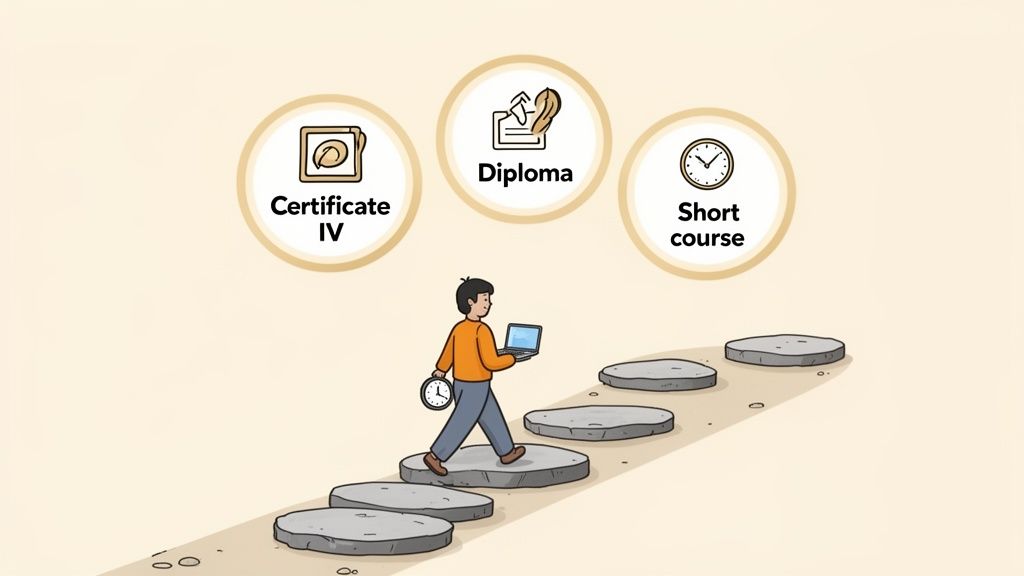
Here’s a look at the most common qualification types to help you map out your path.
Comparing Qualifications for Your Career Change
Trying to figure out if you need a short course or a full diploma? This table breaks down the main options to help you decide which pathway makes the most sense for your career goals.
As you can see, the right choice really hinges on what your new career demands and how deep you need to go to get your foot in the door.
Finding a Course That Fits Your Life
Choosing the right qualification is about more than just the subject—it’s about how it’s delivered. For most career changers, flexibility isn't just a nice-to-have; it's essential.
As you compare course providers, keep an eye out for features that are designed for busy adults:
- Self-Paced Learning: This is a total game-changer. It means you can fit study around work shifts, school pick-ups, and everything else life throws at you, instead of being chained to a rigid timetable.
- Flexible Payment Plans: Many providers offer instalment plans, which makes the financial side of things far less daunting.
- Nationally Recognised Qualifications: Always check that the course is accredited under the Australian Qualifications Framework (AQF). This is your guarantee that employers all over the country will respect your new credential.
Deciding to upskill is a big, bold move. By carefully researching what employers want and then choosing a flexible, recognised course that fits your life, you’re building the most direct bridge to your new career. It's a smart approach that makes sure your investment pays off, getting you where you want to go, sooner.
Creating a Realistic Transition Plan
A great idea for a new career is one thing, but turning it into a reality? That takes a solid, practical plan. This is where you map out the nitty-gritty details of getting from your current job to your first day in a new role. It's about grounding your big vision in a step-by-step process that you can actually manage without feeling overwhelmed.
Think of it as breaking down a huge goal into bite-sized, achievable pieces. It transforms the daunting question of "how do I even start?" into a series of clear, actionable tasks. This plan becomes your roadmap, keeping you on track when the going gets tough.
Mapping Out Your Timeline
One of the biggest traps I see people fall into is underestimating how long a career change actually takes. A realistic timeline, broken into phases, is your best defence against burnout. It also gives you a chance to celebrate the small wins along the way.
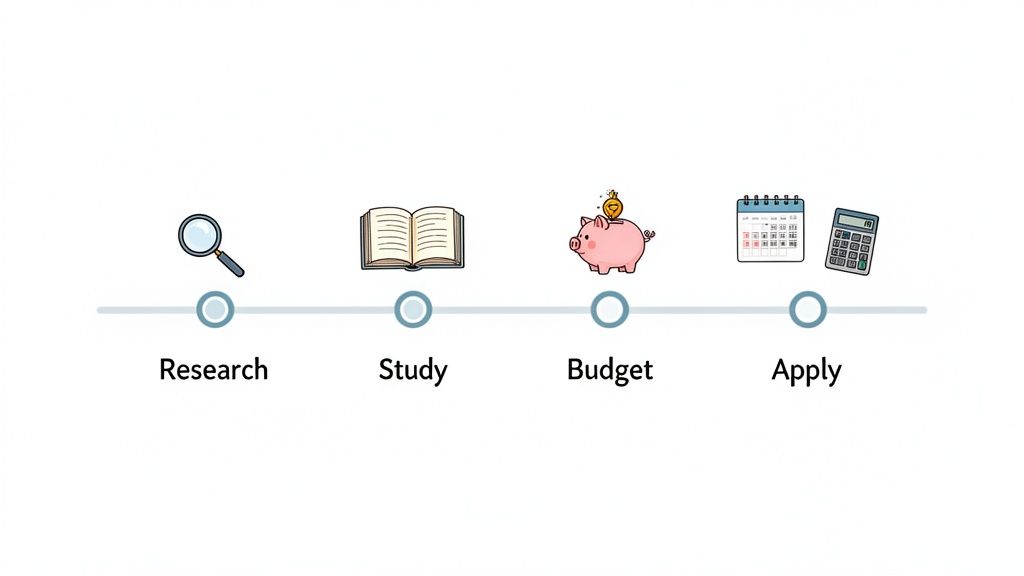
It helps to think of your transition in three key stages:
- Discovery & Research (1-3 months): This is the homework phase—getting clear on your 'why', exploring different industries, and figuring out your skill gaps. Give yourself a firm deadline to lock in your target career and decide on the qualification you'll need.
- Upskilling & Study (6-24 months): The length of this stage really depends on what you choose to study, whether it's a Certificate IV or a more in-depth Diploma. Be honest with yourself here. Juggling part-time study with work and family will naturally take longer, and that's completely fine.
- Job Search & Application (3-6 months): This final leg kicks off as you near the end of your course. You’ll be polishing your CV, building a portfolio, networking, and hitting 'apply'. Finding the right opportunity can take time, so it's smart to build this buffer into your plan from the start.
Your timeline isn't set in stone. Think of it as a living document you can tweak as you go. But having those clear milestones in place makes the whole journey feel less like climbing a mountain and more like a series of manageable steps.
Getting Your Finances in Order
Let's be blunt: money is a huge part of this equation. Flying blind on the financial side is a recipe for stress and can derail even the best-laid plans. A sensible financial strategy gives you the stability and confidence to see this through.
Start by creating a simple budget. You need a really clear picture of what’s coming in versus what’s going out each month. This exercise will show you exactly how much you can realistically put towards your studies and if you need to make any short-term tweaks to your spending.
Once you know your numbers, you can look at smart ways to make your upskilling affordable.
Smart Financial Strategies for Your Career Change
- Study While You Work: For most of us, quitting a job to study full-time just isn't on the cards. Choosing a flexible, self-paced online course means you can keep your income flowing while you gain new skills. It’s easily the most practical way to make a smooth transition.
- Explore Flexible Payment Plans: You don't always have to pay for a course in one lump sum. Many great providers, like those you can find on Get Course, offer interest-free payment plans. This lets you spread the cost over your study period, which is much kinder to your cash flow.
- Build a Safety Net: Try to stash away a small emergency fund before you start the job hunt. Having even 1-2 months of living expenses saved up is a massive psychological buffer. It gives you the breathing room to find the right job, not just the first one that comes along.
Thinking through these logistics is what separates a dream from a plan. By setting a realistic timeline and getting your finances sorted, you're building the foundation your ambition needs to stand on. It’s this kind of practical planning that takes the fear out of the unknown and replaces it with a clear, confident path forward.
Step 6: Build Your New Professional Brand
As you dive into your studies, it’s time to start shaping your new professional identity. This is more than just a quick CV update; it's about telling a compelling story about your career change. You need to pivot your resume and LinkedIn profile away from your old career and point them squarely towards your future.
Think of it as connecting the dots for a hiring manager. Your goal is to show them this career change is a deliberate, well-thought-out move and that your past experience isn't irrelevant—it’s a unique advantage.
Reinvent Your Resume and LinkedIn
Your resume is your foot in the door, and for a career changer, it has to work extra hard. The trick is to shift the focus from what you used to do to what you're ready to do now.
Forget the standard chronological format that puts years of irrelevant experience front and centre. Instead, lead with a punchy professional summary. This is your 2-3 sentence elevator pitch right at the top, explaining your new career direction, highlighting your fresh skills, and showing your commitment to the industry.
Right below that, add a dedicated "Key Skills" section. This is your chance to shine a spotlight on both your new technical know-how and your most powerful transferable skills.
- New Technical Skills: List the specific software, tools, or qualifications you've gained. Think: proficiency in Xero, a Certificate III in Early Childhood Education and Care, or experience with project management tools like Asana.
- Valuable Transferable Skills: Frame your old job in a new light. Were you a retail manager? You've got brilliant stakeholder management and conflict resolution skills. A former hospitality worker? You’re an expert in customer service and working under pressure.
This approach immediately shows a recruiter you’ve got the goods, even if your previous job titles don't seem like an obvious match. For more specific advice, resources with resume tips specifically for career changers can be incredibly helpful for making your past experience work for your future.
Don’t make recruiters dig for your potential. Put your new career goal and most relevant skills right at the top. Your resume should be a billboard for where you’re going, not a history lesson of where you’ve been.
If you're feeling a bit rusty on the basics, our guide on how to write a resume that gets noticed is a great place to start building a document that truly sells you.
Get Some Runs on the Board
A new qualification is a massive achievement, but employers are always looking for proof you can apply that knowledge in the real world. Getting some hands-on experience, even in a small way, builds your confidence and shows you're serious.
This doesn't mean you have to land a full-time role right away. There are plenty of clever ways to build up a portfolio and get a feel for your new industry while you're still studying or job hunting.
Why not try one of these?
- Volunteering: Offer your skills to a not-for-profit in your chosen field. Even a few hours a week can provide priceless industry insight, practical experience, and some great new contacts.
- Freelance or Micro-Projects: Dip your toe in the water with small, paid gigs on platforms like Upwork or Airtasker. This is a brilliant way for budding web developers, copywriters, or bookkeepers to build a body of work.
- Internships and Placements: This is the gold standard. Many nationally recognised courses actually have a mandatory work placement built in. This is structured, real-world experience that very often turns into a job offer.
Every single one of these experiences is a powerful addition to your CV. It bridges that gap between theory and practice and shows employers you have genuine initiative.
Build Your Network From the Ground Up
Switching careers often means leaving an entire professional network behind. It's crucial to start building new connections to find out about unadvertised jobs and get honest advice from people in the know.
Your LinkedIn profile is your digital handshake. Make sure it reflects your new path. Update your headline, rewrite your summary to tell your career change story, and start gathering endorsements for your new skills.
Don't be shy about connecting with people working in roles or companies that interest you. Engage with what they post, ask smart questions, and show up to industry webinars or local meetups. Remember, networking isn't about ambushing people for a job. It's about genuine curiosity—building relationships and learning from people who are already where you want to be.
Often, asking someone for a 15-minute "virtual coffee" to hear about their journey can give you more clarity and confidence than hours of scrolling through job ads.
Got Questions About Changing Careers? We've Got Answers
Thinking about a career change is a huge step, and it naturally comes with a whole lot of questions. It's a path into the unknown, so it's perfectly normal to have worries buzzing around your head about everything from money and age to whether you'll actually land a job.
Let’s tackle some of the most common concerns I hear from people making a switch. Getting some straight answers can often be the confidence boost you need to take that next leap.
"Am I too old for a career change?"
I get this question all the time, and my answer is always a firm "no." Australian employers are starting to wake up to the value of life experience. They're actively looking for those soft skills you've spent years developing—things like resilience, complex problem-solving, and just knowing how to deal with people. A mature worker brings a level of perspective and reliability that a fresh graduate simply can't match.
Your years in another field aren't a weakness; they're your secret weapon. The trick is to reframe that experience. For instance, if you've managed a retail store for a decade, you have a PhD-level understanding of customer psychology. That’s pure gold for a role in marketing or business development.
A career change later in life isn't about starting from scratch. It's about channelling a lifetime of wisdom into a new context. You’re not back at square one—you're bringing a full toolkit to a new project.
"How can I afford this? I can't just quit my job."
Let's be realistic: the financial side of things is often the biggest roadblock. For most of us, dropping everything to study full-time just isn't an option. This is exactly where the beauty of flexible, online learning comes in. It’s designed for real life.
- Study while you earn. This is the go-to strategy for a reason. You keep your income steady while building the qualifications you need for your next chapter.
- Look for payment plans. Nearly all good course providers offer interest-free payment plans. This breaks the cost down into smaller, predictable monthly payments that won't break the bank.
- Build a small safety net. Try to put aside 1-2 months of essential living costs before you start job hunting. It's not a huge amount, but it creates a buffer that takes the pressure off.
A bit of planning here makes a world of difference. It gives you the breathing room to make a calm, considered move instead of a panicked jump.
"But I don't have the right experience!"
Ah, the classic chicken-and-egg dilemma. You need experience to get a job, but you need a job to get experience. It feels like a trap, but there are plenty of ways to break the cycle while you're still studying.
Getting some hands-on runs on the board is the best way to show an employer you're ready to hit the ground running.
- Volunteer. Find a local organisation in your new field and offer your time. It's a fantastic way to learn the ropes and make contacts.
- Pick up freelance gigs. Taking on small, paid projects through platforms like Upwork or Airtasker is a brilliant way to build a real portfolio of work.
- Find a course with a work placement. Many nationally recognised qualifications actually include a mandatory work placement, giving you structured, on-the-job experience.
These aren't just lines on a CV; they're proof you have the initiative and commitment to succeed in your new field.
"Where do I even look for these new jobs?"
While the big job boards are a good start, you'll want to get more specific. For example, if you're looking to break into Australia's booming tech sector, a niche site is a great place to start. You can explore the Australian AI job market to get a feel for the specific roles and skills employers are looking for right now.
But here’s the real secret weapon: networking. Don't just scroll through job ads. Get on LinkedIn and find people doing the jobs you want. Send them a polite message and ask for 15 minutes of their time to hear about their journey. You’d be surprised how many people are happy to help. Remember, a huge number of the best jobs are filled through word-of-mouth before they ever get advertised.
Ready to find a flexible, nationally recognised course that fits your life and your future? Get Course helps thousands of Australians discover and enrol in online courses from leading providers. Explore courses today and take the first step towards your new career.
Find Your Course
Compare courses across every field we write about, and enquire in under a minute.