Project management course building construction: Learn Essentials for a Career
Discover how a project management course building construction can accelerate your career with online certificates and diplomas in Australia.
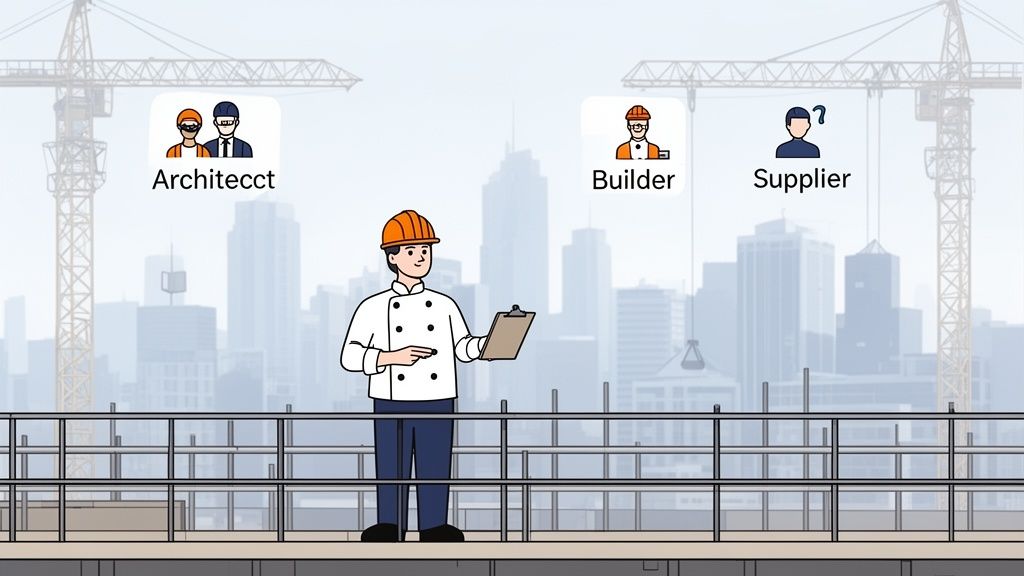
Taking on a career in construction project management is more than just a job – it's a chance to literally build Australia's future. Think of a great project manager like a head chef in a high-end restaurant. They aren't chopping every single onion, but they’re the one orchestrating the entire kitchen to deliver a perfect dish. Getting qualified is your first step to becoming that indispensable leader, and a flexible online course is the most direct way to get there.
Why Construction Project Management Is Your Next Big Career Move
Just look at any Australian city skyline and you'll see it: a constant flurry of cranes, new frames, and groundbreaking developments. We're in the middle of a massive construction boom, from residential high-rises to sprawling public transport projects. But behind every single one of those successful builds is a skilled leader pulling all the strings, making sure everything lands on time and on budget. That's where you come in.
The need for capable project managers isn't just a "nice to have" for companies; it's absolutely critical. Picture the controlled chaos of a large building site: architects are tweaking blueprints, suppliers are dropping off materials, and teams of tradies are getting on with the job. The project manager is the calm centre of it all, the conductor making sure this complex orchestra plays in perfect harmony. Without them, you get expensive delays, blown-out budgets, and a whole lot of miscommunication.
The Numbers Driving The Opportunity
Don't just take my word for it—the data paints a very clear picture of a sector crying out for skilled leaders. Let's break down why this is such a golden opportunity right now.
Australia's Construction Industry At A Glance
These figures, highlighted by Infrastructure Australia, show that the demand isn't slowing down. It covers everything from new housing estates and net-zero energy projects to record-breaking transport upgrades. This environment makes a specialised project management course building construction focused a smart, strategic investment in your future.
If you want to get a better sense of what these qualifications cover, our complete construction management courses guide is a great place to start.
Your Role In A Modern Industry
The game is also changing. Today’s construction sites are becoming more efficient and safer thanks to new tech. For example, knowing the ins and outs of modern drone use in construction for site surveying or progress tracking is no longer a novelty; it’s a real advantage that sets top-tier project managers apart.
By earning a formal qualification, you're not just learning to manage projects the old-school way. You’re positioning yourself to lead the next wave of innovation in the building industry.
A project manager's real worth is their ability to turn chaos into order. You're the one who translates a client's grand vision on paper into a solid, tangible structure they can stand in. It's a career built on practical problem-solving, clear communication, and confident leadership.
Finishing a course gives you the industry-recognised credentials—and the genuine confidence—to step into these big roles, making you a vital asset for any construction company in Australia.
Finding Your Fit in Construction Qualifications
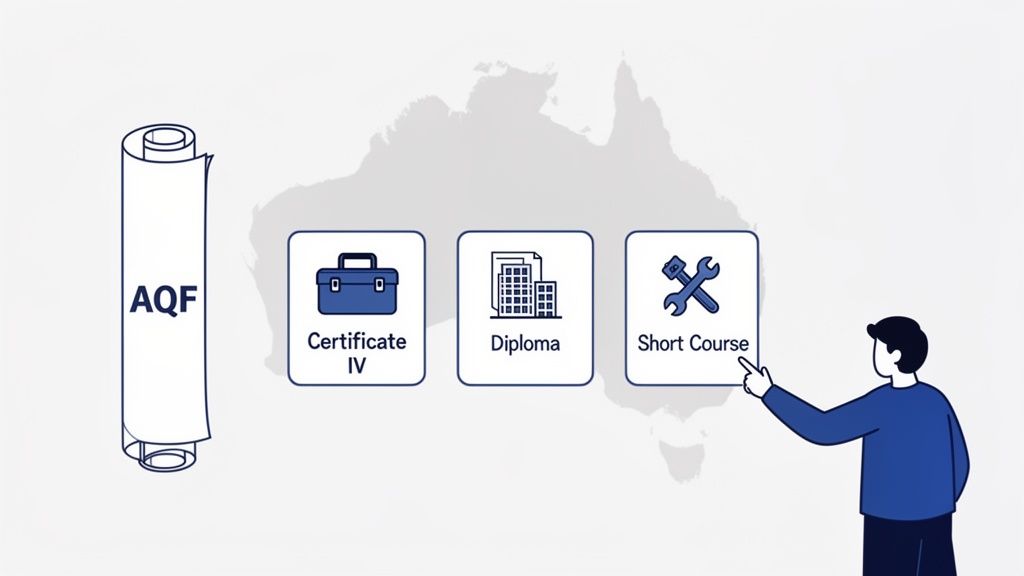
Choosing a qualification in the building industry can sometimes feel like trying to read a complex blueprint without the legend. To make sense of it all, you first need to get your head around the Australian Qualifications Framework (AQF). Think of it as the national standard that ensures every qualification, whether you earn it in Perth or Parramatta, is consistent, high-quality, and recognised by employers.
The AQF organises qualifications into different levels, with each one designed for a specific stage of your career. When it comes to a project management course building construction focused, your options will generally fall into three main categories, each with a clear purpose for your journey up the ladder.
Certificate IV: The On-Site Leader's Toolkit
A Certificate IV is your practical, hands-on ticket to a leadership role on a building site. It’s built for tradies who are ready to step off the tools and start coordinating the team.
Let's say you're a seasoned carpenter who knows the workflow of a residential build like the back of your hand. You've got the experience, but now you want to run the site yourself. This is where a Cert IV comes in, giving you the formal skills to manage schedules, oversee safety, and keep all the different trades working together smoothly.
- Who it's for: Experienced tradespeople, leading hands, or anyone aspiring to become a site supervisor.
- Core Skills: On-site supervision, quality control, interpreting plans, and applying building codes.
- Outcome: You’ll walk away with the confidence and know-how to manage the day-to-day operations of a small to medium-sized construction project.
For anyone looking to make that first real move into management, a Certificate IV in Building and Construction (Site Management) is a brilliant place to start.
Diploma: The Strategic Project Blueprint
If a Cert IV is the toolkit for the worksite, the Diploma is the strategic blueprint for managing the entire project from concept to handover. It pulls the focus back from the day-to-day grind to give you a broader, more administrative view of the whole construction process.
This qualification is perfect for those who want to command the bigger picture—handling contracts, controlling budgets, and dealing directly with clients and stakeholders. You're not just running the site anymore; you're making sure the entire project is viable, compliant, and profitable.
A Diploma shifts your focus from how the work gets done on-site to why the project succeeds financially and contractually. It’s the qualification that builds managers who can deliver projects on time and, crucially, on budget.
Specialised Short Courses: Your Skills Upgrade
Finally, think of specialised short courses as adding a new, high-powered tool to your existing kit. These aren't full-blown qualifications but are laser-focused on teaching you a specific, in-demand skill—and fast.
For instance, you might already be managing projects but need to become an expert in the latest safety protocols. A targeted short course can give you that specific knowledge without the time commitment of a full diploma. Understanding key credentials, like the Occupational Health and Safety Certification, can be a huge asset in this area. These courses are all about keeping your skills sharp and relevant in an industry that never stands still.
What You Will Actually Learn to Get the Job Done
A good project management course for building construction is about much more than just theory. It's about filling your professional toolbox with practical, job-ready skills. Let’s look past the formal course titles and get into what you’ll actually be learning to use on a worksite every single day.
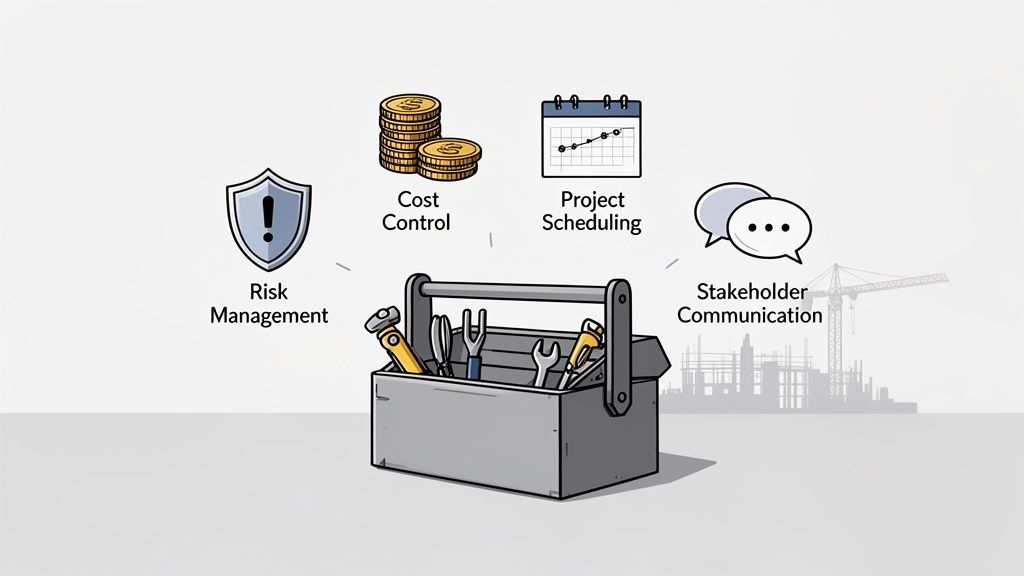
These qualifications are designed to turn you into the person who spots problems and solves them before they become expensive disasters. Essentially, you'll learn to master the four core pillars that hold every successful construction project together.
The Four Pillars of Construction Management
Think of these skills as the vital systems that keep a project running smoothly. Get one wrong, and even the most straightforward build can quickly spiral into chaos and financial loss.
- Risk Management: This is where you develop a kind of sixth sense for what could go wrong. You'll learn to spot potential hazards—from supply chain hold-ups to unexpected site conditions—and, more importantly, create solid backup plans.
- Cost Control: A project’s budget is its lifeblood. This is all about learning to create realistic budgets, tracking every dollar spent, and making smart financial calls to keep the project in the black.
- Project Scheduling: This is the art of mastering the timeline. It involves breaking a massive project down into manageable stages, sequencing every task logically, and using tools to make sure everything happens in the right order, at the right time.
- Stakeholder Communication: This is the skill of keeping absolutely everyone on the same page. You’ll learn how to communicate clearly and effectively with clients, council planners, subcontractors, and your own crew to avoid misunderstandings and build trust.
You’re not just learning to manage tasks; you’re learning to manage expectations, budgets, and people. It’s the difference between simply overseeing a job and actively steering it towards a successful, on-budget completion.
This kind of practical knowledge is non-negotiable in Australia’s dynamic construction market. The industry is projected to grow by 6.9% to reach AUD $193.2 billion in 2025, but that growth comes with plenty of volatility, like fluctuating material costs and shifting dwelling approval rates. Having sharp management skills is what allows you to navigate these challenges instead of being overwhelmed by them. To get a better sense of the market's future, you can explore more on the Australian construction industry forecast.
Applying Your Skills on a Real Worksite
Let’s translate these pillars into real-world scenarios you’ll absolutely face on the job:
The Problem: A crucial delivery of steel framing is delayed by two weeks, threatening to bring the entire site to a standstill.
Your Solution: Drawing on your project scheduling skills, you immediately re-sequence the workflow, bringing forward internal fit-out jobs that don't depend on the frame. Your stakeholder communication training then kicks in as you clearly explain the revised plan to the client and subcontractors, managing expectations and preventing panic.
The Problem: During excavation, your team hits a massive patch of unforeseen rock. Removing it will require expensive specialised machinery that wasn't in the original budget.
Your Solution: This is where your risk management foresight pays off. You access the contingency fund you'd already allocated for unexpected ground issues. Then, using your cost control expertise, you negotiate with suppliers and adjust other non-critical expenses to absorb the financial hit without blowing the overall project budget.
This is what a quality course really prepares you for—moving you from being a bystander to a decisive, problem-solving leader on site.
Where Your Qualification Can Take You: Career Paths and Salary Potential
Think of a project management course for building and construction as your ticket to the job site—and beyond. This isn’t just about getting a piece of paper; it’s about unlocking a clear, structured career path with serious growth and earning potential. You'll start by getting your hands dirty in crucial support roles and climb your way up to leading projects worth millions.
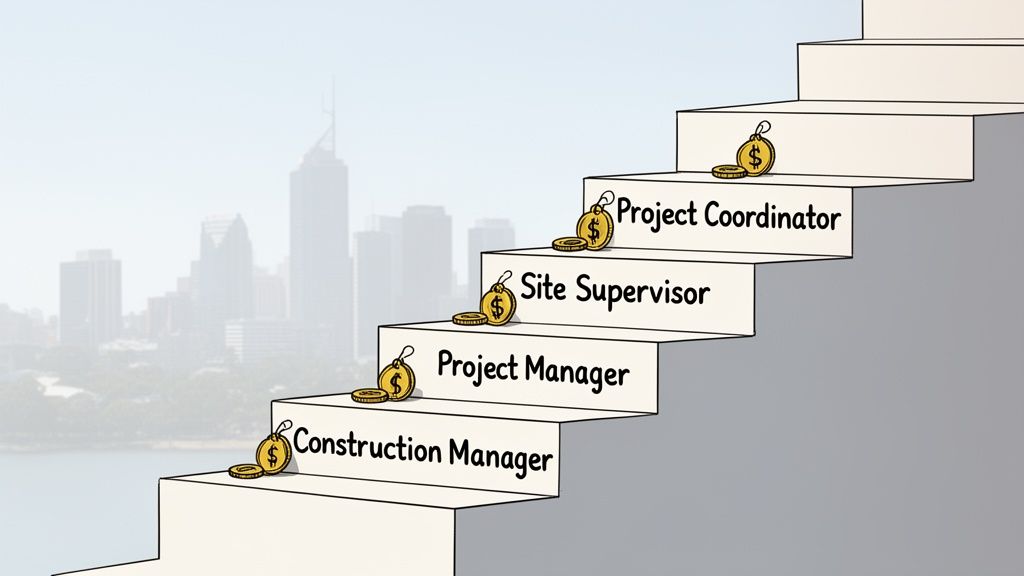
Most people get their start as a Project Coordinator or a Site Supervisor. As a coordinator, you become the nerve centre of the project, wrangling schedules, paperwork, and communication between the site crew and the office. As a supervisor, you’re the on-the-ground general, directing tradespeople and making sure the day-to-day work sticks to the plan.
These first roles are where the real learning happens. You take everything you learned in the classroom and apply it, building a reputation as someone who gets things done.
Climbing the Ladder: From Site to Strategy
Once you’ve proven yourself and have a few projects under your belt, the path to more senior roles opens up. Each step comes with greater responsibility and, naturally, a bigger paycheque. It's a logical climb where every job prepares you for the next.
Here’s what that journey often looks like:
Project Coordinator: This is often your first step. You'll be the project manager's right-hand person, keeping everything organised and learning the natural rhythm of a construction project.
Site Supervisor: Your first real taste of on-site leadership. You're in charge of the daily workflow, enforcing safety standards, and coordinating different trades to hit their deadlines.
Project Manager: Now you're running the show. You’re responsible for the entire project's success, managing the budget, timeline, stakeholders, and risks from the first shovel in the ground to the final handover.
Construction Manager: The top rung of the ladder. You’re overseeing multiple projects simultaneously, focusing on high-level strategy, major client relationships, and leading your team of project managers.
What You Can Expect to Earn
As you move up, your salary will reflect your growing expertise. While exact figures depend on your location, the size of the projects you're on, and your experience, the financial rewards in construction are significant.
To give you a clearer picture, here’s a snapshot of common roles and what you can expect to earn in Australia.
Construction Career Paths and Salary Ranges in Australia
As you can see, the earning potential increases substantially with each step up.
This career path is more than just a series of jobs; it's a tangible framework for building a successful future. Every project you deliver adds to your expertise and reputation, fuelling your earning power in an industry that always rewards capable leaders.
Whether your passion is for building towering city skylines, creating new residential communities, or working on major infrastructure projects, a project management qualification is the key that opens the door. It gives you the skills not just to get started, but to truly build a lasting career.
How to Choose the Right Construction Course for You
With so many options on the table, picking the right project management course for building and construction can feel like your first big project. You want to know your time and money are being invested wisely, setting you up for success right from the start.
Thankfully, figuring it out is a lot simpler when you know what to look for. It’s not just about the course title; it's about the quality, flexibility, and support system that will see you through your studies and launch you into your new career.
Accreditation Is Non-Negotiable
First things first: make sure the course is nationally recognised. This is the most critical factor, hands down. A nationally recognised qualification means it meets the strict standards of the Australian Qualifications Framework (AQF), so employers right across the country will know and respect your credentials.
A non-accredited course might teach you a few things, but it won't give you the formal qualification that actually opens doors to better roles and a bigger paycheque. It’s the difference between a cheap knock-off tool and a certified, trade-quality one—only one of them is trusted on a professional job site.
Finding a Course That Fits Your Life
Next up is thinking about how you'll actually do the course. For most people already working, the flexibility of online, self-paced learning is a total game-changer. It lets you fit study around your current job and family life, instead of trying to bend your life to fit a rigid TAFE timetable.
This is especially important in an industry known for its long hours. Look for providers that offer:
- A self-paced structure: You should be able to move through the material at your own speed, without the stress of impossible deadlines.
- Full online access: All your course content, assessments, and support should be available 24/7, wherever you are.
- Generous enrolment periods: A good provider will give you plenty of time (usually 12-24 months) to get the qualification done without feeling rushed.
Choosing the right delivery mode is about sustainability. A course that respects your existing commitments is one you're far more likely to complete successfully, turning your ambition into a real qualification.
For a great example of a flexible qualification, you might be interested in a Diploma of Project Management that specialises in construction, which is designed for this kind of flexible learning.
The Support System Behind the Screen
Finally, never underestimate the importance of great student support. Studying online doesn't mean you should feel like you're on your own. A quality provider will have a solid support system in place to help you when you hit a snag.
Look for genuine access to tutors and assessors who are actual industry experts. Being able to ask a question and get a timely, helpful answer is what separates a great online experience from a frustrating one. This is especially vital in Australia’s construction industry, which faces a mix of growth and skill shortages. While overall revenue is projected to see a slight dip by the end of 2024-25, the sector is forecast to rebound strongly, driven by major engineering works. You can discover more insights about Australia's construction industry on IBISWorld.
Before you enrol, check provider reviews. Look for comments about helpful tutors, responsive admin teams, and easy-to-use learning platforms. This support network is your secret weapon for success.
Your Top Questions About Construction PM Courses, Answered
Deciding to upskill or switch careers is a huge step, and it’s natural to have a lot of questions. When you're investing your time and money, you want to be sure you're making the right call. We've pulled together the most common questions we get from people looking at a project management course for the building and construction industry.
Let's clear things up and give you the confidence to move forward.
Do I Need to Be On-Site Already to Enrol in a PM Course?
Not at all. While having some hands-on experience is always a plus, it’s definitely not a prerequisite. In fact, foundational courses like a Certificate IV are built specifically for people starting from scratch or changing careers. They’re designed to teach you the fundamentals from the ground up—things like budgeting, scheduling, and coordinating teams.
Think of it like learning the rulebook and strategy before you ever step onto the field. These qualifications give you the essential administrative and planning skills you need to land a junior or coordination role. From there, you can start building up that invaluable on-site experience.
Will Employers Actually Respect an Online Construction Course?
Yes, absolutely—with one crucial condition: it must be 'nationally recognised'. That's the key. Any qualification that meets the standards of the Australian Qualifications Framework (AQF) is valued by employers right across the country, no matter how it was delivered.
Reputable online courses cover the exact same units of competency as their on-campus equivalents. These days, many employers even see online study as a bonus. It shows you’re a self-starter with excellent time management skills and a serious commitment to your professional development, especially if you’re juggling it with work or family.
What’s the Real Difference Between a Project Manager and a Construction Manager?
This is a great question because the lines can seem blurry. The easiest way to think about it is to compare a film director to a stunt coordinator.
A Project Manager has the big-picture, strategic view. They’re orchestrating the entire project from concept to handover, acting as the main point of contact for the client. They're ultimately responsible for the overall budget, the master timeline, and keeping all the stakeholders happy.
The Construction Manager, on the other hand, is the general on the ground. They’re immersed in the day-to-day action, managing the trades, enforcing safety protocols, and solving the immediate, practical problems that pop up on-site. Their job is to bring the project manager's grand plan to life.
A Project Manager ensures the project is a financial and strategic success, while the Construction Manager ensures it is a physical and operational success. Both are vital, but they operate at different altitudes.
Honestly, How Long Does It Take to Finish an Online Course?
The freedom to set your own pace is one of the biggest advantages of studying online. Most quality courses are self-paced, so you’re not locked into strict uni-style semesters. You're in the driver's seat.
As a rough guide, you could expect:
- A Certificate IV to take anywhere from 6 to 12 months to complete, depending on how much time you can dedicate.
- A more comprehensive Diploma usually takes between 12 and 24 months to get through.
The best providers give you generous enrolment periods, so you have the breathing room to fit study around your life and job without the constant pressure. It’s a model built for working adults, not full-time students, so you can actually succeed on your own terms.
Ready to take the next step in your construction career with a course that fits your life? At Get Course Australia, we connect you with flexible, nationally recognised qualifications from Australia’s leading online providers. Find the perfect course to build your future at https://getcourse.com.au.
Find Your Course
Compare courses across every field we write about, and enquire in under a minute.