How to Develop Critical Thinking Skills A Practical Guide
Learn how to develop critical thinking skills with our practical guide. Discover actionable exercises and real-world strategies to boost your career prospects.
If you want to get ahead in your career, learning how to develop critical thinking skills isn't just a good idea - it's essential. Forget the dry, academic definitions for a moment. Think of it as the single most powerful tool in your professional arsenal. It’s the real-world ability to cut through the noise, question what you’re told, and make smart judgements.
This is the skill that gets you noticed and moves you forward.
Why Critical Thinking Is Your Most Valuable Career Skill
Let's be practical. Critical thinking is what separates the doers from the leaders. Anyone can follow a set of instructions, but a critical thinker looks deeper. They’re the ones analysing why something works, spotting potential roadblocks before they become disasters, and uncovering opportunities that everyone else missed.
It's not just a 'nice-to-have' trait for your CV. It's exactly what Australian employers are crying out for. Whether you're in tech, healthcare, business, or the trades, the people who can think clearly and decisively are the ones who get ahead.
Real-World Career Advantages
Developing this skill isn't an abstract exercise; it delivers concrete benefits you'll see in your job every day. People who can analyse situations and make sound decisions are naturally trusted with more responsibility, put on the fast track for promotions, and enjoy far greater job security.
Here’s what that looks like in practice:
- Better Problem-Solving: Instead of slapping a band-aid on an issue, you'll dig down to the root cause. This means you find lasting solutions, not just temporary fixes.
- Smarter Decision-Making: You'll learn to step back from gut feelings and personal bias, making choices based on solid evidence and strategic thinking.
- Faster Career Progression: Companies don't promote people who need their hands held. They promote the ones who can think for themselves, bring fresh ideas, and lead a team through a challenge.
Critical thinking is the filter that turns a flood of information into a stream of actionable intelligence. It's the difference between being overwhelmed by data and being empowered by it.
A Skill That's In Hot Demand
As automation and AI handle more of the routine work, uniquely human skills have become more valuable than ever. A machine can process data, but it can’t handle nuanced judgement, ethical dilemmas, or the creative spark needed to solve a truly complex problem. That’s where you come in.
The data backs this up. Critical thinking is a cornerstone of what experts call transferable skills. A 2017 Australian government report highlighted a massive 158% increase in job ads demanding it. What's more, a 2016 study found that young professionals who could demonstrate this skill earned over $7,500 more per year.
At the end of the day, learning how to develop critical thinking skills is a direct investment in your own career. It’s what will make you resilient, adaptable, and successful in a competitive and constantly changing professional world.
A Simple Framework for Critical Thinking
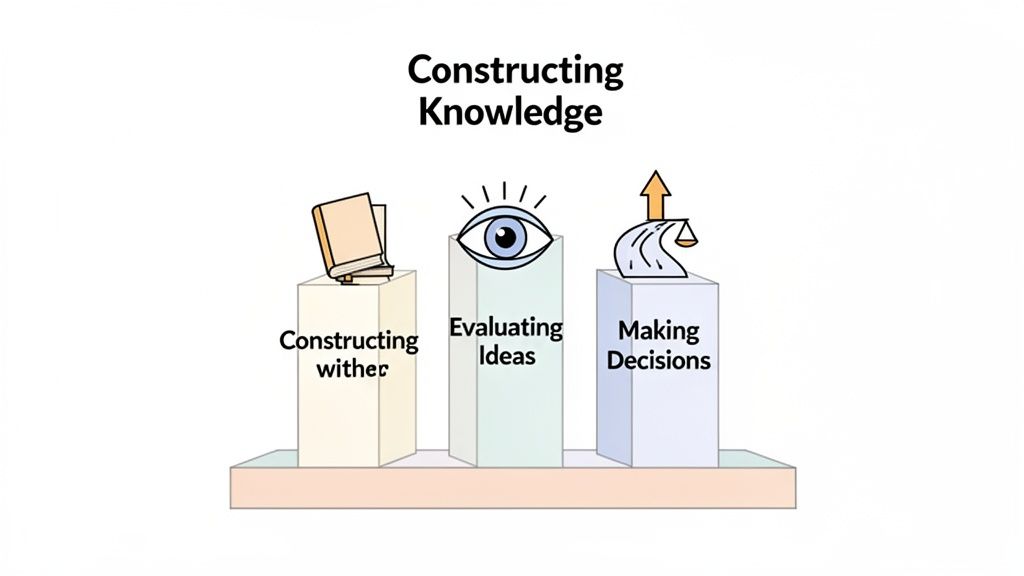
"Critical thinking" can feel like a pretty big, abstract idea. To actually get better at it, you need a way to break it down into smaller, more manageable parts. Having a simple mental model helps you see where you're already strong and, more importantly, where you can focus on improving.
Let's look at a straightforward structure built on three core pillars. Think of these as the fundamental building blocks of good judgement. When you get a handle on each one, you’ll have a reliable process for tackling any problem, idea, or decision that comes your way, whether you're at work or in a classroom.
The First Pillar: Constructing Knowledge
Every journey into critical thinking starts here. Constructing knowledge isn’t just about memorising facts. It’s the active process of gathering, filtering, and organising information to build a solid base of understanding. Without this pillar, any evaluation or decision you make is built on shaky ground.
Imagine you’ve been asked to research a new software platform for your team. The easy route would be to just skim the marketing pages for the top three options. But constructing knowledge means you have to go deeper.
You would actively:
- Seek out diverse sources beyond the official company websites. Look for independent reviews, user forums, and detailed case studies.
- Verify the information by cross-referencing what you find. Does one source’s claim about integration capabilities line up with another’s?
- Organise everything into a logical structure, maybe a comparison table covering features, pricing, and real user feedback.
This pillar is your best defence against misinformation and shallow analysis. It's about becoming a thoughtful consumer of information, not just a passive recipient.
The Second Pillar: Evaluating Ideas
Once you have a solid foundation of knowledge, the next move is to put it under the microscope. Evaluating ideas involves dissecting arguments, spotting hidden biases, identifying logical flaws, and weighing up the strength of the evidence. This is where you shift from simply collecting information to actively questioning it.
Let's say a competitor launches a bold new marketing campaign. Your team is buzzing, and some colleagues are pushing to copy their strategy immediately. This is the perfect moment to bring in the second pillar.
Instead of just jumping on the bandwagon, you would press pause and evaluate:
- What are the underlying assumptions here? Is the competitor assuming their target audience is identical to yours?
- Is the argument sound? Does their campaign message logically lead to the sales outcomes they're probably hoping for?
- Is bias creeping in? Is your team's excitement a form of 'shiny object syndrome', causing them to overlook potential downsides?
This kind of analytical rigour is what stops you from making reactive, poorly-thought-out moves. It’s the quality control check for your entire thought process.
"True critical thinking is not about finding fault. It's about uncovering the truth by systematically questioning what is presented as fact."
The Third Pillar: Making Decisions
This final pillar is where it all comes together. Making decisions is the process of weighing all the evaluated evidence, considering the potential outcomes of different choices, and then selecting the most logical and effective path forward. It’s the actionable output of all your hard thinking.
This pillar is absolutely crucial. The Australian Council for Educational Research (ACER) identifies it as a key strand in their own framework, recognising that building knowledge and evaluating ideas must lead to effective action to be truly valuable. And yet, OECD data shows that 20% of students across six countries perform at the lowest level of critical thinking, which can seriously hamper their decision-making abilities. You can read the full framework from ACER to see how these skills are officially defined.
Going back to our software example: you’ve researched the options (Pillar 1) and analysed their pros and cons (Pillar 2). Now, you have to make a recommendation. This involves carefully weighing factors like cost versus features, short-term implementation pain versus long-term efficiency gains, and how each option aligns with your team's unique workflow.
Your final choice is a well-reasoned judgement, not just a gut feeling. It’s a decision you can confidently stand by with the evidence you’ve gathered and evaluated, showing you've completed a full cycle of critical thought.
The Three Pillars of Critical Thinking in Action
To make these concepts even more concrete, let's look at how they might play out in different settings. This table breaks down each pillar with practical examples from both a TAFE or university course project and a professional healthcare role.
As you can see, this three-pillar framework isn't just a theoretical exercise. It's a practical tool you can apply to almost any challenge, helping you move from simply knowing things to making smarter, more defensible choices.
Practical Exercises to Build Your Mental Muscle
Knowing the theory of critical thinking is one thing, but actually developing the skill? That comes from practice. Your brain is like a muscle - it needs consistent workouts to get stronger and more agile. This is where we move past the abstract and into concrete exercises you can start using today.
Don't worry, these aren't stuffy academic drills. They're practical techniques built for busy people who want to weave critical thinking into their daily routine, not treat it like a chore. By doing so, you'll find your analytical abilities sharpening day by day.
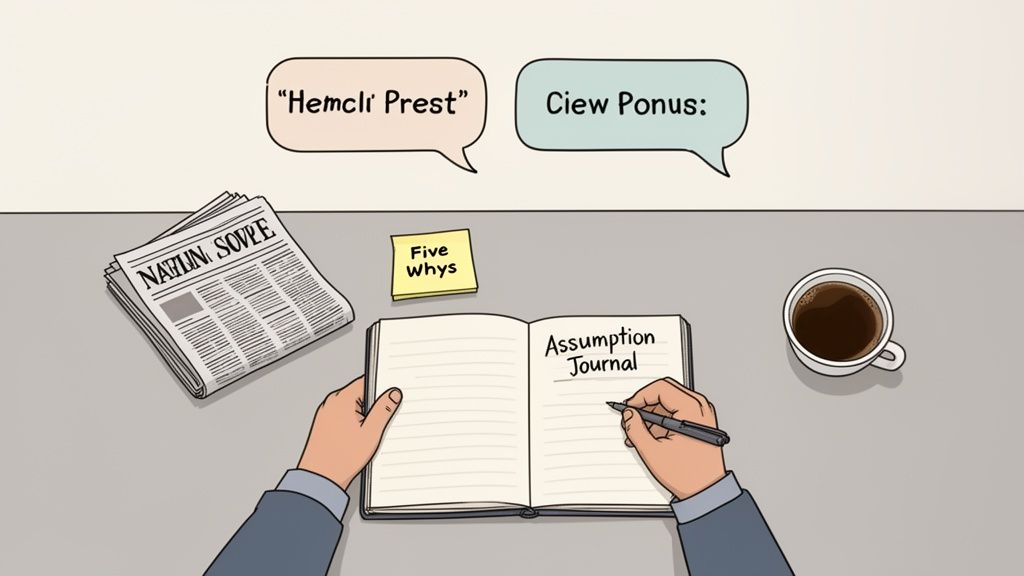
Start an Assumption Journal
One of the biggest hurdles to clear thinking is our own unexamined assumptions. We all have them, and they quietly steer our decisions without us even realising it. An Assumption Journal is a brilliant tool for dragging these hidden beliefs out into the open for a proper look.
The process is deceptively simple but incredibly effective.
- Pinpoint an assumption: Each day, just find one you've made. It could be something at work, like "This client won't be interested in our new service," or a personal one, like "I'm not qualified enough to apply for that promotion."
- Write it down: Get it out of your head and onto paper (or a screen). The simple act of writing makes it real and easier to inspect.
- Question it: Now, poke some holes in it. What evidence do I actually have for this? Is there another way to look at the situation? What’s the worst that could happen if I’m wrong?
This simple habit trains you to pump the brakes on your initial reactions and start looking for the evidence behind your beliefs. That’s the very core of critical thinking.
This daily exercise is a powerful way to switch your brain from autopilot to active analysis. After a while, you’ll find yourself questioning assumptions automatically, before they can lead you astray.
Apply the Five Whys Technique
Ever feel like you’re solving the same problem over and over again? It’s easy to get stuck treating symptoms instead of the real disease. The Five Whys is a classic problem-solving technique that helps you drill down to the root cause of an issue simply by asking "Why?" repeatedly.
Let's say your team keeps missing project deadlines. Instead of just shrugging it off, you could try this:
- The Problem: We missed the deadline for the quarterly report.
- Why? Because the data collection took longer than planned.
- Why? Because several departments sent their figures in late.
- Why? Because they didn't get the request until the last minute.
- Why? Because the project kickoff email was sent to the wrong distribution list.
Boom. Suddenly you see the problem wasn't bad time management - it was a simple communication error right at the start. This method stops you from slapping a band-aid on the issue and helps you find a solution that actually sticks.
Analyse Media with Opposing Viewpoints
In our age of information overload, being able to spot bias is a superpower. A fantastic exercise for this is to pick a current news story and deliberately find coverage from two sources with opposing viewpoints. The goal isn't to decide who's "right," but to see how the story is being told.
As you compare the articles, keep an eye out for:
- Word Choice: Is one source calling people "protesters" while the other calls them "rioters"? Is a new policy a "tax incentive" or a "loophole for the rich"? The language matters.
- Framing: What details are included and what's been conveniently left out? Which experts get quoted?
- Focus: Does one article zoom in on the economic impact, while the other focuses entirely on the social consequences?
This practice sharpens your ability to evaluate information with a critical eye, identify bias, and piece together a much fuller picture of what's going on. The skills you build here are directly transferable to everything from business reports to academic papers. If you're looking for more ways to hone these skills, check out this practical guide on how to develop critical thinking skills. This kind of active analysis pairs beautifully with many of the scientifically proven study methods that actually work, creating a powerful learning combo.
By making these exercises a regular habit, you turn critical thinking from a vague concept into a sharp, active skill that will serve you well in every area of your life.
Putting Critical Thinking to Work, Every Day
The theory is one thing, but the real test - and the real reward - of critical thinking happens on the job. This is where you graduate from practice drills to live performance, using your sharpened analytical skills to solve genuine problems and deliver real value. In my experience, this is what truly separates a good employee from an indispensable one.
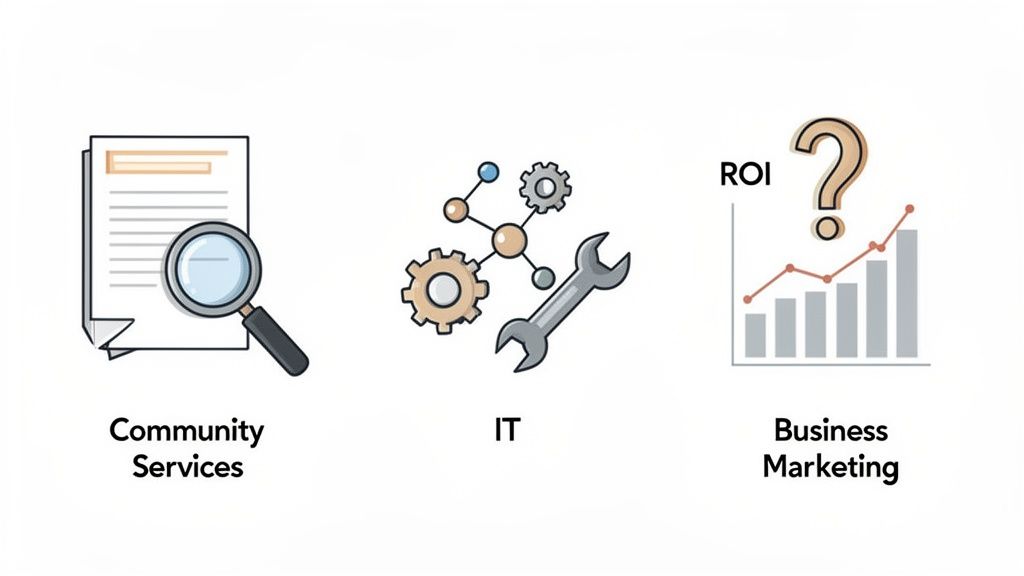
Let’s get practical and look at how this plays out in some of Australia’s most popular career paths. Think of these as blueprints you can adapt, whether you’re studying for a new career or looking to make a bigger mark where you are now.
In Community Services
You're a case worker, and a new client's file lands on your desk. The summary notes paint a pretty clear picture: the client is "uncooperative" and "disengaged" with past services. The easy path? Accept it at face value and roll out a standard, and probably ineffective, support plan.
But this is precisely where critical thinking changes the game. Instead of taking the labels for granted, you start probing.
- You question the assumptions. What does "uncooperative" actually mean in this context? Could it be a reaction to a system that ignored their cultural needs or failed to account for past trauma?
- You look for better evidence. You dig past the summary, piecing together a timeline. You notice the cancelled appointments often coincided with periods of housing instability mentioned elsewhere in the file.
- You hunt for the root cause. Your analysis leads to a new hypothesis: the "disengagement" isn't a personality flaw. It’s a symptom of something deeper, like chronic stress or a fundamental lack of trust in the system.
Suddenly, your assessment isn't about a "difficult client" anymore. It's about a person facing specific, unaddressed barriers. This insight leads to a radically different - and far more empathetic and effective - support strategy.
A critical thinker in community services learns to read between the lines of a case file. They know that behaviour is a form of communication, and their job is to decipher the real message, not just react to the noise.
In Information Technology
Picture this: you’re an IT pro dealing with a network outage that hits like clockwork every Tuesday morning. The standard fix is to reboot the server. It works, but only until next Tuesday. This is firefighting, not problem-solving.
Applying critical thinking here means refusing to accept the weekly reboot as a solution. You decide to dig in.
- First, you analyse the data. You pull the server logs for the past month, hunting for patterns around the outage times. You quickly spot a massive CPU spike just before each crash.
- Next, you form a hypothesis. An automated, resource-heavy task must be the culprit. The weekly antivirus scan is the obvious suspect, but the timing in the logs doesn't quite match up.
- Then, you test and refine. Digging deeper, you discover it’s not the scan itself but a newly rolled-out data backup process. It’s kicking in at the same time, creating a resource bottleneck that crashes the server.
By systematically questioning, investigating, and testing, you found the real root cause. The permanent fix is simple - just reschedule the backup. But you only get to that simple fix through a structured, critical thought process.
This is a skill we need to foster. Recent analyses of the Australian education system show that less than 60% of students consistently use these kinds of critical thinking strategies. Honing these skills is what sets you up for a successful career, as you can discover in more detail from recent Australian education studies.
In Business and Marketing
You're a marketing coordinator looking at the results of a recent social media campaign. On the surface, the numbers are fantastic - sky-high engagement, tons of likes, and a massive reach. It’s tempting to call it a win and ask for a bigger budget to do it all again.
But a sharp critical thinker knows that vanity metrics can be deceiving. You decide to look closer.
- You evaluate the evidence properly. Diving into the analytics, you ask: who actually engaged? Was it your target audience here in Australia, or was it a click farm in another country?
- You connect the dots to business goals. You ask the most critical question of all: did the campaign actually drive sales or generate quality leads? By cross-referencing the campaign dates with website traffic and sales figures, you find no real uplift.
- You draw a more nuanced conclusion. Your final report tells a much different story. You conclude that while the campaign was great at creating buzz, its strategy completely failed to attract actual customers. The return on investment (ROI) was terrible.
Your recommendation is no longer to repeat the campaign but to pivot the entire strategy towards lead quality, not just engagement volume. This level of analysis shows you’re more than just an executer; it proves you have the good qualities that drive business success.
Finding a Course to Fast-Track Your Skills
While daily exercises and on-the-job practice are brilliant for building mental muscle, sometimes you need a more structured approach to really kick your growth into high gear. Making a conscious choice to enrol in a course designed to build these capabilities is a powerful way to invest in your career. It gives you a dedicated space to learn, practise, and get direct feedback on your analytical skills.
But let's be honest, not all courses are created equal. To really develop your critical thinking, you have to look past the course title and get into the nitty-gritty of the curriculum. A qualification that just asks you to memorise and regurgitate information simply won't cut it. You need a learning path that forces you to think.
What to Look For in a Course Curriculum
When you're weighing up your options, you're not just looking for a piece of paper at the end. You're looking for an experience that will fundamentally change how you solve problems. A course that genuinely builds critical thinking will be packed with specific kinds of learning activities.
Keep an eye out for courses that heavily feature:
- Case Study Analysis: These are your bread and butter. You'll be given real-world or hypothetical scenarios and tasked with dissecting complex situations, identifying the core issues, evaluating different viewpoints, and proposing well-reasoned solutions.
- Problem-Solving Projects: Look for courses that ditch the multiple-choice tests for projects where you have to tackle an open-ended problem from start to finish. This forces you to define the problem, gather your own information, and create a genuinely practical solution.
- Data Analysis Modules: Any course that teaches you to interpret data, spot trends, identify outliers, and question the source of information is actively training a core critical thinking competency.
- Ethical Decision-Making Scenarios: Modules that throw tricky ethical dilemmas at you are fantastic for building your ability to weigh competing values, consider consequences, and justify your choices using a logical framework.
These are the hallmarks of a programme designed to create thinkers, not just technicians. They foster an environment where you're constantly challenged to apply what you're learning to messy, real-world situations.
A great course doesn't just give you the answers; it teaches you how to ask better questions. It builds your confidence to tackle ambiguity and find clarity in complexity, which is precisely what modern employers are looking for.
How Different Qualifications Build Specific Skills
The right educational path can sharpen your critical thinking in ways directly relevant to your career goals. Different fields naturally emphasise different facets of this skill, so you can choose a course that hones the exact analytical abilities you need. It’s all about being strategic.
For example, a Diploma of Business (BSB50120) isn't just about learning management theory. Its entire structure is built around strategic analysis. You'll learn how to run a SWOT analysis (Strengths, Weaknesses, Opportunities, Threats), evaluate market trends, and make data-driven decisions on where to put company resources. This qualification is basically a boot camp for commercial critical thinking.
On the other hand, pursuing a Certificate IV in Cyber Security (22603VIC) offers a different but equally valuable kind of training. Here, the focus is on rigorous, methodical problem-solving. You’re trained to analyse network vulnerabilities, trace the source of a security breach, and evaluate digital evidence with absolute precision. It’s a field where a bad assumption can be catastrophic, so it systematically builds your ability to think logically under pressure.
Choosing the right course is a critical decision in itself. By examining the curriculum and understanding how it aligns with the skills you want to build, you can find more than just a qualification. You find a pathway to becoming the kind of sharp, analytical professional every industry is crying out for. For anyone looking to explore their options, browsing a directory of short courses online in Australia can be a great starting point to see how different programmes are structured.
Your Critical Thinking Questions, Answered
Even with a roadmap in hand, it's natural to have a few questions about what the journey to becoming a sharp critical thinker actually involves. Let's clear up some of the most common ones so you can move forward with confidence.
How Long Does It Take to See Real Improvement?
This is the big one, isn't it? The honest answer is, it depends. Developing your critical thinking muscles isn't like flicking a switch; it's much more like getting physically fit. You won't see a massive change overnight, but with consistent effort, the small shifts start adding up fast.
Most people tell me they feel more confident in their analysis within a few weeks of deliberate practice - things like using the "Five Whys" technique or keeping a journal of their assumptions. For those skills to become second nature, though, you’re usually looking at several months of consciously applying them in different situations.
The secret here is consistency, not intensity. A little bit of practice every day is a world away from a long, draining session once a month. You're building a new mental habit, and that takes regular reps.
Is Critical Thinking a Skill, or Are You Just Born With It?
Let's bust this myth right now. While some people might naturally lean towards analytical thinking, critical thinking is absolutely a skill that can be learned and honed. Nobody is born a perfect critical thinker. It’s a collection of habits, mental models, and frameworks that anyone can train themselves to use.
I like to compare it to learning a musical instrument or a new language. Everyone starts from a different place, but with good instruction, dedicated practice, and a clear framework, proficiency is within anyone's reach. That's why formal courses and daily exercises are so effective - they provide the structure you need to build the skill systematically.
How Do I Actually Show This Skill in a Job Interview?
This is where you need to show, not just tell. Simply saying, "I'm a great critical thinker," means very little to an interviewer. You have to back it up with concrete evidence. The STAR method (Situation, Task, Action, Result) is your best friend for this.
Before you walk into that interview, prepare a couple of solid examples from your past where you:
- Pinpointed a problem that everyone else was missing.
- Waded through complex information from different sources to make a tough call.
- Questioned a "that's how we've always done it" process and proposed a smarter alternative.
- Solved a nagging, recurring issue by getting to its true root cause.
When you're telling the story, focus on your thought process. Explain why you made the choices you did and what evidence you based them on. This gives the interviewer a genuine window into how you think, which is infinitely more powerful than just claiming you have the skill.
What's the Single Biggest Barrier to Critical Thinking?
Hands down, the biggest roadblock is our own cognitive bias. These are the mental shortcuts our brains take to make sense of the world quickly, but they're often riddled with flaws. Things like confirmation bias (seeking out info that confirms what we already believe) and anchoring bias (getting stuck on the first piece of information we hear) trip us up constantly.
Learning to spot and challenge these biases is a core part of becoming a better thinker.
The first principle is that you must not fool yourself - and you are the easiest person to fool. Acknowledging that our brains have these built-in glitches is the first step. Actively seeking out opposing viewpoints and making a habit of challenging your own gut reactions are the most powerful tools you have for thinking clearly.
This constant self-awareness is what really separates a true critical thinker from someone who just knows a lot of facts. It's about being willing to be wrong on the path to finding what’s right.
Ready to move from theory to practice with a structured learning path? Get Course Australia connects you with nationally recognised online courses designed to build the analytical and problem-solving skills employers are looking for. Find the right course to sharpen your mind and advance your career today.
Find Your Course
Compare courses across every field we write about, and enquire in under a minute.