Your Guide to a Teachers Aide Course NSW TAFE and Online Options
Explore your options for a teachers aide course NSW TAFE provides. This guide covers qualifications, costs, online study, and career paths in NSW.
If you're looking to start a career in education support in New South Wales, a TAFE course is the most direct and recognised way to get there. The go-to starting qualification is the Certificate III in Education Support, which is designed to give you all the foundational skills you'll need to step confidently into a NSW classroom and assist teachers and students.
Starting Your Career as a Teachers Aide in NSW
Becoming a teacher's aide is one of the most rewarding ways to make a real difference in NSW schools. This role goes far beyond simply helping with classroom chores. You become an essential part of the support system for teachers and students alike, helping to build a positive and effective learning environment where children can thrive.
Whether your passion lies in helping little ones master their first words or providing extra support to students with diverse learning needs, getting a formal qualification is the essential first step. It equips you with the practical skills and theoretical knowledge that schools actively seek when they hire new staff.
Why This Role is So Important
The demand for qualified teacher's aides across New South Wales is consistently high, and for good reason. These professionals are vital for creating inclusive classrooms and offering the one-on-one attention that can completely change a student's confidence and academic journey.
Choosing this career path opens up a world of benefits:
- A Real Impact: You'll see firsthand the positive effect you have on the growth and development of students.
- High Job Satisfaction: There's immense personal fulfilment in being a key part of a collaborative school community.
- Great Work-Life Balance: Most roles follow school hours, making it a fantastic career for balancing work and family commitments.
TAFE's role in training this workforce is huge. In 2022-2023 alone, TAFE NSW had 397,000 enrolments across its various courses, cementing its position as the state's number one vocational trainer. With Australia spending over $5 billion a year on teacher aides, the commitment to this profession is clear and growing. You can read more about TAFE's vital role in the state's education system in their latest annual report.
This guide will walk you through everything you need to know, from picking the right course to understanding your study options. For some extra tips, have a look at our quick guide on how to become a successful teacher's aide.
Understanding Your Teacher's Aide Qualification Options
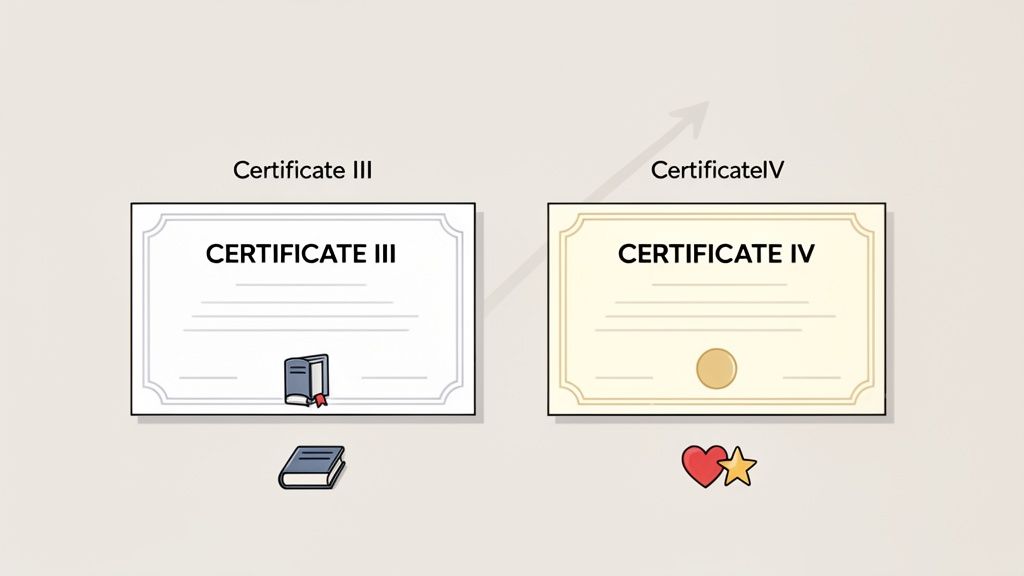
Trying to figure out the right course can feel a bit like navigating a maze. But thankfully, when it comes to education support, the path is actually quite straightforward. In NSW, your journey will almost always begin with one of two nationally recognised qualifications.
Think of them as two different doors into the same fantastic career, each one suited to slightly different aspirations.
The best place to start really comes down to where you see yourself making a difference. Are you excited to get into a mainstream classroom and help with day-to-day learning? Or are you drawn to working more closely with students who have diverse and complex needs?
Let's unpack the two key qualifications you'll come across when looking for a teacher's aide course in NSW with TAFE or another quality provider.
The Perfect Starting Point: Certificate III
The CHC30221 Certificate III in Education Support is the industry standard—it’s your foundational toolkit for working effectively in a school. This is the qualification that will give you the core skills needed to confidently assist a teacher in a mainstream primary or high school classroom.
This course is all about practical, hands-on skills you can use from your very first day. You'll get to grips with how to:
- Help students build their literacy and numeracy skills.
- Contribute to the health and safety of every child in your care.
- Supervise students outside the classroom, whether in the playground or on an excursion.
- Work as part of a team, communicating effectively with teachers and other staff.
In short, it’s the most common and direct path to becoming a qualified teacher's aide, giving you the confidence to step into the role and start contributing right away.
Levelling Up Your Skills: Certificate IV
If you're aiming for a role with more responsibility or have a passion for supporting students with additional needs, then the CHC40221 Certificate IV in Education Support is your next logical step. It builds on the foundations of the Certificate III but dives much deeper into specialised support strategies.
This is the qualification for those who want to work more independently, often providing one-on-one support for students with physical disabilities, learning disorders, or complex behavioural needs. Schools really value this qualification because it signals a higher level of expertise.
Completing the Certificate IV opens up a broader range of opportunities, including roles like an Integration Aide in a specialised learning program. It tells employers you’re equipped to handle more challenging situations with skill and empathy, making you a very strong candidate.
Choosing Your Teacher's Aide Qualification
Deciding between the Certificate III and Certificate IV can feel tricky, but it's really about matching the qualification to your career goals. This table breaks down the key differences to help you see which one is the right fit for you right now.
Whether you start with the foundational Certificate III or aim for the specialised Certificate IV, both qualifications lead to a fulfilling and in-demand career.
Ultimately, the choice is yours. A great next step is to explore a range of nationally recognised teacher's aide courses online and see which one aligns with your schedule and your vision for the future.
TAFE vs Online Study: Which Path Is Right for You?
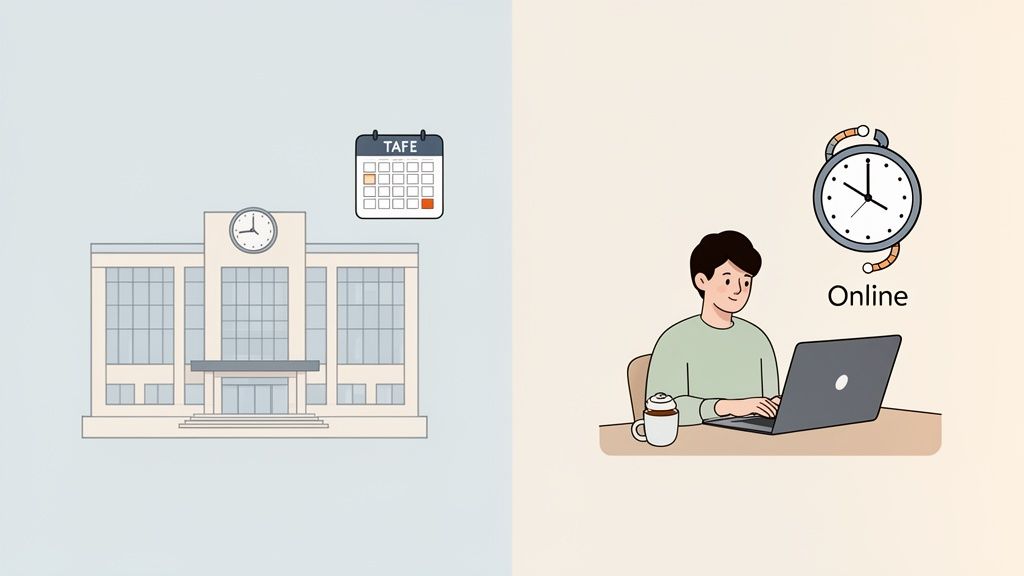
Deciding how to get your teacher's aide qualification is just as important as deciding which one to get. The two main options in NSW, studying on-campus at TAFE or with an online provider, offer completely different learning experiences. Figuring out which one suits your life and learning style is the first real step toward success.
I like to think of it like travel. Going to a TAFE campus is a bit like taking the train. It's reliable, runs on a set timetable, and you share the journey with others. It’s a fantastic option if you crave that structure and the energy of face-to-face learning.
Studying online? That’s like having your own car. You get to decide the route, the speed, and when you take a break. It gives you incredible freedom to make your studies work around your life, not the other way around.
The Power of Flexibility with Online Learning
Let's be honest, the rigid schedule of a physical campus just doesn't work for everyone. If you’re a busy parent, working full-time, or living outside a major centre, you need an option that fits you. This is where online courses really come into their own, offering the same nationally recognised qualification but on your terms.
With a good quality online course, you can:
- Study anytime, anywhere: Got a spare hour after the kids are in bed? Perfect. Want to study on your lunch break? You can. It’s all done from your own space.
- Set your own pace: If you have a clear week, you can power through a few modules. If life gets hectic, you can slow down without falling behind a whole class.
- Forget the commute: Think of all the time and money you'll save by not having to travel to and from a campus every day.
This kind of self-directed learning puts you firmly in the driver's seat of your own education. If you're new to the idea, looking at how other online courses like Tools of the Heart are structured can give you a feel for what virtual study is like.
Why Online Study Is a Game-Changer
Most of us are juggling more than ever before, which can make the traditional classroom a real hurdle. Online providers get this. They've built smart, interactive learning platforms that give you all the support and resources you need, without the pressure of fixed deadlines.
The key thing to remember is that you're not trading quality for convenience. Reputable online Registered Training Organisations (RTOs) deliver the very same CHC30221 and CHC40221 qualifications as TAFE. They are fully recognised by schools and employers right across NSW and the rest of Australia.
At the end of the day, the right choice is a personal one. If you know you need a fixed schedule and enjoy learning in a group, TAFE is a solid path. But if you need to bend your study schedule around your life, the flexibility of online courses is a modern, practical, and very effective way to start your new career.
Navigating Course Fees and Funding in NSW
Let's be honest, one of the first questions that pops into your head when you think about studying is, "So, what's this going to cost me?" It's a perfectly normal and practical question. The great news is, getting qualified as a teacher's aide in NSW is more affordable than you might think, with plenty of pathways to help manage the fees.
So, what are we talking about in terms of cost? A Certificate III or IV in Education Support will generally set you back a few thousand dollars. While that's certainly an investment in your future, a number of government programs and clever payment options are in place to make sure that figure doesn't stand in the way of your career goals.
Unlocking Government Funding: Fee-Free TAFE
The biggest game-changer for anyone looking to study at TAFE in NSW is the Fee-Free TAFE initiative. This is a brilliant government program aimed at filling skills gaps in high-demand areas – and education support is right at the top of that list. If you're eligible, the government could pay your entire tuition fee. Yes, the whole thing. You'd only be left with small incidental costs like for a textbook or uniform.
So, who gets to take advantage of this? Eligibility for Fee-Free TAFE typically hinges on a few things:
- Your residency status in NSW.
- Your age and any previous qualifications you might hold.
- Whether you're part of a priority group, like a job seeker or a young person just starting out.
This program has been incredibly successful. Between January 2023 and September 2024, a massive 568,400 Australians jumped into Fee-Free TAFE courses. Here in NSW, the Care sector alone, which includes education support, saw almost 150,900 enrolments. If you want to dive deeper into the numbers, you can check out the official government report on the Fee-Free TAFE initiative's success.
Flexible Payment Plans: Making Online Study Accessible
But what if you don't qualify for government funding, or you've found the perfect course with a private online provider? This is where payment plans become your secret weapon. Instead of having to find a lump sum upfront, these plans let you slice the total cost into small, manageable weekly or fortnightly payments.
Think of it as a subscription service for your career. You spread the cost over the duration of your course, allowing you to get started right away without the financial headache. It’s all about fitting your education into your life and budget, not the other way around.
Most of these plans are also interest-free, which is a huge plus. You won't pay a cent more than the original course price. This flexibility makes getting qualified so much more achievable, especially if you're juggling work, family, and a mortgage. It puts you back in the driver's seat, letting you invest in yourself without having to put your life on hold.
Your Practical Placement: A Bridge to the Classroom
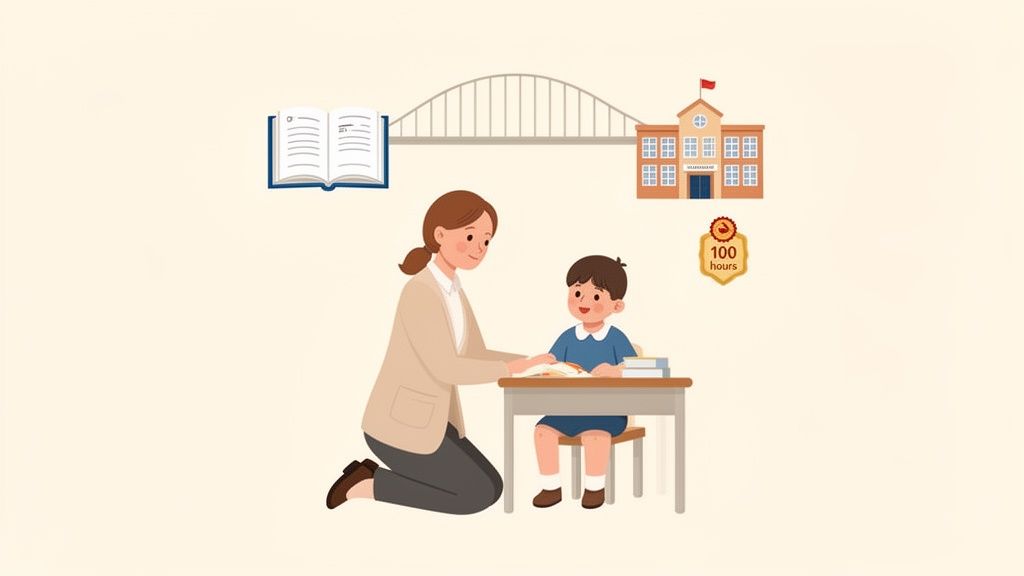
You can read all the textbooks you want, but the real magic happens when you step into an actual classroom. That’s exactly what the practical placement is for. Think of it as the vital link connecting the theory you’ve learned with the lively, unpredictable reality of a school day.
This isn’t just about ticking a box. It’s your chance to see if this career is truly the right fit, all while building confidence and skills you just can’t get from a screen or a book.
Every single nationally recognised teacher's aide course in NSW, whether it's through TAFE or another registered provider, comes with a mandatory work placement. It’s a non-negotiable part of your qualification, and for good reason. It’s where you'll put everything you've learned into practice under the guidance of seasoned professionals.
What to Expect From Your Placement
So, what does it actually involve? The standard requirement is a minimum of 100 hours spent working in an approved school. You won't just be sitting in the corner watching; you'll be right in the thick of it, actively helping out and becoming part of the classroom team.
During your placement, you’ll get a real feel for:
- Applying learning strategies: You'll be helping students with everything from reading and writing to maths, learning how to adapt your methods to suit each child.
- Supporting diverse learners: It’s a fantastic opportunity to work with students from all walks of life, including those who have different learning needs or require extra support.
- Building professional relationships: You’ll quickly learn the ropes of communicating and collaborating with teachers, other support staff, and, of course, the students.
Your placement is also where you'll see effective classroom management strategies in action and get to apply them yourself with the teacher’s support.
This placement is your professional rehearsal. It’s where you prove to yourself—and future employers—that you have the practical skills, patience, and passion to excel in this rewarding role.
Finding and Succeeding in Your Placement
The idea of finding a school might feel a bit intimidating, but you’re not on your own. Your course provider is your biggest ally here. Both TAFE and reputable online colleges have teams dedicated to helping you secure a placement, often using their existing networks of schools across NSW.
They'll guide you through the process, from how to approach a school to making sure you have all the necessary paperwork, like your Working with Children Check (WWCC).
To really make this experience count, treat it like it’s your first real job in the field. Show up ready to learn, don’t be afraid to ask questions, and take on every piece of advice your supervising teacher offers. This is the experience that will make your resume shine and give you the confidence you need to walk into your first paid role.
Where Your Qualification Can Take You
Finishing your teacher's aide course is a huge milestone, but it's really just the beginning of your journey. With a nationally recognised qualification under your belt, a whole world of rewarding career options in NSW schools opens up. You’ve put in the hard work to build the skills—now it’s time to see where they can take you.
Think of your Certificate III or IV as your key to unlocking the door to the education sector. It allows you to step straight into roles where you'll make a genuine difference in students' lives, day in and day out.
Your Immediate Career Options
Once you graduate from a TAFE or online teacher's aide course, you're ready to apply for several crucial roles within the NSW education system. These positions are consistently in demand, offering a stable and deeply fulfilling career.
You can start looking for jobs like:
- Teacher’s Assistant or Aide: This is the role most people think of. You'll be working in a mainstream classroom, right alongside the lead teacher, helping with daily lessons and activities.
- Education Support Worker: This title is a bit broader and might see you working across different year levels or providing general support wherever it’s needed in the school.
- Integration Aide (Special Needs): If you've completed a Certificate IV, you're perfectly set up for this specialised work, offering targeted, one-on-one support to students with diverse learning needs.
In NSW, an entry-level teacher's aide can expect to earn between $25 to $30 per hour. As you gain experience and confidence, your salary and responsibilities will naturally grow, giving you a solid career to build on.
A Stepping Stone to Something More
It's helpful to see your qualification not just as a final destination, but as a powerful launchpad. The real-world experience you'll get as a teacher's aide is an incredible foundation for whatever you decide to do next. Many people use their certificate as a pathway into further study and bigger career moves.
For some, this means taking on a Diploma of Education Support to step into leadership or supervisory positions within a school's support team. For others who find they have a real passion for leading a classroom, their certificate becomes the perfect entry point into a university teaching degree. That hands-on experience gives you a massive advantage, turning your first qualification into a long-term, impactful career in education.
Your Questions Answered
Starting a new course always comes with a few questions. It's completely normal to want to get all the details sorted before you dive in. We get asked a lot about the specifics of studying to become a teacher's aide, so we've put together some straight-up answers to the most common queries.
Do I Need an ATAR to Get into a Course?
Nope, not at all. You can breathe a sigh of relief because an ATAR is not needed to enrol in either the Certificate III or Certificate IV in Education Support.
Providers are much more interested in your real-world language, literacy, and numeracy skills. They just want to make sure you have the foundational abilities to handle the coursework, which is usually checked with a quick and simple skills assessment. This makes the career path open to everyone, no matter what your high school experience was like.
How Long Does an Online Teacher's Aide Course Take?
This is one of the best parts about studying online – it’s up to you! Most training providers give you a window of 12 to 24 months to get everything done, but that’s just the maximum timeframe.
Because these courses are self-paced, you're the one in the driver's seat. If you've got the time and motivation, you can power through the material and finish early. If you're juggling work, kids, and life, you can take the full time. It’s built to fit your schedule.
Is a Qualification From TAFE Different to One From an Online Provider?
As long as the provider is properly accredited, then no, there's absolutely no difference in the eyes of an employer. Both the CHC30221 and CHC40221 qualifications are nationally recognised under the Australian Qualifications Framework (AQF).
What this means for you is that a certificate from a reputable online Registered Training Organisation (RTO) carries the exact same weight as one from TAFE. It’s recognised by schools right across Australia.
Do I Really Need a Working with Children Check?
Yes, this is an absolute must-have. You will need a valid Working with Children Check (WWCC) before you can even think about starting your practical placement in a NSW school.
It’s a non-negotiable step designed to protect the safety and wellbeing of students. Don't worry about the process though; your course provider will walk you through exactly how to apply for it when you sign up.
Ready to turn your interest into a rewarding career supporting students? At Get Course, we connect you with flexible, nationally recognised teacher's aide courses from Australia's leading providers. Explore your options and find the perfect fit to enrol today at https://getcourse.com.au.
Find Your Course
Compare courses across every field we write about, and enquire in under a minute.