Start Your Career with Social Services Classes Online
Discover the top social services classes online in Australia. Learn about flexible certificates that prepare you for a rewarding community services career.
Online social services classes are practical, hands-on training programs designed to equip you with the specific skills you need to support individuals and communities across Australia. Think of them less like traditional university degrees focused on theory and more like an apprenticeship for a career in helping people.
These courses, from entry-level certificates to more advanced diplomas, are all about real-world application, getting you job-ready for a genuinely meaningful career.
Your Toolkit for Making a Difference

The idea of working in social services can seem a bit daunting, but online courses break the journey down into clear, skill-based steps. Instead of just reading textbooks, you're actively building a practical toolkit you can use to make a tangible impact on people's lives.
Each unit of study is like adding a new tool to your kit. One module might teach you active listening and empathetic communication - the absolute bedrock for building trust with anyone you're supporting. Another unit might focus on case management, showing you the ropes of assessing someone's needs, developing a support plan, and connecting them to the right local services.
These programs are built from the ground up to give you the skills Australian employers are looking for right now. The emphasis is always on putting what you learn into practice, so you can walk into a support role feeling capable and confident from day one.
Understanding Qualification Levels
Social services classes aren't a one-size-fits-all deal. They’re structured in tiers, with each qualification level acting as a stepping stone to different roles and responsibilities. This lets you enter the field at a comfortable level and then build on your expertise as you go.
- Certificate III: This is the most common starting point. It's perfect for entry-level roles where you'll be providing direct support to clients while working under supervision. You’ll build foundational skills in communication and ethical practice.
- Certificate IV: A Cert IV takes your skills up a notch. It prepares you for roles with a bit more responsibility, like coordinating community activities or working with specific groups, such as young people or older Australians.
- Diploma: This is your pathway to more complex work like case management, program coordination, or even leading a small team. Diploma-level studies dive deep into topics like client advocacy, developing new services, and navigating challenging situations.
For a closer look at what each level involves, check out this great overview of community services courses online available in Australia.
The Advantage of Online Learning
The 'online' part of the equation is what makes this career path so accessible for so many people. It removes the old barriers to getting qualified, offering a flexible way to earn a nationally recognised qualification without upending your life.
Online study gives you the freedom to fit your learning around everything else you have going on - work, family, or other commitments. You can study from anywhere in Australia, whether you're in a capital city or a regional town, all without having to commute to a campus.
This flexibility is a game-changer for career changers, parents re-entering the workforce, or anyone who doesn't live near a TAFE or college. It puts a stable, rewarding career within reach, empowering you to start making a difference in your community, on your terms.
Choosing Your Social Services Qualification
Deciding to jump into social services classes online is a fantastic first move. The next, and most important, step is figuring out which qualification is the right fit for your career goals. In Australia, community services courses are designed like a clear pathway, letting you start at a level that matches your current experience and build up from there.
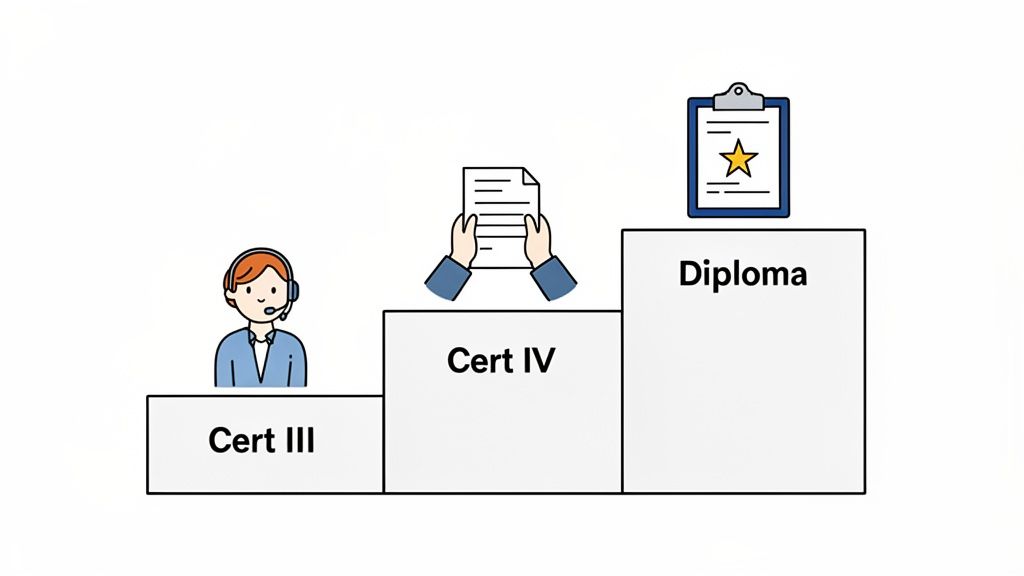
Think of it like an apprenticeship. You don’t start day one running the whole show. You begin with the essential skills, get some hands-on experience, and gradually take on more complex tasks and responsibility as your confidence and knowledge grow.
Each qualification level - Certificate III, Certificate IV, and Diploma - is a stepping stone. They each prepare you for different roles and levels of responsibility within the sector. Let’s break them down so you can see exactly where you fit in.
Certificate III: The Ideal Starting Point
The Certificate III in Community Services is your gateway into the field. It’s perfect if you’re new to the industry or have limited experience and want to build a solid foundation of essential, practical skills for direct support roles.
This qualification gets straight to the core principles. You’ll learn how to communicate effectively and respectfully with clients, work within the proper legal and ethical frameworks, and how to spot and respond to a crisis. Once you’ve completed it, you'll be ready for jobs where you provide that vital day-to-day assistance to clients, all while being guided by more senior professionals.
Common job outcomes include:
- Community Care Worker: Helping clients with their daily living activities.
- Residential Support Worker: Providing support in group homes or other residential facilities.
- Intake and Referral Officer: Being the first point of contact for people reaching out for help.
Certificate IV: Building Specialised Skills
Ready to take on a bit more? A Certificate IV in Community Services is the natural next step. It’s a great choice for those who already have some experience on the ground or have finished a Certificate III and are keen to deepen their expertise.
A Cert IV takes you beyond the basics and into more complex territory. You might focus on coordinating services for individuals, working with specific groups like at-risk youth or people with disabilities, or learning how to advocate for your clients. It really gives you the skills to work more independently and start contributing to case management.
Graduates are well-suited for roles such as:
- Case Worker (entry-level): Managing a small caseload under supervision.
- Youth Worker: Supporting young people as they navigate different challenges.
- Family Support Worker: Providing crucial assistance to families in need.
Diploma of Community Services: Pathway to Leadership
The Diploma of Community Services is designed for the future leaders, case managers, and program coordinators of the sector. This is where you really shift from direct, hands-on support to managing and overseeing how services are delivered. If you're aiming for a senior role, this advanced training is non-negotiable, and it’s worth exploring what a Diploma of Community Services online truly involves to see if it aligns with your ambitions.
Here, the focus is all about strategic thinking and high-level skills. You’ll learn how to develop and roll out service programs, manage complex cases, lead and mentor other staff, and make sure your services are hitting the mark on quality and community needs. It's the key that unlocks roles with real autonomy and decision-making power.
Thanks to flexible online learning, getting qualified has never been more achievable. Community services courses in Australia now frequently offer part-time and self-paced options. A Certificate III can often be done in 6–12 months, a Certificate IV in around 9–12 months, and a Diploma typically takes 12–18 months. And while a university degree like a Bachelor of Social Work is a bigger commitment, TAFE-level qualifications are now far more affordable, with some providers offering payment plans from as little as $28 per week.
Comparing Units in Online Social Services Courses
As you move up the qualification ladder, the skills and knowledge you gain become more specialised and strategic. The table below gives you a snapshot of the types of units you’ll encounter at each level and how the focus shifts from foundational skills to management and leadership.
Ultimately, choosing the right starting point is about honestly assessing your current skills and knowing where you want to go. Each qualification builds on the last, creating a clear and rewarding career path in a sector where you can make a genuine difference.
Is a Career in Social Services Right for You?
Choosing to study social services online usually comes from a place deep inside you, a feeling that you want your work to mean something more. It's more than just a career change; it's a calling. Before you jump in, it’s worth taking a moment to see if your own personal drive and natural traits are a good match for the realities of this unique field.
A career in social services is a real commitment to walking alongside people through some of their toughest times. This demands a certain kind of person, with qualities you can’t always learn from a textbook. Let’s look at a few common profiles of people who really thrive in this sector.
The Career Changer
Do you find yourself staring at a spreadsheet in your corporate job, feeling a bit empty? Maybe you’re in retail, and you know you have more to give than just hitting sales targets. This is a classic story for 'The Career Changer,' someone who feels a growing gap between what they do every day and what they actually value.
They’re looking for work with genuine purpose, a way to make a real, tangible difference in the community. Often, they bring fantastic organisational and communication skills from their previous careers but want to use them to help people, not just drive profits. If you’re searching for work that truly speaks to your heart, community services could be exactly what you’re looking for.
The Empathetic School Leaver
Are you the one all your friends come to when they need to talk? Do you just naturally find yourself wanting to help people figure things out? 'The Empathetic School Leaver' is someone with a built-in ability to listen, understand, and support others without passing judgment.
They might not have a long CV, but their natural empathy and intuition are gold in the social services world. They’re often fired up about social justice issues and are ready to take their innate caring nature and shape it into a professional skill set. These are the people who seem born to help.
A career in social services is built on far more than just good intentions. It demands a powerful mix of empathy, resilience, brilliant communication skills, and a rock-solid commitment to fairness. These qualities are the very foundation of professional practice.
The Upskilling Professional
Perhaps you’re already working in a related area, like in admin at a health clinic or as a teacher's aide. 'The Upskilling Professional' sees the incredible impact support workers have and feels pulled towards a more hands-on role. They're ready to step from the background onto the frontline of client care.
This person already has valuable industry insight but wants to use it in a more direct, meaningful way. They get the systems, but now they want to be the one building relationships and guiding individuals through them. For them, enrolling in social services classes online is a smart, strategic move towards a role that offers far more personal and professional reward.
No matter which of these sounds most like you, the common thread is a powerful desire to help others. This work isn't always easy - it will test you. It requires resilience to navigate tough situations and the skill to connect with people from every walk of life. If these stories feel familiar, you might just have found your calling.
Career Pathways in the Community Services Sector
Finishing your social services classes online is your entry ticket into one of Australia's most stable and rapidly growing fields. This isn't just an industry with jobs; it's a sector with real, long-term security, fuelled by community needs that are only getting bigger. When you put your energy into a nationally recognised qualification, you're setting yourself up to walk straight into a career that's both meaningful and in high demand.
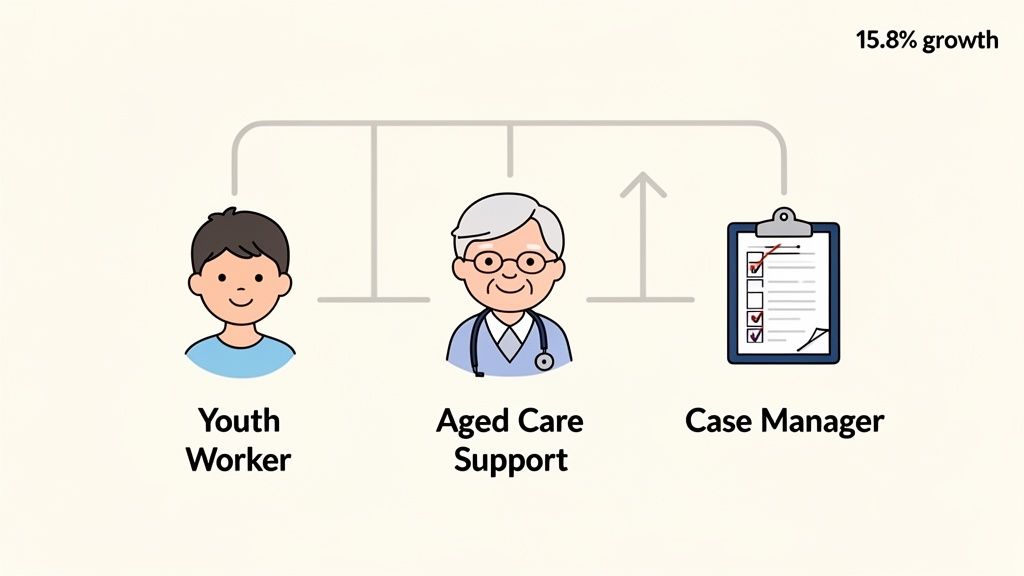
The need for skilled community services professionals is skyrocketing. In fact, projections show the Community Services and Case Management industry is on track for a massive 15.8% market expansion over the next five years.
This isn't just a number - it translates to thousands of new jobs, with an estimated 88,500 professionals needed by 2026. This huge demand is driven by Australia’s ageing population and a much-needed greater focus on mental health and social support. It's a solid, rewarding field to build a career in.
So, what does this look like in the real world? Let’s take a peek at what a day in the life is like for some of the roles you could step into.
A Day in the Life of a Youth Worker
As a Youth Worker, predictable days are a rarity. Your morning might kick off at a local youth centre, where you’re organising activities and making sure it’s a safe, welcoming space for young people to hang out. A bit later, you could be sitting down one-on-one with a teenager, helping them figure out tricky stuff like finding a place to live, applying for a job, or sorting out family problems.
You're part mentor, part advocate, and a huge part of their support system. An afternoon could be spent running a workshop on building resilience or teaming up with local schools to help out at-risk students. It's dynamic, hands-on work focused on one thing: empowering young people to build a better future for themselves.
The heart of community services work is all about putting theory into practice. What you learn in your online studies - things like client advocacy, communication, and case management - are the exact skills you'll use every day to support vulnerable people and families.
Working as an Aged Care Support Worker
Being an Aged Care Support Worker is about providing compassionate, practical care that helps older Australians live with independence and dignity. Your day might start with a visit to a client’s home, where you’ll help with daily tasks like preparing meals, personal care, and a bit of tidying up. Just as importantly, you're there for a chat and a bit of companionship, which can make all the difference.
If you’re based in a residential facility, your role could involve getting residents involved in social activities, helping them with mobility, and keeping an eye on their general wellbeing. This career is built on a foundation of patience, empathy, and a real desire to support the elderly with the respect they deserve. You see the positive impact of your work right away, every single day.
The Role of a Case Manager
Stepping into a Case Manager role, which often comes after finishing a Diploma, means you're looking at the bigger picture of a client's needs. A typical day starts with reviewing your caseload - you might be working with people experiencing homelessness, dealing with domestic violence, or facing mental health challenges. You become the central coordinator for all their support.
A huge chunk of your time is spent on the phone or in meetings with other services, like housing authorities, Centrelink, mental health professionals, and legal aid. You’ll be assessing what your clients need, creating personalised support plans, and fighting in their corner to make sure they get the help they’re entitled to. This role demands sharp organisational skills and the ability to connect all the dots to help someone get back on their feet. To dive deeper, you can learn more about building a career in community services and the different pathways you can take.
How to Find the Best Online Social Services Course
Choosing the right online social services course is a bit like picking the right tool for a big job. The flashiest or most expensive option isn't always the best one for you. What really matters is finding a program that gives you the skills employers are looking for, supports you properly, and actually lines up with your career ambitions.
Let's be honest, navigating the world of online courses can be a headache. Every provider seems to promise the world, making it tough to know who to trust. The best way to cut through the noise is to have a solid checklist of questions ready to go. Asking these questions before you enrol is the single most important thing you can do to make sure you're investing your time and money wisely.
Is the Qualification Nationally Recognised?
This is the big one. Seriously, if you only ask one question, make it this. In Australia, our vocational education system is built on nationally recognised qualifications. This means a Certificate IV in Community Services you complete online from a provider in Perth is worth exactly the same as one from a TAFE in Brisbane.
Always look for the nationally recognised training logo or double-check that the course code is listed on the official Australian Qualifications Framework (AQF). This is your guarantee that employers across the country will respect your qualification. A course without this recognition is, frankly, just an expensive piece of paper.
What Level of Trainer Support Is Available?
Studying online shouldn't mean you're on your own. A huge part of what makes a course great is knowing you can easily get help from your trainers when you're stuck. A good training organisation makes its experts accessible.
Before you sign up, get specific about the support:
- How can I contact my trainers? You want to see a few options, like phone, email, and maybe even scheduled one-on-one video calls.
- What's the typical response time? Getting an answer within 24-48 hours is a pretty good industry standard to look for.
- Are there live workshops or tutorials? Even if they're optional, these online sessions can be a game-changer for understanding tricky topics and connecting with other students.
High-quality student support is the bridge between self-paced study and actually finishing the course. It's the difference between feeling isolated with a problem and feeling guided by an expert who genuinely wants you to succeed.
Does the Delivery Mode Suit Your Lifestyle?
The main reason people study online is for flexibility, but "online" can mean a few different things. It’s so important to find a delivery mode that works with your life, not against it.
- Self-paced learning gives you total control. You work through the material and submit assessments on your own schedule, which is perfect if you're juggling work, kids, or other commitments.
- Structured or scheduled learning involves set deadlines and sometimes compulsory live online classes. This approach is fantastic if you need that extra push to stay motivated and on track.
There’s no right or wrong answer here. It’s all about what fits you. The best program is one that blends into your life, rather than forcing you to rearrange everything for it.
How Are You Assessed?
Assessments are how you prove you've actually learned the skills. You want to see a course that uses practical, real-world assessment methods, not just endless essays or multiple-choice quizzes. Workplace-relevant tasks show you can do the job, not just talk about it.
Look for assessments like:
- Case study analysis: Where you apply what you've learned to solve a realistic client problem.
- Role-playing exercises: To practice and demonstrate your communication and support skills.
- Project-based work: Like developing a client support plan or creating a community resource guide.
These kinds of tasks build your confidence and give you concrete examples of your abilities to talk about in job interviews.
Understanding Costs and Payment Options
Finally, let's talk money. While the price tag is obviously a big deal, the cheapest course is rarely the best value. You need to look at the whole package. What's actually included in the fee? Are there hidden costs for textbooks or resubmitting an assessment?
Many reputable providers offer flexible payment plans, letting you pay in small weekly or fortnightly instalments. This can make a quality education much more achievable and lets you focus on your studies without the financial stress.
And if you’re thinking about a career in birth support, which is a wonderful field closely related to community services, you can also learn how to become a doula online through specialised courses. By asking these key questions, you can move forward confidently and choose an online social services course that will set you up for a truly rewarding career.
What Studying Social Services Online Is Really Like
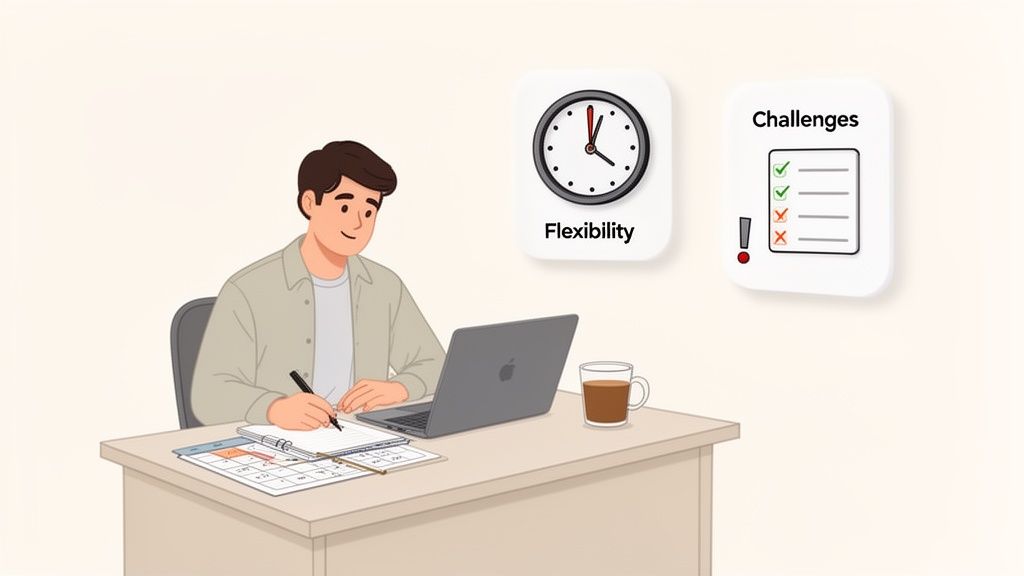
The biggest drawcard for studying social services online is, without a doubt, the flexibility. You can genuinely mould your studies around your life - whether that’s a full-time job, family responsibilities, or anything else you've got going on. Forget the daily commute; you can log in and learn from anywhere in Australia, from a city apartment to a regional farm.
But it’s important to go in with your eyes open. That freedom comes with a trade-off: you are in the driver's seat. There’s no lecturer physically there to remind you about deadlines, which means you need a solid dose of self-discipline. Staying motivated and on track is your responsibility, so being comfortable reaching out to trainers or classmates when you're stuck is a must.
Setting Yourself Up for Success
To make online study work, you have to create your own structure. Think of it as becoming the project manager of your own education. First things first, set up a dedicated study space. It doesn't have to be a whole room, but a clear, organised desk tells your brain, "Okay, it's time to focus."
Next, get real with your calendar. Don't just hope you'll find time to study; schedule it. Block out specific hours each week for lectures, readings, and assignments. This simple act of planning makes all the difference and stops you from falling into the last-minute panic trap.
And of course, a reliable internet connection is non-negotiable. If you’re in a rural area, this can be a real hurdle. It’s worth doing some research, like reading an Activ8me review for rural internet, to make sure your connection won’t drop out mid-seminar.
Thriving in the Online Environment
Doing well in an online course is about more than just good time management. It's about how you show up and engage with everything and everyone involved.
The most successful online learners are not passive recipients of information. They are active participants who take ownership of their journey, connect with peers, and treat their online course with the same commitment as an in-person class.
This is what turns a good learning experience into a great one. You’ve got the tools, so make sure you use them.
- Connect with Your Peers: Don’t be a stranger in the student forums. Post a question, share an interesting article, or just cheer someone on. It makes the whole thing feel less like you're studying alone and more like you're part of a team.
- Build a Relationship with Trainers: Your trainers are there to help you succeed, so let them. They are your best resource for clarifying confusing topics or getting feedback on a draft.
- Create a Routine: Treat your scheduled study blocks like any other important appointment. Have a clear goal for each session - like finishing a chapter or outlining an essay - to keep the momentum going.
When you embrace both the freedom and the responsibility of online learning, you walk away with more than just a piece of paper. You build incredible self-management skills that are gold in the community services sector. It’s a rewarding path that builds both your knowledge and your character.
Got Questions? We’ve Got Answers
As you think about taking social services classes online, it's completely normal for a few questions to pop up. Let's tackle some of the most common ones we hear from people just like you, so you can move forward with confidence.
Do Online Courses Really Have a Practical Work Placement?
Yes, they absolutely do – and it's a critical part of any quality, nationally recognised course. This isn't just about reading textbooks; it’s about getting real-world experience. The work placement is where you'll step out of the online classroom and into a community services organisation.
Course providers know you’ve chosen online study for a reason, so they'll help you find a suitable placement near you. This hands-on part of your training is non-negotiable. It’s your chance to build confidence, make professional connections, and apply everything you've learned.
Think of your work placement as the bridge connecting your study to your career. It’s where all the theory comes to life, giving you the practical skills employers are looking for from day one.
Can My Previous Work Experience Count for Anything?
It sure can. In Australia, this process is called Recognition of Prior Learning (RPL). It’s a formal pathway designed to acknowledge the skills and knowledge you've already gained through relevant work in the community services sector.
If you have a solid background, you might be able to get credit for some of the course units. To do this, you'll need to gather evidence that proves your experience. This usually looks like:
- A portfolio showing examples of your work
- Detailed references from past employers
- Old job descriptions or performance reviews
- Sometimes, a skills assessment or interview
A successful RPL application can be a game-changer, potentially shortening your study time and reducing the overall cost. It's all about getting recognised for the expertise you already bring to the table.
What Kind of Tech Do I Actually Need?
Good news – you don't need a high-tech setup or a powerful computer. The technology requirements for online study are kept pretty simple to make sure everyone can participate.
For the most part, you'll just need the basics:
- A reliable computer or laptop: As long as it can run a standard web browser, you’re good to go. It doesn't have to be the latest model.
- A steady internet connection: This is your lifeline for accessing course materials, joining discussions, and submitting work.
- Basic software: You'll likely just need a word processor like Microsoft Word or a free alternative like Google Docs for your assignments.
Your training provider will give you access to their online learning portal, which is where you’ll find everything you need. The focus is always on your learning, not on making you a tech expert.
Ready to turn your passion for helping people into a real, rewarding career? At Get Course Australia, we help you find flexible, nationally recognised social services classes online from some of Australia's best providers. Take a look at your options and find the perfect course to kickstart your journey at https://getcourse.com.au.
Find Your Course
Compare courses across every field we write about, and enquire in under a minute.