How to Start a Career in Counselling: how do i become a counsellor in australia
Become a counsellor in Australia: qualifications, study options, and registration steps. how do i become a counsellor in australia
Thinking about becoming a counsellor? It’s a career path that’s not just about earning a living; it’s about making a real, tangible difference in people's lives. But how do you actually get there in Australia? The journey involves a mix of formal education, hands-on experience, and professional accreditation. To work as a qualified counsellor, you'll need to complete a recognised course, get practical experience through a student placement, and become a member of a professional body like the Australian Counselling Association (ACA) or PACFA. This process ensures you have the skills and ethical grounding to support clients effectively.
Your Career Pathway to Becoming a Counsellor

Mapping out your journey to becoming a counsellor is an exciting first step. It's a profession that demands empathy, resilience, and a deep-seated desire to help people navigate their challenges. This guide is designed to be your roadmap, breaking down each stage into clear, manageable parts.
We'll walk you through everything, from finding the right qualification and completing your practical hours to gaining professional registration and securing your first job. Think of this as your blueprint for building a successful and rewarding career.
A Profession in High Demand
If you're considering this path, you've chosen a great time. The counselling field in Australia is booming, with a projected growth of 14.2% between 2022 and 2026. That puts it right in the top tier for employment growth across all Australian occupations.
As of 2025, there are around 33,800 counsellors working across the country, and another 4,800 new jobs are expected to open up over the next few years. This demand isn't just in one area, either—it's across schools, corporate wellness, aged care, and, of course, private practice. You can dive deeper into the workforce data in this comprehensive research report.
Key Milestones on Your Journey
The path to becoming a qualified counsellor involves several crucial stages, each one building on the last. It's more than just a qualification; it's about developing the hands-on skills, ethical framework, and professional identity needed to be a truly effective practitioner.
The path to becoming a counsellor is a marathon, not a sprint. It requires a deep investment in both your education and the relationships you build along the way, from supervisors to future colleagues.
This structured journey ensures you are fully prepared to meet the complex needs of your clients and the high standards of the profession.
Australian Counsellor Pathway at a Glance
To help you visualise the journey, the table below summarises the key stages and what they typically involve. It provides a quick snapshot of what to expect as you move from student to registered professional.
This table shows that while the initial steps have a clear timeline, the final stage—your career growth—is a continuous process of learning and refinement.
Let’s unpack these key milestones a bit more:
- Foundation and Education: It all starts here. You'll need to choose a nationally recognised qualification that meets industry standards, like a Diploma of Counselling or a Bachelor's degree.
- Practical Application: This is where theory meets reality. A mandatory student placement lets you work with real clients under professional supervision, which is an invaluable part of your training.
- Professional Recognition: Joining a professional body like the ACA or PACFA is a non-negotiable step. It shows you're committed to ethical practice and professional standards.
- Career Launch and Growth: Once qualified and registered, you'll start your job search. But the learning doesn't stop there; great counsellors are committed to ongoing professional development to keep their skills sharp.
Throughout your career, staying curious and continuing to learn is what will set you apart. You might find it useful to explore continuous learning opportunities on LinkedIn Learning to stay on top of new techniques and research. This commitment is the hallmark of a truly great counsellor.
Choosing the Right Counselling Qualification for Your Goals
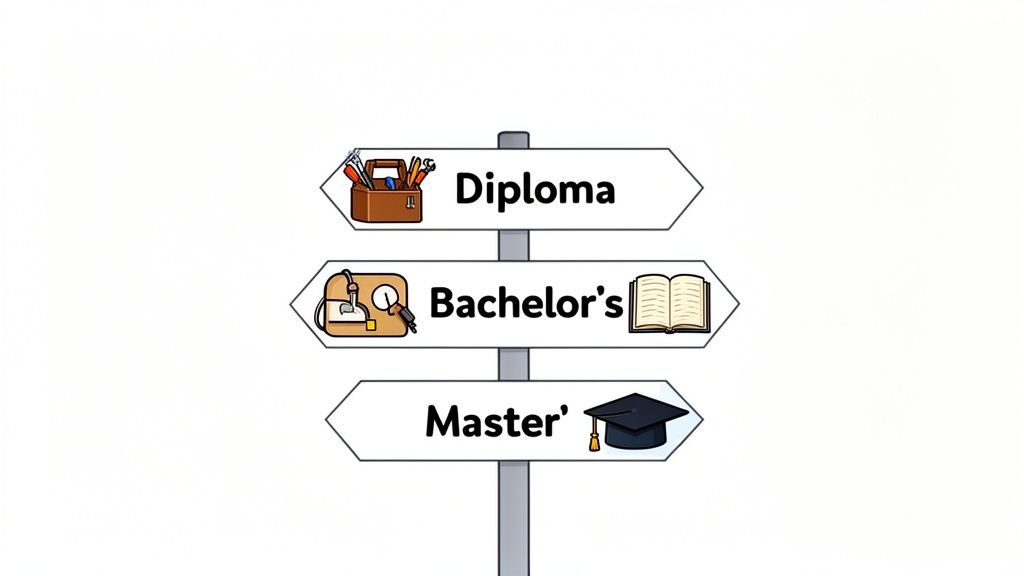
Selecting your first qualification is probably the biggest decision you'll make on the road to becoming a counsellor. This isn't just a box to tick; it's the foundation for your entire career, so it really pays to look past the course titles and understand what each path offers. In Australia, your main options are a Diploma, a Bachelor's degree, or postgraduate study like a Master's degree.
Each level opens different doors and suits different people. The right choice for a school leaver who wants a deep theoretical grounding will look very different to that of a career changer who needs a practical, efficient way into the profession.
Think about your ultimate goal. Do you see yourself providing general support in a community centre, or are you aiming for a specialty like addictions, grief, or family therapy down the line? Your starting point should align with that vision.
Diploma of Counselling: A Practical Starting Point
A Diploma of Counselling is often the quickest and most direct route into the field. These courses are intensely practical, designed to build the core, hands-on skills you'll use with clients every single day. They're perfect if you want to get started quickly and gain real-world competence from the get-go.
Let’s take Sarah, for example. She's a 40-year-old marketing manager who feels a pull towards community mental health but can't commit to a three-year university degree. A Diploma lets her earn a nationally recognised qualification in about 18 months, complete her practical placement, and become eligible for registration with the Australian Counselling Association (ACA).
Many diplomas are offered through flexible online providers, which is a huge advantage for anyone juggling work, family, or other commitments. To get a feel for what’s out there, have a look at this detailed guide to different counselling courses available in Australia.
Bachelor and Master's Degrees: The Path to Specialisation
If you’re looking for a deeper academic understanding and want to keep your career options as broad as possible, a Bachelor's degree is the traditional university pathway. Over three years, you'll dive deep into psychological theories, research methods, and human development. It's also often the non-negotiable prerequisite for any postgraduate study.
Speaking of which, postgraduate qualifications like a Master of Counselling are for those who want to become specialists or move into senior clinical roles. This level of study is essential for many psychotherapist positions and advanced practice areas. For instance, some niche fields require advanced training, and understanding the requirements for essential ERP therapy training for clinicians can show you where a Master's degree might lead.
In Australia, a university degree is a clear marker of professional commitment. The industry is heavily graduate-dominated, with a strong trend towards postgraduate qualifications for anyone serious about specialisation and career advancement.
The statistics from Jobs and Skills Australia really tell the story. A massive 38.7% of counsellors hold postgraduate qualifications—that’s more than triple the average across all other professions. On top of that, 34.2% hold a Bachelor's degree. These figures make it clear that a significant educational investment is the norm.
Comparing Australian Counselling Qualifications
Choosing your entry point can feel overwhelming. To help clarify the options, this table breaks down the common qualifications, who they're best for, and where they can lead.
Ultimately, the 'best' qualification is the one that fits your life and your career ambitions. Use this as a guide to decide which path feels right for you right now.
Aligning Your Choice with Industry Standards
No matter which level you choose, one thing is absolutely non-negotiable: your course must be recognised by a professional body like the Australian Counselling Association (ACA) or the Psychotherapy and Counselling Federation of Australia (PACFA). Membership with one of these organisations is your ticket to professional credibility and something most employers expect to see.
Before you even think about enrolling, you must check that the course meets the educational requirements for registration. This typically includes:
- A minimum duration of study specific to that qualification.
- A significant supervised work placement, usually at least 100 hours.
- A curriculum covering core areas like ethics, counselling theories, and practical skills.
This step is critical. Graduating from a non-accredited course is, unfortunately, a dead end. It can leave you unable to gain professional registration and therefore unable to practise as a qualified counsellor. Taking the time now to verify a course’s standing will save you a world of time, money, and heartache. Your qualification is your passport to a fulfilling career—choose it wisely.
Getting Your Hands Dirty: Student Placements and Real-World Experience

The theory you learn in class is the foundation, but your student placement is where the walls go up. This is the part of your training where you step out of the textbook and into the room with real people, facing real challenges. It’s a mandatory part of your qualification, and honestly, it’s often the most rewarding (and nerve-wracking!) part of the entire journey.
Successfully finding and navigating your placement is a massive milestone. It’s your first proper taste of clinical practice and the moment you truly start building your professional identity as a counsellor.
Finding a Placement That Fits You
The first challenge is finding an organisation to take you on. While your course provider will have a list of partners, I can't stress this enough: be proactive. Don't just sit back and wait for an assignment. The best placements are often the ones you seek out yourself because they genuinely connect with your passions.
Think about what really interests you. Do you feel a pull towards working with young people, families, or perhaps in addiction support or aged care? Having a clear focus helps you target your search and shows organisations that you're genuinely invested.
Consider looking into:
- Community Health Centres: Great for broad exposure to a really diverse mix of clients and issues.
- Non-Profit Organisations: Groups like Relationships Australia, Lifeline, or smaller, local charities can offer incredible, value-driven experiences.
- School and University Wellness Centres: An obvious choice if you’re keen on working with adolescents or young adults.
- Private Practices: Some larger clinics will bring on students, which offers a fantastic look into that side of the industry under very close supervision.
When you reach out, make it personal. A generic email won’t cut it. Tailor your cover letter to show you understand what that specific organisation does and why you feel a connection to the people they support.
Making Your Application and Interview Count
Good placements can be competitive. You need to show them you’re more than just a student trying to tick a box—you're a developing professional who is ready to learn and contribute.
Think about your transferable skills. Don't have direct counselling experience yet? That's okay. Your background in customer service, HR, teaching, or even retail has given you skills in communication, problem-solving, and empathy. Highlight them!
Remember, your placement interview isn't a test to see if you have all the answers. It’s about showing your self-awareness, your willingness to take on feedback, and that you have a firm grasp of ethical boundaries. They want to know you're teachable and, most importantly, safe to work with clients.
Be ready to talk about why you want to be a counsellor, what you do to manage your own stress, and what you’re hoping to gain from the placement. Knowing your own goals makes a very strong impression.
How to Thrive, Not Just Survive, Your Placement
Once you’ve got your foot in the door, the real learning begins. This is an active experience, not a passive one. Your mission is to soak up everything you can and apply your knowledge with the safety net of an experienced supervisor.
To get the most out of your time:
- Lean on Your Supervisor: Your supervisor is your single most important resource. Show up to your sessions prepared. Bring questions, reflect on your client work, and be honest about where you feel stuck or uncertain. Supervision is the safe space to be vulnerable and grow.
- Keep a Reflective Journal: After your sessions, jot down your thoughts. What went well? What was a struggle? What did you learn about your client, and just as importantly, what did you learn about yourself? This practice is crucial for building self-awareness.
- Network with the Team: Get to know the other counsellors and staff. These professional relationships provide priceless insights and can sometimes even lead to a job down the track.
- Look After Yourself: You're going to hear some tough stories. Prioritising your own wellbeing isn't a "nice-to-have"—it's an ethical must. You can't be fully present for your clients if you're running on empty.
The practical skills you pick up here are invaluable. Completing a placement as part of a nationally recognised Diploma in Counselling is what ultimately makes you an employable graduate. It’s where you finally learn the art of counselling, not just the science.
Getting Registered and Meeting Industry Standards
With your qualification in hand, you’re ready for the next big step: professional registration. It’s a common misconception that registration is a legal must-have for counsellors in Australia, the way it is for doctors or psychologists. While our industry is self-regulated, getting registered is the universal benchmark for professional, ethical practice.
Think of it as your seal of approval. Being a member of a recognised professional body signals to clients and employers that you're properly qualified, follow a strict code of ethics, and are dedicated to keeping your skills sharp. Honestly, trying to find a job or get professional indemnity insurance without it is a real uphill battle.
The Two Big Players: ACA and PACFA
In Australia, you’ll hear two names come up again and again: the Australian Counselling Association (ACA) and the Psychotherapy and Counselling Federation of Australia (PACFA). They are the two main peak bodies for counsellors and psychotherapists. While both are highly regarded, they have slightly different entry points and membership structures.
The path you take often depends on the qualification you’ve completed, which is why it's so important to check this before you even enrol in a course. As a general rule, many Diploma-level qualifications are aligned with ACA membership, whereas degree-level studies are often recognised by both organisations.
- Australian Counselling Association (ACA): The ACA offers a tiered membership, so you can join as a student and move up the ranks as you gain more experience and qualifications. They are also a powerful voice in advocating for the profession.
- Psychotherapy and Counselling Federation of Australia (PACFA): PACFA represents a huge range of practitioners. Their standards for registration are particularly high—often requiring a Bachelor's degree or higher—and they maintain a public list of qualified counsellors you can search.
No matter which one you join, you'll need to meet specific criteria for your training, supervised practice hours, and ongoing professional development.
What's the Deal with Supervision?
Supervision is the absolute cornerstone of good counselling, and it's not just something you do while you're studying. It’s a career-long commitment. Don’t think of it as a manager breathing down your neck; it's a supportive and collaborative process designed to help you grow.
You'll meet regularly with a more experienced counsellor to discuss your client work confidentially. It’s an invaluable space to:
- Reflect on your work: You get to unpack your techniques, your gut feelings, and your reactions to client stories.
- Uphold ethical practice: Your supervisor is your sounding board, helping you navigate those tricky ethical grey areas.
- Prevent burnout: This work can be emotionally demanding. Supervision is a non-negotiable part of staying resilient and healthy.
For new graduates, the supervision requirements are naturally more intensive. For example, the ACA requires new members to log 1.5 hours of supervision for every 20 hours they spend with clients during their first two years. It's a critical investment in both your competence and your own wellbeing.
Your Learning Never Really Ends: Continuing Professional Development
Graduation isn’t the finish line. The world of counselling is always changing, with new research and therapeutic models emerging all the time. Staying effective and ethical means committing to being a lifelong learner.
This commitment is formalised through Continuing Professional Development (CPD). Both the ACA and PACFA require members to complete and log a certain number of CPD hours each year.
Don't see CPD as a box-ticking exercise. See it as your license to stay curious and fired up about what you do. It’s how you’ll deepen your expertise, pick up new skills, and ultimately, give your clients the very best support possible.
CPD can come in all shapes and sizes, including things like:
- Attending specialist workshops and seminars
- Taking short courses or even another qualification
- Keeping up with industry journals
- Joining a peer supervision or learning group
Meeting these standards—for registration, supervision, and ongoing development—is what truly defines you as a professional counsellor. It's your public promise of excellence and the foundation for building a career you can be proud of.
Launching Your Counselling Career and Salary Insights

You’ve done the hard yards—you've got the qualification and your professional registration is sorted. Now, you’re standing at the starting line of your new career, ready to put all that theory and training into practice.
The great thing about counselling is that your career path doesn't have to be a straight line. Many dream of building a private practice from scratch, shaping a service that truly reflects their personal and professional values. Others find their calling within established organisations, bringing their skills to a school, hospital, community health centre, or even a corporate wellness program. The options are broad and genuinely exciting.
Crafting a Standout Resume
Your first resume as a qualified counsellor needs to tell a compelling story. It’s not just a list of what you’ve studied; it’s proof that you're ready to make a real-world impact. This is where your student placement becomes your greatest asset.
Don't just mention it—showcase it. Instead of a generic line like "counselled clients," get specific. Try something like, "Provided person-centred counselling to a diverse caseload of 15 clients, addressing issues such as anxiety, grief, and relationship challenges." This immediately demonstrates tangible, hands-on experience.
To really make your resume shine, make sure you highlight:
- Specific skills you honed during placement (e.g., risk assessment, SOAP note-taking, collaborative treatment planning).
- Client demographics you gained experience with (e.g., adolescents, couples, older adults, culturally diverse backgrounds).
- Supervision hours completed, as this signals a strong commitment to ethical and reflective practice.
Understanding Your Earning Potential
Alright, let's talk numbers. It’s one of the most practical questions every new graduate has: what can you actually expect to earn? While counselling salaries in Australia vary, the overall outlook is really encouraging.
According to Jobs and Skills Australia, the median weekly income for counsellors is $1,477, which works out to about $76,804 a year. However, broader industry data paints an even brighter picture, showing an average gross salary somewhere in the $86,000–$96,000 range annually.
As a new graduate, your starting salary will likely fall between $63,000–$85,000. With a few years of experience under your belt, senior counsellors can command salaries upwards of $108,000.
Your starting salary is just that—a starting point. With experience, specialisation, and a commitment to ongoing professional development, your earning potential will grow significantly throughout your career.
Factors That Influence Your Salary
Three key variables will shape your income as a counsellor in Australia. Getting your head around these can help you make strategic moves as your career unfolds.
1. Location
It’s no surprise that where you work matters. Salaries often reflect the cost of living and local demand, so counsellors in major hubs like Sydney and Melbourne may earn more than those in regional towns. That said, some roles in remote or underserved communities can come with attractive incentives.
2. Qualifications and Specialisation
Your level of education has a direct impact on your pay packet. A counsellor with a Master's degree and a specialisation in a high-demand area like trauma or family therapy can usually negotiate a higher salary than a generalist practitioner with a diploma.
3. Type of Employment
Private practice often offers the highest earning potential, but it also comes with the overheads and hustle of running a business. Government sector roles in schools or public health tend to provide stable salaries and great benefits. Meanwhile, positions in non-profit organisations might offer slightly lower pay but deliver immense job satisfaction and purpose.
For a deeper dive into building your professional life, check out our guide on how to have a successful career in counselling.
Your Top Questions About Becoming a Counsellor
Thinking about a career as personal and important as counselling naturally brings up a lot of questions. It's smart to want a clear picture of the path ahead before you dive in. Let's tackle some of the most common queries we hear from aspiring counsellors, so you can move forward with real confidence.
We'll get into the nitty-gritty of study timelines, whether online qualifications hold up, and the crucial differences between counselling and other mental health roles. Consider this your go-to guide for clearing up any doubts about your future in this field.
How Long Does It Take to Become a Counsellor?
This is usually the first thing people ask, and the honest answer is: it depends on the path you take and how it fits with your life. There’s no single timeline for becoming a counsellor in Australia.
For many, a Diploma of Counselling is the most direct route into the profession. If you’re studying full-time, you can often wrap this up in about 12 to 18 months. It's a very practical, skills-first qualification, which is why it’s such a popular choice for people changing careers or those who want to get started without delay.
If you’re looking for a deeper theoretical dive, a Bachelor of Counselling is the more traditional university option, typically taking three years of full-time study. Already have a degree? A Graduate Diploma or Master of Counselling could be perfect, usually taking around two years to complete.
The best part about studying today is the sheer flexibility on offer. So many providers have self-paced online courses, which means you can fit your learning around your job, family, or whatever else you have going on. It might stretch out the timeline a bit, but it makes becoming a counsellor a realistic goal for so many more people.
Can I Get Qualified by Studying Entirely Online?
Absolutely. You can definitely become a qualified counsellor through a course studied mostly online. Many of Australia's best, nationally recognised qualifications are delivered this way because it offers the flexibility that working adults need. The real test of a course isn’t how it's delivered, but its accreditation and what it covers.
The most important thing is to make sure your course is recognised by a professional body like the Australian Counselling Association (ACA) or PACFA. This is your assurance that the qualification meets the high standards needed for you to register as a professional counsellor.
One thing to remember: a quality online course will always have a mandatory, face-to-face work placement. This is non-negotiable. You can learn theory and ethics from your kitchen table, but you can only build hands-on counselling skills by working with real people under professional supervision. This blended learning model truly gives you the best of both worlds.
Counselling vs. Psychology: What’s the Difference?
This is a really common point of confusion, but the lines between counsellors, psychotherapists, and psychologists become much clearer when you look at their training and what they do day-to-day. They all support mental wellbeing, but their roles and qualifications are quite different.
- Psychologists have a legally protected title and must complete a minimum of six years of university study to be registered with the Psychology Board of Australia. They are trained to diagnose and treat complex mental health conditions.
- Counsellors and Psychotherapists both use 'talk therapies' to help people. They create a space for clients to explore their feelings, work through life’s challenges, and build better coping skills.
- Counsellors often enter the field with a diploma or bachelor's degree.
- Psychotherapists tend to have more specialised, postgraduate training that focuses on deeper, long-term emotional and personality patterns.
Because the title "counsellor" isn't legally protected like "psychologist" is, being a member of a professional body like the ACA or PACFA is non-negotiable. It’s the clearest way to show the public that you’re a credible, ethical, and qualified professional.
What Personal Qualities Make a Good Counsellor?
Your qualification gives you the tools, but your personal qualities are what truly make you a great counsellor. These are the traits that build the trust and safety a client needs to open up and begin to heal.
At the heart of it all is genuine empathy – the ability to truly step into someone else’s shoes and understand their feelings without judgment. This goes hand-in-hand with exceptional listening skills, where you’re hearing not just the words but the emotions and meanings underneath.
Other key traits include:
- Patience: Understanding that healing isn't linear and giving clients the time they need.
- Resilience: The strength to sit with difficult stories while looking after your own emotional health.
- Self-Awareness: Knowing your own biases and values, and making sure they don't get in the way of your client's progress.
If you are a naturally compassionate person who loves to communicate and feels a real pull to help others navigate their lives, then you likely have the foundation for a deeply rewarding career in counselling.
Ready to explore courses that fit your life? At Get Course, we connect you with flexible, nationally recognised online qualifications from Australia's top providers. Find your path and start your journey by visiting Get Course Australia.
Find Your Course
Compare courses across every field we write about, and enquire in under a minute.