Guide: qualifications required to be a social worker
Discover the qualifications required to be a social worker, how to qualify, education options, and practical career tips.
So, you're thinking about a career in social work in Australia? It's a field built on empathy and a genuine desire to help people navigate some of life's toughest challenges. But before you can make that difference, there's a clear pathway of qualifications you'll need to follow.
Let's break down exactly what that journey looks like.
Your Roadmap to a Career in Social Work
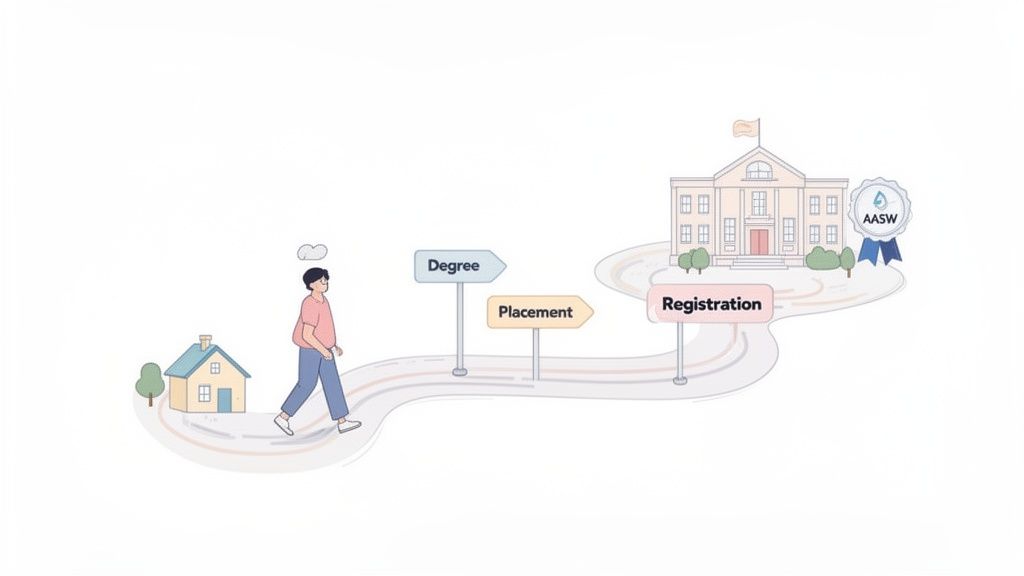
The first thing to know is that becoming a qualified social worker in Australia isn't just about good intentions. It requires a specific university degree, one that’s been given the green light by the Australian Association of Social Workers (AASW). Think of this accreditation as the national benchmark for quality—it's your key to unlocking professional roles and assures employers you have the right skills and ethical grounding.
This guide will walk you through each step, from picking the right degree to getting your final clearances, so you know exactly what to expect.
Core Pillars of Your Social Work Journey
Your path to becoming a practising social worker is built on a few non-negotiable milestones. These are designed to make sure you're not just academically prepared, but also ready for the real-world complexities of the job.
Here are the fundamental building blocks of your career:
- An Accredited University Degree: You’ll need to complete either a Bachelor of Social Work (BSW) or a Master of Social Work (MSW) from a university recognised by the AASW.
- Supervised Field Placements: Getting your hands dirty is essential. The degree includes a minimum of 1,000 hours of practical, on-the-job experience under the guidance of a professional supervisor.
- Crucial Background Checks: You must be able to pass a National Police Check and a Working with Children Check. This is standard practice and an absolute must.
- Professional Association Membership: Joining the AASW isn't just a good idea; it connects you to resources, signals your professional commitment, and keeps you in the loop with industry standards.
The demand for skilled social workers is growing fast. Projections show a massive 23.2% increase in jobs over the next five years. To meet this need, the profession holds itself to high standards—a huge 81.7% of social workers have a bachelor's degree or higher. This ensures you’re fully equipped to support people in all sorts of settings, from family support services to helping NDIS participants.
A big part of the job also involves understanding the breadth of care services available so you can connect people with the right support systems. This guide is here to clarify every part of that process, helping you move forward with total confidence.
Choosing Your Accredited Social Work Degree
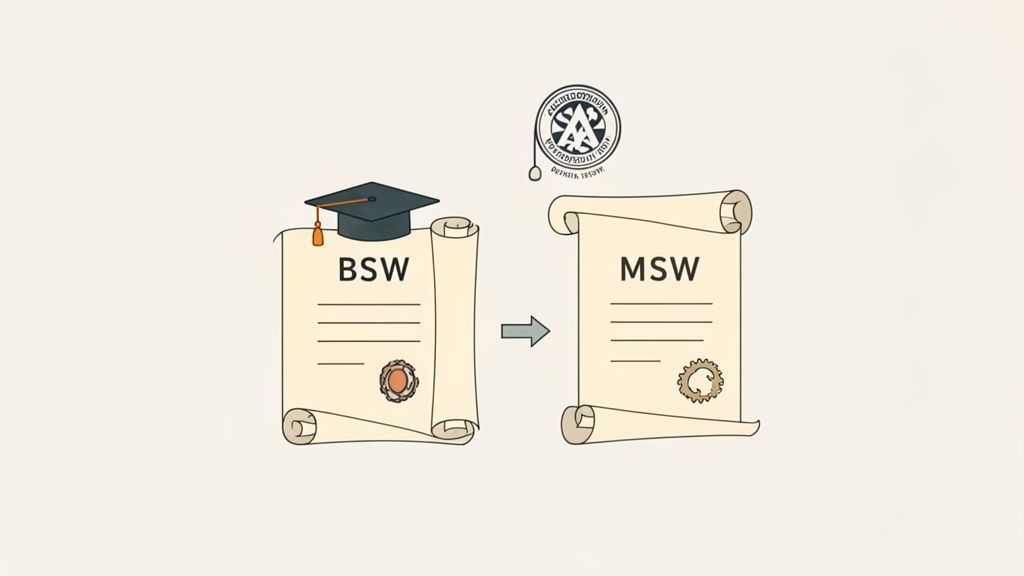
The first and most critical step on your journey to becoming a social worker in Australia is securing an accredited university degree. This isn't just a box to tick; it's the bedrock of your entire career. It equips you with the ethical grounding, theoretical knowledge, and practical skills needed to support vulnerable people and communities.
The Australian Association of Social Workers (AASW) is the national body that sets the standard. Think of their accreditation as a seal of approval—a guarantee to employers and clients that your education has met rigorous benchmarks for professional practice.
This high standard is the norm across the industry. Data from Jobs and Skills Australia shows that 51.5% of practising social workers hold a Bachelor degree, while another 30.2% have a postgraduate qualification. That means over 81.7% of the profession is university-educated, making it the clear pathway to entry.
The Bachelor of Social Work (BSW)
For most people, the Bachelor of Social Work (BSW) is the traditional starting point. It's a dedicated four-year undergraduate program perfect for those fresh out of secondary school or anyone without a previous university degree.
Think of the BSW as building a house from the ground up. You’ll start with the foundations—sociology, psychology, and social policy—before moving on to specialised social work theories, intervention skills, and ethical decision-making. It’s a comprehensive path designed to turn you into a fully prepared, practice-ready graduate.
The Master of Social Work (MSW)
But what if you already have a degree in another field, like psychology, sociology, or even the arts? That’s where the Master of Social Work (Qualifying), or MSW, comes in. This is an intensive postgraduate program, typically taking two years, that builds on your existing degree.
It’s less like building from scratch and more like an expert renovation. You already have the solid structure of an undergraduate education; the MSW adds the specialised social work 'rooms' and 'fittings'. This is a brilliant route for career-changers, allowing you to pivot into social work without having to start another four-year degree from the beginning.
Comparing University Pathways to Become a Social Worker
Choosing between these two accredited degrees really comes down to your personal academic background and career plans. This table breaks down the key differences to help you see which path aligns with your situation.
Ultimately, both the BSW and the MSW will get you where you want to go—a career where you can make a real, tangible difference. The right choice is the one that best fits your life and your learning journey.
Critical First Step: Verify Your Course Accreditation
Before you even think about enrolling, your absolute first move must be to check that the course is accredited by the AASW. An unaccredited degree, no matter how appealing, simply won't qualify you to practise as a social worker in Australia. Always cross-reference your options with the official AASW list of accredited courses.
To get a better feel for what's out there, it’s a good idea to explore the range of social worker courses online to see which study mode and institution might be the right fit for you.
Building Foundational Skills in Community Services
So, you want to be a social worker, but a four-year university degree feels like a huge mountain to climb right now? That's completely understandable. The good news is, there's another way to start making a real difference in the community, and it doesn't require diving straight into a long degree.
Vocational Education and Training (VET) qualifications are a fantastic, practical starting point. Think of a Certificate IV or a Diploma in Community Services as laying the groundwork. You’re building the strong, practical foundation you'll need before you start adding the specialist knowledge a university degree provides. These courses are designed to give you job-ready skills to step directly into vital support roles.
Understanding Paraprofessional Roles
It's really important to get this distinction clear: a VET qualification won't make you a social worker, but it will qualify you for incredibly important paraprofessional roles. These are the people on the front lines, the absolute backbone of the community services sector. They work shoulder-to-shoulder with social workers and other health professionals every day.
With a diploma or certificate, you could find yourself working as a:
- Community Support Worker: Helping people with their day-to-day lives, connecting them with services, and cheering them on as they work towards their goals.
- Casework Assistant: Supporting a case manager with the nuts and bolts of client care—from paperwork to coordinating appointments.
- Youth Worker: Being a trusted guide and advocate for young people navigating life's challenges.
- Intake Officer: The first friendly face a client sees, helping to assess what they need and pointing them in the right direction.
These jobs are where you roll up your sleeves and gain priceless, real-world experience. You get to see if this field is truly for you and start honing the skills that will set you up for a long and successful career.
These foundational roles are more than just jobs; they are an apprenticeship in empathy and practical problem-solving. You learn to connect with people, navigate complex systems, and see firsthand the challenges and triumphs that define the human services sector.
Creating a Pathway to a Social Work Degree
One of the smartest things about starting with a VET course is that it can be a direct stepping stone to university. It’s like taking a scenic route that gives you a ton of practical experience before you merge onto the main highway of a degree program.
Finishing a Diploma of Community Services, for instance, can often get you credit towards a Bachelor of Social Work. This is often called 'recognition of prior learning' (RPL), and it can genuinely shorten the time and reduce the cost of your uni degree. Many universities and VET providers have official agreements that make this transition smooth and simple. You can explore what's involved and learn more about how a Diploma of Community Services works online.
This pathway means you can start earning and making an impact much sooner, all while building a portfolio of experience that will make your future studies more meaningful. Learning how to become a community advocate at this level gives you a powerful skill set that will benefit you for your entire career, providing a grounded, practical perspective that will enrich your professional practice for years to come.
Gaining Real-World Experience Through Field Placements
Studying social work isn't just about lectures and textbooks. In fact, some of the most critical learning happens far from the classroom during your supervised field placements. This is where theory meets reality, and it's an absolutely essential part of the qualifications required to be a social worker.
Think of it like learning to drive a car. You can read the road rules and understand how the engine works, but you don't truly learn until you're behind the wheel with an instructor. Field placements are your time in the driver's seat, applying what you've learned under the watchful eye of a seasoned professional.
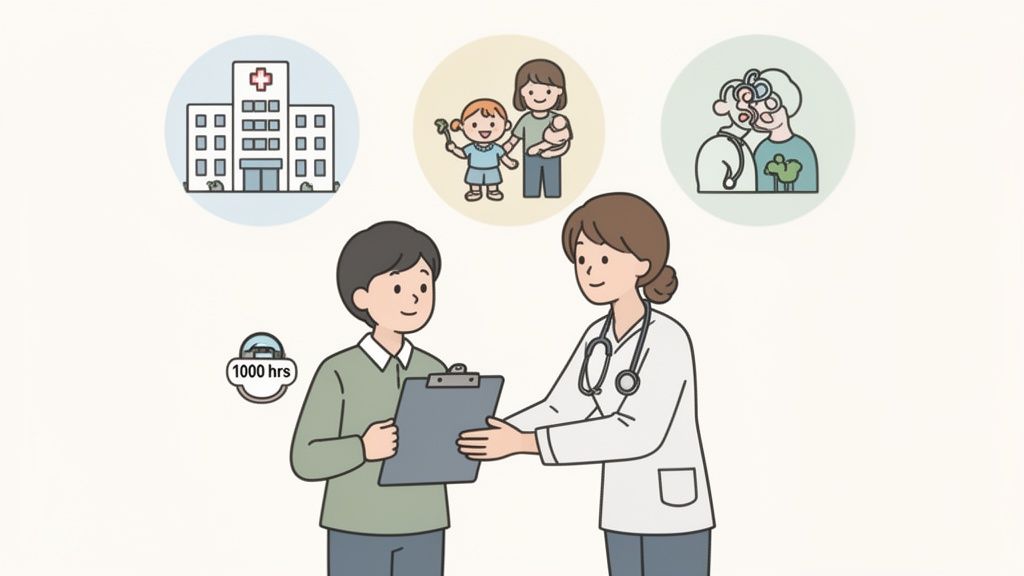
The Australian Association of Social Workers (AASW) sets the professional standard, requiring a minimum of 1,000 hours of supervised field placements in every accredited degree. This isn't just an arbitrary number; it’s designed to make sure you graduate competent, confident, and ready for the challenges of the job.
What Happens During a Field Placement?
Your placements will drop you right into a professional social work environment. This could be anywhere from a busy hospital or a community health centre to a child protection agency or a mental health service. Your uni will have a network of partner organisations and will help find a placement that fits.
Day-to-day, you'll be actively involved in real work. This usually includes:
- Direct Client Interaction: Engaging with individuals, families, and groups where you'll use your new counselling and assessment skills.
- Case Management: Learning the ropes of managing client files, creating support plans, and liaising with other services.
- Advocacy and Policy Work: You might find yourself advocating for a client’s rights or even contributing to community-level projects.
- Professional Supervision: You'll have regular meetings with your supervisor to get feedback, ask questions, and reflect on what you’re learning.
This is where you start to find your feet and build your professional identity. You’ll learn how to navigate tricky situations, work through ethical dilemmas, and build genuine rapport with clients in a structured, supported way.
A field placement is essentially your professional apprenticeship. It's an incredible chance to test-drive different areas of social work, build your network, and figure out what kind of work truly motivates you—all before you've even graduated.
The Role of Your Supervisor
Your field supervisor is one of the most important people in your training journey. They are an experienced social worker who mentors you, oversees your work, and assesses your progress. It's a supportive relationship designed to help you connect what you learned in a lecture with the messy, complex realities of people's lives.
This supervised practice is what transforms a student into a practitioner. It ensures that when you graduate, you don't just have a piece of paper—you have the practical skills and professional grounding to start making a real difference from day one.
Meeting Professional and Legal Requirements
Finishing your accredited degree is a huge milestone, but there are a few final administrative steps that truly unlock your career. These professional and legal requirements aren't just red tape; they are essential safeguards designed to protect vulnerable people and maintain the integrity of the profession.
Think of it like getting your driver's licence. You’ve passed the test (your degree and placements), but now you need to finalise the paperwork to prove you’re a safe and trustworthy professional, ready to get on the road.
Essential Background and Safety Checks
Before you set foot in a professional setting with clients, especially children or vulnerable adults, you’ll need to pass a couple of key background checks. This is standard procedure right across the community services sector and a non-negotiable part of the qualifications required to be a social worker.
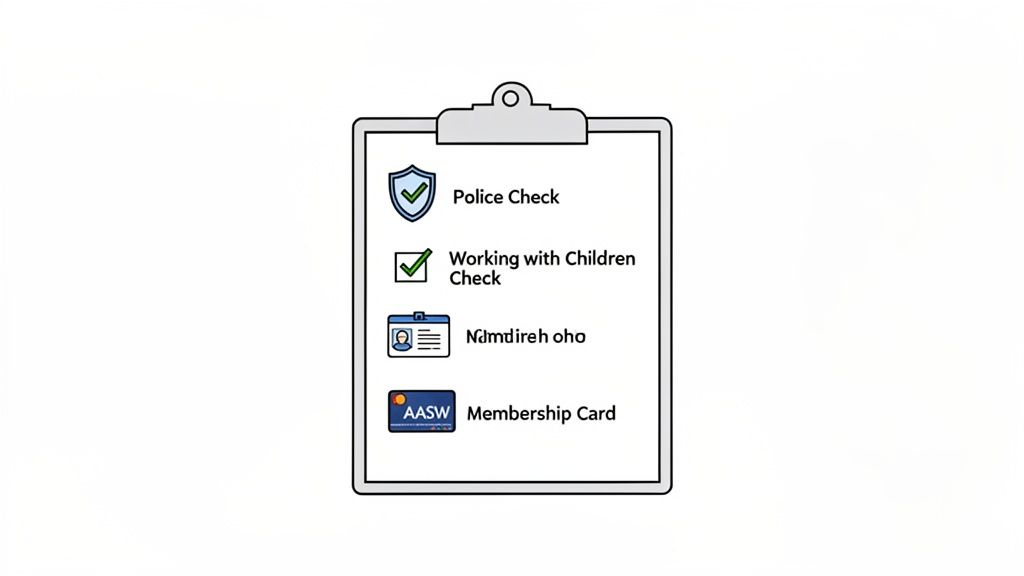
You'll almost always be asked to provide:
- A National Police Check: This confirms your criminal history and is a must-have for pretty much any job in human services.
- A Working with Children Check (WWCC): This is a more detailed check for anyone who will be working with people under the age of 18. Each state and territory has its own version of the WWCC, so you'll need to get the right one for where you plan to work.
These checks are much more than a formality. They're critical for ensuring client safety and building public trust in social workers.
The Role of the AASW Beyond Accreditation
We’ve mentioned the Australian Association of Social Workers (AASW) a lot, mainly when talking about course accreditation. A quick refresher on the accredited course meaning and explanation shows why their approval is so important. But the AASW’s role in your career goes well beyond just signing off on degrees.
Once you graduate, the AASW essentially becomes your professional home. While membership isn't legally required to practise in most parts of Australia, it's absolutely the industry standard and something employers look for.
Becoming a member of the AASW signals your commitment to the profession's code of ethics, practice standards, and continuous learning. It tells employers and clients that you are serious about upholding the highest standards of professional conduct.
Joining also gives you access to fantastic career resources, networking opportunities, and a supportive community of peers. It’s the best way to stay connected to new ideas in practice and policy, making sure your skills never get stale.
The Future of National Registration
It's also worth keeping an eye on the conversation around national registration for social workers in Australia. Right now, South Australia is the only state where registration is mandatory, but there's a strong push to create a national system.
If this goes ahead, it would make social work a legally regulated profession, much like nursing or psychology. All practising social workers would need to be registered with a national board to legally use the title and do their job. This change is all about providing greater protection for the public and standardising professional accountability across the entire country.
Got Questions About Social Work Qualifications? Let's Clear Things Up
Figuring out the exact steps to become a social worker can feel a bit overwhelming. As you start planning your career, it’s completely normal to have a bunch of questions about what qualifications you need and how it all works.
This section is all about giving you straight, simple answers to the most common queries we hear. The goal is to clear away any confusion so you can move forward with confidence.
Can I Become a Social Worker Without a Degree?
The short answer is no. In Australia, the title "social worker" is protected. It's reserved for people who have graduated with an accredited university degree—either a Bachelor of Social Work (BSW) or a Master of Social Work (MSW). This isn't just a guideline; it's a strict requirement upheld by the Australian Association of Social Workers (AASW) to maintain professional standards.
You can definitely work in really important support roles with a qualification like a Diploma of Community Services, but you can't legally or ethically call yourself a social worker without the university degree. Think of it like medicine: you can be a paramedic or a nurse's aide, but to be a "doctor," you need a specific medical degree. It's the same principle here.
How Long Does It Take to Qualify?
This really depends on where you're starting from. Here’s a quick look at the typical timeframes if you're studying full-time:
- Bachelor of Social Work (BSW): If you're coming straight from school or don't have a prior degree, this is your path. It takes four years to complete.
- Master of Social Work (MSW): This is the postgraduate route for those who already have a bachelor's degree in another field. It typically takes two years.
Both of these options include the mandatory 1,000 hours of supervised practical placements, which are woven into the course structure. Don't forget, most universities offer part-time study, which gives you more flexibility but will naturally extend these timelines.
The Bottom Line: There are no shortcuts. The time you invest in an accredited degree is what ensures the profession's high standards and truly prepares you for the challenges and complexities of the job.
Does My Previous Work Experience Count?
Absolutely! Your life and work history can be a massive advantage, even though it doesn't take the place of a formal degree. If you've spent time in community services, healthcare, or similar fields, that experience will give you a real leg up.
For one, it gives you a solid foundation and real-world context for all the theory you'll be learning in your course. Plus, some universities may offer Recognition of Prior Learning (RPL). This is especially common if you've already completed a relevant diploma. While it’s unlikely to chop years off your degree, it could get you credit for an introductory subject or two, saving you a bit of time and money. It's always worth asking the specific universities you're interested in about their RPL policies when you apply.
Can I Get My Qualification Entirely Online?
Yes, for the most part. Many Australian universities now offer accredited BSW and MSW programs online, which is a game-changer for anyone juggling work, family, or living in a regional area. You can complete all the coursework and lectures from home.
However, there's one crucial part you can't do remotely: your practical placements. The required 1,000 hours of hands-on experience must be done in person at an approved organisation, guided by a qualified social worker. The good news is that universities are very experienced in helping their online students find and arrange these placements in their own local communities. This way, you get the essential real-world training no matter how you study.
Ready to find a course that fits your life? At Get Course Australia, we connect you with flexible, nationally recognised online qualifications from leading providers across the country. Explore your options and take the next step in your career journey by visiting https://getcourse.com.au.
Find Your Course
Compare courses across every field we write about, and enquire in under a minute.