Your Guide to Social Worker Courses Online in Australia
Explore accredited social worker courses online. Compare degrees, diplomas, and certificates to start or advance your career in social work today.
If you feel a pull towards a career built on social justice and supporting people in your community, you’re in the right place. For anyone in Australia looking to change careers, return to study, or build on existing skills, the huge range of social worker courses online has made this profession more achievable than ever.
This guide is here to walk you through it all.
Begin Your Social Work Journey Online

Deciding to become a social worker isn't just a career choice; it's a real commitment to making a tangible difference in people's lives. It means showing up for individuals and families during tough times and pushing for a fairer, more equitable society for everyone.
But how do you get there, especially when you're already juggling work, family, and life? Online study has completely opened up the possibilities, offering a flexible but still academically solid pathway into this essential field. We've put this guide together to give you a clear, confident understanding of the entire process, from your first thoughts to your first day on the job.
What You Will Discover
We'll break down all the crucial steps so you feel ready for this next chapter. Together, we'll explore:
- Qualification Levels: Sorting out the difference between certificates, diplomas, and university degrees.
- Accreditation and Registration: Understanding why this is a non-negotiable part of becoming a professional social worker.
- Study Realities: A realistic look at what online learning and practical field placements actually involve.
- Career Outcomes: The incredible variety of roles and specialisations waiting for you after you graduate.
- Choosing a Provider: Practical tips for finding the course and institution that’s the right fit for you.
At its heart, social work is about working alongside people, their families, and communities to address their needs. But it's also about advocating for systemic change. It’s a profession that tackles challenges on both a personal and a societal level.
Think of this guide as your map to navigating the world of social work education in Australia. We'll help you connect your passion for helping others with the right qualification, all with the flexibility of studying from home.
For a more detailed dive into the day-to-day work, check out our comprehensive guide to becoming a social worker. Now, let's get started on building your future.
Understanding Your Online Study Options
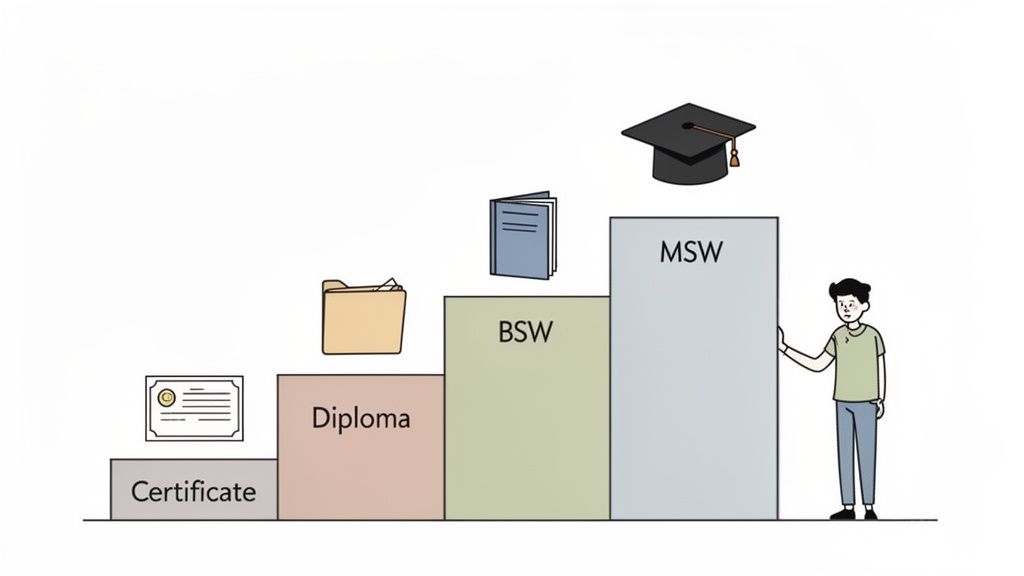
Trying to figure out which social or community work qualification is right for you can feel a bit overwhelming at first. But the good news is, it's not as complicated as it looks. The various social worker courses online are designed to be a clear ladder, letting you step on at the right rung for your current situation and climb as high as you want to go.
Think of it like building a career in nursing. You could start with a certificate to become an assistant in nursing, gaining crucial hands-on experience right away. But to be a Registered Nurse, you need that bachelor's degree. The pathway into social work is quite similar - different qualifications open doors to different jobs and levels of professional responsibility.
Foundational and Entry Level Courses
You don't always need a full university degree to make a real difference in the community sector. Many incredibly important support roles are well within reach through vocational qualifications. These are brilliant for getting your hands dirty with practical skills and seeing if the industry is the right fit for you.
These courses are a fantastic entry point and often act as a direct stepping stone into a university degree down the track.
- Certificate IV in Community Services: This is a perfect place to start if you're aiming for roles like a community support worker or welfare support worker. It gives you all the essential skills for client advocacy and support.
- Diploma of Community Services: This takes things a step further, preparing you for case management and program coordination. A diploma often gives you a direct pathway into a bachelor's degree, sometimes even with credit for what you've already learned.
Vocational courses like these build a strong, practical foundation. You can check out a huge range of community services courses online to get a feel for how they might line up with your career goals.
Professional Degrees: The Path to Becoming a Social Worker
Now, if you want to hold the official title of 'Social Worker' in Australia, you'll need to complete a university degree accredited by the Australian Association of Social Workers (AASW). This is the absolute standard that employers and the professional body recognise - it's non-negotiable.
These degrees go way beyond just foundational skills. They dive deep into social work theory, ethics, research methods, and social policy.
A professional social work degree isn't just about learning how to help. It's about understanding the complex social, economic, and political systems that shape people's lives and learning how to advocate for real, lasting change.
The two main qualifications that will get you to this professional level are the Bachelor of Social Work and the Master of Social Work. Let's break down the key pathways.
Here is a quick overview of how the different qualifications stack up, from entry-level TAFE courses to postgraduate university degrees.
Online Social Work Qualification Pathways in Australia
As you can see, the path you choose depends entirely on your end goal. While certificates and diplomas are invaluable for support roles, only a bachelor's or master's degree will allow you to practise as a registered Social Worker.
Bachelor of Social Work (BSW)
The Bachelor of Social Work (BSW) is the most common way people enter the profession straight out of school or as an undergraduate. It’s typically a four-year full-time degree that expertly blends academic theory with extensive, supervised practical placements in the field.
This qualification is considered the gold standard for starting your professional career. Once you graduate from an AASW-accredited BSW program, you are eligible to become an AASW member and can start working in all sorts of settings, from hospitals and schools to community health centres.
Master of Social Work (MSW)
The Master of Social Work (MSW) is a postgraduate degree aimed at people who've already completed a bachelor's degree in another area, like psychology, sociology, or the arts. It's an incredibly popular option for career-changers who have decided their passion lies in social work.
Usually taking two years of full-time study, an MSW (Qualifying) program packs all the essential knowledge and practical skills into a more condensed timeframe. Think of it as an accelerated pathway that gives you the exact same professional standing as a BSW, making you eligible for AASW membership when you finish. Your choice between a BSW and an MSW really just comes down to your previous education and where you are on your career journey.
Why AASW Accreditation Is Non-Negotiable
As you start exploring online social work courses, you'll come across one term again and again: AASW accreditation. This isn’t just a nice-to-have badge or a university marketing buzzword. It's the single most important factor you need to check.
Put simply, if your course doesn’t have it, your degree might be a dead end for a professional social work career in Australia.
Think of the Australian Association of Social Workers (AASW) as the official guardian of the profession’s standards. Their accreditation is a professional seal of approval, just like a law degree needs to be recognised by the Bar or a medical degree by the Australian Medical Council. It’s a rock-solid guarantee to you, employers, and the public that your course meets the highest national benchmarks for ethics, skills, and knowledge.
Choosing a non-accredited course is a huge gamble. You could pour years of hard work and thousands of dollars into a qualification that won't actually let you practise as a social worker.
The Real-World Impact of Accreditation
So, what does this actually mean for your career once you graduate? The consequences of picking a course without AASW accreditation are immediate and serious. It fundamentally shapes your entire professional path from day one.
An accredited degree is your key to unlocking professional doors. It directly affects whether you can become a member of the AASW, which is often a non-negotiable requirement for jobs in government agencies, hospitals, and major non-profits.
"AASW accreditation ensures that social work graduates have the required skills and knowledge to practise safely and ethically. It is the benchmark that employers rely on to identify qualified professionals who are ready to meet the complex needs of the community."
This formal recognition tells employers you’ve completed not just the necessary theory, but also the crucial 1,000 hours of supervised field placements required to build genuine, real-world competence.
Why Employers Prioritise Accredited Graduates
Employers in the human services sector don’t have time to second-guess a candidate's qualifications. They need a reliable, standard way to know that the person they’re hiring has been trained properly. AASW accreditation gives them that confidence.
Here’s what choosing an accredited online social work course guarantees you:
- Professional Recognition: Your degree is recognised right across Australia as the standard for professional practice.
- AASW Membership Eligibility: You can join the peak professional body, opening up access to resources, networking, and career support.
- Clear Career Pathways: It gives you a ticket to jobs that specifically call for a qualified social worker, from child protection to mental health services.
- Foundation for Registration: It’s the essential first step to becoming a Registered Social Worker, a growing standard for professional accountability.
This formal stamp of approval streamlines the hiring process for organisations and protects the public by making sure practitioners are held to high ethical standards. You can dive deeper into this topic by exploring what an accredited course means for your career and why it's such a critical part of your educational journey.
A Note on Professional Registration
While AASW membership has long been the industry gold standard, the profession is moving towards national registration for social workers. This is much like the systems already in place for nurses, psychologists, and doctors.
Registration adds another layer of public protection and professional accountability. It will mean that to legally use the title 'Social Worker', you must be registered with a national board - and the main requirement for that registration will be a degree from an AASW-accredited course.
By choosing an accredited program today, you're future-proofing your career and making sure you’ll meet the evolving standards of the profession. This one simple check - verifying a course’s AASW accreditation - is the most important step you will take.
What Online Social Work Study Really Involves
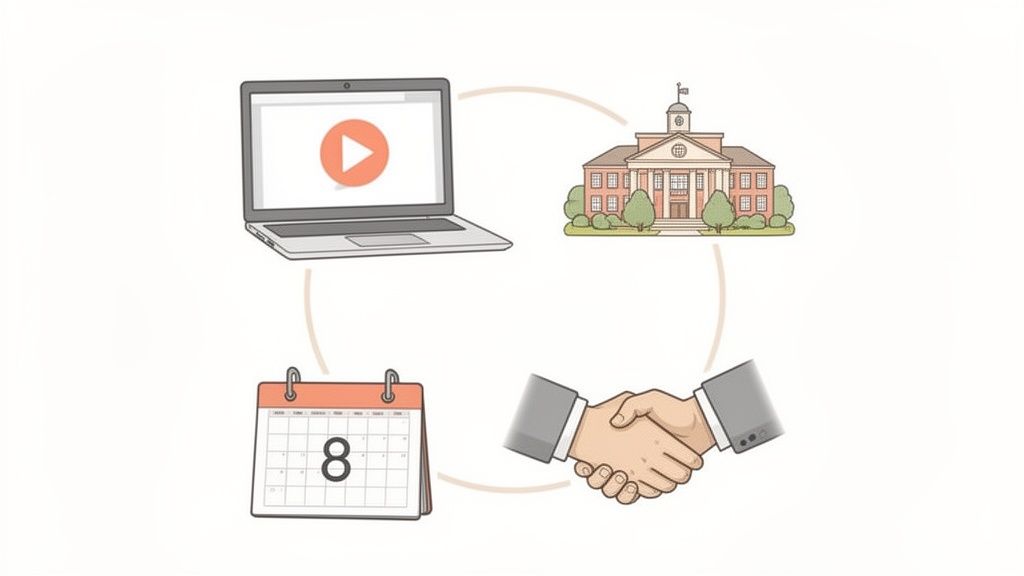
Let's pull back the curtain on what studying social work online is actually like. Many people imagine it's a lonely experience, just watching pre-recorded lectures on a laptop with very little human contact. The reality is far more dynamic and connected.
For anyone juggling work, family, and life, the big question is always about balance. How can you possibly fit a demanding professional degree into an already packed schedule? The answer is a modern, flexible approach known as blended learning.
This model cleverly combines the convenience of online study with the absolutely essential experience you only get in the real world. It’s designed to give you the best of both worlds, making sure you graduate with both the theory and the practical skills to make a real difference.
The Core of Blended Learning
Think of your online social work course as having two equally vital parts. First, you've got the digital campus, which is where you'll do most of your academic work. This is where the flexibility really shines.
Your online learning hub will typically include:
- Virtual Classrooms: Live, interactive tutorials and workshops where you can engage with tutors and classmates in real-time.
- Online Modules: Self-paced readings, videos, and activities you can tackle whenever it suits you - whether that’s early in the morning or late at night.
- Discussion Forums: A space to hash out ideas, ask questions, and build a sense of community with your peers.
- Digital Libraries: 24/7 access to all the academic journals, textbooks, and research materials you'll ever need.
Of course, this style of study requires a certain level of discipline. Getting a handle on some good strategies for managing remote learning early on can set you up for a much smoother journey.
On-Campus Intensives: Short Bursts of Skill Building
Many online social work degrees feature on-campus intensives. These are short, focused blocks of face-to-face learning where you and your cohort gather on campus for a few days at a time. It’s your chance to step away from the screen and dive into hands-on learning.
These sessions are crucial for practising skills that just don't translate well online. Think counselling techniques, group facilitation, and role-playing crisis intervention scenarios. They're also an amazing opportunity to build genuine, lasting connections with your lecturers and the other students you've been talking to online.
Field Placements: Where Theory Meets Reality
Now for the most critical part of any accredited social work course: the field placement, or practicum. This is where you put the books down, leave the classroom behind, and step into a professional social work environment.
Field placement is the heart of social work education. It’s the supervised, real-world experience where you translate everything you’ve learned into direct practice with individuals, families, and communities.
To become an accredited social worker, you’ll need to complete a minimum of 1,000 hours of supervised practice. This is usually split across two different placements in agencies like hospitals, community health centres, or child protection services. This isn't just an internship; it's a core, assessed part of your degree.
Good universities have dedicated field education teams whose entire job is to help you find and secure these placements. They’ll support you every step of the way, making sure your experience is both challenging and incredibly rewarding. This blended structure proves that studying ‘online’ never means you’re on your own.
Your Career Pathways After Graduation
Finishing your accredited online social work course is a huge achievement, but it’s really just the starting line. Think of your new qualification as a key - one that unlocks an incredible number of doors to a career that truly matters.
This isn't just a piece of paper. It’s a testament to your resilience and a confirmation that you have the skills and ethical grounding to stand with people during their most difficult moments. Now, let’s explore where you can put those skills to work.
Diverse Roles Across Vital Sectors
One of the best things about a social work degree is that it doesn’t pigeonhole you into one specific job. Instead, it equips you for a massive range of roles where compassion and advocacy are front and centre.
Your career can be as varied as you want it to be. You might start in one area and discover a passion for another down the track. That flexibility is built right into the profession.
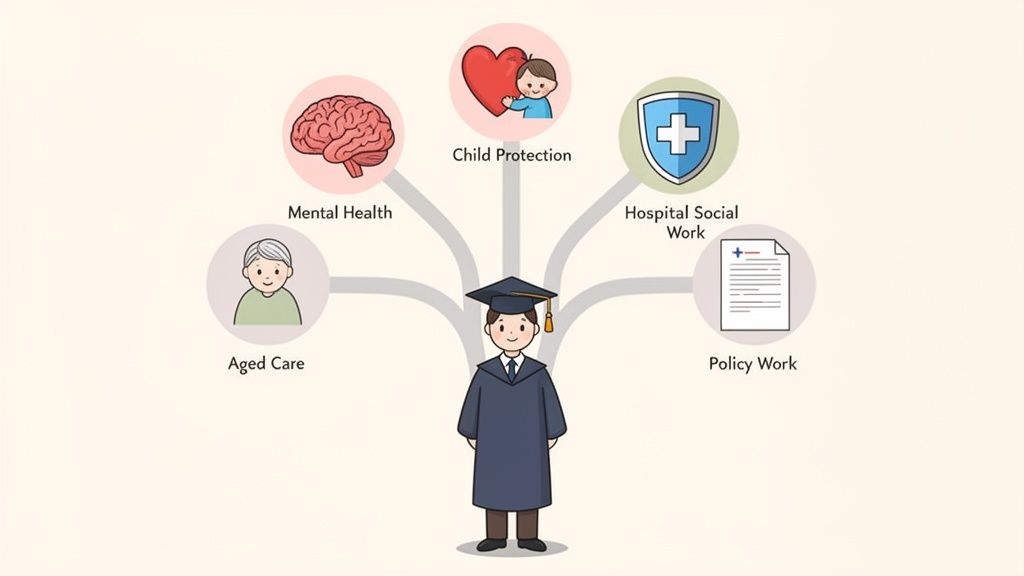
Just to give you a taste, here are a few of the sectors crying out for qualified social workers:
- Mental Health and Counselling: Offering one-on-one or group support in community health centres, NGOs, or even private practice.
- Child Protection and Family Services: Working at the coalface to safeguard children and support families navigating crisis.
- Hospital and Healthcare Social Work: Acting as a crucial link for patients and families, helping them understand the health system and cope with the emotional toll of illness.
- Aged Care: Championing the rights of older Australians, coordinating their care, and ensuring they can live with dignity and respect.
- Justice and Corrections: Supporting people moving through the criminal justice system, from providing support in court to helping with rehabilitation programs.
A career in social work isn't just a job; it's an investment in the health of our communities. The need for professionals who can handle complex human issues is not just steady - it's growing fast in almost every corner of Australia.
This versatility lets you build a career that genuinely reflects what you care about. To get a clearer picture of the human services field, it can be helpful to look at resources distinguishing counselling from psychology.
A Strong and Growing Job Outlook
Deciding to study social work online is a smart move for your future. With a growing national focus on mental health, aged care, and disability support, the demand for qualified professionals is skyrocketing.
In fact, the numbers speak for themselves. The Australian government projects a massive 23.2% increase in jobs for social workers over the next five years. This isn’t just a number; it represents real, tangible opportunities in government agencies, non-profits, and private organisations all across the country. You can dive deeper into the data by reading the full Australia's social work education and employment outlook report.
This powerful demand means you’re entering a field with excellent job security and clear pathways for growth. As you build experience, you can step into senior practitioner roles, team leadership, policy development, or even academia. And by studying online, you’re preparing for these vital roles without having to leave the very community you want to serve.
How to Choose the Right Online Provider
Alright, you've got your career goals mapped out. Now for the final, crucial piece of the puzzle: picking the right online provider to get you there.
Looking at all the social worker courses online can feel a bit overwhelming, but a little structure goes a long way. This isn't about getting dazzled by a fancy website; it's about finding a program that genuinely has your back and sets you up for success.
Think of it like hiring a guide for a trek through the wilderness. You wouldn't just pick the one with the shiniest compass. You’d want to know if they've actually walked the trails, what support they offer if you run into trouble, and if their route is even recognised by the park rangers. It's the exact same logic for choosing a course provider.
Your Evaluation Checklist
To make a smart choice, you need a solid list of what to look for. It’s time to look past the marketing slogans and find real proof that a provider can deliver what they promise. A good institution will be upfront about these things.
Here are the non-negotiable questions to ask every single provider on your list:
- Is the course AASW accredited? We've mentioned this before, but it's the most important question of all. If you don't get a clear and immediate "yes," it's a hard pass.
- How do you handle field placements for online students? Dig into the specifics. Ask how their field education team works. Do they have established relationships with agencies in your local area, or will you be left to fend for yourself?
- Who will be teaching me? Look up the faculty. You want to see teaching staff with recent, hands-on industry experience, not just a string of academic papers. That real-world perspective is what makes a good course great.
- What kind of student support is really available? Look for dedicated academic advisors, mental health services, and tech support that understand the needs of online students juggling study, work, and life.
Choosing a provider is about more than the piece of paper you get at the end; it's about the partnership. A quality provider invests in your entire journey, offering strong support systems that acknowledge the unique pressures of online study.
Use this checklist to cut through the noise and compare your options on the things that truly matter.
Making Sense of Course Costs and Financial Aid
Let’s talk money. The financial side of studying is a big deal for almost everyone. It's vital to get a clear picture of the full cost, from tuition fees to government help, so you can plan without stress.
Most Australian universities and TAFEs list their fees clearly on their websites. When you're comparing social worker courses online, make sure you’re looking at the total estimated cost for the whole qualification, not just the price per unit or subject. Don’t forget to budget for other potential costs, like textbooks or travel for any on-campus intensives.
The good news? You probably won't have to pay for it all upfront. For eligible students in higher education diplomas and degrees, the Australian Government provides a loan scheme called FEE-HELP.
This program lets you defer your tuition fees and pay them back slowly through the tax system once your income hits a certain level. It's an incredibly important system that opens the door to university study for many Australians. Just be sure to double-check with your provider that your specific course is eligible for FEE-HELP.
Your Next Steps to Get Enrolled
Once you've narrowed it down to one or two accredited providers that tick all your boxes, it's time to make your move. The application process is the last hurdle before you start this amazing new chapter.
- Get Your Paperwork Ready: You’ll almost always need proof of ID, academic transcripts from any past study, and sometimes a personal statement or your CV.
- Mark Your Calendar: Find the application closing dates and semester start dates. Pop them in your calendar so you don’t miss a deadline.
- Talk to an Enrolment Advisor: Seriously, don't be afraid to book a call. These advisors are experts who can answer any lingering questions and walk you through their specific application portal.
By taking this methodical approach, you can step into your studies with absolute confidence, knowing you’ve chosen a course and a provider that will help you build a long and meaningful career.
Got Questions? We've Got Answers
Thinking about studying social work online is a big step, and it's natural to have questions pop up. Let's tackle some of the most common ones we hear from people just like you.
Can I Really Become a Social Worker Entirely Online?
This is a big one, and the short answer is no, not entirely. While you can complete all your theoretical learning for a Bachelor or Master of Social Work online, no AASW-accredited degree is 100% remote.
Every single recognised social work program in Australia has mandatory, hands-on field placements. Think of it as an apprenticeship where you apply what you've learned in a real-world setting. These placements are non-negotiable because they're essential for you to become a safe, competent, and ethical practitioner. Some courses also have short, compulsory on-campus workshops sprinkled throughout the degree.
What if My ATAR Isn't High Enough?
Don't let a number stop you. A high ATAR is just one road into a university degree, and frankly, it's not the only one that matters, especially if you're not coming straight from high school.
Universities are actively looking for students with life experience. Many offer alternative entry pathways, which can look like:
- Completing a related qualification first, like a Diploma of Community Services.
- Demonstrating your passion and experience through relevant paid or volunteer work.
- Enrolling in and passing a university's own bridging or pathway program.
The key is to look at the specific entry requirements for each course. You'll often find they're a lot more flexible than you think.
How on Earth Do I Find a Field Placement?
This is a completely valid worry for online students, but you're not on your own. Any good university knows this is a challenge and has a dedicated team to help you. These field education units have established relationships with all sorts of government and community organisations to help find you a suitable placement.
It's a partnership, though. The university will provide the connections and the framework, but they'll also expect you to be actively involved in the process. When you're comparing courses, make sure you ask exactly what kind of placement support they offer.
Do Employers Actually Respect Online Degrees?
Yes, without a doubt. In the Australian social work sector, employers have one main question: is your degree AASW-accredited? How you got there - online or on-campus - doesn't matter.
An accredited online degree holds the exact same weight as one studied in a lecture hall. The qualification you earn at the end is identical and proves you've met the high national standards for professional practice. Employers care about the skills and knowledge that accreditation guarantees, not your study mode.
Ready to find the right course to kickstart your social work journey? Get Course Australia makes it simple to compare flexible, nationally recognised qualifications from leading online providers. Explore our range of community services and social work courses today.
Find Your Course
Compare courses across every field we write about, and enquire in under a minute.