Guide to cybersecurity certification australia: Fast-Track Your IT Career
cybersecurity certification australia: compare TAFE vs industry certs, costs, and map your high-demand IT career path.
If you're looking for the quickest, most direct route into Australia's booming digital defence sector, a cybersecurity certification is it. Think of it as your official ticket to the game—it's the formal proof that you have practical, job-ready skills, something employers often value even more than a traditional degree, especially for getting your foot in the door.
A certification can be the launchpad for a brand-new career or the specialist key that unlocks the next level in your current IT role.
Why a Cybersecurity Certification Is Your Smartest Career Move
Let's be blunt: the demand for skilled cybersecurity professionals in Australia isn't just growing, it's exploding. For anyone looking to change careers or an IT pro wanting to specialise, the field can seem a bit intimidating. A certification cuts through the noise. It acts as a clear roadmap, validating your skills and telling employers you’re ready to protect their digital assets from day one.

Here’s a simple analogy: becoming an electrician. You could read every book on electrical wiring, but it’s the formal qualification that proves you can actually do the job safely and correctly. A cybersecurity certification works the same way. It's the tangible evidence that you're competent in a very high-stakes environment.
The Unmistakable Demand for Certified Professionals
Australian businesses are on high alert. The local cybersecurity market was already valued at a staggering US$5.99 billion in 2023 and is on track to more than double, hitting a projected US$13.95 billion by 2028.
What's driving this? A relentless and frightening rise in cyber threats. We're talking over 76,000 cybercrimes reported in a single financial year—that's a fresh attack being launched every 7 minutes. This desperate need has created a massive skills gap, and it's certified professionals who are perfectly placed to fill it.
A certification doesn't just teach you theory. It gives you the hands-on defensive and offensive skills that organisations are crying out for to fight real-world threats. It’s the bridge between knowing about cybersecurity and being able to do it.
Your Direct Path to Career Advancement
For someone just starting out, a foundational certification is your key to an entry-level job. For an experienced IT professional, a specialised cert can be the catalyst for a promotion and a significant pay rise.
It proves you're committed to staying current and have mastered a specific area like ethical hacking, cloud security, or risk management. That kind of dedication really stands out to hiring managers.
A well-chosen certification streamlines your career path by focusing on the skills that are in high demand right now. Instead of a broad, multi-year degree, you can concentrate on gaining the specific expertise needed for roles like:
- Security Analyst: The frontline defender, monitoring networks and investigating alerts.
- Penetration Tester: The "ethical hacker" who finds system weaknesses before the criminals do.
- GRC Consultant: The strategist who ensures the business meets its governance, risk, and compliance obligations.
- Security Architect: The builder who designs and implements secure IT systems from scratch.
Ultimately, a strong certification history is often a non-negotiable for getting to the top of the ladder, including senior leadership roles like CISO (Chief Information Security Officer) positions. By investing in a cybersecurity certification in Australia, you're doing more than just earning a piece of paper; you're strategically setting yourself up for a long, successful, and rewarding career.
National Qualifications vs. Industry Certifications
When you start looking into cybersecurity credentials in Australia, it can feel like you've stumbled into a world of acronyms. But really, it all boils down to two main types of qualifications. Getting your head around the difference between them is the single most important step in choosing the right path for your career.
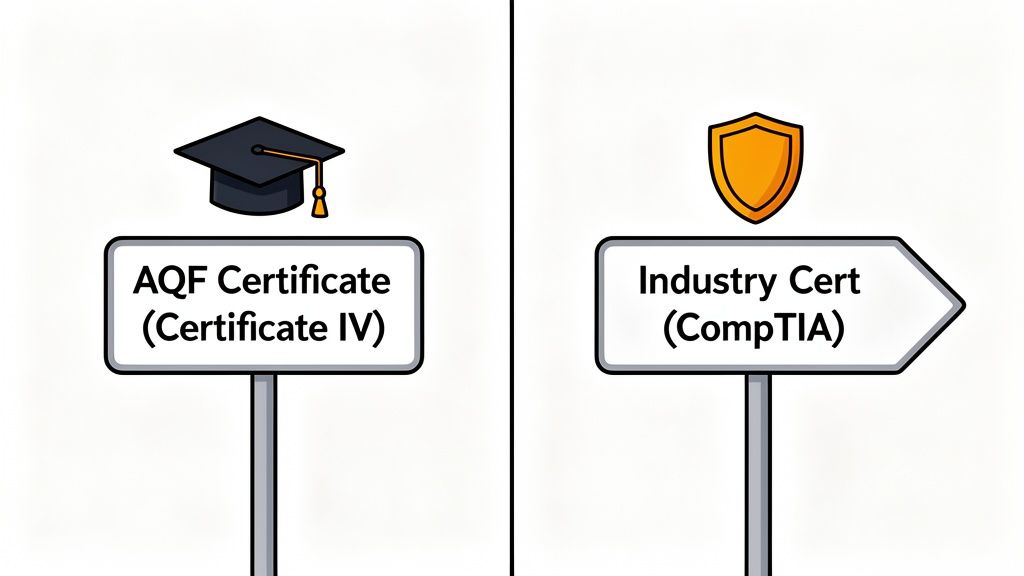
Here’s a simple way to think about it: a nationally recognised qualification is like your apprenticeship as a mechanic. It gives you a broad, structured, and complete understanding of how cars work from the ground up.
An industry certification, on the other hand, is like getting your license to race a Formula 1 car. It proves you’ve mastered the specific, high-level skills needed for a very particular, high-stakes job.
The Foundation: National Qualifications
Nationally recognised qualifications, like a Certificate IV in Cyber Security or a Diploma of Information Technology, are formal courses that sit within the Australian Qualifications Framework (AQF). This is a big deal because it means they are quality-controlled and officially recognised by employers and universities right across the country.
These courses are all about building a solid, well-rounded education in the fundamentals. You’ll cover a huge range of topics—from network security principles and risk management to incident response—which makes them a perfect starting point if you're new to the field or switching careers.
The real win here is that you build a deep, holistic understanding of the entire cyber ecosystem, which is something you absolutely need before you can specialise. For anyone looking for that comprehensive launchpad, a course like the Diploma of Information Technology with a cyber security specialisation is designed to provide exactly that foundational knowledge.
The Specialist: Industry Certifications
Industry certifications come from global tech giants and professional bodies like CompTIA, ISACA, or EC-Council. Unlike the broad scope of an AQF qualification, these are laser-focused on proving you have specific, technical, job-ready skills.
A few you’ll see everywhere include:
- CompTIA Security+: Widely seen as the global benchmark for core cybersecurity skills. It's the one many employers look for first.
- Certified Ethical Hacker (CEH): This shows you know how to think like an attacker and find weaknesses in a system.
- Certified Information Systems Security Professional (CISSP): This is a heavy-hitter certification for experienced security managers and leaders.
These are recognised all over the world and are often the exact keywords employers search for in job applications. Getting one proves you can walk in on day one and use a specific tool, perform a specific task, or work within a specific security framework.
Think of it this way: a national qualification proves you understand how a car works (the engine, the transmission, the electrical system), while an industry certification proves you can drive a specific model of high-performance race car expertly on a track.
So, Which Path Is Right for You?
The best way forward really depends on where you are now and where you want to be. It's not a case of one being "better" than the other; they're designed for different jobs and often work best when you combine them.
To help you figure it out, this table breaks down the key differences.
National vs. Industry Certifications at a Glance
In the end, most of the top professionals I know have a mix of both. They might kick things off with a Certificate IV to get the fundamentals down pat, then go after a CompTIA Security+ certification to sharpen their skills for a specific role. That one-two punch is what makes a resume really stand out to a hiring manager.
Exploring the Top Cybersecurity Certifications in Australia
Once you’ve got your head around the difference between a national qualification and an industry certification, it's time to dig into the specific credentials that Aussie employers are actually looking for. Think of it like learning the names of the most valuable tools in a professional's toolkit. Some are essential for building a solid foundation, while others are highly specialised instruments for advanced, high-stakes work.
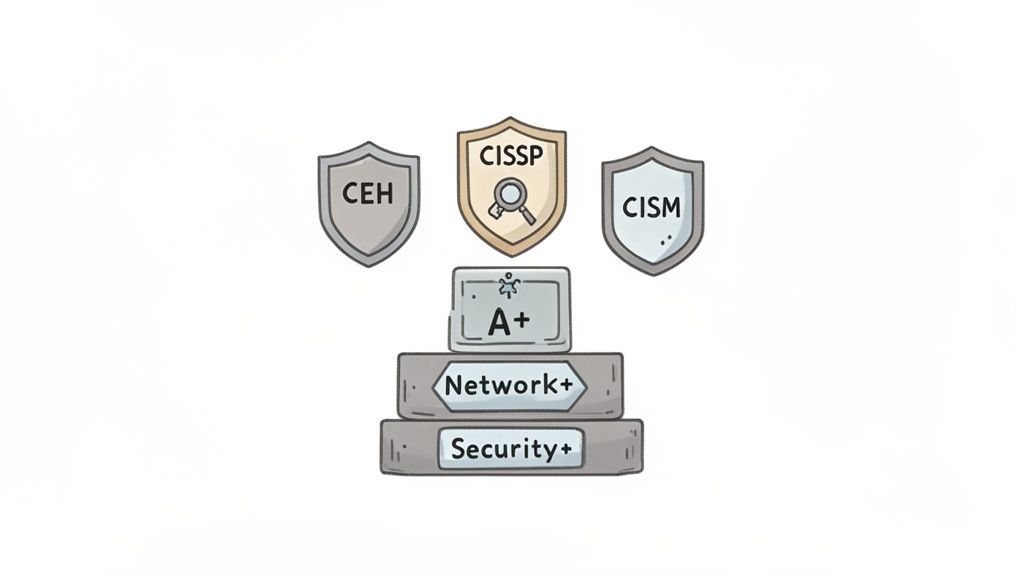
We’ll start with the foundational certs that open doors to your first job, then move up to the specialist qualifications that define senior-level careers.
The Foundational Trio from CompTIA
For decades, CompTIA has been the globally recognised jumping-off point for IT careers. Their certifications are vendor-neutral, which is a huge plus. It means the skills you learn aren't tied to one specific company's products (like Microsoft or Cisco); instead, you learn a universal IT language that’s understood everywhere.
Imagine you're building a house. You can't just start with the roof; you need a solid foundation, walls, and wiring first. That's exactly what CompTIA’s core certifications provide.
- CompTIA A+: This is your concrete slab foundation. It proves you have a solid grasp of hardware, operating systems, and basic troubleshooting—the absolute starting point for any hands-on IT role.
- CompTIA Network+: Think of this as the walls and plumbing. This cert shows you understand how networks actually function, from cabling and routers to IP addressing and network security protocols. After all, you can't secure a network if you don't know how it works.
- CompTIA Security+: This is the security system—the locks, alarms, and cameras. Security+ is widely considered the baseline cybersecurity certification in Australia for anyone serious about the field. It covers core security concepts, threat analysis, and risk mitigation.
For many aspiring pros, getting the Security+ certification is the key that unlocks their first role as an IT Support Officer with a security focus or a Junior Security Analyst.
Specialised Certifications for Advancing Your Career
Once you've got the fundamentals down and have some real-world experience under your belt, it’s time to aim higher with specialist certifications. These credentials are a powerful signal to employers that you’ve mastered a specific, high-value area within cybersecurity, opening doors to more senior roles and much bigger paycheques.
A foundational certification gets you in the door. A specialised certification gets you a seat at the table where strategic decisions are made. It’s the difference between being a security guard and being the architect of the entire security system.
Let's break down some of the most respected advanced options on the Australian market.
Certified Ethical Hacker (CEH)
The CEH, offered by EC-Council, is one of the most famous certifications in 'offensive security'. It trains you to think and act like a malicious attacker, but for one crucial reason: to bolster defences.
Instead of just building walls, a CEH professional learns how to find the cracks in them. This skillset is invaluable for roles like Penetration Tester or Vulnerability Analyst. You'll get hands-on with the tools and techniques hackers use to breach systems, which allows you to spot and fix weaknesses before the bad guys can exploit them.
Certified Information Systems Security Professional (CISSP)
Offered by (ISC)², the CISSP is widely seen as the gold standard for experienced cybersecurity professionals. It’s less about day-to-day technical tools and more about security management, high-level strategy, and governance.
Holding a CISSP tells the world you have the expertise to design, implement, and manage a best-in-class cybersecurity program. This isn't one for beginners; it requires a minimum of five years of cumulative, paid, full-time work experience in two or more of the eight domains of the CISSP knowledge base.
It's the credential that signals you're ready for leadership roles like:
- Security Manager
- Security Architect
- Chief Information Security Officer (CISO)
Certified Information Security Manager (CISM)
Offered by ISACA, the CISM is another top-tier management certification, but it has a slightly different flavour to the CISSP. While CISSP covers the broad technical and managerial landscape, CISM zeroes in on information risk management and governance from a business perspective.
A CISM professional is an expert at aligning an organisation's security program with its overall business goals. They know how to manage risk, ensure compliance, and crucially, communicate the value of security to the executives holding the purse strings. It's the perfect certification for those aiming for strategic roles like IT Risk Manager or Director of Information Security.
If you're keen to enter the industry with a solid footing, exploring a comprehensive program like a Certified Cyber Security Professional course can provide the structured learning needed to eventually pursue these elite credentials.
Choosing the right cybersecurity certification for your Australian career comes down to your personal goals. Start with the foundation, get that crucial experience, and then strategically target the specialised credential that aligns with the senior role you're aiming for.
Mapping Your Australian Cybersecurity Career Path
A certification isn't just a piece of paper to frame and hang on the wall—it's a strategic move on your career chessboard. Think of it less as a final goal and more as the first step on a calculated journey, connecting the skills you have with the high-demand, high-salary roles that Australian businesses are desperate to fill. This is your blueprint for turning a qualification into real career progression.
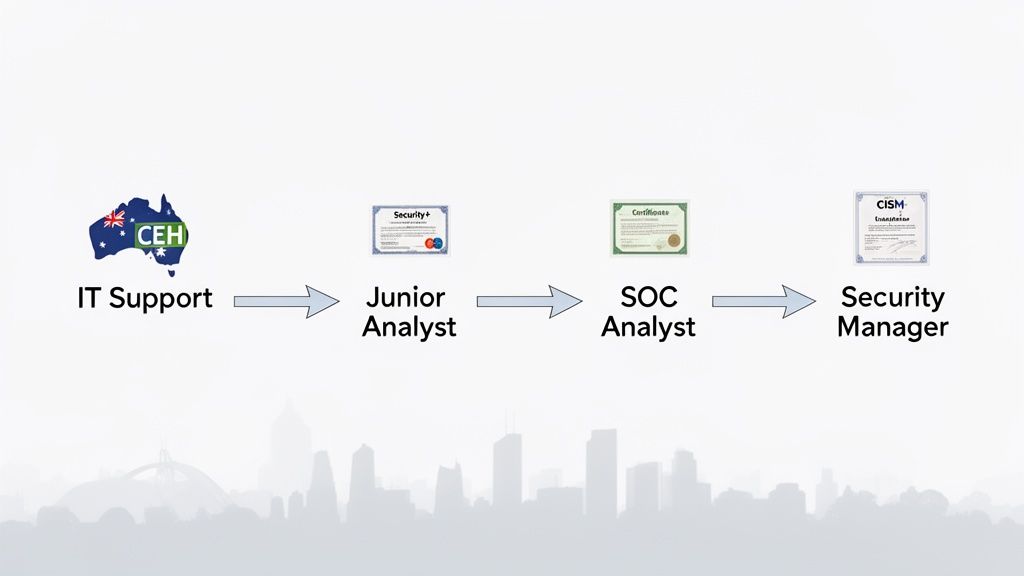
It’s a bit like planning a road trip. You wouldn't just jump in the car and start driving aimlessly; you’d pick a destination and figure out the best route to get there. A cybersecurity career works the same way, with certifications acting as the key signposts guiding you along your chosen path.
The Analyst Path: From Foundation to Frontline
This is a classic and highly effective route, especially if you’re starting out with a good IT foundation or have just finished a course like a Certificate IV. The focus here is on getting you into a hands-on technical role where you can start building that all-important real-world experience.
Here’s what that progression typically looks like:
- Starting Point: You kick things off with CompTIA Security+. This is widely seen as the industry standard for foundational skills, proving you’ve got a solid grasp of core security concepts and practices.
- First Role: With a Security+ certification on your resume, you're in a great position to land a job as a Junior Security Analyst or a SOC (Security Operations Centre) Analyst. This is where you get your hands dirty on the frontline, monitoring network traffic, investigating alerts, and becoming familiar with professional security tools.
- Next Step: After a couple of years on the job, it’s time to specialise. Pursuing a certification like the Certified Ethical Hacker (CEH) shows you have advanced skills in finding vulnerabilities, setting you up for a role as a Penetration Tester or a more senior analyst.
This pathway is all about building a solid base of practical experience and then using specialised certifications to pivot into more advanced, and often better-paying, technical roles.
The Leadership Track: From Strategy to Management
If your long-term goal is to lead teams, shape security strategy, and have a seat at the management table, your career path will look quite different. This track is less about the day-to-day technical tools and more about risk, governance, and aligning security with business objectives.
- Starting Point: You might also begin with Security+ or a similar foundation, but your focus will be on gaining experience in areas like risk assessment and policy development.
- Mid-Career Move: From there, you would aim for a credential like the Certified Information Security Manager (CISM). This certification proves you have the expertise to manage a company's entire information security program from a business perspective.
- Ultimate Goal: The CISM is often the final stepping stone before moving into senior leadership positions like Security Manager, Head of IT Security, or even the Chief Information Security Officer (CISO).
This path uses certifications to highlight your strategic thinking and leadership potential, transitioning you from a technical expert into a trusted business advisor. For more ideas on what these roles involve, check out our overview of popular information and technology jobs.
Bridging Australia’s Critical Skills Gap
The reason these pathways are so effective is simple: Australian businesses are facing a relentless barrage of cyber threats. Cybercrime is hitting medium-sized businesses particularly hard, with the average cost of an incident soaring to over $88,000. This figure is much higher than for small or large companies, highlighting a critical vulnerability for businesses that have big-company risks but small-company resources. You can read more in the Ai Group Cyber Security Survey.
For Australian employers, a certified professional isn't a luxury; they are an essential investment in business survival. Each certification on a resume represents a specific problem solved—a skill gap filled, a risk mitigated, and a defence strengthened.
By mapping your certifications to these urgent business needs, you directly align your career with what the market is demanding. Once you've earned your cybersecurity certification in Australia, learning how to stand out in job applications is the next critical step to securing the role you want.
Alright, let’s talk brass tacks. You’ve decided a cybersecurity certification is your next move—a smart one. So, what’s the actual process look like? Getting certified is more straightforward than you might think, with plenty of flexible options that can fit around your life, not the other way around.
Most people today are leaning into online, self-paced courses, and for good reason. It’s the standard for tech education because it just works. You get to learn at your own pace, rewind a tricky lesson on cryptography at 10 pm if you need to, and never feel the pressure of a fixed classroom schedule. For anyone changing careers while holding down a full-time job, this kind of flexibility isn't just a nice-to-have; it's essential.
What’s the Real Cost and Time Commitment?
The first question on everyone's mind is, "How much is this going to set me back?" The investment you’ll make for a cybersecurity certification in Australia really depends on the path you choose.
If you're looking at a nationally recognised qualification, like a Certificate IV in Cyber Security, you're typically looking at course fees that can land anywhere from a few thousand dollars up to about $15,000. These are comprehensive programs, and most students complete them within 12 months.
On the other hand, industry certifications like the CompTIA Security+ are often sold as part of a prep course package. These bundles, which usually include all your learning materials, access to virtual labs for hands-on practice, and the exam voucher itself, generally cost between $2,000 and $5,000. The timeline is more fluid here, but most people knuckle down and are ready to sit the exam in 3 to 12 months.
Try to think of the cost not as an expense, but as an investment in your future paycheque. The right credential can be the key that unlocks roles with starting salaries that give you a pretty quick return on that initial investment.
How to Fund Your Studies and Find Support
Don't let the price tag scare you off. The upfront cost doesn't have to be a roadblock. Most reputable Australian course providers offer flexible payment plans, letting you break down the fee into manageable weekly or monthly payments. It makes top-tier training genuinely accessible.
And be sure to explore a few other avenues for funding:
- Get Your Boss to Pay: If you’re already in an IT role, have a chat with your manager about employer sponsorship. You’re not just asking for a freebie; you're pitching a direct benefit to the business. You’ll be gaining skills to better protect their most valuable digital assets.
- Check Government Programs: For those who are eligible, initiatives like Workforce Australia’s Skills for Education and Employment (SEE) program or other jobseeker support schemes can sometimes help fund nationally recognised qualifications.
This isn't just about individual careers; it's a national priority. The Australian government’s 2023-2030 Cybersecurity Strategy has earmarked over $586 million to strengthen our digital defences, a huge part of which involves closing a critical skills gap. With studies showing only one-third of small businesses are investing in cyber training for staff, the demand for certified professionals is only getting more intense. You can read more about the government's plans in the official Australian Cyber Security Strategy.
Nailing it on Exam Day
Just getting through the course material is only half the battle. The real prize is passing that final exam to earn your credential. A solid preparation strategy isn't optional; it's the difference between passing and failing.
First things first: make practice exams your new best friend. They do more than just quiz you. They get you comfortable with the style of questions, the pressure of the clock, and the overall feel of the real exam. It’s the best way to build confidence and pinpoint any topics you need to hit the books on one last time.
Finally, don’t go it alone. Use the support systems around you. Most good online course providers will give you access to dedicated student advisors or expert mentors who can help you when you get stuck on a technical concept. And don’t underestimate the power of community. Hopping into online forums on Reddit or Discord can be a goldmine for study tips, resources, and encouragement from people who’ve been exactly where you are.
Your Top Questions About Cybersecurity Certifications, Answered
Stepping into a new career always brings up a few questions. And when that career is in a field as crucial and fast-moving as cybersecurity, it’s completely normal to feel a bit unsure about where to start. Let's tackle some of the most common queries we hear from aspiring cyber pros across Australia, so you can move forward with confidence.
Do I Need a University Degree to Get a Cybersecurity Job in Australia?
The short answer? Absolutely not.
While a university degree definitely has its place and can be a huge asset for senior leadership roles down the track, the cyber industry is obsessed with one thing: practical, real-world skills. This is where certifications really come into their own.
For a hiring manager, seeing a respected credential like a CompTIA Security+ or a Certificate IV in Cyber Security on your CV is proof that you have the job-ready skills they desperately need right now. It tells them you can hit the ground running.
For most people, especially career changers, a certification is the quickest and most direct path into that first professional role. It cuts out the time and expense of a three-year degree, focusing squarely on the specific skills that will get you hired.
In cybersecurity, what you can do often carries more weight than the academic path you took. Think of a certification as your proof of capability—a trusted signal to employers that you’re ready for the frontline.
Which Cybersecurity Certification Pays the Most in Australia?
This is a great question, and the answer almost always points to the advanced end of the career ladder. As a rule of thumb, the certifications linked to the highest salaries are those built for senior-level practitioners and managers.
We're talking about credentials that can command six-figure incomes, typically designed for seasoned leaders, like:
- Certified Information Systems Security Professional (CISSP): Widely considered the gold standard for security architects and managers responsible for designing and running entire security programs.
- Certified Information Security Manager (CISM): A top-tier cert for professionals who manage, govern, and assess an organisation's information security.
But here’s the crucial part: you can't just wake up one day and decide to get a CISSP. It requires a minimum of five years of verified, hands-on professional experience before you can even sit the exam.
For anyone starting out, the real goal should be getting a foundational certification that opens the door to your first job. The experience you build in that role is the essential stepping stone to chasing those high-paying, advanced certs later on.
How Long Does It Take to Get a Cybersecurity Certification?
The timeline really depends on a few things: which certification you’re aiming for, how much IT knowledge you already have, and how much time you can realistically set aside to study each week.
For a foundational cert like CompTIA Security+, you could be exam-ready in anywhere from 3 to 12 months with a flexible, self-paced online course. This is perfect for fitting your learning around your current job and life commitments.
On the other hand, a nationally recognised qualification like a Certificate IV in Cyber Security is a bit more structured, usually with an enrolment period of around 12 months to give you a really comprehensive learning journey.
Advanced certifications are a different beast entirely. They don't just involve a tough exam; they require years of on-the-job experience before you're even eligible to apply.
Are Online Cybersecurity Courses Actually Respected by Employers?
Yes, 100%. In a field that is fundamentally digital, online training isn't just respected—it's become the industry standard.
Employers are far more interested in the skills you have and the certification you hold than how you studied for it. What they care about is your capability.
Reputable online course providers in Australia give you everything you need to succeed. This includes detailed learning materials mapped to the official exam, virtual labs for crucial hands-on practice, and access to expert mentors when you get stuck.
A globally recognised certification from an authority like CompTIA, (ISC)², or ISACA holds the exact same weight on your resume whether you studied online or in a classroom. At the end of the day, what matters is that you passed the exam and earned the credential.
Ready to find the right course to kickstart your career? At Get Course Australia, we connect you with flexible, online cybersecurity qualifications from Australia's leading education providers. Explore our range of IT and cybersecurity courses and find your perfect fit today.
Find Your Course
Compare courses across every field we write about, and enquire in under a minute.