Information and Technology Jobs: In-Demand Roles & Salaries in Australia
Discover information and technology jobs in Australia, with in-depth role guides, salaries, skills, and paths to your next tech career.
Information and technology jobs are a massive part of Australia's economy. It’s a field known for strong growth, huge demand for skilled people, and real opportunities for individuals from all sorts of backgrounds. This sector is one of the most stable and fastest-growing career areas out there, thanks to the constant push for new tech in just about every industry you can think of.
Why Australia's Tech Sector Is Booming

You could say Australia is in the middle of a digital gold rush. While some industries are facing uncertain times, the tech sector has become a reliable engine for growth, constantly creating new roles and career paths. Think of it as a rapidly expanding ecosystem that needs a steady stream of new talent to keep it flourishing.
This incredible resilience makes IT one of the smartest career moves you can make, whether you're just leaving school or you're a professional looking to switch to a more secure field. The need for skilled people isn't just a passing trend; it reflects a fundamental shift in how Australian businesses get things done.
A Story of Explosive Growth
The numbers behind this boom really tell the story. Australia's tech sector is now the seventh largest employing industry in the country, with a massive 861,000 people on its payroll. That means 1 in every 16 working Australians is part of this vital field. Between 2005 and 2020, the number of tech jobs shot up by an incredible 66%—a growth rate nearly double the average across the entire economy. You can explore more data on this tech job expansion and see its impact firsthand.
And this isn't just about big tech companies in Sydney or Melbourne. The effect is being felt everywhere:
- Small businesses are using digital tools to stay competitive and find new customers.
- Hospitals and clinics are using technology to deliver better patient care.
- Even farms are using data to improve their efficiency and crop yields.
In essence, every industry is becoming a technology industry. This widespread adoption fuels the relentless demand for professionals who can build, manage, and secure the digital infrastructure that powers modern Australia.
Your Entry Point Doesn't Require a Degree
One of the biggest myths about starting a career in tech is that you absolutely need a four-year university degree. That's just not the case anymore. Today, employers are far more interested in practical, job-ready skills than they are in traditional academic credentials.
This shift has opened the door for a much more diverse range of people. Practical, skill-based qualifications like professional certificates and diplomas are now seen as powerful and efficient pathways into information and technology jobs. These courses are designed to give you the specific skills that businesses need right now, letting you get qualified and start earning much faster.
A Closer Look at In-Demand Tech Roles and Salaries
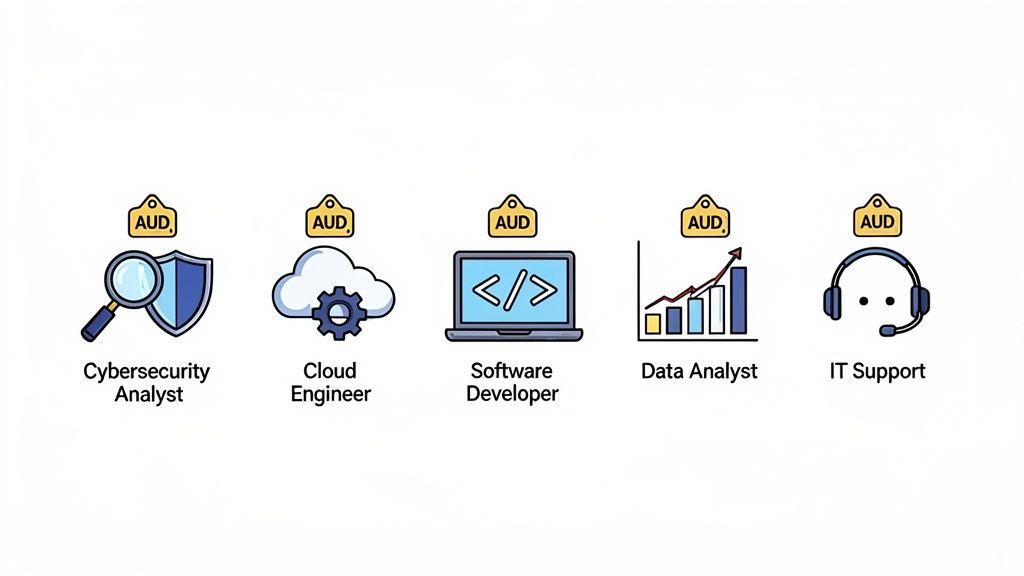
Stepping into the world of information and technology jobs can feel like learning a whole new language. To make sense of it all, let’s take a practical look at some of Australia's most popular tech careers. We'll explore what these professionals actually do day-to-day, so you can see where your own skills and interests might line up.
Think of this as a behind-the-scenes tour of the people who build, protect, and maintain our digital lives. Each role is a distinct specialisation, offering a different way to solve real-world problems for businesses and their customers.
Cybersecurity Analyst: The Digital Bodyguard
A Cybersecurity Analyst is part detective, part digital guardian. Their core job is to shield a company’s computer networks and systems from cyberattacks, data breaches, and any unauthorised prying eyes. They are the front line of defence against ever-evolving digital threats.
Day-to-day, they're often busy with tasks like:
- Monitoring network traffic for suspicious activity.
- Investigating security alerts to figure out what happened and why.
- Setting up and managing security tools like firewalls and data encryption.
- Teaching staff about good security habits to avoid preventable risks.
In short, they build a digital fortress and patrol its walls to keep company data safe. It’s a role that’s perfect for sharp, analytical thinkers who enjoy solving complex puzzles, often under pressure.
Cloud Engineer: The Digital Architect
Imagine a business moving all its data and software out of a dusty server room and into a massive, secure, and globally accessible digital warehouse. A Cloud Engineer is the architect and manager of this "warehouse," using platforms like Amazon Web Services (AWS) or Microsoft Azure.
They are responsible for designing, building, and maintaining an organisation's cloud setup. This means ensuring systems can grow as the business does, are consistently reliable, and don't cost a fortune to run. A Cloud Engineer makes it possible for teams to get the tools and data they need from anywhere, at any time.
Software Developer: The Creative Builder
Software Developers are the creative force behind the apps on your phone, the programs on your computer, and the websites you browse every day. They write the code that brings ideas to life, transforming a concept into a working, user-friendly digital product.
Their work is highly project-driven and usually involves:
- Writing and testing code for brand-new applications.
- Working alongside designers and project managers to meet user needs.
- Hunting down and fixing bugs in existing software.
- Continuously improving and updating applications to keep them relevant.
This career is a fantastic fit for anyone who loves creative problem-solving and has an eye for logic and detail. The demand for skilled developers remains incredibly high. A similar high-demand position is the DevOps Engineer; you can find a detailed breakdown in this guide on the Job Description of DevOps Engineer: Roles, Skills, Salary.
Data Analyst: The Storyteller
In a world drowning in information, a Data Analyst is the person who finds the meaning in it all. They gather, clean, and study huge sets of data to spot trends, patterns, and insights that help organisations make much smarter decisions.
Think of them as storytellers who use numbers to show what’s working, what isn't, and where the next big opportunity lies. A Data Analyst might help a retailer understand customer buying habits or a hospital improve patient care. If you're naturally curious and enjoy uncovering the story behind the numbers, this path has massive potential. For a deeper dive, check out our guide on how to start a career as a Data Analyst.
Data Analysts don’t just report on numbers; they translate them into actionable strategies. They answer the critical "so what?" question, turning raw information into a roadmap for business growth and efficiency.
IT Support Specialist: The Problem Solver
When technology inevitably goes wrong, the IT Support Specialist is the hero who comes to the rescue. They are the go-to experts for fixing hardware, software, and network problems for employees or customers, making them absolutely vital for keeping a business running smoothly.
Their duties are hands-on and can change by the hour, from setting up a new employee’s computer to resolving a system-wide network outage. Patience, great communication skills, and a genuine desire to help people are the keys to thriving in this essential role.
Australian IT Job Roles and Typical Salary Ranges
To give you a clearer picture of the financial opportunities in these fields, the table below outlines some of the most common IT roles in Australia alongside their typical salary ranges. Keep in mind that these figures can vary based on your location, the size of the company, and your specific experience level.
As you can see, these roles not only offer engaging work but also provide strong career progression and significant earning potential as you build your expertise.
The Skills and Certifications Employers Actually Want
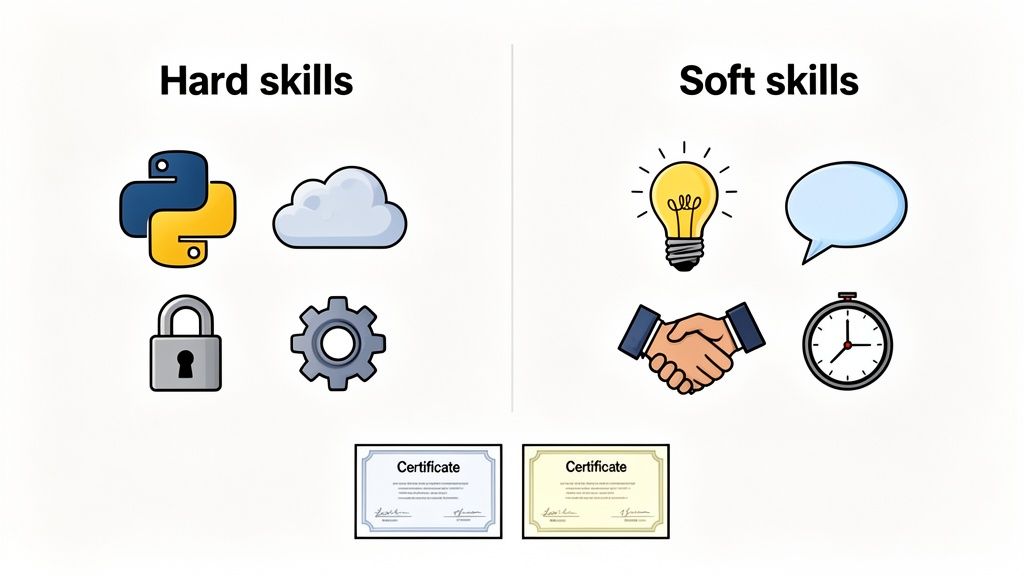
To land one of the many rewarding information and technology jobs, it takes more than just a keen interest. You need a specific set of skills that employers are actively looking for. Think of it like this: your skills are your professional toolkit. To build a successful career, you need the power tools (technical skills) and the precision hand tools (soft skills) to get the job done right.
Mastering both is what separates a good candidate from a great one. Your technical abilities show you can do the job, while your soft skills prove you can collaborate, innovate, and grow within a team. Let’s take a look at what this modern toolkit actually looks like.
Essential Technical Hard Skills
Technical skills, or 'hard skills', are the hands-on abilities you need for specific IT roles. They’re the languages you speak and the platforms you operate. For example, a programming language like Python is the vocabulary you use to tell a computer what to do, while a cloud platform like AWS is the digital workshop where you build things.
Some of the most in-demand technical skills across Australia right now include:
- Programming and Scripting: Being fluent in languages like Python, Java, or JavaScript is non-negotiable for software development, automation, and data work.
- Cloud Computing Platforms: With so many businesses moving online, expertise in Amazon Web Services (AWS), Microsoft Azure, or Google Cloud Platform (GCP) is critical.
- Cybersecurity Principles: Knowing your way around threat detection, network security, and data protection is vital for keeping a company's digital assets safe.
- Data Analysis and Management: Skills in SQL for managing databases, along with tools like Power BI or Tableau for making data easy to understand, are incredibly valuable.
These skills are concrete and measurable—they form the foundation of your professional value.
The Power of Professional Soft Skills
While technical skills might get your foot in the door, it’s your soft skills that will truly make your career flourish. These are the interpersonal abilities and professional habits that dictate how well you work with others and tackle challenges. It’s less about what you can do and more about how you do it.
Think about it: a developer who can write perfect code but can't explain their work to a non-technical manager will always be limited in their impact. This is why employers put such a huge emphasis on things like creative problem-solving, clear communication, and genuine teamwork.
Strong soft skills are the glue that holds a technical team together. They enable collaboration, turn complex data into clear business strategy, and ensure projects are delivered successfully from start to finish.
Of course, knowing what skills to have is one thing, but presenting them effectively is another. For some great insights, check out these 10 key things employers look for in resumes.
Industry Certifications: Your Signal of Expertise
So, how do you prove you have these skills before you even get an interview? This is where industry certifications come into play. A certification is like an official stamp of approval from a respected industry body, confirming you have a specific level of knowledge and can apply it in the real world.
For employers, certifications are a powerful, at-a-glance signal that a candidate is job-ready. They cut through the resume clutter and show you’ve invested time into mastering a specific technology. This is especially important in a market where IT spending in Australia is projected to hit A$146.85 billion in 2025—an 8.7% jump from 2024—as companies pour money into software, AI, and cybersecurity.
Popular and respected certifications include:
- CompTIA A+: The go-to standard for anyone starting a career in IT support.
- Cisco CCNA: Validates your ability to install, configure, operate, and troubleshoot networks.
- Certified Ethical Hacker (CEH): Proves you have the skills to find and fix vulnerabilities in a network.
- AWS Certified Solutions Architect: A crucial credential for professionals working with cloud infrastructure.
These credentials act as a trusted shortcut, telling hiring managers you have the verified, practical skills they need on their team right now.
Smart Pathways into Your First Tech Job
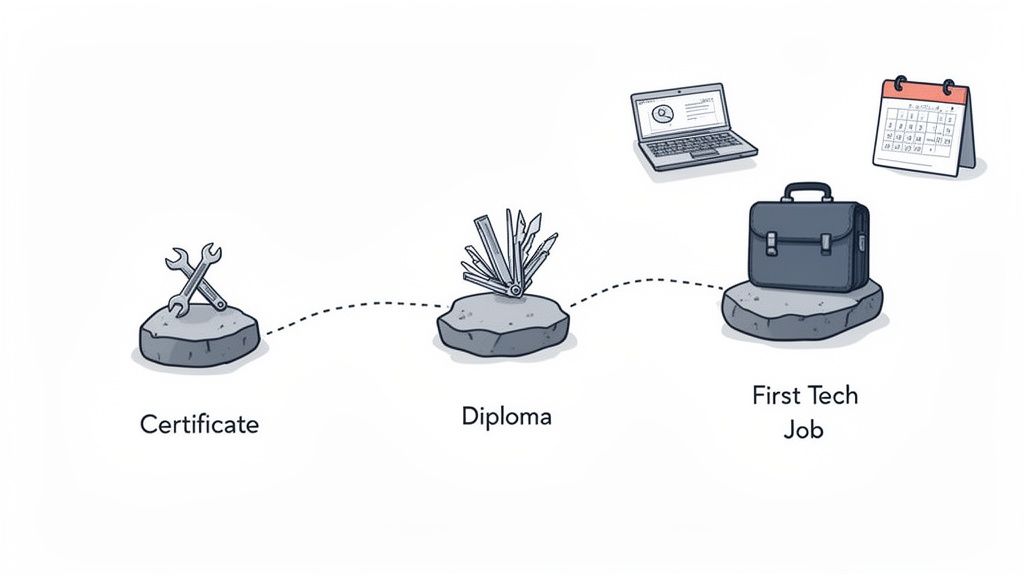
One of the biggest myths about information and technology jobs is that you need a multi-year university degree to even get your foot in the door. Thankfully, that idea is well and truly outdated. Today, employers are far more interested in practical, job-ready skills, which has opened up smarter and faster ways to launch your career.
These modern routes are built for real life. They skip the fluff and focus on giving you the specific expertise needed for an entry-level role, without the massive time and financial commitment of a traditional degree. It's about building a direct bridge from learning to earning.
The Power of Vocational Training
Vocational Education and Training (VET) courses have become a seriously powerful alternative to the old university-only path. These are nationally recognised qualifications, designed with input from industry experts, so you can be sure the curriculum is current, relevant, and exactly what hiring managers are looking for.
Here’s a good way to think about it: a uni degree might give you a broad, theoretical understanding of an entire forest. A VET qualification, on the other hand, teaches you how to identify specific trees, use the right tools to work with them, and navigate the terrain like a pro. It's a hands-on approach designed to make an impact from day one.
Understanding Certificates and Diplomas
Two of the most common and effective entry points are Certificates and Diplomas. They might sound similar, but they play slightly different roles in your career journey. Nailing the difference is the key to picking the right starting line for your personal goals.
A Certificate, like a Certificate IV in Cyber Security, is like a specialised, precision tool. It’s designed to arm you with a very specific skillset for a particular job, like becoming an entry-level cybersecurity analyst. These courses are generally shorter, getting you qualified and ready for the workforce as efficiently as possible.
A Diploma is more like a versatile multi-tool. It gives you a much broader base of knowledge across a field, setting you up for a wider range of roles and responsibilities. A Diploma of Information Technology, for instance, provides a solid foundation that could lead to careers in networking, database management, or general IT support.
The key takeaway is that you have options. Whether you want to specialise quickly or build a broader foundation, there’s a flexible pathway that fits your career ambitions and your timeline.
These qualifications aren't just about theory; they are grounded in practical application. By focusing on real-world problems and hands-on skills, they give you the confidence you need to step straight into your first tech role.
The Advantage of Flexible Online Learning
Perhaps the best part about these modern pathways is just how flexible they are. Most VET courses are now offered online, which means you can study around your current job, family, and life commitments. You can learn at your own pace, from anywhere in Australia, without having to press pause on everything else.
This learning model puts you in the driver's seat of your career transition. You can upskill in the evenings or on weekends, applying what you learn directly to your job search. This makes a career change feel genuinely achievable, not completely overwhelming.
For a complete overview, explore our guide to information technology courses and career paths to see how all these options connect.
Ultimately, these smart pathways have opened the doors to the tech industry for everyone. They prove that a rewarding, well-paid career in IT is within reach for anyone with the drive to learn practical skills, no matter their background.
Ready to Start Your IT Career Journey?
It's one thing to read about all the possibilities in tech, but it's another thing entirely to take that first real step. Let's shift from theory to action. This is your practical guide to moving from curiosity to enrolment and landing one of Australia's most rewarding information and technology jobs.
Making the jump is often simpler than people imagine. It's really just about finding the right course that teaches you what you need to know, in a way that actually fits into your life.
Explore Your Course Options
The best place to start is by browsing a curated selection of courses from Australia’s top training providers. Platforms like Get Course Australia are great because they pull together qualifications from respected institutions like Upskilled and Lumify Learn, so you can easily compare everything in one spot.
You can filter by what genuinely interests you, whether that's building digital defences against hackers or digging into complex data sets. This helps you cut through the clutter and focus on the specific skills that will get you job-ready, fast.
Find Your Perfect Starting Point
Not quite sure which path to take? Think back on the roles we've talked about—which ones made you lean in a little closer? Every specialisation has a clear entry point, usually through a specific qualification.
- Keen to become a cyber defender? A Certificate IV in Cyber Security is the perfect launchpad, giving you the foundational skills for an entry-level analyst role.
- Dreaming of building slick websites and apps? A Diploma of Information Technology (Front End Web Development) will arm you with the creative and technical chops to bring digital ideas to life.
- Want to be the person everyone calls to fix things? Check out a Certificate IV in Information Technology (Networking) to learn how to manage and secure the essential systems that keep businesses running.
Each of these courses is a direct line to a specific career. There's no guesswork involved. For a more detailed look at what those first steps involve, you can learn more about how to start a career in information technology in Australia.
Picking your first course is a huge decision. It lays the groundwork for your entire career, so it’s worth taking the time to talk to an expert who can help match your passion with a practical, in-demand qualification.
Connect with an Expert Advisor
You don't have to figure this out on your own. Honestly, one of the smartest moves you can make is to have a chat with an expert student advisor. They're there to listen to your career goals, walk you through the different qualifications, and explain any flexible payment options that might be available.
Think of them as your personal career navigator, making sure the course you choose is genuinely the right fit for you. It’s a simple step, but it provides the clarity and confidence you need to get started. Your new career is just a conversation away.
Your Top Questions About IT Careers, Answered
Jumping into a new career path always brings up a few questions. When that path leads into the ever-changing world of information and technology, it's completely normal to want a clearer picture before you take the leap. Let's tackle some of the most common queries to help you move forward with confidence.
One of the biggest myths that stops people from pursuing a tech career is the idea that you need a university degree to even get your foot in the door. Thankfully, that’s just not the case anymore.
These days, Australian employers are far more interested in practical, job-ready skills than they are in traditional academic credentials. A degree is still a great option, of course, but it’s definitely not the only one.
Do I Really Need a University Degree to Get an IT Job?
Short answer: no. A university degree is not essential for a huge range of entry-level and even mid-career IT roles. While some highly specialised jobs in areas like AI research might still look for a degree, the industry as a whole has made a major shift.
Hiring managers now care more about what you can do than where you learned to do it. This means nationally recognised qualifications, like a Certificate IV or a Diploma, paired with industry-standard certifications from vendors like CompTIA or Cisco, are incredibly valuable. They show an employer you have the specific, hands-on skills to start contributing from day one.
In today's tech world, proven ability is king. A solid portfolio showcasing your projects and a few relevant certifications can often carry more weight with a hiring manager than a university transcript. This skills-first mindset has blown the doors wide open for people from all sorts of backgrounds.
How Quickly Can I Get Qualified for an Entry-Level Role?
You can get job-ready much faster than you probably think. Unlike a traditional three or four-year university degree, vocational training is designed to be direct and efficient.
You could complete a solid foundational course, like a Certificate IV in a specific field like cyber security or IT networking, in around 12 months. These courses cut straight to the chase, focusing on the core skills and knowledge that employers are actively looking for, without the extra theoretical subjects. It’s a direct line from learning to earning.
What’s the Job Outlook for Tech in Australia?
The future for tech professionals in Australia is looking incredibly strong. Across almost every industry—from healthcare and finance to retail and even agriculture—the demand for skilled IT people continues to grow faster than the supply.
As more businesses go digital, the need for experts in cyber security, cloud computing, and data analytics is set to explode. Projections consistently show that roles like software developers and information security specialists are expected to grow much faster than the average for all other jobs. This makes investing in IT skills a smart, secure move for long-term career stability and growth.
Ready to find a course that can kickstart your tech career? Get Course Australia helps you compare flexible, online qualifications from Australia's top training providers. Find your ideal path and start the journey today by exploring courses on Get Course Australia.
Find Your Course
Compare courses across every field we write about, and enquire in under a minute.