A Practical Guide to a Career Change at 30
Thinking about a career change at 30? Discover a practical roadmap for Australians, from self-discovery to landing a new role with flexible online courses.
Thinking about changing careers in your thirties? It's a thought that crosses a lot of people's minds, and for good reason. This isn't just about a "seven-year itch" with your job; it's a strategic moment where experience meets ambition, creating the perfect launchpad for a career you'll actually love.
Why Your Thirties Are the Perfect Time for a Career Pivot

If you're hitting your 30s and feeling like your current career path isn't quite right, you are definitely not alone. It’s not a sign you’ve failed or a late-blooming "quarter-life crisis." It’s actually a pretty smart response after spending a solid decade in the workforce. You finally have a real sense of what truly drives you – and what absolutely doesn't.
This decade is a unique sweet spot. You've got a foundation of real-world experience, a handle on crucial soft skills, and a level of professional maturity that recent grads are still working on. At the same time, you have decades of work ahead, giving you plenty of runway to skill up, dive into a new field, and see a real return on your efforts.
The Great Aussie Job Shuffle
Right now, the Australian job market is buzzing with activity. We're seeing the highest level of workforce mobility in a decade, with 9.5% of workers switching jobs in the year to February 2023. This trend is even more pronounced for people aged 25-44, who clocked a job change rate of 11.2%.
This shows the time is right for reinvention. For anyone considering a career change at 30, the biggest motivator is often the search for more meaningful work. In fact, 32.3% of people who changed jobs said their main reason was simply ‘wanting a change or a better job’. You can learn more about the trends shaping Australian job mobility from the Australian Bureau of Statistics.
A career change in your thirties isn't about throwing everything away and starting from zero. It's about using the wisdom you've already earned to make a smarter, more intentional choice for your future.
Why Now Is Your Moment
A few key things come together to make your thirties the ideal time to write a new professional chapter. You're simply better equipped to pull off a successful transition. Here’s why:
- You Actually Know Yourself: After almost a decade of working, you have a much clearer view of your strengths, weaknesses, and what you genuinely need from a job to feel fulfilled. You’ve seen different workplace cultures and team dynamics, so you know what you’re looking for.
- You Have a Toolkit of Transferable Skills: Things like communication, project management, problem-solving, and teamwork aren't just buzzwords on a resume anymore—you've actually used them. These skills are gold to employers in any industry and become the foundation for your next role.
- You're on Steadier Ground: While not true for everyone, many people in their 30s have a bit more financial stability than in their early 20s. This gives you breathing room to plan for study or retraining without the same kind of pressure.
The goal isn't to erase your past experience but to reframe it. Your journey so far has taught you invaluable lessons that you can bring to a new field, giving you a unique edge that new graduates just don't have. It's this powerful combination of experience and fresh motivation that makes a career change at 30 such a great move.
Getting to Know Yourself: Your Pre-Change Career Audit
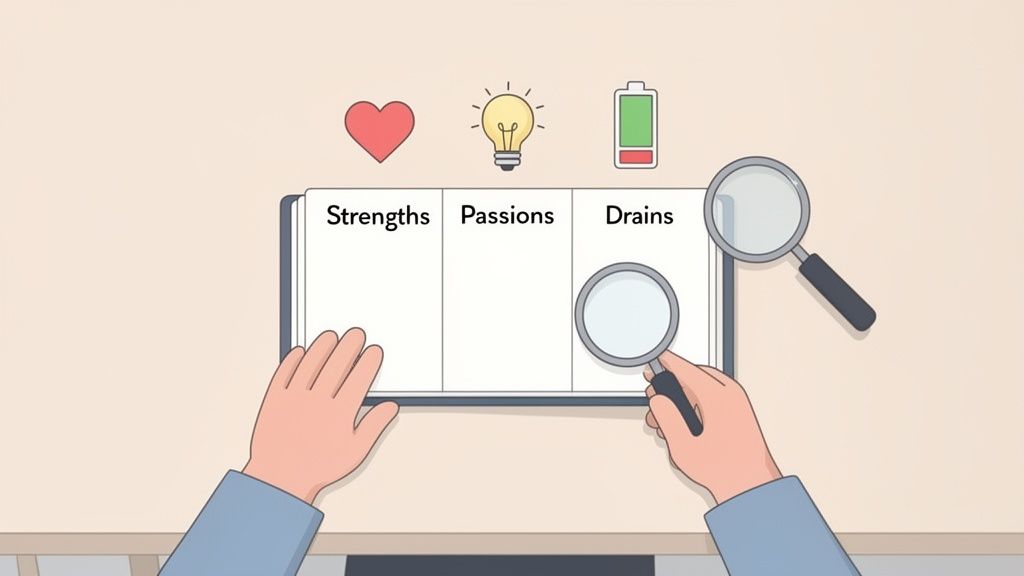
Before you even think about scrolling through job ads, it’s time for some honest self-reflection. A personal career audit is your starting line. It’s about creating a clear map of your own professional landscape before you try to navigate a new one.
This isn’t just a simple pros and cons list. It's about digging deep to move from a vague "I need a change" feeling to a concrete understanding of what actually makes you tick. Making a career change at 30 means you have a decade of real-world experience to draw from, so let’s put it to good use.
What Lights You Up and What Burns You Out?
Think back over your past jobs. I mean really think. Pinpoint the specific tasks, projects, or even just moments that left you feeling energised and motivated. Then, do the same for the things that made you watch the clock and left you feeling completely drained.
Grab a piece of paper and draw three columns: Energisers, Drains, and Neutral. Start listing specific work activities under each.
- Energisers: What tasks made you lose track of time? Maybe you loved mentoring a new team member, untangling a complex spreadsheet, or planning the office social event. These are your clues.
- Drains: What did you put off until the very last minute? Was it writing long reports, constant public speaking, or dealing with unhappy customers? Knowing what to avoid is just as important as knowing what to seek.
- Neutral: Some tasks are just… work. Listing them is fine, but the real gold is in the extremes.
You'll probably start to see patterns emerge. You might realise that while you hated your overall sales job, you secretly loved the problem-solving and relationship-building parts of it. That’s a powerful insight.
Uncovering Your Hidden Superpowers: Transferable Skills
After a decade in the workforce, you’re sitting on a goldmine of skills that can be applied almost anywhere. These are your transferable skills, and they’re your ticket from an old career to a new one.
Think bigger than your official job title. A retail manager isn’t just a stock-watcher; they’re a pro at team leadership, conflict resolution, budgeting, and customer service. An admin assistant has killer organisational skills, top-notch communication abilities, and is likely a whiz with multiple software platforms.
Your past experience isn't a limitation; it's leverage. The key is learning how to translate what you did in a previous industry into the language of the one you want to enter.
If you need a hand getting started with this kind of self-reflection, we’ve got a guide with some great prompts. Check out the 5 questions to ask yourself before changing careers to help frame your thinking.
Defining Your Ideal Day-to-Day
A job is so much more than what you do; it’s about where and how you do it. A career change at 30 gives you the perfect chance to be deliberate about the kind of work environment and lifestyle you actually want.
Get practical and think about what really matters to you:
- Team Vibe: Are you at your best bouncing ideas off colleagues, or do you prefer to plug in your headphones and work solo?
- Work-Life Blend: Is a classic 9-to-5 what you’re after, or is the freedom of remote work or a flexible schedule non-negotiable?
- Company Culture: Do you get a buzz from the high-energy, fast-paced world of a startup, or does the stability of a larger, more established company sound better?
- The Money Question: Let's be real. What’s the minimum salary you need to live comfortably? Be honest with yourself about your budget, bills, and savings goals. This will immediately help you filter out unrealistic options.
When you pull all these threads together—your energisers, skills, and ideal lifestyle—you’ve built your career compass. This isn't just about finding a new job title; it's about finding a career that genuinely fits the person you are today.
Researching High-Growth Industries and Future-Proof Roles
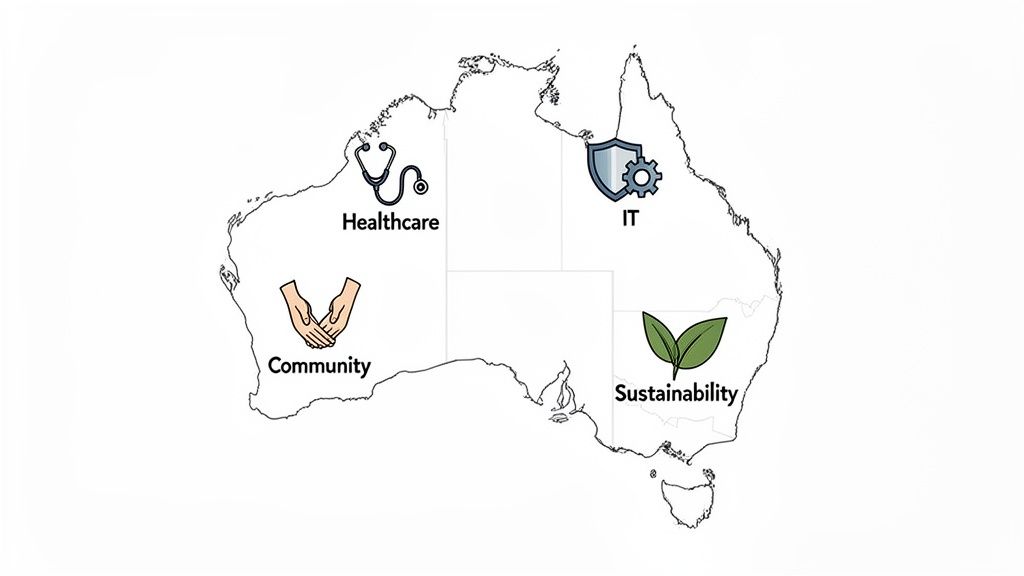
Alright, you’ve done the introspective work and have a much better handle on what makes you tick. Now it's time to marry that self-awareness with what’s actually happening in the job market. A smart career change at 30 isn’t about chasing the latest fad; it’s about finding a stable, growing industry where you can plant your feet for the long haul.
Australia’s economy is constantly evolving, and that's creating some fantastic openings in certain sectors. The key is to be strategic—don’t just spray your resume everywhere. Focus your energy on fields with proven long-term demand.
Pinpointing Australia's Growth Hotspots
Some industries are simply booming right now, driven by major shifts in technology, our population, and what we value as a society. These are the sweet spots where employers are actively looking for new talent, making them perfect targets for a career pivot.
Three of the most reliable sectors right now are Healthcare, Community Services, and Information Technology.
These aren't just trendy fields; they’re essential. That means they are far less likely to be rocked by economic ups and downs, which is exactly the kind of stability you want when you’re making a big move.
The goal is to find where your personal strengths intersect with market demand. That’s the sweet spot for a sustainable and fulfilling career change.
The job market is buzzing with activity. Recent figures from the Australian Bureau of Statistics showed that 1.1 million people changed jobs in the year ending February 2025. Digging deeper, professionals had a turnover rate of 25.4%, while community and personal service workers saw a 14.0% turnover. This movement signals that doors are wide open in these sectors for people ready to step in.
Real-World Pivot Examples
Sometimes it’s hard to imagine how your skills from one job could possibly apply to another. Let’s make it real.
- From Retail Manager to Community Services Coordinator: Think about it—a retail manager is a pro at leading teams, juggling rosters, managing budgets, and handling tricky customer situations. With a Diploma of Community Services, they can leverage all that experience to manage support programs, coordinate volunteers, and run outreach initiatives.
- From Admin Assistant to Cybersecurity Analyst: An admin professional is organised, meticulous, and great at managing sensitive information. A Certificate IV in Cyber Security builds directly on that foundation, equipping them to monitor security systems, spot threats, and protect data—a non-negotiable skill for any business today.
See the pattern? These pivots work because they build on the experience you already have. Your past roles gave you the soft skills; a targeted qualification gives you the specific industry knowledge to make the jump.
Comparing Top Industries for Career Changers in Australia
To help you get a clearer picture of where you might fit, we’ve broken down some of the key growth industries. This table compares what to expect in terms of roles, qualifications, and salary potential to help you weigh your options.
This table is a starting point. Your personal interests and skills will ultimately guide you to the best fit.
As you dive into your research, it’s also smart to keep one eye on the future. Taking the time for understanding AI's impact on future jobs will help you pick a path that's built to last. For more on this, check out our guide on developing career strategies to make the most of changing trends.
Finding the Right Upskilling Pathway
The idea of going back to study can feel a bit overwhelming, especially when you’re already juggling a job, family, and a mortgage. But here’s the good news: changing careers at 30 doesn't mean you have to lock yourself into a four-year university degree and live off two-minute noodles again.
Education has changed. It’s no longer a rigid, one-size-fits-all system. Today, learning is designed to fit around your life, not the other way around.
Online, self-paced courses are built for working adults. They let you gain genuinely useful, job-ready skills without having to press pause on everything else. It’s all about getting the practical qualifications that employers are looking for right now, one module at a time, during your evenings or on weekends.
Suddenly, that big career change feels a whole lot more manageable.
Certificates vs Diplomas: What's the Difference?
Once you start browsing, you'll see two terms pop up constantly: Certificates and Diplomas. Knowing the difference is crucial for picking the right launchpad for your new career.
Certificates (e.g., Certificate III or IV): Think of these as your fast-track into a new industry. A qualification like a Certificate III in Community Services gives you the exact hands-on skills you need to walk into an entry-level role with confidence. They're shorter, super-focused, and designed to get your foot in the door quickly.
Diplomas (e.g., Diploma of Information Technology): These take you deeper. A diploma gives you a more comprehensive understanding of a field, preparing you for jobs with more responsibility—think team leadership, project management, or specialised technical work.
A simple way to look at it is that a Certificate helps you start a new job, while a Diploma helps you build a new career. Both are nationally recognised and tell employers you’ve got the specific skills they need.
Flexible Learning That Fits Your Life
For anyone changing careers in their 30s, flexibility isn't just a nice-to-have; it's essential. This is where online, self-paced study really comes into its own. You can log in and learn whenever it works for you—early in the morning before work, after the kids are asleep, or on a quiet Sunday afternoon.
Providers like Open Colleges and Upskilled have designed their entire approach around this reality. They get that you have bills to pay and commitments to honour.
The modern way to upskill is about integration, not disruption. You should be able to earn while you learn, without sacrificing your current income to chase a future one.
This model dismantles one of the biggest hurdles to changing careers: financial pressure. With flexible payment plans often available, you can manage the cost without derailing your budget. If you're weighing up different study options, our guide to the benefits of short courses online in Australia offers some more helpful insights.
Finding a Pathway to Your Passion
The sheer variety of online courses available today is incredible. It means you can find a direct pathway into almost any field you've been dreaming about, whether that's working with animals or diving into the strategic world of business.
Here’s how a qualification can translate directly into a new reality:
- Got a love for animals? A Certificate III in Animal Care Services is your ticket to working in a vet clinic, animal shelter, or grooming business.
- Known for your organisational skills? A Diploma of Business (Operations) can sharpen your existing administrative experience and set you up for a rewarding role in operations management.
Each course is built to give you exactly what you need to make the switch. By focusing on practical, in-demand skills, these qualifications bridge the gap between where you are now and where you want to be, making your career change at 30 an exciting—and completely achievable—next chapter.
Putting Your Plan into Action: How to Land That First Role
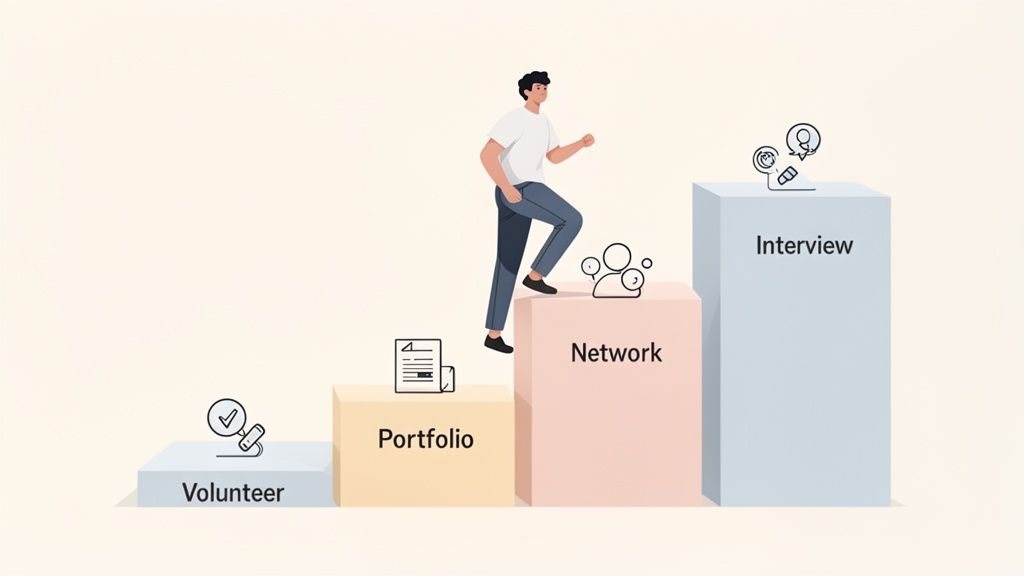
Finishing your course is a massive achievement, but it's really just the starting line. Now, the real work begins: bridging that gap between what you've learned and actually getting paid for it. To make your career change at 30 a success, you need a solid, practical plan to get your foot in the door.
This is where you start telling your story through action. It’s not just about firing off job applications. It’s about building real-world proof of your new skills and making genuine connections with people in your target industry. This shows employers you’re not just academically qualified—you're genuinely committed and ready to hit the ground running.
Get Some Runs on the Board Before You Graduate
"But I don't have any experience!" This is the number one worry for almost every career changer. The secret is to start building that experience while you're still studying. Don't wait.
You don't need a paid job straight away. Just get creative and find ways to apply your new knowledge in the real world. This hands-on experience is what will make you stand out and give you great stories to tell in an interview.
Here are a few proven ways to build that crucial experience:
- Volunteer strategically. Find a not-for-profit or community group in your new field. Even a few hours a week can give you incredible industry exposure. For instance, if you're studying Community Services, volunteering at a local youth centre is a perfect fit.
- Pick up freelance or project work. Sites like Upwork or Airtasker are great for finding small, paid projects. Studying web development? Offer to build a simple website for a local small business. This is how you start building a portfolio that speaks for itself.
- Hunt down an internship. Many courses include work placements, but there’s nothing stopping you from finding one on your own. Internships are a fantastic, structured way to learn the ropes, find a mentor, and start building your professional network.
Networking Without the Awkwardness
Let's be honest, the word "networking" can make you cringe. But it doesn't have to mean forcing small talk in a stuffy room. For a career changer, it's simply about building genuine relationships and learning from people who are already where you want to be.
Shift your mindset from "I need a job" to "I'm here to learn." You'd be surprised how willing people are to share their story if you approach them with genuine curiosity.
Your career change is your unique story. Don’t hide it. When you network, position your pivot as a strategic move driven by passion and new skills—employers find that compelling.
A few simple actions can make a huge difference:
- Give your LinkedIn a makeover. Change your headline to reflect your new career goal (e.g., "Marketing Pro pivoting to IT Support"). Start sharing articles or posts about what you're learning.
- Join industry webinars. These are a goldmine. They're a low-pressure way to get up to speed on industry trends and see who the key players are.
- Ask for a 'virtual coffee'. Find someone in a role you admire and ask for 15 minutes of their time for an "informational interview." Ask about their journey, what their job is really like, and what advice they have for someone starting out.
Telling Your Story on Paper and in Person
Think of your resume as a marketing brochure for you. As a career changer, its main job is to connect the dots for a hiring manager, showing them exactly how your past experience makes you a great fit for your future role.
Forget the old chronological format. A skills-based or combination resume is your best friend here. It lets you highlight your killer transferable skills—like project management, client communication, or data analysis—right at the very top. When you're ready to put your plan into action, crafting a resume that effectively highlights your transferable skills is crucial. Explore these career change resume examples for inspiration on how to structure your story effectively.
When you finally land that interview, be ready to own your story. Why this change? Why this company? Why now? Don't be shy about it. Frame your career pivot as your superpower—a deliberate choice that brings a unique mix of mature professionalism and fresh, hungry enthusiasm to the table.
Your Top Career Change Questions, Answered
Taking the plunge into a new career always brings up a few questions. It’s totally normal to have those “what if?” moments when you’re planning such a big move. A career change at 30 feels like a massive decision—because it is—but most of the common worries are much more manageable than they seem.
Let's cut through the noise and tackle some of the most pressing questions head-on.
Is 30 too old to start something completely new?
Not a chance. In fact, your thirties might just be the perfect time to make a change. Think about it: you’ve got a decade of real-world work experience, a much better sense of who you are, and a level of maturity that many employers are desperate for.
You're not starting from zero; you're building on a solid foundation. Fields like community services or healthcare, for example, really value the life experience older candidates bring. It helps you connect with clients and patients with a level of empathy that’s hard to teach. The trick is to frame your past as a strength that gives you a unique edge.
How can I possibly afford to study with all my financial commitments?
This is the big one, isn't it? Juggling a mortgage, bills, and maybe even a family makes the idea of quitting work to study seem like a fantasy. This is exactly why flexible online learning has become such a game-changer for career changers.
Online, self-paced courses are literally built to fit around your 9-to-5. You can keep earning while you learn, studying on evenings or weekends. Many providers also offer interest-free payment plans, which takes a lot of the financial pressure off. The modern approach is all about integrating learning into your life, not letting it blow everything up.
Your 30s are not an endpoint for career development; they are a launchpad. You have the ideal combination of experience and future potential to make a successful pivot.
Will employers see my lack of direct experience as a red flag?
Honestly, most employers are more open-minded than you’d think, as long as you can tell a convincing story. Your resume, cover letter, and interview need to clearly connect the dots for them and explain the "why" behind your move.
Your new qualification shows you're serious. After that, it's all about hammering home your transferable skills.
For example:
- Leaving hospitality for business administration? You're a pro at team leadership, rostering, budgeting, and keeping customers happy.
- Switching from retail to IT support? You’ve spent years solving problems on the fly, explaining things to non-technical people, and staying cool under pressure.
Your different background isn't a weakness—it's what makes you interesting and memorable in a stack of otherwise identical CVs.
How long does this whole process realistically take?
There's no magic number, but a solid career transition usually takes somewhere between 12 and 24 months. That might sound like a long time, but it flies by when you break it down.
Here’s what a typical timeline can look like:
- Study and Upskilling: Completing a job-ready online Certificate or Diploma while you're still working usually takes between 6 and 18 months. Because many courses are self-paced, you can often speed this up if you have more time to throw at it.
- Experience & Job Hunting: This next phase of networking, maybe some volunteer work, and applying for roles can take another 3 to 6 months.
Remember, slow and steady wins the race. Taking consistent, deliberate steps is far more effective than trying to do everything at once. It makes the whole journey feel exciting and achievable, not completely overwhelming.
Ready to see which qualifications could make your career change happen? Get Course Australia has a huge range of flexible, online courses designed for busy adults. Find the right pathway for your next career move today.
Find Your Course
Compare courses across every field we write about, and enquire in under a minute.