The Best Online Auslan Courses for Every Learner
Discover the top online Auslan courses in Australia. Our guide compares accredited diplomas and beginner classes to help you find the perfect fit.
Thinking about learning Auslan online? You've come to the right place. An online course gives you a flexible and easy way to learn Australian Sign Language, no matter where you are.
The best course for you really comes down to what you want to achieve. If you're just dipping your toes in or want to learn some basic signs for everyday conversation, a short, self-paced course is a great fit. But if you're serious about using Auslan in your career, you’ll need to look at an accredited VET qualification, like a Certificate II.
Why Learn Auslan Online
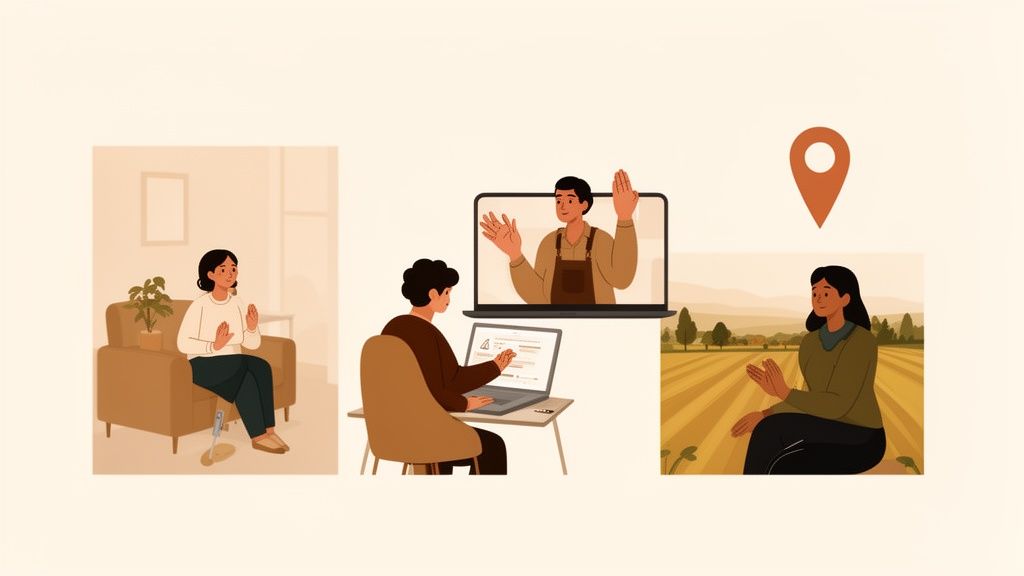
Learning Australian Sign Language (Auslan) is more than just acquiring a new skill; it's about bridging communication gaps and helping to build a more inclusive community. Thanks to a boom in online education, high-quality online Auslan courses are now more accessible than ever, breaking down geographical barriers for anyone in Australia keen to learn.
This guide is here to help you navigate the different options out there. We'll compare the various learning pathways, from introductory short courses designed for absolute beginners to nationally recognised qualifications for those on a professional track. Figuring out the difference between them is the first big step.
Comparing Your Learning Options
The right online Auslan course for you will really depend on your personal and professional goals. A community workshop, for example, might be perfect for a parent wanting to better connect with their Deaf child. On the other hand, a Certificate II is the essential starting block for someone aiming to become an interpreter.
Let’s quickly break down the two main pathways.
Choosing an online course is a strategic move for career advancement. Digital learning provides the flexibility to gain new, in-demand skills like Auslan without pausing your current professional life.
This guide will dive into each of these areas in more detail, covering everything from course costs and provider reputations to what you can do with your qualification. By understanding how online study can benefit your career opportunities, you can pick a course that truly lines up with what you want to achieve.
Whether you're learning for personal connection or professional growth, the right online program is out there waiting for you.
The Growing Demand for Auslan Skills in Australia
There’s been a real groundswell of interest in learning Australian Sign Language lately. You can feel it. It’s driven by a much-needed push for greater inclusivity and a growing appreciation for the Deaf community. But this isn't just about personal growth; it reflects a clear, practical need across many professions and community services.
As more Australians look for ways to genuinely connect, the demand for accessible Auslan courses has exploded. In response, education providers have stepped up, creating a whole host of online Auslan courses. These programs cater to everyone, from absolute beginners wanting to learn the basics to dedicated students aiming for accredited qualifications and a career. This move online has been a game-changer, opening up Auslan to so many more people.
The flexibility of studying online is a perfect fit for today's busy lives. People are juggling work, family, and other commitments, and being tied to a campus just isn't feasible. Now, you can get high-quality instruction from anywhere in Australia, which creates opportunities that simply didn't exist before.
A Community Growth and a Professional Skills Gap
A key reason for this surge in demand is the growing number of Auslan users, which stands in stark contrast to the shortage of qualified professionals to support them. The 2021 Australian Census revealed a significant jump in people using Auslan at home, rising to around 16,000 from about 10,000 in 2011. Yet, there are only 302 active interpreters nationwide. That’s a huge skills gap.
You can get a better sense of this gap from Deaf Connect's overview of beginner courses. This shortage creates a powerful reason for people to start learning. The need is particularly strong in sectors like healthcare, education, and any customer-facing role where being able to communicate in Auslan is a massive advantage.
This isn't just a trend; it's a fundamental shift towards a more accessible society. The current shortage of interpreters means that every new learner contributes to bridging a vital communication divide, enhancing both their career prospects and community connection.
The Rise of Flexible Online and Blended Learning
To meet this demand, providers have gotten creative with how they deliver courses. The traditional classroom is no longer the only way to learn; online and blended formats are now incredibly popular.
- Self-Paced Online Modules: Perfect for beginners or anyone with a hectic schedule. You can learn foundational signs and concepts whenever it suits you.
- Live Virtual Classrooms: These sessions are fantastic for getting real-time interaction with instructors and classmates. It gives you immediate feedback and that sense of community so vital for language learning.
- Blended Models: This approach mixes the convenience of online study with occasional face-to-face workshops. It really gives you the best of both worlds—flexibility and practical, hands-on practice.
This adaptability has made Auslan education far more accessible, especially for people in regional and remote areas. In the past, if there wasn't a local provider, you were out of luck. Online platforms have completely removed that barrier. Now, anyone with an internet connection can start their journey, whether the goal is to learn a few signs for fun or to become a professionally fluent user.
Accredited Qualifications vs Short Courses Compared
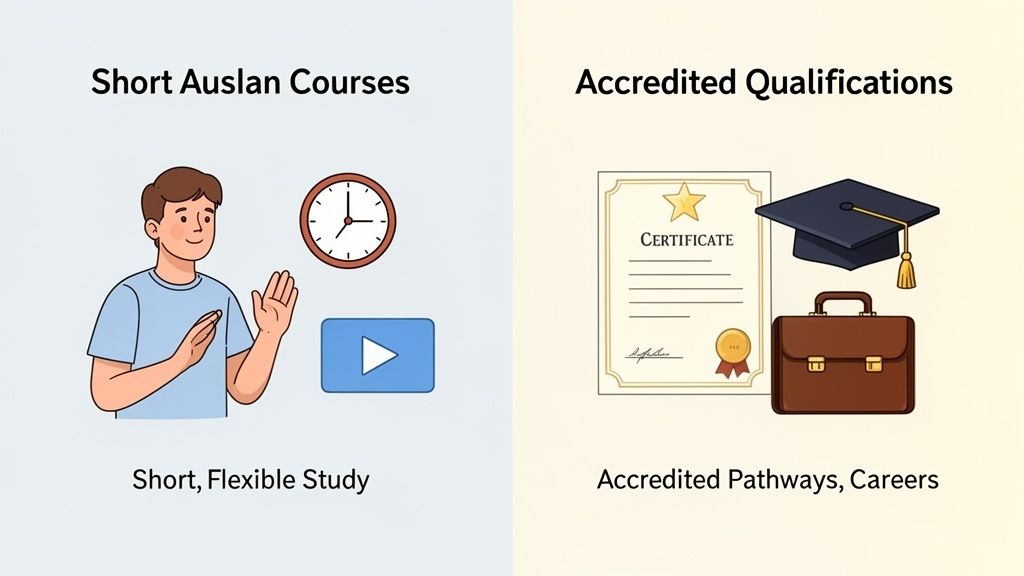
When you start looking into learning Auslan online, you'll quickly discover there are two main roads you can take: introductory short courses and nationally recognised accredited qualifications. They might both teach you how to sign, but they’re built for completely different journeys and lead to very different destinations.
Getting this distinction right from the start is the most important step you'll take. It ensures the online Auslan course you choose actually fits what you want to achieve. A non-accredited short course is perfect if you’re learning for personal interest or to add a basic skill to your job. On the other hand, an accredited qualification is a serious, in-depth program that lays the groundwork for a professional career using Auslan.
Learning Outcomes and Depth of Study
The biggest difference between the two is just how deep you'll go. An introductory short course is really designed to give you a feel for the language.
Think of it as a conversational starter pack. You’ll pick up the essentials – greetings, fingerspelling the alphabet, and some basic signs for everyday topics like family, food, or hobbies. The whole point is to get you communicating on a simple level, right away.
Accredited Vocational Education and Training (VET) qualifications, like a Certificate II or III in Auslan, are a different beast altogether. These courses are built around a robust curriculum that dives into not just vocabulary but also the intricate grammar, syntax, and cultural nuances that make Auslan a living language. You’ll be studying linguistic principles, the history of the Deaf community, and the ethics of communication. The goal here is genuine, functional fluency—the kind you need to work in a professional setting.
An accredited course awards you a nationally recognised statement of attainment, which formally verifies that you’ve met a specific standard. A short course gives you a certificate of completion—a fantastic personal achievement, but it doesn't carry the same weight in the eyes of employers looking for qualified professionals.
If you want to get your head around the formal recognition process in Australia, our guide on what makes a course accredited breaks it all down.
Career Pathways and Industry Recognition
Your career goals should really steer this decision. If you dream of using Auslan professionally—as an interpreter, a teacher’s aide, or a community support worker—then an accredited qualification isn’t just an option; it’s a necessity.
These are the qualifications that employers and professional bodies across Australia recognise as the benchmark for competence. Finishing a Certificate II is often the stepping stone you need to get into higher-level studies, like a Diploma of Interpreting. Without that formal training, those professional doors will likely remain closed.
A short course, however, is a fantastic way to enhance your current career. For instance:
- A healthcare professional can use basic Auslan to build rapport and communicate more effectively with Deaf patients.
- A childcare worker can foster a more inclusive space by teaching simple signs to all the children in their care.
- A retail or customer service worker can help a Deaf customer with a straightforward question.
In these situations, the aim isn't to become a fluent practitioner but to improve communication and accessibility. The certificate you get shows a real commitment to inclusivity, which is always a great look on a resume.
Time Commitment and Financial Investment
It probably comes as no surprise that the investment in time and money is worlds apart for these two paths. Introductory online Auslan courses are built to be flexible and accessible.
Most are self-paced, meaning you can knock them over in a few weeks or even a weekend. They’re also light on the wallet, usually costing anywhere from under a hundred to a few hundred dollars. This makes them a brilliant, low-risk way to test the waters and see if you enjoy the language before diving into something more intense.
Accredited qualifications are a much bigger commitment. A Certificate II in Auslan can take six months to a year and involves a structured schedule with regular classes (even if they’re online), practical assessments, and a lot of independent study. The price tag is also higher, often in the thousands, though you may be eligible for government subsidies or VET Student Loans to help with the cost.
Online Auslan Course Types Compared
Here’s a simple side-by-side look to help you weigh your options based on what matters most to you.
Ultimately, making the right choice comes down to being honest about your end goal. If you're exploring a new hobby or just want to add a useful skill to your toolkit, a short course is a smart, low-risk move. But if you see a future where Auslan is a core part of your professional life, then an accredited qualification is the only real path forward.
Comparing the Top Online Auslan Course Providers
Choosing where to study Auslan online isn't just about picking a course; it's about finding a provider that clicks with how you learn and what you want to achieve. While there are many options out there, the big names in the game—like Deaf Connect, Melbourne Polytechnic, and the various TAFEs—each have a totally different vibe. Understanding what sets them apart is the key to making the right choice.
Some providers throw you right into the deep end with an immersive, community-first approach, which is fantastic for anyone on a formal accreditation path. Others are brilliant at offering accessible, go-at-your-own-pace content that’s perfect for dipping your toes in. Let's pull back the curtain on what makes each of these top providers tick.
Deaf Connect: The Community-Led Authority
Deaf Connect isn't just a training organisation; it's the largest service provider for Deaf, deafblind, and hard-of-hearing Australians. This is their superpower. When you learn with Deaf Connect, your teachers are Deaf, bringing their lived experience and cultural richness into every single lesson. It’s as authentic as it gets.
Their accredited courses, especially the Certificate II and III, are built around practical, real-world use and cultural immersion. You’re not just learning signs in a vacuum. The setup often mixes online theory with live virtual classes and in-person workshops, making sure you grasp the why behind the signs and the community they belong to.
For anyone serious about a career using Auslan, the cultural understanding you gain from a Deaf-led provider is priceless. It goes beyond simply knowing the signs and helps you build genuine respect for Deaf culture—an absolute must for aspiring interpreters or community support workers.
If you value authenticity and want a direct line to the Deaf community from day one, this is the place for you. Their structured, blended model is perfect for students in accredited courses who need the flexibility of online study but also crave that crucial real-time interaction.
Melbourne Polytechnic: A VET-Focused Academic Approach
Melbourne Polytechnic delivers Auslan qualifications with a more traditional vocational education and training (VET) flavour. As a major polytechnic, its programs are built on a solid academic foundation, digging into the linguistic theory and principles behind Auslan. This makes it a great fit for anyone who thrives in a structured, curriculum-first environment.
You can expect a blend of online learning portals for your course materials and scheduled virtual classes for direct teaching. It offers the predictability of a standard TAFE or uni course, just with the added convenience of online access. Because it’s a larger institution, you’ll also likely have access to more extensive student support, like academic help and library resources.
Consider Melbourne Polytechnic if you:
- Like a formal, academic learning style with very clear assessment goals.
- Are aiming for further study where a VET qualification is a stepping stone.
- Want the safety net of comprehensive student support services that come with a large institution.
Their approach is especially well-suited to career-changers or school leavers who are used to formal study and see Auslan as a key piece of their professional development within the VET system.
The TAFE Network: Localised and Practical Training
TAFE institutions across the country, like TAFE NSW and TAFE SA, are the backbone of vocational education, and their Auslan courses are no exception. While what's on offer can differ from state to state, TAFEs are known for one thing: delivering practical, job-ready skills. Their online Auslan courses are often tailored to what local communities and industries actually need, making them incredibly relevant if you plan to work in your home state.
One of the biggest draws of the TAFE system is accessibility. Many TAFEs offer government-subsidised places, which can make accredited study much more affordable. They’ve also become incredibly flexible, with many courses now running entirely online or in a blended format to suit students juggling work and family.
The TAFE pathway is a smart move for learners who:
- Want a nationally recognised qualification that focuses on practical, workplace skills.
- Might be eligible for state government funding to bring down the course fees.
- Trust the solid reputation of a government-backed training provider.
To get a wider view of your options, you can browse a full list of Australian course providers and see how TAFEs stack up against specialists like Deaf Connect. Ultimately, picking the right provider comes down to matching their teaching style and community focus with your own learning needs and future goals.
Building a Career with Auslan Skills
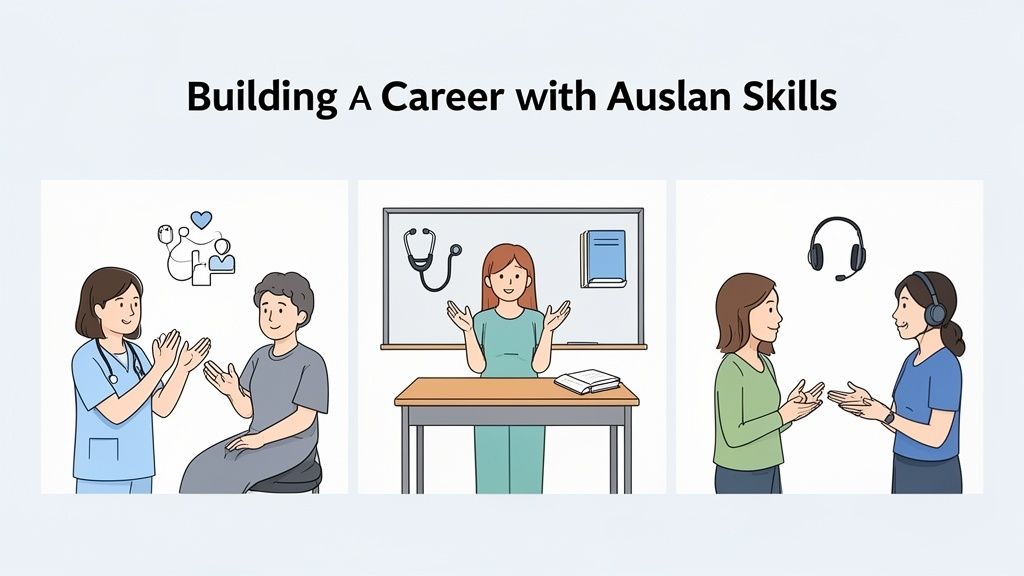
Finishing an online Auslan course is more than just a personal goal; it can be your launchpad into a deeply rewarding profession. While a short course can certainly boost your skills in an existing job, an accredited qualification is what really opens up new career paths, especially in fields crying out for proficient Auslan users.
For anyone serious about a professional career, the Certificate II in Auslan is the typical starting block. Think of it as the foundational key that unlocks more advanced study, like the Diploma of Interpreting—a non-negotiable for becoming a professional Auslan interpreter. It's a stable and impactful career, largely because the demand for qualified interpreters in Australia far outstrips the current supply.
Pathways Beyond Interpreting
But it's not all about professional interpreting. The need for Auslan skills weaves through a huge range of community and client-facing jobs. Holding a formal qualification makes you an incredibly attractive candidate, as the ability to communicate directly with Deaf Australians is a rare and valuable asset.
Just look at some of these high-demand career pathways:
- Disability Support Worker: Imagine being able to provide more empathetic and effective support by communicating with clients in their first language. It builds stronger relationships and fosters genuine independence.
- Teacher's Aide (Education Support): You could be the person in the classroom ensuring Deaf and hard-of-hearing students get fair access to education, helping them participate fully alongside their peers.
- Community Services Worker: In roles centred on welfare, advocacy, or support, you can break down the communication walls that often prevent Deaf community members from accessing essential services.
These aren't just jobs; they're opportunities to make a real, tangible difference. An accredited qualification gives you both the language fluency and the cultural insight to do this work with competence and respect.
The real professional edge of Auslan proficiency is how immediately useful it is. In sectors that constantly struggle with communication gaps, a qualified Auslan user isn't just a team member—they're an invaluable resource who elevates the entire team's ability to deliver inclusive services.
Enhancing Your Current Profession
You don't have to switch careers to feel the impact of learning Auslan. Many professionals are finding that becoming proficient in Auslan dramatically improves their effectiveness and helps create a more inclusive atmosphere right where they are. This is particularly true for anyone in a frontline service role.
Vocational education providers often point out how useful Auslan skills are in fields where many adults already work, such as teaching, childcare, community welfare, public service, and health. For people in these jobs, gaining Auslan skills through flexible online study is a powerful way to upskill, rather than making a complete career change. You can learn more about how TAFE supports these learning pathways.
For instance, a nurse with Auslan skills can talk directly with a Deaf patient about their condition, providing far better care and minimising the risk of dangerous misunderstandings. In the same way, a childcare educator can create a truly welcoming space for a Deaf child and their family, supporting crucial early development.
Across both public and private sectors, having staff who can use Auslan is increasingly seen as essential for equitable service delivery. By enrolling in an accredited online Auslan course, you're not just learning a language; you're investing in a skill that is in high demand and deeply enriching, opening up a whole new world of professional possibilities.
How to Choose the Right Online Auslan Course
Picking the perfect online Auslan course can feel like a huge decision, but it's much easier once you know what you’re trying to achieve. By getting clear on your personal goals, budget, and how you like to learn, you can confidently find a path that fits your life.
The best first step is a little self-reflection. Answering a few straightforward questions will immediately help you filter through the options, showing you whether a flexible short course or a formal qualification is the right fit. This initial clarity saves you from putting time and money into a course that just isn't right for you.
Define Your Primary Motivation
Before you even look at course descriptions, ask yourself a simple question: Why do I want to learn Auslan? Your answer is genuinely the most important piece of the puzzle. Are you learning for personal reasons, or is this a career move?
- For Personal Interest: If you're hoping to chat with a family member, get involved in your local community, or just pick up a new skill, a non-accredited short course is a fantastic starting point. They're usually low-cost, flexible, and get you signing basic phrases almost immediately.
- For Professional Development: If your goal is to become a qualified interpreter, a disability support worker, or to use Auslan in a professional capacity, you absolutely need an accredited VET qualification. Your pathway has to start with a nationally recognised program, like a Certificate II.
Assess Your Practical Constraints
Once you know your 'why', it's time to get real about your resources. How much time and money you can commit will quickly narrow down your best options.
Think about your weekly schedule. Can you lock in time for scheduled virtual classes and meet deadlines, or do you need a course that’s completely self-paced so you can slot it in around work and family? Likewise, what’s your budget? Are you after a cheap and cheerful entry point, or are you ready to invest in a full qualification, perhaps with the help of a government subsidy? When weighing your options, it's also worth thinking about what makes a great online learning setup, including the tech and tools platforms offer, like the best tools for distance learning.
Your learning style is another huge factor. Do you learn best with the structure of live online classes and direct feedback from a teacher? Or do you prefer to go it alone with pre-recorded videos and exercises? Be honest with yourself about what actually keeps you motivated.
Scenario-Based Recommendations
Let's put this into practice with a few common examples:
- The Healthcare Professional: You want to communicate more effectively with Deaf patients. Recommendation: A flexible, self-paced online short course focusing on conversational basics and some medical-specific signs is your best bet to start.
- The Aspiring Interpreter: Your end goal is a career as a professional interpreter. Recommendation: Don’t hesitate. Enrol in an accredited Certificate II in Auslan. It’s the non-negotiable first step on your professional journey.
- The Curious Parent: You want to learn some signs to support your child or connect with other families in the Deaf community. Recommendation: A fun, introductory online community course is the perfect, low-pressure way to get started.
By matching your own situation to these kinds of real-world scenarios, you can choose an online Auslan course with confidence, knowing it’s the right move for you.
Frequently Asked Questions
Thinking about jumping into an online Auslan course often brings up a few practical questions. Sorting out these final details can help you enrol with confidence, so you know exactly what your learning journey will look like.
Here are some of the most common queries we see.
Do I Need Any Prior Experience to Start?
Not at all! For most introductory short courses and even the accredited Certificate II in Auslan, there are no formal prerequisites. These courses are built from the ground up for absolute beginners who have zero prior knowledge of signing.
Of course, if you're looking at higher qualifications like a Certificate III or IV, you'll need to have passed the certificate level below it. This makes sure you've got the solid foundation needed to tackle more complex skills.
What Technology Will I Need?
Since Auslan is entirely visual, you’ll need a few basics to get the most out of an online class. Being able to see your teacher and yourself clearly is non-negotiable for learning and getting your signs right.
You'll definitely need:
- A stable internet connection.
- A computer or laptop with a decent webcam.
- Good lighting, so your hands, face, and upper body are clearly visible on camera.
Your course provider might use a specific learning platform or common video software like Zoom. Don't worry, they'll always walk you through how to use these tools before your first class, so you'll feel completely prepared.
How Are Online Auslan Courses Assessed?
Assessments are all about checking your practical signing skills and your understanding of the theory behind the language. For a non-accredited short course, this could be as simple as fun quizzes or sending in a short video of yourself signing a few phrases.
Accredited qualifications are a bit more formal. You'll likely see a mix of written tasks about Deaf culture and language, alongside practical video assessments. For these, you’ll record yourself signing specific conversations or telling a story. A qualified Deaf or native-signing assessor then reviews your submission, giving you detailed feedback on your fluency, accuracy, and expression.
Ready to find the perfect course to match your goals? At Get Course Australia, we connect you with leading online course providers across the country. Discover flexible, job-ready qualifications and start your learning journey today. Explore our range of courses at https://getcourse.com.au.
Find Your Course
Compare courses across every field we write about, and enquire in under a minute.