A Guide to Online Courses Australia
Discover the best online courses Australia has to offer. This guide breaks down qualifications, providers, and career paths to help you find the right fit.
Online courses in Australia offer a genuinely flexible way to gain nationally recognised qualifications or pick up new skills, all from the comfort of your own home. This modern take on education lets you fit learning around your existing work, family, and life commitments, making that next career step—or a complete change—feel truly achievable.
The Rise of Online Learning in Australia
The whole idea of how we learn and upskill has been completely turned on its head. Gone are the days when a quality education meant you had to be physically present in a lecture hall. Today, online learning has opened up a world of new opportunities, offering everything from short professional development courses to full-blown university degrees, all through a screen.
This isn't just a passing phase; it's a massive shift in the Australian education scene. The ability to study at your own pace is a huge drawcard, especially for those juggling a full-time job or managing a busy family life. Whether you’re chasing a promotion, switching careers entirely, or just diving into a personal passion, online study provides the framework to get you there.
A Booming Digital Education Sector
The numbers speak for themselves. Australia's online education market was valued at around $3.85 billion in 2023 and is on track to hit an estimated $5.81 billion by 2027. This boom is driven by incredible demand, with over 50% of Australian adults taking part in some form of online training last year, often in high-demand areas like business, IT, and healthcare.
This explosion in popularity is great news for students, as it means more choice and better quality courses than ever before. As the technology evolves, so do the teaching methods, with many providers exploring things like adaptive learning technologies that can customise course content to fit how you learn best.
At its heart, the appeal of online learning is simple: it breaks down the old barriers. Location, time zones, and rigid timetables no longer stand in the way of gaining valuable skills and qualifications.
What This Means for You
This shift puts you firmly in the driver's seat of your career. You can gain practical, job-ready skills that employers are actively searching for, all without needing to press pause on the rest of your life.
To get a better handle on this trend, check out our guide on why more Australians are taking online courses. It provides a great backdrop for everything we'll cover next, from understanding the different types of qualifications to figuring out which course is the perfect fit for you.
2. Decoding Australian Qualifications From TAFE to Degrees
Stepping into the world of online courses in Australia can sometimes feel like trying to understand a new language. You'll see terms like 'Certificate IV', 'Diploma', and 'AQF' thrown around, but what do they actually mean for your career?
Think of Australian qualifications as a builder's toolkit—each tool has a very specific purpose designed for a particular job. Getting your head around this system is the first step to choosing a path that actually gets you where you want to go, ensuring you walk away with a qualification that Aussie employers recognise and value.
The Australian Qualifications Framework Explained
At the heart of all this is the Australian Qualifications Framework (AQF). The AQF isn't a college or a university; it’s the national policy that sets the standard for every formal qualification in the country. It organises qualifications into 10 levels, creating a clear ladder from a high school certificate right up to a PhD.
This framework is fantastic because it shows you how different qualifications connect. You can see how a Certificate IV can be a stepping stone into a Diploma, which might then get you credit towards a Bachelor's Degree at uni. It’s all designed to support lifelong learning, letting you stack your skills and credentials over time.
The infographic below shows how online learning creates a flexible path to picking up new skills and moving your career forward.
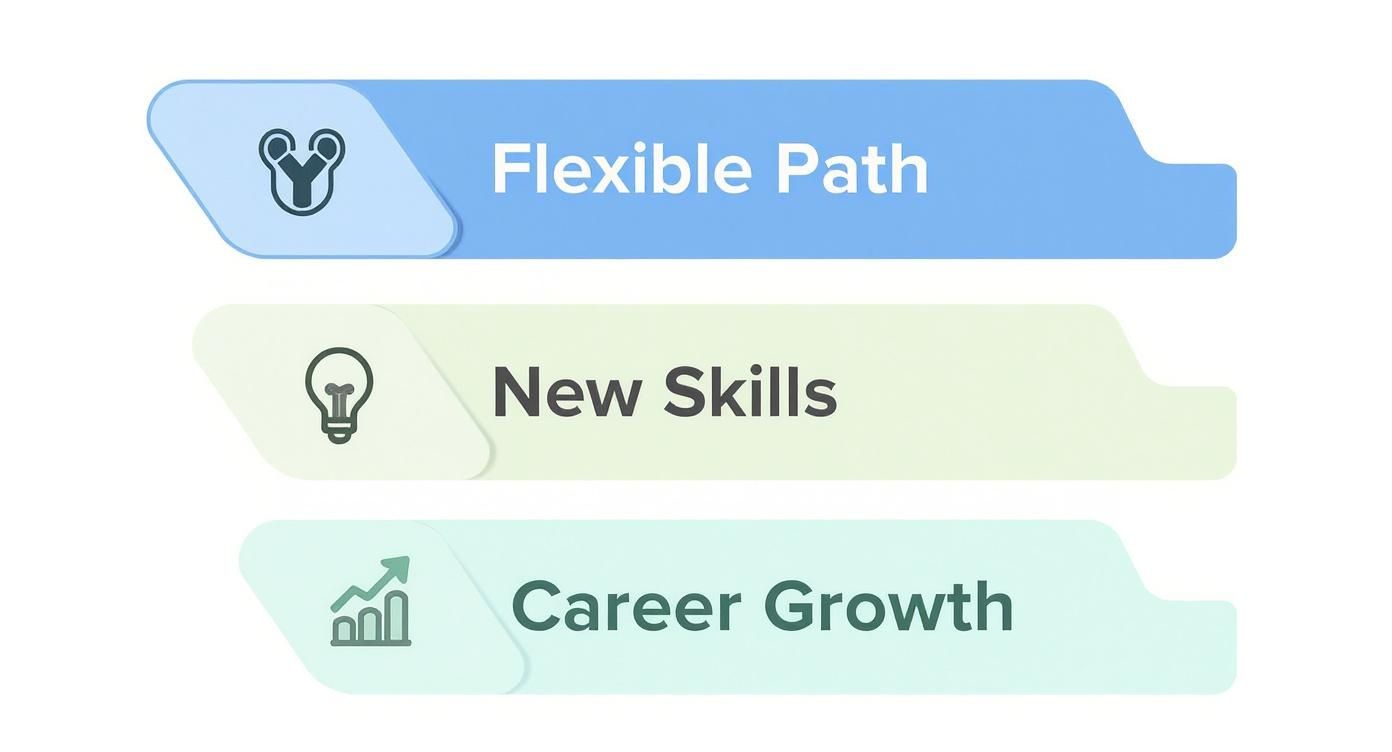
The real takeaway here is that online education isn't about a single destination. It’s a dynamic process that gives you the power to adapt and get ahead, one skill at a time.
Nationally Recognised Training vs. Short Courses
One of the biggest things to get straight is the difference between nationally recognised qualifications and other short courses. They both have their place, but they do very different jobs.
A nationally recognised qualification is any course that’s part of the AQF. These are delivered by Registered Training Organisations (RTOs), which include TAFEs and many private colleges. Finish one of these, and you get a formal qualification that’s officially recognised by employers and other educational institutions right across Australia.
On the other hand, a short course (often called professional development) usually isn't accredited under the AQF. These are laser-focused on teaching a specific skill, like mastering a new software or a particular marketing technique. They’re brilliant for upskilling fast, but they don't give you a formal qualification.
Think of it like this: a nationally recognised qualification is like earning a driver's licence—it's a formal credential proving you have the comprehensive skills to operate a vehicle safely. A short course is like an advanced driving workshop to learn a specific skill, like defensive driving in the rain. Both are useful, but only one is a formal, widely recognised credential.
To help you get a clearer picture, this table breaks down the main differences at a glance.
Recognised Qualifications vs Short Courses: A Snapshot
Choosing the right option really comes down to what you need right now. For a deeper dive, especially if you're weighing up TAFE-level options, you can explore the differences between diploma and certificate courses in Australia and see how they fit into a career plan.
Common Qualification Levels and What They Mean
So, what do those different course levels actually mean in practice? Let's break down the most common ones you'll see.
- Certificate III: This is your foundational, job-ready qualification. It’s often the entry-level ticket for skilled trades or service industries and is all about practical, hands-on skills.
- Certificate IV: A step up from a Cert III, this qualification gives you more specialised, advanced skills. It often gets you ready for supervisory roles and can be a great pathway to a Diploma.
- Diploma: A Diploma offers deep technical knowledge in a specific field. Graduates are usually prepared for paraprofessional roles and can often use their Diploma to get into university with credit.
- Bachelor's Degree: This is your classic undergraduate degree from a university. It’s focused on building a deep theoretical understanding and strong analytical skills for a professional career.
How to Choose the Right Online Course
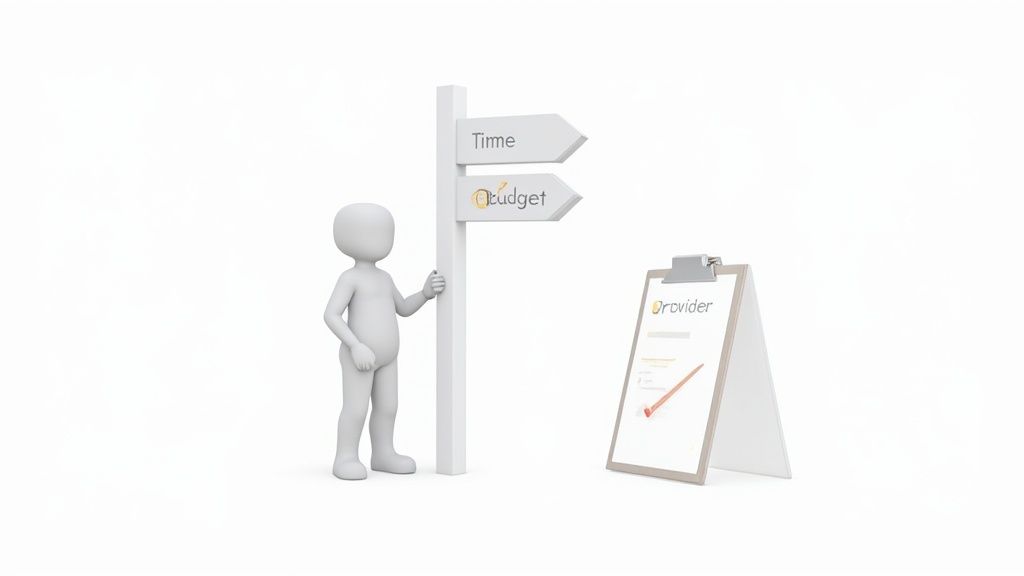
With a seemingly endless sea of online courses, picking the right one can feel a bit daunting. It’s easy to get lost in the options. The trick is to tune out the noise and figure out what you actually need.
Instead of just browsing, it’s about creating a personal checklist. This means getting really honest about what you want to achieve, how much time and money you can genuinely commit, and which providers are going to give you the best bang for your buck.
Start With Your Career Goals
First things first, let's pin down your 'why'. Before you even open a single course page, ask yourself why you're thinking about studying online right now. Having a clear goal is the single best filter for cutting through the clutter.
So, what’s the plan? Are you trying to:
- Break into a new industry? In that case, you'll want to focus on foundational, nationally recognised qualifications like a Certificate III or IV.
- Climb the ladder at your current job? Look for a specialised Diploma or targeted short courses that add serious weight to your existing skill set.
- Learn a specific, in-demand skill? A punchy short course in something like digital marketing or data analysis could be just the ticket.
- Kick off a side hustle or your own business? You’ll need practical, hands-on skills you can use from day one, which you’ll find in courses focused on business management or a specific trade.
Answering these questions transforms a vague thought like "I should do a course" into a solid plan, such as "I need a Certificate IV in Community Services to become a support worker." See the difference?
Assess Your Practical Constraints
Once your goal is in sharp focus, it's time for a reality check. The most amazing course in the world is useless if it doesn't actually fit into your life. So, be brutally honest with yourself about your budget and how many hours you can realistically study each week.
Time Commitment
Think about how many hours you can truly carve out. Most online courses in Australia are self-paced, which sounds great, but you still need discipline. A Diploma might demand 10-15 hours a week of your time, whereas a quick short course might only need a few.
Budget and Payment Options
Costs vary wildly, from a couple of hundred dollars for a professional development module to thousands for a full-blown Diploma. The good news is that many providers offer flexible payment plans, like weekly or fortnightly instalments, so you don’t need a huge chunk of cash upfront.
Your perfect course lies at the intersection of your career goals, your available time, and your budget. Nailing this balance is the secret to not just starting a course, but actually finishing it.
Evaluate the Course Provider and Content
Let's be clear: not all education providers are created equal. The quality of your learning and the respect your qualification gets in the real world all comes down to who you choose to study with.
Here’s a quick checklist to size up any potential provider:
- Accreditation: Is the course nationally recognised and delivered by a Registered Training Organisation (RTO)? This is non-negotiable if you need a formal qualification for a job.
- Industry Connections: Does the provider actually talk to people in the industry? A curriculum designed with input from real-world experts means you’ll be learning relevant, up-to-date skills.
- Student Support: What happens when you get stuck? Look for real access to trainers, reliable tech help, and even a student community. Good support is a lifeline when you're studying online.
- Reviews and Testimonials: What are past students really saying? Check independent sites like Trustpilot for the unfiltered truth about their experience.
Australia's online education scene is booming for a reason. In 2025, the market is expected to pull in US$4.91 billion in revenue, with the number of users growing to 24.9% of the population. This huge demand is driven by people just like you looking for quality, flexible learning.
Knowing what makes a great online course will help you spot a winner. Check out these 9 essential online learning best practices for 2025; they'll give you a framework for identifying providers who are genuinely invested in their students' success. By carefully weighing these factors, you can go from feeling overwhelmed to feeling empowered, ready to choose your perfect online course with confidence.
Finding Top Online Course Providers in Australia
Picking the right online course provider is just as crucial as picking the right course. In Australia, you’ve got a lot of choice, and it helps to know who’s who. The online learning world is pretty diverse, with different institutions excelling in different areas. Knowing the lay of the land is the first step to finding a provider that truly clicks with your career goals and how you like to learn.
You can generally group providers into three main camps: universities offering comprehensive degrees, TAFEs focused on job-ready vocational skills, and a whole host of private providers delivering super-specialised training.
Universities Online Learning
Australian universities were early pioneers of distance education, and they've only gotten better at it. Big names like Deakin, Monash, and RMIT now offer world-class Bachelor's and Master's degrees entirely online. The focus here is on deep theoretical knowledge and critical thinking.
This is the path for you if you're chasing a traditional academic qualification to get into fields like engineering, law, or medicine. These degrees carry a lot of weight, but be prepared for a serious commitment in both time and money, often following standard university semesters.
TAFE and Vocational Training
TAFE (Technical and Further Education) is the backbone of Australia’s vocational training sector. Providers like TAFE Digital are experts at delivering nationally recognised qualifications that are all about practical, hands-on skills employers are looking for right now.
A TAFE qualification, like a Certificate IV in Community Services or a Diploma of Information Technology, is your ticket if you want to gain specific skills for a trade or a hands-on professional role. They offer a more direct route into the workforce and are highly valued by employers for their real-world focus.
Private Registered Training Organisations
Then you have the private Registered Training Organisations (RTOs). There are hundreds of them, and they offer an incredible range of online courses, often in niche areas you won't find elsewhere—think everything from animal care to digital marketing or interior design. Their biggest selling point is flexibility; most offer self-paced study and let you enrol anytime during the year.
This makes them a fantastic option if you're changing careers or just need to upskill quickly without signing up for a three-year degree. They're known for working closely with industry pros to keep their content fresh and relevant.
A special mention has to go to Open Universities Australia (OUA). Think of them as a gateway to university-level study. They’ve built a central hub where you can enrol in subjects and even full degrees from multiple top Australian universities, all through one single platform.
The screenshot below shows just how clean and easy it is to start exploring different study areas on the Open Universities Australia homepage.
It’s a perfect example of how much easier it has become to access higher education in Australia, no matter your background.
Platforms like OUA have been instrumental in opening up university to more people. Since starting in 1993, OUA has helped over 540,250 people enrol in university courses. Many of these students jump into high-demand fields like data analysis, proving just how valuable that flexibility is. You can learn more about studying statistics online with Open Universities Australia on their site.
Understanding Delivery Formats
Finally, let’s talk about how the course is actually delivered, because this will shape your entire study experience. It really boils down to two main styles:
- Asynchronous (Self-Paced): This is the most common setup for TAFE and private RTOs. All your materials—lectures, readings, and assignments—are ready and waiting for you online. You log in and study whenever you want, which is a lifesaver for anyone juggling work, family, or a chaotic schedule.
- Synchronous (Live-Streamed): You'll see this more often with university courses. It involves tuning in for live lectures and tutorials at set times via video conference. You get that real-time interaction with your lecturers and classmates, which helps create a more traditional classroom vibe from home.
The choice between them is personal. Do you need the structure of a timetable and enjoy live discussions? Or do you value the freedom to study at midnight if that's what works for you? Answering that question will get you one step closer to finding the perfect provider for your online courses australia journey.
Navigating Enrolment and Finding Student Support
https://www.youtube.com/embed/K7c9Sy-nPZI
Choosing your course is a huge step, but the journey really kicks off with enrolment. This part shouldn't feel like a barrier. For most online courses Australia offers, getting started is a pretty simple process designed to get you learning as quickly as possible.
The first part is usually just a simple online form. After that, you'll need to send through some basic documents. This typically includes proof of identity, any old academic transcripts, and your Unique Student Identifier (USI) – that's the number the Australian government uses to keep track of your vocational education and training.
Once your application is looked over, you’ll get an offer. Accepting it is the final step before you can log in to your learning portal and officially get started.
The Importance of Strong Student Support
While the course content is vital, what truly sets a provider apart is the quality of its student support. Studying online doesn’t mean you have to go it alone. The best institutions build an entire ecosystem around you to make sure you feel connected and guided, not isolated.
Think of student support as your personal pit crew. When you hit a bump in the road—whether it's a tricky assessment question or a technical glitch with the learning platform—you need a team that can get you back on track, fast. Without it, small hurdles can quickly turn into major roadblocks.
Great student support is the difference between just another online course and a genuine learning experience. It’s the assurance that there’s always someone in your corner, ready to help you succeed from enrolment to graduation.
What Does Great Support Look Like?
When you're weighing up different providers, look for a comprehensive support network. It’s a clear sign that an institution is genuinely invested in its students' success. Top-tier support for online learners in Australia usually includes a few key things.
You should have easy access to academic help from trainers or tutors who can answer your questions about the course material. This might be through email, phone calls, or even scheduled one-on-one sessions.
On top of that, reliable technical support is non-negotiable. A dedicated IT helpdesk that can quickly sort out platform issues or software problems makes sure your learning is never held up for long. Many of the leading providers also offer:
- Online Libraries and Resources: Access to digital journals, articles, and research materials to back you up on assignments.
- Mental Health and Wellbeing Services: Confidential counselling and resources to help you manage the stress that can sometimes come with study.
- Career Services: Help with resume writing, interview prep, and job searching to make the most of your new qualification.
This holistic approach is fast becoming the standard. For example, providers like Swinburne Online offer a full suite of services, including dedicated Student Advisors, 24/7 tech support, and even mental health counselling, ensuring every student has the tools they need to thrive. Choosing a provider with this level of care means you're not just enrolling in a course, but joining a community that's genuinely committed to your growth.
Connecting Your Online Course to Real Career Outcomes

Finishing an online course is a huge achievement, but let's be honest, the real prize is seeing that hard work pay off in your career. This is the moment your investment in time and effort translates into a better job, a promotion, or a whole new professional direction in the Australian job market.
Think of your new qualification as a key. It’s not just a certificate to hang on the wall; it’s a purpose-built tool designed to unlock specific doors, whether that's getting your foot in the door of a new industry or climbing the ladder where you are now. It’s your proof to employers that you have both the skills and the drive to succeed.
From Qualification to Job Title
The path from online study to a new job title is often more direct than you might think. A good course is designed backwards from what the industry actually needs, giving you a clear pathway from the virtual classroom to a real-world role.
Here are a few concrete examples of how this works:
- A Diploma of Project Management doesn't just teach you theory. It gives you the exact methodologies used in roles like Project Coordinator or Project Administrator, so you're speaking the industry's language from day one.
- Finishing a Certificate IV in Information Technology (Cyber Security) provides the foundational skills you need to confidently apply for positions like a junior Cyber Security Analyst or Technical Support Officer.
- A Graduate Certificate in Data Analytics is the perfect launchpad for pivoting into the booming tech world as a Data Analyst, equipping you with specialised, in-demand knowledge.
Each of these qualifications is structured around the skills you see listed in job ads all over Australia. The goal is for you to graduate ready to hit the ground running.
Highlighting Your New Skills
Earning the qualification is step one. Step two is making sure recruiters and hiring managers actually see it. It's time to update your resume and, just as importantly, your LinkedIn profile.
Of course, add the qualification to your 'Education' section with the full title and the name of the Registered Training Organisation (RTO). But don't stop there. The real magic happens when you weave your new skills into the 'Experience' section of your resume. Instead of simply listing what you learned, show how you can apply it.
Your new qualification isn't just an academic line item—it's powerful evidence of your commitment to professional growth. Frame it as the solution to an employer's problem; you have the fresh, relevant skills they're looking for.
When you land an interview, be ready to talk about your learning journey. Discuss specific projects you worked on, the software you now know how to use, and how the course has given you the confidence to tackle the role's challenges. For a deeper dive, you can learn more about how online courses benefit your career opportunities in our detailed guide.
Ultimately, studying online in Australia is a strategic play for a stronger, more rewarding career. When you clearly connect what you’ve learned to real-world outcomes, you turn your education into a powerful engine for professional growth.
Your Questions About Online Courses Answered
Deciding to start studying is a pretty big deal, so it’s completely normal to have a few questions buzzing around your head before you commit. To help you feel confident about taking that next step, we’ve tackled some of the most common queries we hear from people looking at online courses in Australia.
Are Online Qualifications Respected by Employers?
Yes, absolutely. A nationally recognised qualification you earn online is just as valuable as one you’d get from studying on-campus. They both fall under the same national standard—the Australian Qualifications Framework (AQF)—which ensures every provider meets strict quality benchmarks, no matter how they deliver the course.
What employers really care about are the skills and knowledge you can bring to the table, not whether you were sitting in a classroom or at your kitchen table while you learned them.
In fact, studying online can be a bonus on your resume. It shows you're a self-starter who can manage your own time and stay motivated—skills that are gold in any workplace.
Can I Get Government Funding for My Course?
You might be able to. It really boils down to the specific course, the provider you choose, and your own situation. Certain vocational qualifications, especially in industries where there’s a skills shortage, can attract government subsidies or funding. The specific programs available often change and vary between states and territories.
For higher-level qualifications like diplomas, you may be eligible for schemes like a VET Student Loan, which lets you study now and pay the loan back later through the tax system. The best thing to do is check the course page on the provider's website or give them a call to find out exactly what financial assistance you could get.
What if I Have No Prior Experience in the Field?
That’s what these courses are for! Most Certificate and Diploma level qualifications are designed for people who are starting fresh. There’s no expectation that you have any background in the industry because the curriculum is built to take you from the very basics and build your knowledge and confidence step by step.
Think of a Certificate III as the perfect launchpad. It’s designed to equip you with the fundamental, job-ready skills you need to walk into a new industry. Your passion and willingness to learn are the only prerequisites you need.
How Much Time Do I Really Need to Study?
This is where the flexibility of online learning really shines. How much time you need to put in depends on the level of the qualification. Here’s a rough idea:
- Certificate III/IV: You’ll probably want to set aside about 5-10 hours per week.
- Diploma: These are a bit more involved, so you might need closer to 10-15 hours per week.
But the great thing about self-paced study is that you decide when those hours happen. You can chip away at your coursework in the evenings after work, on a quiet Sunday morning, or whenever you can find a spare moment. It’s all about making your study fit around your life, not the other way around.
Ready to take the next step and find a course that fits your career goals? At Get Course Australia, we connect you with leading providers offering flexible, nationally recognised qualifications to help you succeed. Explore courses and find your perfect fit today at https://getcourse.com.au.
Find Your Course
Compare courses across every field we write about, and enquire in under a minute.