How to Become a Youth Worker: Your Path to Making a Difference
how to become a youth worker: a practical guide to qualifications, hands-on experience, and rewarding career paths.
So, you're thinking about a career in youth work? Fantastic choice. It’s one of those rare jobs where you can see the direct, positive impact of your work every single day, helping young people navigate some of the most challenging and formative years of their lives.
But how do you get there? The path to becoming a youth worker in Australia is pretty clear-cut. It's a combination of the right education, some real-world experience, and ticking off a few essential safety checks.
Your Roadmap to a Career in Youth Work
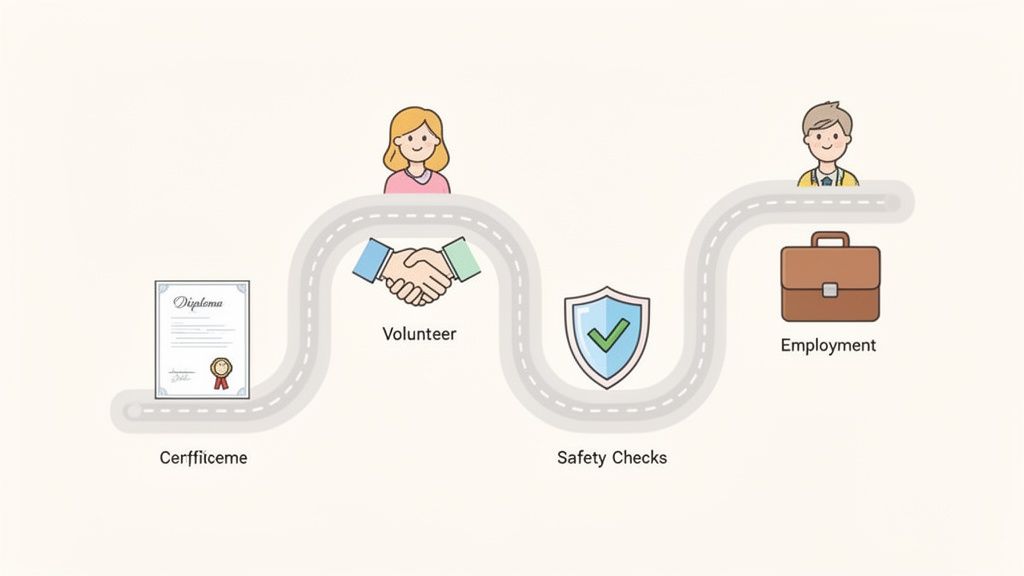
This isn't just a job; it's a calling. You become a mentor, an advocate, and a trusted guide. To do that well, you need to build a solid foundation of skills and knowledge first. This roadmap will walk you through everything you need to know, from picking the right TAFE or VET qualification to getting your hands dirty in the field and clearing all the necessary background checks.
Laying the Groundwork for Success
You'd be joining a strong community. Right now, there are 16,200 youth workers employed across the country, which shows just how vital this role is. So, where do you start?
For most people, the journey begins with a formal qualification. The industry data from Jobs and Skills Australia speaks for itself: 44.9% of youth workers hold a Certificate III or IV, and another 28.3% have a Diploma or higher. These courses are the perfect entry point, especially with so many flexible online options that let you study around your existing commitments.
To give you a bird's-eye view, the table below breaks down the essential steps.
Quick Guide to Becoming a Youth Worker in Australia
This table summarises the essential steps and requirements for starting a career as a youth worker, providing a quick reference for readers.
Think of these as the three core pillars of your new career. Getting qualified, gaining practical experience, and getting your clearances are the non-negotiables that will set you up for success.
Choosing the Right Youth Work Qualification
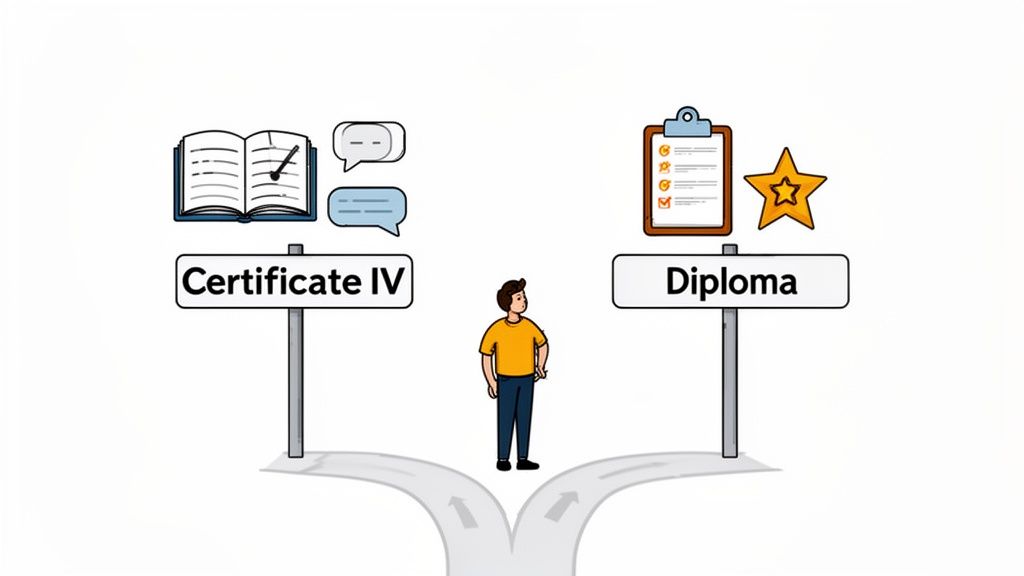
Your qualification is more than just a piece of paper; it’s the bedrock of your career. It gives you the theory and practical frameworks you'll be drawing on every single day out in the field. For most aspiring youth workers in Australia, the journey starts with one of two nationally recognised VET qualifications.
Which one is right for you? It really boils down to where you are now and where you want to go. Think of it as choosing the right gear for an expedition. Are you just starting out and need the essential survival kit, or are you ready to lead the team up the mountain?
The Certificate IV: Your Ideal Starting Point
The Certificate IV in Youth Work is the most common and practical entry point into the sector, and for good reason. It’s perfectly designed for people who are new to the field or might have some life experience but no formal training. This course is your launchpad.
It focuses squarely on the essential, hands-on skills you need to work effectively with young people from day one. You’ll get stuck into critical topics like:
- Building Rapport: How to genuinely connect and build trust with young people from all walks of life.
- Advocacy in Action: Understanding how to help youth navigate complex systems and access the services they need.
- Creating Safe Spaces: Mastering the protocols for ensuring physical and emotional safety and responding to at-risk situations.
- Cultural Competency: Developing the awareness to work respectfully with Aboriginal and Torres Strait Islander youth and those from culturally diverse backgrounds.
If you’re changing careers or leaving school with a passion to make a difference, this is almost certainly the best place to start. A great way to see if it’s a good fit is to look through a detailed Certificate IV in Youth Work course outline to see the exact units you’ll cover.
The Diploma: Aiming for Leadership
The Diploma of Youth Work is a significant step up. This qualification is tailored for people who already have some experience in a related field—perhaps disability support or community services—or who have finished a Certificate IV and are hungry for more. The Diploma prepares you not just to support young people, but to lead programs, manage complex cases, and supervise others.
It adds a strategic layer to the foundational skills of the Cert IV, with a strong focus on:
- Complex Case Management: Learning to develop, implement, and review comprehensive support plans for individual clients.
- Program Development: Gaining the skills to design, manage, and evaluate youth programs from start to finish.
- Supervisory Skills: Preparing you to confidently lead teams and mentor newer youth workers.
A Diploma is your ticket to more senior roles like Team Leader, Case Manager, or Community Development Officer. It tells employers you’re ready to take on greater responsibility and drive bigger outcomes.
Deciding between these two paths is a crucial first step. To make it a little clearer, here’s a quick breakdown of how they compare.
Comparing Youth Work Qualifications: Certificate IV vs Diploma
This table lays out the key differences to help you see which qualification aligns best with your career goals right now.
Ultimately, both qualifications are highly respected in the industry. The best choice is the one that meets you where you are and takes you where you want to be.
Gaining Essential Hands-On Experience

While your qualification gives you the foundational knowledge, your work placement is where the theory truly comes to life. This is where you roll up your sleeves and translate everything you've learned into real-world impact.
This hands-on experience is a mandatory part of any accredited youth work course for a good reason—it’s arguably the most critical part of your training. It’s your first real taste of the day-to-day challenges and incredible rewards of the job.
This isn’t just about ticking a box to graduate. It's your chance to build confidence, test your skills in a supported environment, and start making professional connections. You’ll learn the subtle art of communication that no textbook can teach—like how to de-escalate a tense situation or earn the trust of a young person who’s built their walls up high.
Finding and Securing Your Placement
Most good training providers will have established networks with local organisations and can help you find a suitable placement. But taking the initiative yourself can give you a real edge. Think about the kind of environment where you see yourself making a difference.
The options are incredibly diverse. You could find yourself in:
- Community Centres running after-school programs, workshops, or drop-in services.
- Non-Profit Organisations focusing on specific areas like youth homelessness, mental health, or refugee support.
- Local Council Youth Services delivering a huge range of recreational and support programs.
- Residential Care Facilities providing a home and intensive support for young people who can't live with their families.
Once you have a shortlist, don't be afraid to reach out directly. A well-crafted email or a phone call expressing your passion, mentioning your course, and explaining what you hope to learn can make a fantastic impression.
Turning Your Placement into a Career Advantage
Think of your work placement as one long job interview—because that’s often what it is. Your attitude, your eagerness to learn, and your ability to connect with the team and the young people you’re supporting will not go unnoticed. This is your time to shine and prove you have what it takes.
Your placement is where you'll shift from just knowing the theory to actually applying it. You'll be managing group dynamics and supporting individual growth, perhaps by implementing effective social emotional learning activities to help young people build essential life skills.
To make the most of it, be present and engaged. Ask thoughtful questions, seek regular feedback from your supervisor, and volunteer for different tasks. Sit in on team meetings, shadow experienced workers, and just absorb everything you can. It’s not uncommon for students who excel during their placement to be offered casual work or even a full-time role when they graduate. This experience doesn't just complete your course—it launches your career.
Getting Your Mandatory Checks and Clearances Sorted
Working with young people is a huge privilege, and in Australia, it comes with serious responsibilities. To protect vulnerable youth, there are a few non-negotiable legal hoops you need to jump through before you can even think about starting a placement, let alone a paid job.
Think of these as your official green light to enter the field. While it might feel like a bit of admin hassle, getting your checks done early is one of the smartest things you can do. It shows potential employers and placement hosts that you’re organised, professional, and ready to hit the ground running.
The good news is that the process is pretty standard across the country, though each state and territory manages its own system. Let's break down exactly what you'll need.
The Working with Children Check
This is the big one. The absolute cornerstone of your clearances is the Working with Children Check (WWCC). You’ll find it has different names depending on where you are—in Queensland, it’s the Blue Card, and in Tasmania, it's a Working with Vulnerable People (WWVP) registration.
Don't let the different names fool you; they all do the same thing. This check takes a deep dive into your national criminal history to flag any offences that would make it unsafe for you to work with kids and teens. It’s a legal must-have for anyone in child-related work, whether you're paid or volunteering.
Getting one usually involves:
- Filling out an online application via your state or territory’s government agency.
- Proving who you are with several forms of ID (think passport, driver's licence, birth certificate).
- Paying an application fee, though this is often waived if you’re a student on placement or a volunteer.
My advice? Apply for your WWCC the moment you enrol in your course. Processing times can be unpredictable, and you absolutely cannot start your work placement without it. Having it in hand early makes you a far more appealing candidate for placement hosts.
Other Key Clearances You'll Need
On top of the WWCC, pretty much every employer will ask for a National Police Check. This gives a broader picture of your record and is a standard requirement right across the community services sector. It’s a separate application, but you can get it done pretty easily online through an accredited body or the Australian Federal Police website.
Finally, there are a couple of other tickets that, while not always mandatory, will seriously boost your chances of landing a role:
- First Aid Certificate (HLTAID011): Proves you can keep a cool head and act confidently if a medical emergency happens.
- A valid Driver's Licence: So many youth work roles, especially in outreach, involve driving. Having your licence opens up a lot more doors.
Ticking these boxes isn't just about paperwork; it’s about showing you’re serious and fully prepared for the responsibilities that come with being a youth worker.
How to Land Your First Youth Worker Job
You’ve done the hard yards—the study is finished and your clearances are all sorted. Now for the exciting part: turning all that effort into your first paid role as a youth worker. Landing that job is all about showing employers you have the passion, resilience, and practical skills to genuinely connect with and support young people.
This process starts with your resume, which needs to be much more than a dry list of tasks. Forget the generic, corporate-style templates. In the community services sector, hiring managers are looking for personality and real-world proof that you understand the challenges young people are up against.
That's why your work placement experience is so valuable. It’s not just another line on your CV; it's the heart of your application and your best evidence that you’re ready for the job.
Crafting a Standout Resume
When describing your placement, avoid simply listing duties. Instead, focus on your achievements and the skills you put into practice. Use strong, action-oriented words to make your experience feel tangible and impactful.
For instance, instead of saying you "assisted with daily programs," you could reframe it to highlight your direct contribution:
- Developed and facilitated engaging group activities for at-risk teens, which boosted program attendance by 15%.
- Built rapport with a cohort of 12 young people, providing one-on-one mentoring and vital emotional support.
- Successfully advocated for a young person to access local mental health services, confidently navigating the referral process.
See the difference? These examples don’t just say what you did; they show the positive impact you made. That’s what will make your application stand out from the pile.
Preparing for the Youth Work Interview
Youth work interviews aren't designed to trip you up with brain teasers. They’re a genuine attempt to understand who you are, what motivates you, and how you think on your feet in realistic situations.
You can expect to be asked scenario-based questions that dig into your problem-solving skills, empathy, and emotional intelligence. They want to hear about your real-life experiences.
Be ready for questions like:
- "Tell me about a time you connected with a young person who was withdrawn or reluctant to engage."
- "What steps would you take if a young person disclosed they were in an unsafe environment?"
- "Can you share an example of how you've adapted your approach to work with a culturally diverse group of young people?"
The best way to answer these confidently is to have a simple, clear framework for telling your stories.
Using the STAR Method to Prove Your Skills
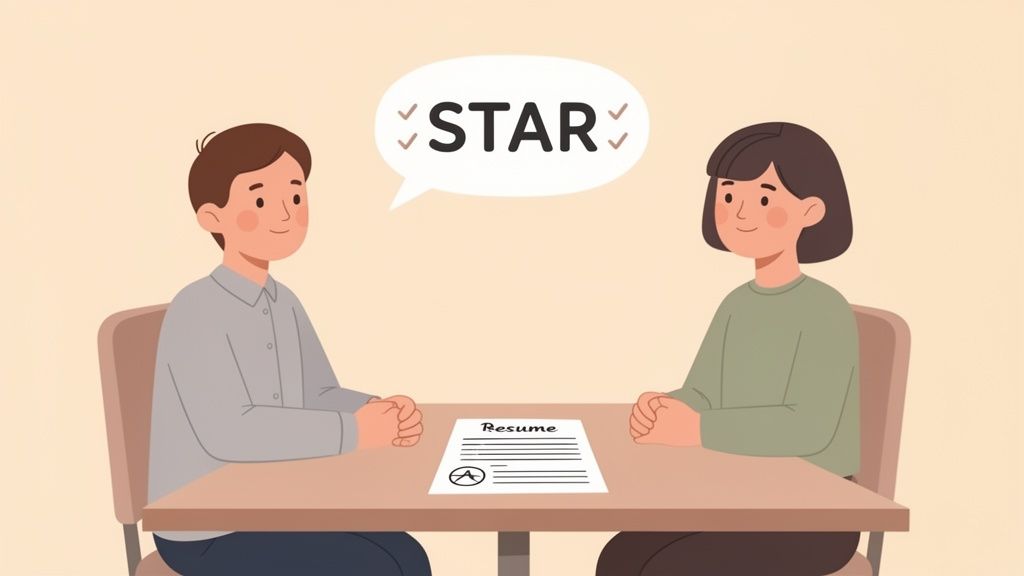
The STAR method is your secret weapon for behavioural interviews. It’s a straightforward way to structure your answers and ensure you’re providing the evidence the interviewer is looking for. It breaks your story into four clear parts:
- Situation: Briefly describe the context. Where were you? What was the scenario?
- Task: What was your specific goal or responsibility in that situation?
- Action: Detail the specific steps you personally took to handle the task.
- Result: Explain the outcome of your actions. What was the positive result? If you can, add a number or specific detail.
The STAR method stops you from rambling and keeps you focused on what matters: the outcome. It’s a powerful way of demonstrating your capability by saying, "Here's a challenge I faced, here's what I did, and here's the positive result"—which is exactly what an employer needs to hear.
Before your interview, take some time to think through your key experiences from your placement and practise framing them using this method. Walking in with a few well-prepared stories will help you feel calm, confident, and ready to show them you’re the right person for the job. You’ve got this.
Building a Long-Term Career in Youth Services
Landing your first youth worker role is a massive milestone, but it’s really just the starting line. This isn't a static job; it's a dynamic career with incredible pathways for growth, letting you sharpen your skills and focus on the areas that truly spark your passion.
When you kick off your job search, don't just stick to the usual suspects. While big sites like SEEK and Indeed are worth a look, you'll often find the most rewarding roles on industry-specific platforms. EthicalJobs and Pro Bono Australia are fantastic resources, specifically listing jobs in the community and not-for-profit sectors. You’re more likely to find organisations there that genuinely align with your own values.
Exploring Your Career Pathway
Once you’ve got your feet on the ground and a bit of experience under your belt, it's time to think about what's next. That initial support role is the perfect launchpad for moving into more senior positions where you can have a greater influence.
You'll find a few common pathways opening up as you gain experience:
- Case Manager: This is where you take the lead on developing and managing long-term support plans for young people with more complex needs. It's a role that requires deep-seated commitment and strategic thinking.
- Team Leader: Ready to guide others? As a Team Leader, you’ll supervise a team of youth workers, offering mentorship, handling daily operations, and ensuring your team is well-supported.
- Community Development Officer: If you're a big-picture thinker, this could be for you. You'll be designing and rolling out broad-scale programs that tackle systemic issues affecting young people across an entire community or region.
To truly build a sustainable career in this field, you also need to keep your skills sharp and current. This includes adapting to how young people communicate today, which often means learning new strategies for engaging youth online.
Specialisation is another powerful way to advance your career. By developing expertise in a high-demand area, you become a more valuable asset to any organisation and can make a profound difference in specific communities.
Think about focusing on areas that resonate with you, like youth mental health, Alcohol and Other Drugs (AOD) support, or working within the youth justice system. For a realistic look at what this career path holds, understanding the challenges and rewards of youth work can give you some fantastic insight as you map out your future.
Got Questions About Becoming a Youth Worker?
Embarking on a new career path always comes with a few questions. If you're wondering what it's really like to be a youth worker in Australia, you're not alone. Let's dig into some of the most common queries people have.
Is Youth Work a Stressful Job?
Let's be honest: yes, it can be. You’ll be walking alongside young people as they navigate some of life’s toughest challenges, and carrying that emotional load isn't always easy.
But here’s the other side of the coin – it's one of the most rewarding careers you can choose. A good training course will give you the tools and resilience strategies you need, and solid support from your team is crucial for managing the tougher days. The immense satisfaction you feel when you see a young person start to believe in themselves makes it all worthwhile.
What’s the Typical Salary for a Youth Worker?
In Australia, what you earn as a youth worker really depends on your qualifications, how much experience you've got under your belt, and the specifics of your role.
If you're just starting out with a Certificate IV, you can expect to earn somewhere in the range of $55,000 to $65,000 a year. Once you have a Diploma and a few years of experience, that figure can climb to $70,000 and beyond, especially if you move into a senior or specialised position.
This is a career people are drawn to for the personal impact, not the paycheque. The real reward is knowing you’ve helped change the course of a young person’s life for the better.
Do I Need a University Degree to Get Started?
Not at all. For most people getting into the field in Australia, the go-to pathway is through VET qualifications, like a Certificate IV or a Diploma of Youth Work. These courses are designed to give you the practical, hands-on skills you need to be effective from day one.
While a university degree might be needed for very specific roles in research or policy development, the vast majority of frontline youth work jobs are perfectly accessible with a VET qualification. It's all about getting the right skills for the job.
Ready to take that first step towards a career that truly matters? At Get Course Australia, we can help you find flexible, nationally recognised online courses to get you qualified and on your way.
Find Your Course
Compare courses across every field we write about, and enquire in under a minute.