Your Guide to the Certificate IV in Nursing in Australia
Is the Certificate IV in Nursing your path to becoming an Enrolled Nurse? Uncover the course details, career outcomes, and key differences from the Diploma.
Thinking about getting into healthcare? You've probably seen the Certificate IV in Nursing mentioned and thought it sounds like the perfect entry point. It's a common assumption, but it’s really important to understand where this qualification actually sits in Australia's healthcare system today. While it offers a solid foundation, it's not the direct path to becoming a registered Enrolled Nurse.
Let's break down what that means for your career plans.
Demystifying the Certificate IV in Nursing
Here's the most crucial thing to know upfront: to legally practise as an Enrolled Nurse (EN) anywhere in Australia, you need to be registered with the Nursing and Midwifery Board of Australia (NMBA). The absolute minimum qualification to get that registration is the HLT54121 Diploma of Nursing.
So, where does the Certificate IV in Nursing fit into this picture?
Think of it as the theory part of your driver's licence test. It gives you all the essential knowledge of the road rules and how a car works, which is incredibly valuable. But you can't actually get your licence and drive solo with just that knowledge. The Diploma is like your practical driving test - it's the official, hands-on qualification that proves you're ready and gets you registered to hit the road.
Getting this distinction right from the start is key to setting yourself up for success. The Certificate IV can be a useful stepping stone, but it won’t get you the professional registration you need to work as an EN.
Why It's Less Common These Days
The nursing industry has shifted its standards, and that's had a direct impact on which courses people choose. Since the Diploma of Nursing became the mandatory entry ticket for EN registration, most aspiring nurses now head straight for that qualification. It's the most direct route to their goal.
As a result, the Certificate IV in Nursing has become a bit of a niche course. To put it in perspective, the latest data shows it had just 2,705 enrolments across Australia in 2023. Compare that to a course like the Certificate III in Individual Support - a hugely popular starting point for aged and disability care - which had a massive 107,210 enrolments.
This trend shows that students are savvy; they're choosing courses that lead directly to registration and a job. You can explore a range of popular nursing qualifications that are better aligned with what the industry is looking for right now.
The bottom line: The Certificate IV in Nursing is a foundational course, not a registration qualification. It introduces you to essential concepts, but the Diploma of Nursing is the credential you need to become an Enrolled Nurse in Australia.
Understanding this helps you plan your educational journey without any detours. The table below lays out the main qualification pathways in the Australian nursing sector to make it even clearer.
Australian Nursing Qualification Pathways
This table gives you a quick snapshot of the most common nursing qualifications in Australia, the jobs they lead to, and their registration status.
As you can see, the Diploma and Bachelor degrees are the qualifications that unlock professional registration and the ability to practise as a nurse.
Who Is the Certificate IV in Nursing Really For?
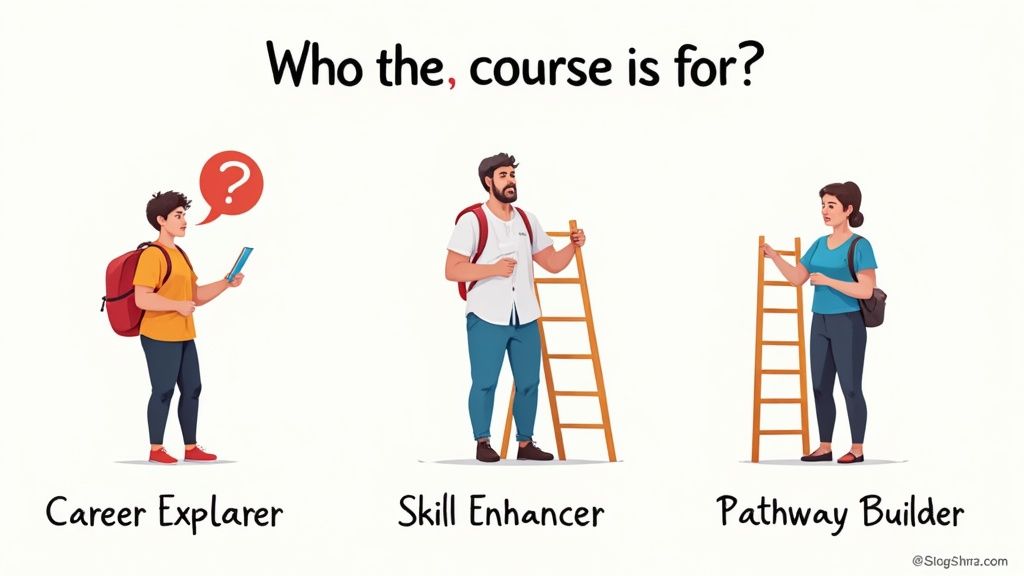
While the Certificate IV in Nursing is no longer the direct ticket to registration it once was, it’s still a fantastic fit for a few specific types of people. It’s less about jumping straight into an Enrolled Nurse role and more about building a solid, strategic foundation for a long-term career in healthcare.
Think of it as a specialised launchpad. If any of the descriptions below sound like you, this qualification could be the perfect first step on your journey. It offers a structured way to build essential skills and confirm your passion before you dive into a more intensive qualification.
So, let's break down who really gets the most out of this course.
The Career Explorer
Ever found yourself drawn to healthcare but not 100% certain if nursing is your calling? The Certificate IV is a brilliant way to test the waters without the full-blown commitment of a Diploma or Bachelor’s degree.
It’s a bit like renting a house before you buy it. You get a real feel for the day-to-day of patient care, you start speaking the language of the medical world, and you find out if the environment truly clicks with you. This course lets you make a smart, informed choice about your future, saving you a whole lot of time and money down the track.
If you love it, you’ve built a fantastic base to keep studying. And if you realise it’s not for you? You walk away with valuable, transferable skills without having invested in a multi-year program.
The Skill Enhancer
This one’s for those of you already working in similar fields, like aged care or disability support. Perhaps you're an experienced Personal Care Assistant (PCA) or an Assistant in Nursing (AIN) holding a Certificate III, and you're ready to formalise your knowledge and step up.
The Certificate IV in Nursing is designed to bridge the gap between your hard-earned hands-on experience and the clinical theory behind it all. It puts the ‘why’ behind the ‘what’ you do every single day.
Taking this step can help you:
Deepen Your Clinical Understanding: Go beyond just performing tasks to truly understanding human anatomy, physiology, and the principles of clinical assessment.
Strengthen Your Professional Standing: A higher qualification on your resume shows a real commitment to your career, potentially opening up senior AIN or team leader roles.
Prepare for Further Study: It builds the academic confidence and foundational knowledge you’ll need to successfully tackle the more demanding Diploma of Nursing.
The Pathway Builder
For many, the end goal is becoming an Enrolled Nurse (EN). The Pathway Builder is someone who sees the Certificate IV as the first clever step on that longer journey - a launchpad for the Diploma of Nursing.
This approach is incredibly smart. It breaks down a big goal into smaller, much less intimidating chunks. By finishing the Certificate IV first, you arm yourself with the core knowledge and study skills to really shine in the Diploma program.
A huge plus here is that successfully completing units in the Certificate IV can often make you eligible for Recognition of Prior Learning (RPL) or credit transfers. This can shorten the time and cost of your Diploma of Nursing, creating a much smoother and more affordable path to registration.
At the end of the day, this course is for the planner - the person who wants to build their career with purpose. Whether you’re exploring your options, enhancing your current skills, or building a pathway to your dream job, the Certificate IV in Nursing gives you the structure you need to take that next step with total confidence.
What You Will Actually Learn in the Course
It’s easy to get lost in a list of official unit codes and course descriptions. They don’t really give you a feel for what you’ll be doing day-to-day. So, let’s pull back the curtain on the HLT54121 Certificate IV in Nursing and talk about the real-world skills you’ll walk away with.
Think of the curriculum less like a checklist and more like the foundation of a house. Each unit is a crucial building block, designed to make you not just competent, but confident when you step into a real clinical environment.
We can break down the core learning into three key pillars that really hold up the practice of quality, patient-centred care.
Mastering Essential Patient Care
This is the absolute heart and soul of the course. It’s where you’ll learn the hands-on skills that directly affect a patient's comfort, safety, and well-being. This is about so much more than just following a chart; it’s about truly understanding the human body and delivering care with precision and genuine empathy.
You'll get comfortable with the fundamentals - the tasks that are non-negotiable in any healthcare setting. You’ll learn to perform them safely and effectively, every single time.
Key skills you will develop include:
Monitoring Vital Signs: You’ll learn how to accurately take and interpret blood pressure, heart rate, temperature, and respiration. These are the first and most important clues to a patient's health status.
Assisting with Daily Living: This covers everything from helping with hygiene and mobility to providing nutritional support, all while ensuring patients are treated with dignity and respect.
Understanding Anatomy and Physiology: This is the 'why' behind everything you do. Learning how the human body works gives you the critical context for the care you provide.
Developing Strong Clinical Communication
In healthcare, how you communicate can be just as vital as the clinical tasks you perform. This part of the course is all about building the skills to connect effectively with patients, their families, and the rest of the healthcare team.
It’s about turning complex medical jargon into clear, compassionate language and documenting every detail accurately. Great communication is what prevents errors, builds trust, and makes teamwork seamless.
You’ll learn how to navigate sensitive conversations, listen actively to what a patient is telling you (and what they’re not), and maintain that perfect balance of professionalism and empathy. It’s the skill that elevates a good caregiver into a great one.
Imagine a patient who is deeply anxious about an upcoming procedure. Your training will give you the tools to calmly explain what’s going on, manage their stress, and in turn, help the entire clinical team do their jobs better.
Upholding Workplace Safety Protocols
Working in healthcare means sticking to strict standards for safety and infection control. This isn’t just about ticking boxes; it's about actively protecting yourself, your colleagues, and your patients from harm. This pillar of your learning is dedicated to the procedures that keep a clinical environment safe and functioning.
You’ll go way beyond basic hygiene to master the principles of asepsis and learn how to spot and manage risks in what can be a very fast-paced world.
You’ll become proficient in:
Infection Control: Mastering the essentials, like proper hand hygiene, using Personal Protective Equipment (PPE), and safely managing contaminated waste.
Work Health and Safety (WHS): Learning to identify and minimise workplace hazards, follow emergency procedures, and contribute to a culture where everyone looks out for each other.
Legal and Ethical Practices: Understanding your professional boundaries and responsibilities when it comes to patient privacy, confidentiality, and working within your scope of practice.
The knowledge you’ll gain from the Certificate IV in Nursing provides a rock-solid foundation for your career.
Bridging Theory with Practice: The Work Placement
Now for the most important part of the entire course: your mandatory work placement. This is where all that classroom theory collides with reality. You'll step out of the simulated lab and into a real hospital or aged care facility, applying your skills under the watchful eye of experienced nurses.
Work placement is your chance to build real confidence, practise your skills on actual patients, and get a feel for the true pace and rhythm of the industry. It's an incredible opportunity to see how everything you've learned fits together, cementing your knowledge and making you genuinely job-ready. This is the experience that makes it all click.
Choosing Your Learning Style: Online vs On-Campus
Deciding how you’ll study for your Certificate IV in Nursing is a massive decision, almost as important as choosing the qualification itself. Will you go for the flexibility of online learning, the structure of a traditional campus, or maybe a blend of both? This isn't just about convenience; it's about finding a rhythm that works with your life, your learning style, and your career goals.
Some of us just click with the buzz of a classroom. We feed off the energy of face-to-face chats with tutors and classmates. For others, life is a juggling act of work shifts, school runs, and other commitments, making a self-paced online course the only realistic path forward.
There’s no "right" answer here - only what’s right for you. Be honest with yourself. Are you a self-starter who can boss your own schedule? Or do you thrive with the clear deadlines and in-person support that a campus provides? Nailing this down is the first step to setting yourself up for success.
The Freedom of Online Learning
Online study hands you the keys. It offers incredible flexibility, letting you dive into your coursework and lectures whenever and wherever it suits you best. This is a game-changer for anyone trying to fit study around an already packed life. You can power through modules late at night, on the weekend, or even during your lunch break.
But with great freedom comes great responsibility. To succeed online, you have to be your own cheerleader, organiser, and taskmaster. When you're looking at online courses, it’s also a good idea to get your head around the tech. Having a basic understanding Learning Management Systems (LMS) will make navigating your digital classroom feel like second nature.
And don’t worry, your theory might be online, but the hands-on part isn't. Every provider will make sure you complete your mandatory work placement in a real healthcare facility, giving you the critical practical skills you need.
Key Takeaway: Online learning is a perfect match for the disciplined, independent student who needs to mould their education around their life. It asks for solid time-management skills but pays you back with ultimate control.
The Structure of On-Campus Learning
There’s a reason the traditional campus model has stuck around for so long - it works. On-campus learning gives you a clear, structured path with set class times, face-to-face tutorials, and instant access to your instructors. It’s an excellent fit if you benefit from a predictable routine and direct support.
The sense of community is a huge plus. You can easily form study groups, ask questions the moment they pop into your head, and learn directly from your classmates' experiences. That shared journey can be incredibly motivating and often helps complex topics click into place through group discussions.
Plus, being on-campus usually means you get direct access to cutting-edge simulation labs. These purpose-built facilities let you practise your clinical skills in a safe, controlled environment long before you set foot in a hospital for your work placement. It’s an amazing way to build real confidence from day one.
To help you weigh it all up, here’s a straightforward, side-by-side look at what each study mode brings to the table.
Comparing Study Modes for the Certificate IV in Nursing
Ultimately, choosing between online and on-campus study is about knowing yourself and what kind of environment will help you not just finish your qualification, but truly thrive.
Your Career Path After Graduation
Finishing your Certificate IV in Nursing gives you a very specific and valuable set of skills, opening up essential support roles right across the Australian healthcare system. It's important to be clear: this isn't the qualification that gets you registered as an Enrolled Nurse. Instead, it places you perfectly for several in-demand jobs where you'll make a huge difference in patients' lives every single day.
Think of this certificate as your formal entry ticket into the clinical world. It proves you have the skills to work under the supervision of Enrolled or Registered Nurses, becoming a vital part of the team that looks after patients. Your work will be hands-on, focused on giving direct support, comfort, and assistance to patients and residents.
Immediate Job Opportunities
With your Certificate IV in hand, you’re ready to step into roles that are the bedrock of the healthcare sector. These are the jobs that hospitals, aged care homes, and community health services are always looking for.
The two most common paths you'll see are:
Assistant in Nursing (AIN): As an AIN, you’re the nurse’s right hand. You’ll help with everything from monitoring vital signs and helping patients move around safely to assisting with hygiene and documenting key observations.
Personal Care Assistant (PCA): Usually found in aged care or home care settings, PCAs help people with their daily activities. Your support is what enhances their quality of life, whether it's helping with personal grooming or providing social engagement.
A huge part of these roles is keeping accurate patient records, and you'll quickly learn that modern patient charting software is an essential tool of the trade. This certificate gives you the solid grounding needed to handle these tasks with confidence.
Salary Expectations For Graduates
Jumping into the workforce with a Certificate IV in Nursing means you’ll earn a stable income with clear room to grow as you build experience. Salaries do change depending on where you live, whether you're in the public or private system, and what penalty rates you get for shift work, but you can definitely expect a solid starting wage.
Generally, an AIN or a skilled PCA in Australia can look forward to an annual salary that truly reflects how important their job is. For a more detailed look at what different nursing roles are earning across the country, check out our comprehensive guide to current nurse salaries in Australia.
This qualification is more than just a certificate for an entry-level job; it's a strategic investment in your future. It's designed to be the first, powerful step on a much larger career ladder.
For many, the real power of the Certificate IV lies in its ability to act as a direct pathway to higher qualifications.
A Smart Pathway To Becoming An Enrolled Nurse
If your ultimate goal is to become a registered Enrolled Nurse (EN), then the Certificate IV is one of the smartest ways to start. It's the perfect launchpad into the HLT54121 Diploma of Nursing - the qualification you actually need to get registered.
Think of it as building your career in logical, manageable stages. By knocking over the Certificate IV first, you gain foundational knowledge and real-world experience that makes the more intense Diploma program feel much less overwhelming.
The biggest win here is something called Recognition of Prior Learning (RPL). This is how it works:
You Complete the Certificate IV: You tick off all the required units and graduate.
You Enrol in the Diploma: When you apply for the Diploma of Nursing, you show them your Certificate IV qualification.
You Receive Credit: The training provider looks at the units you've already passed and matches them to equivalent units in the Diploma course.
Your Study Load is Reduced: You get credit for those units, which means you don't have to study them all over again.
This isn't just a small perk. This process can shave a significant amount of time off your Diploma studies and often reduces the total cost. It’s a structured, efficient, and budget-friendly way to reach your goal of becoming an Enrolled Nurse.
Finding the Right Training Provider for You
Choosing where to study for your Certificate IV is a massive decision, and it’s one that will shape your entire learning experience. Let’s be clear: not all Registered Training Organisations (RTOs) are created equal. The right one will do more than just hand you a qualification - it will genuinely prepare you for a successful and rewarding career in healthcare.
Think of it like picking a personal trainer. You wouldn't just go with the one who has the flashiest website. You’d look for someone with proven results, great client reviews, and an approach that feels supportive and right for you. Selecting an RTO requires that same level of careful thought to make sure you’re investing your time and money wisely.
Look Beyond the Marketing Claims
Every RTO is going to tell you they're the best. Your job is to look past the slogans and dig into the details that actually matter. You need to focus on the core elements that directly affect the quality of your education and how ready you'll be for the workforce. A great provider doesn't just enrol students; they build competent, confident healthcare professionals.
Your investigation should really centre on three key areas:
Quality of Clinical Placements: Find out about their partnerships with hospitals and aged care facilities. Where will you actually be doing your hands-on training?
Level of Student Support: What happens when you're struggling with a concept? Ask about tutor availability, academic support, and whether they offer any kind of mentorship.
Industry Reputation: A provider with strong industry connections often produces graduates that employers already trust and want to hire.
Use Official Resources to Verify Credentials
Before you even think about committing to a provider, you absolutely have to do your homework. Thankfully, the Australian government makes this process pretty straightforward. Your first and most important stop should always be the official national register.
The training.gov.au website is your single source of truth. Here, you can check an RTO's registration status, see the exact qualifications they are approved to deliver (like the HLT54121 Certificate IV in Nursing), and view any regulatory decisions made against them.
This simple check is non-negotiable. It ensures the provider is legitimate and meets the national quality standards set by the Australian Skills Quality Authority (ASQA). If an RTO isn't listed or has restrictions on its registration, see it as a major red flag and walk away.
Questions to Ask an Admissions Advisor
Once you've narrowed it down to a few verified RTOs, it's time to pick up the phone or book a meeting with an admissions advisor. This is your chance to get straight answers to the questions that will define your study experience. Don't be shy - a good provider will welcome your questions and be transparent with their answers.
Here’s a practical checklist of what to ask:
Placement Logistics: "Can you tell me about your process for securing work placements? Do students have to find their own, or do you arrange them?"
Trainer Expertise: "What is the professional background of the trainers who teach the Certificate IV in Nursing? How much real-world clinical experience do they actually have?"
Student Support Services: "What specific support is available if I fall behind or need extra help with the coursework? Is there one-on-one help available?"
Graduate Outcomes: "What percentage of your graduates find a job in the field within six months of finishing the course?"
Total Costs: "Can you give me a full breakdown of all the fees? I mean everything - materials, uniforms, and any placement costs - so there are no surprises down the track."
Making an informed choice now lays the foundation for your entire career in healthcare. Taking the time to properly vet your training provider is the first and most crucial step toward reaching your goals.
Got Questions About the Certificate IV in Nursing? We've Got Answers.
It's completely normal to have a few questions when you're trying to figure out the right qualification. The world of nursing courses can be confusing, so let's tackle some of the most common queries we get about the Certificate IV in Nursing.
Think of this as your go-to FAQ section – simple, straight answers to help you see the path ahead more clearly.
Can I become an Enrolled Nurse with this certificate?
This is the big one, and the answer is a straight no. It’s probably the most important thing to understand about this qualification.
To work as an Enrolled Nurse (EN) anywhere in Australia, you need to complete the HLT54121 Diploma of Nursing. That's the mandatory qualification that allows you to register with the Nursing and Midwifery Board of Australia (NMBA). The Certificate IV is a great stepping stone and can open doors to the Diploma, but it won't get you EN registration on its own.
How long does the course actually take?
This really depends on how you choose to study. If you jump in full-time, you could be finished in as little as 6 to 12 months.
Of course, many people need to juggle study with work and family. That’s where part-time or self-paced online options come in. They offer a lot more breathing room, but naturally, it might take a bit longer to complete the course.
Is there any government funding for this course?
It’s a bit of a mixed bag, and the answer depends heavily on your location and personal circumstances.
Most government subsidies are funnelled towards the Diploma of Nursing because that's a high-priority qualification for the healthcare workforce. However, it never hurts to check what’s available for the Certificate IV in Nursing. The best approach is to check your state's vocational training website or chat directly with the training providers (RTOs) – they’ll know exactly what funding schemes or payment plans might apply to you.
What’s the difference between an AIN and an EN?
An Assistant in Nursing (AIN) and an Enrolled Nurse (EN) are very different roles. An EN has a Diploma, is registered with the NMBA, and has a wider scope of practice (like administering medications). An AIN, who might hold a Certificate III or IV, provides direct patient care but isn't registered and always works under the supervision of an EN or RN.
Ready to take that first step and find the right course to launch your healthcare career? At Get Course Australia, we specialise in connecting people like you with flexible, nationally recognised qualifications from Australia's top providers. Discover a course that fits your life and goals today!
Find Your Course
Compare courses across every field we write about, and enquire in under a minute.