A Practical Guide to a Career Change at 50 in Australia
Thinking about a career change at 50? This guide offers a realistic roadmap for Australians, from assessing your skills to finding the right path forward.
Thinking about a career change at 50? You’re not alone. In Australia, this isn't just a possibility; it's becoming a popular and strategic move for thousands of professionals looking for more fulfilling work. The secret isn’t starting from scratch—it’s about smartly pairing your decades of experience with a few new, targeted skills.
Embracing a New Professional Chapter After 50

The thought of starting a new professional chapter can be a potent mix of excitement and nerves. If you're considering a big shift, know that you’re part of a growing movement of Aussies choosing to redefine their careers, whether it’s for a greater sense of purpose or simply to keep pace with a changing job market.
This isn't just about finding another job. It's about consciously designing the next stage of your working life. It’s your chance to finally align your career with what truly matters to you now, which is probably a world away from what motivated you at 25.
Confronting the Fear of Ageism
Let's get straight to the elephant in the room: ageism. It's a real and valid concern. Perceptions in the workplace have certainly shifted, with some research showing that about 25% of Australian employers now view workers between 51 and 55 as 'older'—a startling jump from just 10% a few years ago. You can read more about these findings in the Australian Human Rights Commission's research on ageism in the workplace.
But that statistic doesn't paint the whole picture. Not even close. While biases exist, many employers are actively searching for the exact qualities that mature workers bring to the table. This is where a strategic approach becomes your superpower.
Instead of seeing age as a hurdle, reframe it as your competitive edge. Your wealth of experience delivers a depth of knowledge, emotional intelligence, and proven problem-solving skills that younger candidates simply haven't had the time to develop.
Why Now Is the Perfect Time for a Pivot
The reasons for wanting a change at 50 are as diverse as the people making them. It's rarely one single thing but often a collection of drivers pushing for something new.
- You're chasing fulfilment: After years in a field, you might be craving work that gives back or has a tangible impact on your community.
- Your industry is changing: Automation and new technologies might be making your old role feel uncertain, creating a natural push to reskill for a more future-proof career.
- You want better work-life balance: The hustle might not appeal anymore. You could be looking for a role with more flexibility to spend time with family or pursue other passions.
- It's time to follow a long-held dream: Now might be the perfect moment to turn that lifelong hobby or interest into a real profession, backed by the financial stability you've built.
A career change at 50 isn't about throwing everything away and starting again. It’s about building on the rock-solid foundation you've already laid. For more ideas, take a look at our guide on career change tips and strategies for success at any age. This transition is a calculated next step—one that honours your past while building a future you can get genuinely excited about.
Time for a Career Stocktake: What Are You Working With?
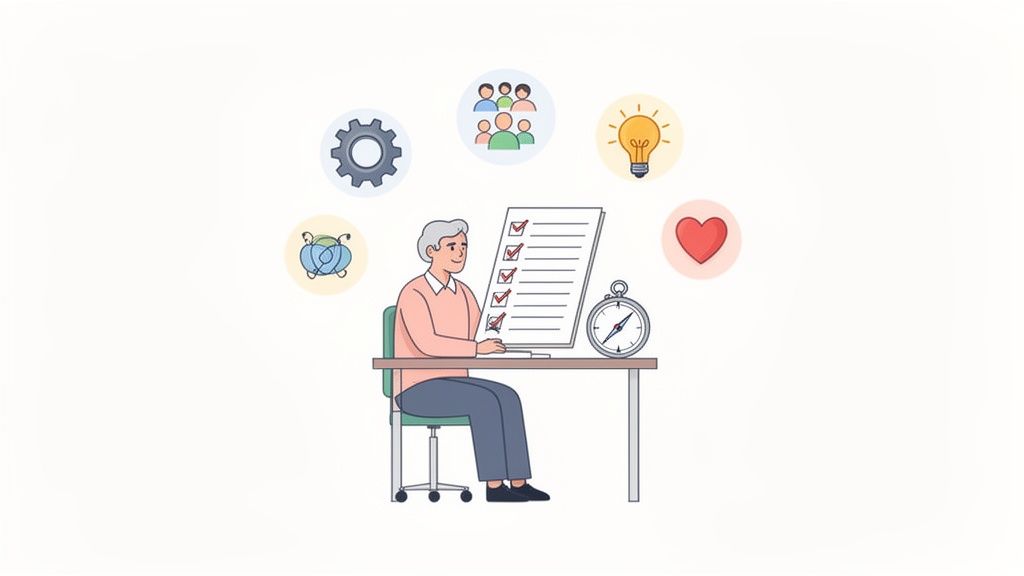
Before you jump into browsing courses or updating your CV, the most important first step is to take a good, hard look at where you are right now. This isn't about getting stuck in the past; it's about making a realistic inventory of your professional toolkit to figure out your next move.
It’s a step many people rush through, but it’s the foundation for everything that follows. The goal is to shift your thinking from a vague "I need a change" to a confident, clear statement like, "Here's the value I bring, and this is where I want to take it."
You're not alone in feeling this way. Research from National Seniors Australia found that among mature-age Aussies looking for career guidance, 21% needed help finding the right education or training, and 18% wanted support just to identify their own skills. You can read more in their full report on mature-age career planning.
Finding the Gold: Your Transferable Skills
After decades in the workforce, you've picked up a huge range of skills that are incredibly valuable across different industries, even if they feel specific to your old job. These are your transferable skills, and they're the bedrock of your career pivot. Don't sell them short.
Think beyond your job title. Instead of just "Retail Manager," unpack what you actually did every day. You weren't just running a shop; you were juggling dozens of complex tasks.
Try this. Grab a notepad and list your last few significant roles. For each one, jot down answers to these questions:
- Problem-Solving: What was the trickiest problem you ever solved? Did you smooth over a major customer complaint, fix a nagging operational issue, or figure out how to cut costs without sacrificing quality?
- Leadership & Mentoring: Who did you train, mentor, or manage? How did you help them improve or get ahead in their own careers?
- Communication & Negotiation: Who did you have to convince or negotiate with? This could be anyone from senior executives and suppliers to unhappy customers or your own team members.
- Project Management: What projects did you see through from start to finish? Think about launching a new product, rolling out a software update, or organising a major office move.
This isn't just an exercise for your CV—it's for you. It’s about rebuilding your professional confidence by reminding yourself just how capable you are and seeing your experience through a new lens.
Matching Your Career to Who You Are Today
A truly successful career change at 50 is about more than just a new paycheque. It’s about finding a role that fits the person you are now. What you value in a job today is probably worlds away from what mattered to you at 25.
So, what do you really want your day-to-day work life to feel like? Getting clear on this is what makes the difference between just hopping to another job and finding a sustainable career that actually brings you satisfaction.
Here’s a quick way to think about it. Which of these areas are most important to you?
- Impact and Purpose: Do you want to help people? Contribute to a cause you believe in?
- Autonomy and Control: Is managing your own schedule or working independently a top priority?
- Creativity and Growth: Do you need a job where you're always learning and solving new problems?
- Stability and Security: Is a predictable routine, a steady income, and a supportive team what you crave most?
Once you know your non-negotiables, you can start looking for industries that actually align with them. If "Impact" is at the top of your list, you might explore roles in community services or aged care. If "Autonomy" is the big one, perhaps a career in bookkeeping or IT support is a better fit.
Let's look at how your hard-earned experience can translate into some of Australia's fastest-growing fields.
Mapping Your Experience to In-Demand Fields
By connecting what you can do (your skills) with what you want to do (your values), you create a powerful filter. Suddenly, that overwhelming world of possibilities shrinks to a focused, exciting shortlist of realistic career paths worth exploring.
Choosing the Right Training to Get You There
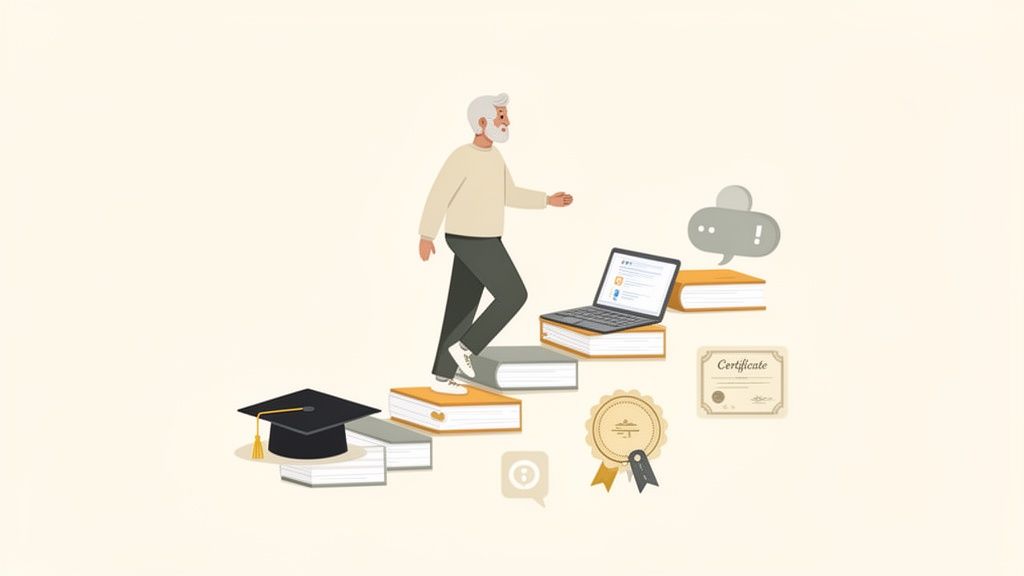
Once you’ve got a new career direction in your sights, the next logical step is figuring out how to make it happen. For most people pivoting in their 50s, this almost always involves learning some new skills.
The thought of going back to study can be a bit intimidating, but today’s education options are a world away from the rigid university timetables you might remember. Flexible online learning has really become the go-to for mature-age professionals because it’s designed to fit around your life, not upend it. You can build new skills for a new role without quitting your job, missing family dinners, or trekking to a campus.
And the desire to learn is definitely there. Despite facing barriers, a huge number of Australians over 50 are keen to stay in the workforce. In fact, research from 2021 found that nearly three-fifths (58.7%) of older Australians have clear plans to reskill or get further training. You can read more about the findings on Australia's ageing workforce and see just how committed people are to growth.
Making Sense of Australian Qualifications
Diving into the world of online courses can feel like navigating a maze. With so many options—from short courses to full diplomas—it’s crucial to understand what each qualification is actually for. This is what empowers you to pick a pathway that perfectly matches your career goals, timeline, and budget.
The main thing is to focus on job-ready learning. You don’t always need a three-year degree to make a successful career change. More often than not, a targeted, nationally recognised qualification is exactly what employers are looking for to see you’ve got the right skills.
Your goal isn't just to earn a piece of paper. It's to gain practical, in-demand skills that you can confidently add to your CV and discuss in an interview. The right course gives you both the knowledge and the credential to prove it.
Short Courses vs Certificates vs Diplomas: What's the Difference?
Let’s break down the main types of online qualifications you’ll come across. Each serves a distinct purpose, and the best one for you depends entirely on what you’re trying to achieve.
Short Courses or Professional Certificates: These are quick, focused programs designed to teach a very specific skill or tool. Think of a course in Xero for bookkeeping, social media marketing, or an intro to cybersecurity. They’re fantastic for testing the waters in a new field or just adding a specific, valuable line-item to your CV.
Certificate IV: This is a solid, nationally recognised qualification that makes you job-ready for a particular role. A Certificate IV in Community Services, for example, is a standard entry requirement for many support worker positions. It tells employers you have the core practical skills and theory to hit the ground running.
Diploma: A Diploma takes things a step further, offering a deeper and more comprehensive level of knowledge. This qualification often prepares you for roles with more responsibility, like team leadership, project management, or specialised technical work. A Diploma of Information Technology, for instance, covers a much broader scope than a certificate and opens doors to more senior positions.
Choosing the right one is a strategic move. If you're a logistics manager aiming for a project management role, a targeted short course in PM software might be all you need to bridge the gap. But if you’re a corporate administrator wanting to switch into animal care, a Certificate IV in Animal Care is essential to gain that foundational industry knowledge.
You can explore a whole range of online certificate courses available in Australia to get a feel for what’s out there.
Choosing Your Online Study Pathway
Here's a quick comparison to help you weigh up the options and find the best fit for your career change.
Ultimately, the right choice depends on how big of a leap you're making and what your new industry expects.
The Freedom of Self-Paced Learning
Perhaps the single biggest advantage of modern online education is the self-paced format. This is an absolute game-changer when you’re balancing a career change with a job, family, and everything else life throws at you.
With a self-paced course, you’re not locked into a rigid lecture schedule. You can study on a Saturday morning, a Tuesday evening, or even during your lunch break—whatever works for you. This flexibility makes your career transition feel like a manageable project, not a stressful upheaval.
It puts you in the driver’s seat, letting you move quickly through topics you already have a feel for and spend more time on the brand-new concepts. This ensures you truly master the skills you’ll need for your next chapter.
Crafting a Modern Job Application That Gets Noticed
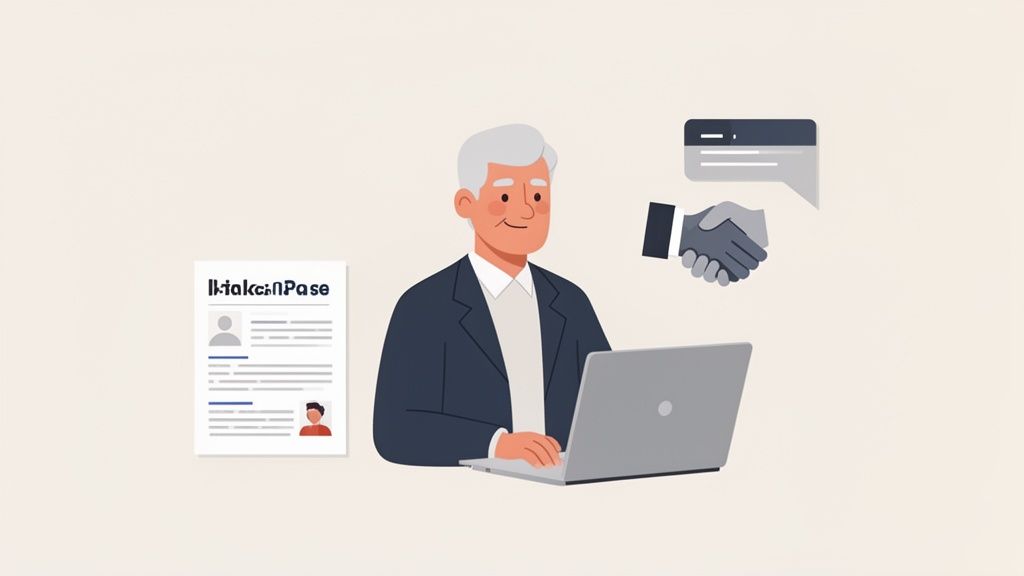
Your resume and LinkedIn profile are your personal marketing campaign. When you’re making a career change at 50, they have to do more than just list past jobs. They need to tell a compelling story about where you're headed next.
This isn't about hiding your experience; it's about reframing it. The goal is to shift the focus from a long, chronological work history to a forward-looking narrative that shines a spotlight on your fresh skills, transferable talents, and genuine excitement for your new industry.
Rethinking Your Resume for a Career Pivot
Let's be blunt: a traditional resume listing every job you've had since you were 20 isn't going to cut it. It risks dating you, and worse, it buries the most important information—your new qualifications and transferable skills—under decades of roles that might seem irrelevant.
Your mission is to make it dead simple for a busy recruiter to see why you’re the right person for this job, right now.
It all starts with a powerful professional summary at the top. Think of this as your three-to-four-sentence elevator pitch. It replaces the outdated "Objective" and should immediately state your new career goal, mention your recent training, and connect your best transferable skills to the job ad.
Take a former retail manager moving into community services, for example:
"A newly qualified and highly motivated Community Services professional with a Certificate IV and over 20 years of experience building client relationships and leading teams. Eager to apply proven skills in empathy, problem-solving, and resource coordination to support vulnerable individuals and achieve positive community outcomes."
See how that works? It instantly frames your entire career through the lens of your new direction. The hiring manager immediately gets it.
Structuring Your CV to Highlight Potential
After nailing the summary, the layout of your resume is absolutely critical. Forget a purely chronological list of jobs. A hybrid or functional format that puts your skills front and centre will serve you much better.
This approach means grouping your abilities under smart headings. You could try sections like:
- Key Skills and Competencies: Use bullet points for things like "Stakeholder Engagement," "Project Coordination," or "Digital Literacy." Don't forget to list the specific software you mastered in your recent course.
- Recent Qualifications: Get that new Certificate or Diploma right up top, just after your summary. It’s a powerful signal of your commitment.
- Relevant Experience: This is where you hand-pick achievements from past jobs that directly relate to your new field. Make sure to use the language and keywords from your new industry.
Your full employment history can then be summarised more briefly towards the end of the document. For roles older than 10-15 years, you can often get away with just the job title, company, and dates. This keeps your resume sharp, focused, and relevant.
If you want to dig deeper into modern formatting, you can learn more about how to write a resume that truly stands out. It's also incredibly helpful to review specific examples of how to write a career change resume to see how others have successfully highlighted their transferable skills.
Transforming Your LinkedIn Profile into a Magnet for Recruiters
Think of your LinkedIn profile as more than just an online CV. It's a living, breathing tool for building your professional brand. To make it work for your career transition, you need to optimise it for your target industry.
First things first: rewrite your headline. It's the most visible real estate on your profile. Ditch your old job title and state your new ambition loud and clear.
Old Headline: "Senior Operations Manager at ABC Logistics"
New Headline: "Aspiring Project Coordinator | Recently Certified in Business Administration | Seeking Opportunities in the Tech Sector"
That one simple change means you'll start showing up in the right recruiter searches. Next, give your "About" section a makeover so it tells the same forward-looking story as your resume. Explain your pivot—why you made the change, what you've learned, and the value you're ready to bring.
Finally, make your new credentials impossible to miss.
- Add your new Certificate or Diploma to both the "Education" and "Licences & Certifications" sections.
- Don't be shy—ask your course instructors or classmates for recommendations that speak to your new skills.
- Join and participate in LinkedIn Groups related to your new industry. It’s a fantastic way to start building a relevant network before you even need it.
By taking control of your narrative, you position yourself as a proactive, relevant candidate who is defined by their potential, not just their past.
Hitting the Pavement: How to Navigate the Modern Job Hunt
Alright, you’ve got your updated CV and a sharp new LinkedIn profile. Now comes the part that might feel a bit daunting: actually finding and landing the job. The way people find work has changed a lot, but your decades of experience give you a massive advantage if you play your cards right.
Forget spending all your time on job boards. Your most powerful asset is your network. Think about it – you've spent a lifetime building professional relationships. Now is the time to lean on those connections to tap into what’s often called the "hidden job market," where the best roles are often filled before they're ever advertised.
Tapping Into Your Network (Without Being Annoying)
First up, make a list. Think of all the former colleagues, managers, clients, and industry contacts you’ve genuinely liked and respected over the years.
The key is to reach out with a light touch. You’re not asking for a job; you’re asking for advice. People love being asked for their opinion – it’s flattering and non-committal.
A simple, friendly message can work wonders. Try something like this:
"Hi [Name], hope you're doing well. I'm getting in touch because I've just finished a [Your New Qualification] and I'm shifting gears into the [Your New Industry] world. Knowing your experience in this space, I'd really appreciate your take on the industry and any tips you might have for someone like me."
This approach is respectful of their time and opens the door for a genuine conversation. That chat could easily lead to an introduction, a heads-up about a role that’s about to open up, or just some invaluable insider knowledge.
Owning the Interview and Tackling the Age Question
The interview is where you bring it all home. Preparation is everything. While it's illegal for an employer in Australia to ask your age directly, you might sense questions dancing around the topic – subtle probes about your long-term goals, your energy, or how you feel about new technology.
Your job is to get ahead of these unasked questions. Frame every potential negative as a positive that a younger candidate simply can't compete with.
Your Experience is Your Superpower
When they ask about your background, don't just list off old job titles. Frame your career as a portfolio of valuable assets they can’t find anywhere else.
- You’re a safe pair of hands. You have a proven history of showing up and getting the job done. You’re not a flight risk looking to jump ship in 18 months.
- You’ve got serious emotional intelligence. You’ve dealt with difficult people, navigated office politics, and calmed tense situations more times than you can count. That kind of maturity is gold in any team.
- You're a master problem-solver. You've seen a thing or two. You can often spot a problem coming a mile away and draw on a huge bank of past experiences to solve it.
For example, if you’re asked about a tough project, tell a story that doesn't just focus on the great result, but on the calm, measured process you used to get there—a skill honed only through experience.
Answering Those Tricky Interview Questions
Let's break down a few of the questions that can feel like traps and turn them into opportunities to shine.
"Where do you see yourself in five years?"
- What they're really asking: Are you just winding down for retirement?
- How you can answer: "I'm genuinely excited about this new career path. In five years, I plan to be an essential part of this team, having really mastered this role. I'd hope to be at a point where I can help mentor new starters. This career change at 50 wasn't a whim; it was a deliberate move for my next chapter."
"This role uses a few new software platforms. How are you with learning new tech?"
- What they're really asking: Are you an old dog who can't learn new tricks?
- How you can answer: "I love learning. In fact, to get my [Your Qualification], I had to get up to speed on [Software A] and [Software B], which I really enjoyed. I'm always keen to learn tools that make my job easier, and I find my problem-solving background helps me pick up new systems pretty quickly."
The goal is to consistently shift the focus from your age to your adaptability, your recent training, and your solid-as-a-rock commitment. You’re not defined by the year you were born; you’re defined by the proactive choices you're making right now.
Getting the offer is the final step in the process. After you've successfully navigated the job hunt and smashed the interview, it's just as important to know how to accept a job offer the right way to kick off this new chapter on a high note. Walk into that interview knowing the incredible value you bring, and you'll have the confidence to land the role you truly deserve.
Got Questions About Changing Careers at 50? (You're Not Alone)
Thinking about a major career shift at 50 brings up a lot of "what ifs." It's a big move, and it's completely normal to have questions about the practical side of things. Let's tackle some of the most common concerns we hear from people just like you, with some straight-up, practical advice.
"Is It Actually Possible to Afford a Career Change at 50?"
Yes, it absolutely is—but it's all about smart, honest planning. The biggest worry is usually taking a hit to your income, and that's a fair point. The first thing to do is get a really clear picture of your finances. A detailed budget will show you exactly what's coming in and going out, helping you figure out your financial "runway"—how long you could manage if your income dips for a while.
But here’s the thing: you don't have to just stop earning. A gradual transition can be a game-changer. Think about freelancing or picking up part-time work in your new field to get a foot in the door while you're still in your old job. Many online courses also offer flexible payment plans, so you can upskill without a huge upfront investment.
And for those in Australia, it’s worth looking into government initiatives like the Skills Checkpoint for Older Workers program, which can offer valuable support and even funding for the right kind of training.
"How on Earth Do I Compete with Younger, Tech-Savvy Candidates?"
You don't compete on their terms—you make them compete on yours. Instead of trying to out-tech a 25-year-old, you play to your own massive strengths. When technology comes up in an interview, tackle it head-on.
Talk about the new digital skills you’ve just picked up from a recent course. This immediately shows you're adaptable, willing to learn, and serious about staying relevant. Then, steer the conversation back to the one thing they can't offer: decades of real-world experience.
Frame your experience as your superpower. You bring tried-and-tested problem-solving skills, a high degree of emotional intelligence, rock-solid reliability, and an innate understanding of how businesses actually work. That's a level of stability and wisdom that only comes with time.
"What Are the Best Industries in Australia for Someone My Age?"
The good news is that several booming sectors in Australia don't just tolerate mature-age workers; they actively seek them out for their life experience.
- The 'Caring' Industries: Think aged care, disability support, and community services. These fields are growing fast, and what they value most—empathy, patience, and brilliant communication—are qualities you've been honing your whole life. Here, your experience is a genuine asset.
- IT and Cybersecurity: This might sound surprising, but with massive skills shortages across the board, employers are far more interested in what you can do than when you were born. A solid, industry-recognised certification can get you in the door of a sector with a very bright future.
- Business and Administration: Good people are always needed for roles in bookkeeping, project management, and business administration. The discipline, organisational skills, and attention to detail that you've developed over a long career are exactly what employers are looking for.
By aiming for industries where your maturity gives you an edge, you're not just changing careers—you're setting yourself up for success.
Ready to find a course that can bridge the gap to your new career? At Get Course Australia, we specialise in helping people find flexible, job-ready online qualifications that fit their life. Explore our range of courses and start your next chapter today at https://getcourse.com.au.
Find Your Course
Compare courses across every field we write about, and enquire in under a minute.