accounting course tafe: Your Complete Guide to TAFE Accounting Courses
Discover accounting course tafe options in Australia. Compare qualifications, tuition, and career paths to start your finance career today.
Deciding to study accounting at TAFE is one of the most direct and practical ways to launch a career in finance. It's a savvy choice for anyone who wants hands-on skills and a nationally recognised qualification that employers genuinely value.
Why Choose a TAFE Accounting Course for Your Career
Let's think about it like learning to cook. A university might deep-dive into the complex chemistry behind flavour pairings, but TAFE will have you in an apron, learning how to perfectly sear a steak on day one. TAFE accounting courses are built with this exact job-ready mindset.
The whole experience is designed to build your skills step-by-step. You can start with a foundational certificate to get your foot in the door quickly, then move up to a diploma that opens up more senior opportunities. It’s a well-respected pathway that perfectly balances essential theory with the practical application businesses are looking for.
From Theory to Practice
Instead of just reading about financial principles from a textbook, you’ll be putting them into practice from the get-go. A TAFE accounting course gets you comfortable with fundamental skills like understanding double-entry bookkeeping, which is the bedrock of any accounting role. You'll quickly get up to speed with industry-standard software and learn how to manage real-world financial tasks.
And this approach works. Just look at the numbers from TAFE NSW for the 2023-2024 academic year. They had over 404,000 enrolments across the state. A huge chunk of those—around 23,900 completions—were at the Certificate IV level, which is a popular starting point for accounting and bookkeeping, as their annual report highlights. You can dig into the full TAFE NSW report here for more insights.
A Clear and Structured Pathway
One of the best things about the TAFE system is that it gives you a clear roadmap for your career. Each qualification stacks neatly on top of the last, so you can enter the workforce at different points or continue studying without a hitch. If you want to see the bigger picture, our guide on how to become an accountant in Australia lays out the entire career landscape.
The real edge a TAFE qualification gives you is its immediate relevance. You don’t just graduate with a piece of paper; you walk out with a toolkit of specific skills you can use in an accounts department the very next day.
To give you a clearer picture of this pathway, here’s a quick overview of the main TAFE accounting qualifications and what they prepare you for.
TAFE Accounting Qualification Levels At a Glance
This table breaks down the three main stepping stones in the TAFE accounting world, showing you where to start and where you can go.
Each level is a self-contained qualification that makes you employable, but together they form a powerful pathway toward a rewarding and stable career.
Navigating Your TAFE Accounting Qualification Options
Picking the right TAFE accounting course can feel a bit like standing at a trail map—each path leads somewhere different. Each qualification is its own destination, opening doors to specific skills and career opportunities. The trick is to figure out which path aligns with where you want to go.
Let’s break down the journey, starting from the foundational certificates and working our way up to the more advanced diploma. Think of it like building a house: the Certificate III is the slab and frame, the Certificate IV is the walls and roof, and the Diploma is where you start doing the complex wiring and high-end finishes.
Certificate III in Accounts Administration: Your Starting Point
The Certificate III in Accounts Administration is your ground-floor entry into the finance world. It's designed for people with little to no prior experience, giving you the practical skills you need for those first-rung-on-the-ladder roles. This qualification is all about getting comfortable with the daily financial tasks that keep a business ticking over.
You’ll get your hands dirty with the practical stuff, like processing financial transactions, handling accounts payable and receivable, and helping out with basic payroll duties. It’s the perfect launchpad for a career as an Accounts Clerk or Accounts Assistant.
Certificate IV in Accounting and Bookkeeping: The Industry Standard
Ready to step up? The Certificate IV in Accounting and Bookkeeping is widely considered the gold standard for professional bookkeepers here in Australia. This is where you move past simple data entry and start managing a business's financial story with real confidence.
This accounting course at TAFE gets into the nitty-gritty of some really crucial areas:
- Preparing Business Activity Statements (BAS): You'll get to grips with GST and PAYG, which is non-negotiable knowledge for any Aussie business.
- Managing Payroll Systems: This covers everything from calculating wages and super to making sure everything is above board with industry awards and regulations.
- Developing Financial Reports: You’ll learn to build balance sheets and profit and loss statements, turning raw numbers into a clear financial picture.
- Using Accounting Software: You'll become proficient with industry-standard tools like MYOB or Xero—a must-have skill for any modern bookkeeper.
Nailing this course sets you up perfectly for roles like Bookkeeper, Payroll Officer, or even gives you the confidence to hang out your own shingle and start a bookkeeping service.
A Certificate IV doesn't just teach you how to enter a transaction; it teaches you why you're doing it that way. It's that deeper understanding that separates a true professional from someone just punching numbers.
This infographic clearly shows how you can progress through the TAFE system, building your skills one qualification at a time.
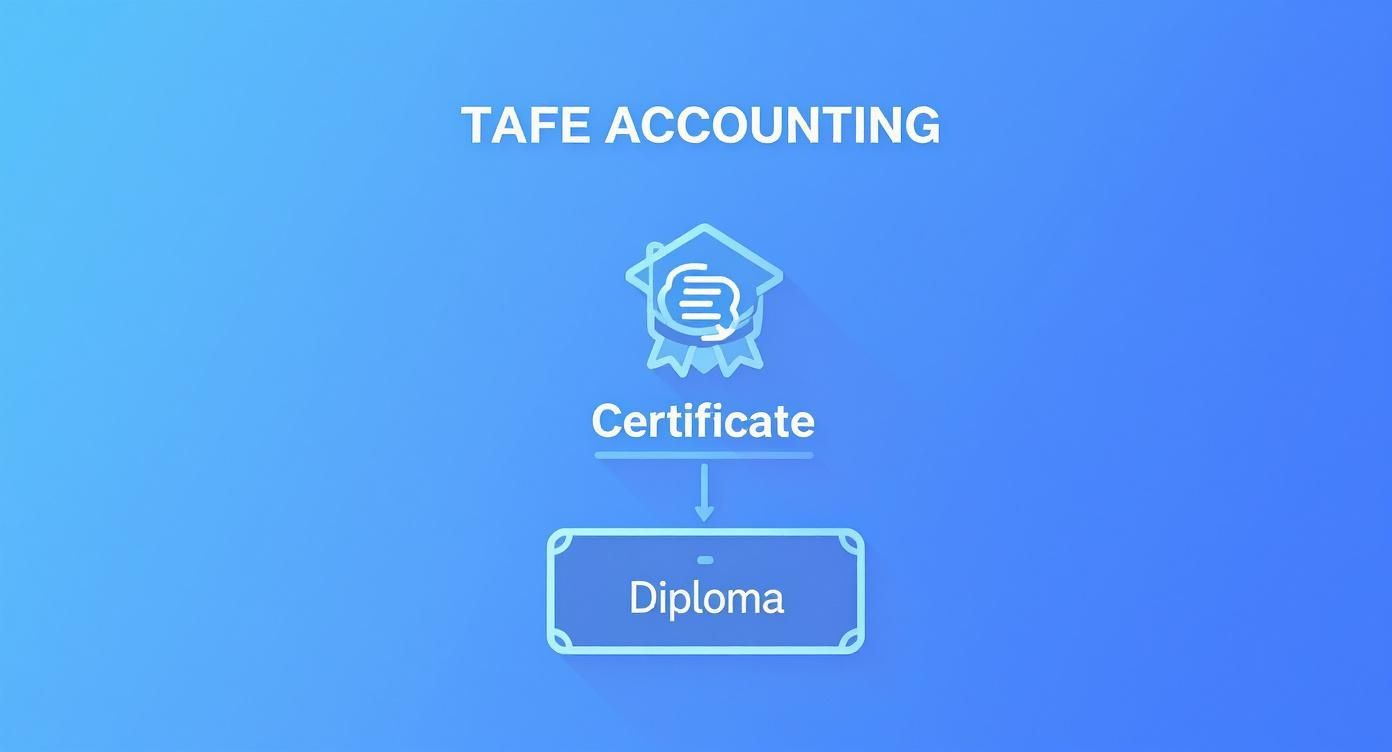
As you can see, each level builds logically on the one before it, creating a clear and structured career path towards more senior accounting roles.
Diploma of Accounting: Advancing Your Skills
The Diploma of Accounting is where you shift gears from doing the day-to-day work to thinking more strategically. This qualification is for those aiming for roles like Assistant Accountant or wanting to take on more complex financial management tasks. It builds directly on what you learned in the Certificate IV.
Here, the focus is on higher-level thinking. You’ll learn to manage budgets and forecasts, prepare complex tax documents for individuals and businesses, and analyse financial statements to provide genuine business insights. This course really prepares you to be part of an organisation's financial decision-making team.
It’s also a fantastic stepping stone if you’re thinking about university down the track. Many Australian universities will give you credit for a TAFE Diploma of Accounting, which could slash a year or more off a Bachelor of Commerce or a similar degree. By exploring the full range of accounting courses available in Australia, you can see how this TAFE qualification creates a smart, cost-effective pathway to higher education—giving you the best of both worlds.
Choosing Your Study Mode: On-Campus Versus Online
One of the first big decisions you’ll make is how you want to study. These days, TAFE isn't just about sitting in a classroom from nine to five. You've got options designed to fit around your life, not the other way around.
It really boils down to three main choices: the traditional on-campus experience, the flexibility of fully online learning, or a blended approach that gives you a bit of both. Each has its own vibe and set of perks, so the right one for you will depend on your learning style, work schedule, and personal commitments. This isn't just about convenience; it's about setting yourself up for success.

The Case for On-Campus Learning
There's a reason the classic classroom model has stuck around. Studying on campus gives you structure and routine, which is perfect for anyone who thrives on a schedule and face-to-face interaction. Being able to ask your instructor a question and get an answer on the spot is a massive plus.
You also get the benefit of building real-world connections. Being in a classroom with your peers means you can easily form study groups, bounce ideas off each other, and start networking. Those relationships can be incredibly valuable when you step into the workforce. It’s a supportive, collaborative environment that helps keep you on track.
The Freedom of Online Study
For a lot of people, flexibility is everything. This is where online learning really comes into its own. An online accounting course at TAFE lets you fit your education around your job, your family, or whatever else life throws at you. You can study from anywhere, at any time.
This self-directed approach means you can power through the topics you find easy and spend more time on the trickier concepts. You're in complete control of your learning pace. If you're curious about just how adaptable this can be, it's worth exploring the benefits of completing online courses in Australia to see if it’s the right fit.
Choosing your study mode is like choosing your workout style. On-campus is the scheduled group fitness class with a motivating instructor, while online is the personalised gym program you complete whenever it suits you. Both get you to your goal; the key is picking the one you'll consistently show up for.
Finding Your Perfect Fit
So, how do you actually choose? It comes down to being honest with yourself about what you need and how you work best. A little self-assessment can go a long way.
Ask yourself a few key questions:
- How disciplined are you? Online study is fantastic, but it demands a high level of self-motivation to stay on top of things without a fixed timetable.
- What’s your learning style? Do you learn best by listening to a teacher and chatting with classmates, or do you prefer to read and work through problems on your own?
- What does your schedule look like? If you’re working full-time or have unpredictable hours, the 'anytime, anywhere' nature of an online course might be a lifesaver.
Full-Time Versus Part-Time Commitment
Your study mode is also tied to your time commitment. A full-time course, whether on-campus or online, can often be wrapped up in as little as six months. It's an intensive path, but it’s great if you want to get qualified and into a job quickly.
On the other hand, studying part-time lets you spread the same coursework over a year or more. This lightens the weekly study load, making it a far more manageable option if you're juggling work, family, and other major commitments. This kind of flexibility is what makes a TAFE accounting course a realistic goal for almost anyone.
How to Fund Your TAFE Accounting Course
Figuring out the money side of things is just as important as picking the right course. The great news is that studying accounting at TAFE is designed to be affordable, and there are a few well-trodden paths to help you manage the costs.
Before we jump into funding, it’s worth a quick mention that your eligibility for financial help can sometimes be linked to the course's entry requirements. Generally, for a Certificate III, you'll need to have finished Year 10. To get into a Certificate IV in Accounting and Bookkeeping, you’ll likely need that Cert III under your belt or have some real-world experience.
And for the Diploma of Accounting? You’ll usually need to have successfully completed the Certificate IV. This step-by-step approach is classic TAFE—it makes sure you have a rock-solid foundation before moving on to the trickier stuff.
Government Subsidies and Concessions
One of the best ways to slash your course fees is through government subsidies. Both the federal and state governments know Australia needs skilled finance professionals, so they often foot a large chunk of the bill for eligible students.
This could mean you only pay a small fraction of the total course fee. Your eligibility will usually depend on things like your citizenship or residency status, your age, and whether you've studied before.
These subsidies are a massive help. A course that might otherwise set you back several thousand dollars could end up costing just a few hundred. Honestly, this should be the very first thing you look into.
VET Student Loans (VSL)
Once you get to higher-level qualifications like the Diploma of Accounting, you might be able to get a VET Student Loan (VSL). It works a lot like the HECS-HELP scheme you see for university degrees, but it’s specifically for vocational education. Essentially, it’s a loan from the government to cover your tuition fees.
You don't have to find the money upfront. Instead, you start paying the loan back through the tax system once your income hits a certain level. It’s a smart system that lets you get qualified now and worry about paying for it later, knocking down one of the biggest barriers to study.
VET Student Loans are a game-changer for many students. They make higher-level TAFE qualifications accessible by deferring the cost, allowing you to invest in your career without immediate financial pressure.
Of course, there are criteria. Eligibility for a VSL depends on the course itself, the TAFE provider, and your personal circumstances, like citizenship status.
The image below from TAFE International Western Australia gives you a feel for how course fees for a Diploma of Accounting are typically structured.
As you can see, fees are often broken down per unit. This makes it much easier to budget, particularly if you’re planning to study part-time and spread your units out.
TAFE Payment Plans
What if you're not eligible for a subsidy or a VSL, or you still have a gap to cover? Don't stress. Almost every TAFE offers flexible payment plans. These let you break your fees down into smaller, bite-sized instalments over the duration of your course.
So, instead of a massive upfront bill, you might pay a set amount weekly, fortnightly, or monthly. It’s a practical, student-focused solution that helps you manage your budget without the headache.
For instance, the Diploma of Accounting at providers like North Metropolitan TAFE has a very clear fee structure. You might find that key units cost somewhere between AUD $289 and AUD $405 each, plus some minor resource fees. This kind of transparency, paired with practical training in things like tax documentation and financial reporting, really shows how TAFE delivers high-quality education that’s also affordable. You can discover more about TAFE course details and entry requirements to see a full breakdown for yourself.
To help you see how everything fits together, here's a quick comparison of the main funding avenues available.
Funding Options for Your TAFE Accounting Course
By taking the time to explore these options, you can put together a financial plan that makes your TAFE accounting course a smart and manageable investment in your future.
Your Career Path After Graduating from TAFE
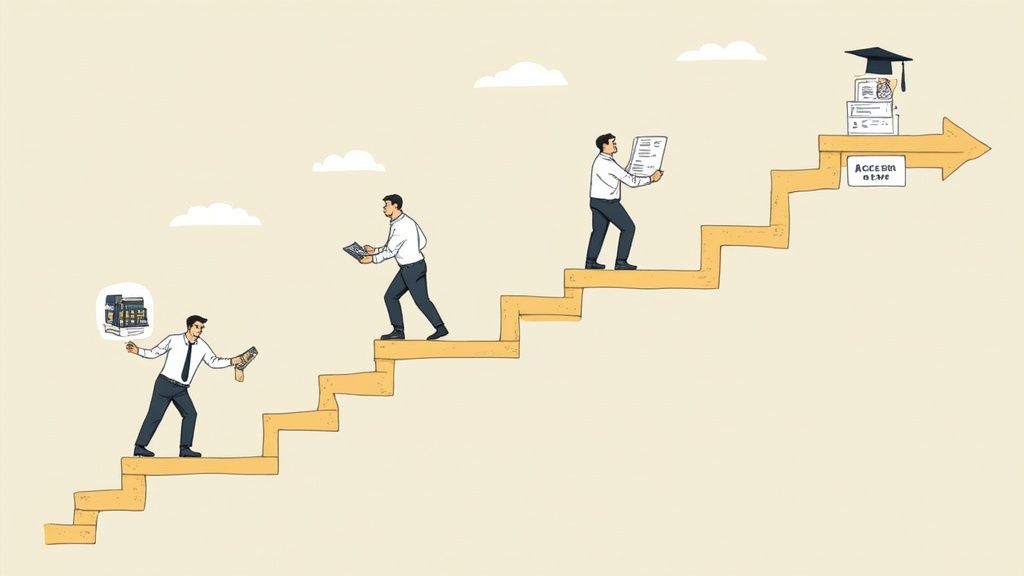
Finishing a TAFE accounting qualification is more than just getting a piece of paper—it's your ticket into a massive range of real-world careers. Don't think of it as the end of your studies. See your certificate or diploma as a launchpad into a stable, rewarding profession with clear steps for advancement.
Each qualification is carefully designed to match specific roles in the industry. This means the time and effort you put in has a direct payoff, making you job-ready at every stage of your training.
From Qualification to Vocation
Your TAFE journey translates directly into job titles that employers recognise and need. The hands-on skills you pick up are exactly what businesses are hunting for, whether you're just starting out or looking to step up.
Here’s a simple breakdown of how your TAFE qualification lines up with potential jobs:
- A Certificate III in Accounts Administration gets you ready for roles like Accounts Clerk, Accounts Payable/Receivable Officer, or Payroll Support Officer. These are the crucial cogs in any finance team, with typical salaries between $50,000 and $65,000 a year.
- The Certificate IV in Accounting and Bookkeeping qualifies you to work as a professional Bookkeeper, a registered BAS Agent (once you meet the other criteria), or a senior Payroll Officer. Your earning potential jumps, often sitting between $60,000 and $75,000.
- With a Diploma of Accounting, you’re looking at more senior positions like Assistant Accountant, Senior Bookkeeper, or Accounts Manager. These roles demand more analytical thinking and come with salaries typically ranging from $70,000 to $90,000.
Of course, once you land a role, knowing your tools is key. This includes practical skills like choosing the right accounting software to work efficiently.
A Strategic Launchpad for Higher Education
One of the smartest reasons to study an accounting course at TAFE is its power as a pathway to university. This isn’t a detour; it’s a clever shortcut.
Many Australian universities will give you direct credit for your TAFE diploma. By completing a Diploma of Accounting, you can often slice a full year—sometimes more—off a Bachelor of Commerce or Bachelor of Business degree. That saves you a huge amount of money in uni fees and gets you into the workforce with a degree much, much faster.
Think of TAFE as your unfair advantage. You can join the workforce with a Diploma, get paid to gain real industry experience, and then finish a university degree in less time and for less money than someone who went straight from high school.
This double-pronged approach makes you incredibly valuable to employers. You'll have the practical, job-ready skills from TAFE backed by the high-level theory from university—a combination that’s tough to beat.
Industry Recognition and Professional Membership
Your TAFE qualification also carries serious weight with professional industry bodies. Graduating with a Certificate IV in Accounting and Bookkeeping, for instance, is a critical step towards becoming a registered BAS Agent with the Tax Practitioners Board (TPB).
On top of that, organisations like the Institute of Certified Bookkeepers (ICB) formally recognise TAFE qualifications. Becoming a member adds another layer of credibility to your CV and shows potential employers that you’re committed to professional standards and continuous learning.
Accounting is a pillar of the Australian economy, and TAFE is a major pipeline for training its workforce. Back in 2020, there were around 205,700 accountants employed across the country. A solid 16% of them held a Diploma or Advanced Diploma—the very qualifications you earn at TAFE—as their highest credential. With employers consistently reporting shortages for skilled accounting staff, TAFE graduates are in a fantastic position.
By linking your studies directly to job outcomes, university pathways, and professional recognition, it’s clear that a TAFE accounting course is so much more than just an education. It's a calculated and highly effective first move in building a long and successful career in finance.
Your Top Questions About TAFE Accounting Courses, Answered
Deciding to jump into a TAFE accounting course is a big move, and it's totally normal to have a few questions buzzing in your head. Let's clear up some of the most common ones we hear from students, so you can feel confident you're making the right call.
We'll tackle everything from what employers really think about TAFE grads to whether you'll need to be a maths whiz to succeed.
Are TAFE Accounting Courses Respected By Employers?
Absolutely. In fact, TAFE qualifications are more than just recognised—they're genuinely valued by employers all over Australia. The reason is simple: TAFE courses are designed hand-in-hand with industry, which means the skills you learn are exactly what businesses are looking for right now.
When a hiring manager sees a Certificate IV in Accounting and Bookkeeping on your resume, they see someone with practical, job-ready skills. They know you’ve been trained on the latest software and industry practices, which means you can hit the ground running from day one without needing your hand held.
Can I Become an Accountant With Just a TAFE Diploma?
A TAFE Diploma of Accounting is the perfect ticket to a great career as an Assistant Accountant, Senior Bookkeeper, or Accounts Manager. These are crucial roles in any finance team, and the diploma gives you the advanced skills to excel in them.
However, if your goal is to become a fully qualified Chartered Accountant (CA) or Certified Practising Accountant (CPA), you will eventually need a university degree.
Think of your TAFE diploma as a powerful launchpad, not a final destination. It's one of the smartest and most efficient stepping stones toward a university degree, giving you a huge advantage over those who go straight from high school.
Many universities offer direct credit for a TAFE Diploma of Accounting, potentially shaving a year or more off your degree. This pathway lets you get into the workforce sooner, gain real-world experience (and get paid for it!), then finish your degree faster and with less debt. It's a strategic approach that blends practical know-how with high-level theory.
What's the Difference Between Bookkeeping and Accounting?
This is a fantastic question, and getting your head around the distinction is key. Imagine a business's finances are a story being written.
Bookkeeping is the act of meticulously writing that story down, moment by moment. It involves recording every single daily transaction—every sale made, every invoice paid, every expense logged. The Certificate IV makes you an expert in accurately capturing this financial narrative.
Accounting is the art of reading that story, interpreting what it all means, and using those insights to shape the future. Accountants analyse, summarise, and report on the data the bookkeepers have gathered to offer strategic advice. The Diploma is where you start learning these higher-level analytical skills.
So, you could say bookkeeping is about the 'what happened', while accounting is about the 'so what?' and 'what's next?'.
Do I Need to Be a Maths Genius to Study Accounting?
This is probably the biggest myth out there, and the answer is a firm no. You don't need to be a mathematical prodigy, but you should be comfortable working with numbers. The skills that really matter for success in a TAFE accounting course are a bit different.
You'll really need:
- A sharp eye for detail: Spotting a small mistake before it snowballs into a major problem is a vital skill.
- Logical thinking: Accounting is all about rules and principles, so being able to think things through step-by-step is essential.
- A problem-solving mindset: You'll often be playing detective, figuring out why the numbers don't quite line up.
Modern accounting is driven by powerful software like Xero and MYOB that does all the heavy lifting and complex calculations for you. Your TAFE course is designed to make you an expert in using these tools. The actual maths you'll do is typically at a high-school level—addition, subtraction, multiplication, and division. TAFE makes sure to teach you the financial formulas you need in a clear, practical way, so you’ll never feel out of your depth.
Ready to take the next step and find the perfect accounting course for your career goals? At Get Course Australia, we connect you with flexible, nationally recognised online courses from Australia's leading education providers. Explore your options and start building your future today.
Find Your Course
Compare courses across every field we write about, and enquire in under a minute.