What is quality assurance: A Practical Guide to Mastering QA
What is quality assurance and why it matters in every project? Learn basics, key practices, and real-world paths to a rewarding QA career.
Let's get one thing straight: quality assurance isn't just about ticking boxes. Forget the dry, textbook definitions for a moment. At its core, QA is all about being one step ahead - a proactive game plan designed to prevent mistakes before they ever get a chance to happen.
It’s the framework you build to make sure a product or service meets the mark, right from the very beginning.
What Is Quality Assurance, Really?

Think of a chef who is absolutely obsessed with getting their signature dish perfect every single time. Before they even think about cooking, they're meticulously planning the recipe, sourcing only the freshest ingredients, and making sure the oven is calibrated to the exact degree.
Their goal is to guarantee a flawless dish from the outset, not just taste it at the end to check if it's burnt. That forward-thinking mindset is the essence of quality assurance. It’s about baking quality in, not just inspecting it later.
This entire approach is designed to catch and fix potential problems within the process itself, not just in the final item that rolls off the production line. It's about building a rock-solid system that you can trust to deliver high-quality results, time and time again.
The Proactive Mindset of QA
Being proactive is the name of the game in quality assurance. It’s not a single action but a whole collection of activities that establish and uphold high standards.
This typically involves things like:
- Defining the process: Writing the playbook on how tasks should be done to keep everyone on the same page and ensure consistency.
- Auditing: Regularly checking in on those processes to make sure they’re being followed correctly and are still fit for purpose.
- Training: Giving the team the skills and knowledge they need to be champions of quality.
This focus on the entire journey of a project is what sets QA apart. It's also why you see specific frameworks pop up to guarantee certain outcomes, like understanding what is SOC 2 for companies that handle sensitive customer data.
QA vs. Quality Control: What’s the Difference?
People often use Quality Assurance (QA) and Quality Control (QC) interchangeably, but they are worlds apart. It’s a classic mix-up. While they're both aiming for a great outcome, their timing and methods couldn't be more different.
Think of it this way: QA is about the process and is preventative. QC is about the product and is reactive.
Quality assurance is all about preventing defects by refining the process of how something is made. Quality control, on the other hand, is about identifying defects in the finished product.
Quality Assurance vs Quality Control at a Glance
To make this crystal clear, here’s a table that breaks down the key differences between the two. Think of it as a quick cheat sheet.
So, while both QA and QC are essential for a quality outcome, they play very different roles on the team. QA is the coach setting up the winning strategy, while QC is the referee making sure the final play was by the book. You really need both to succeed.
Why Quality Assurance Is a Core Business Advantage
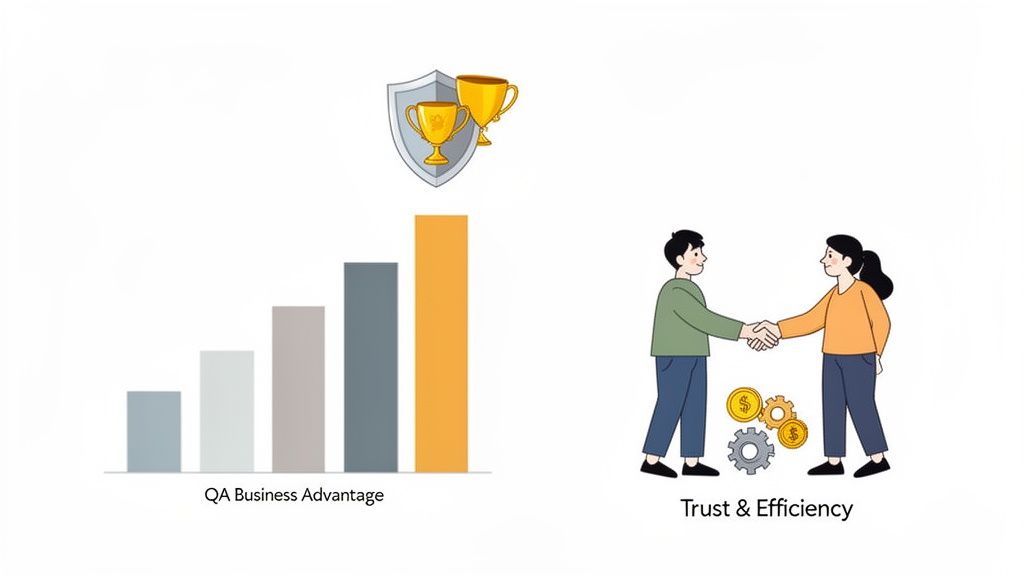
It’s easy to think of quality assurance as just another business cost. But that’s a huge misconception. In reality, a solid QA framework is one of the smartest investments you can make, laying the groundwork for long-term growth.
Instead of just reacting to problems after they happen, QA is all about preventing them in the first place. This proactive mindset sends positive ripples through the entire business, from the factory floor to the boardroom.
The most obvious win is in enhanced customer trust and loyalty. Think about it – when a product or service just works, every single time, you keep coming back. That’s what good QA delivers: consistency. It builds a rock-solid reputation for excellence that your competitors will struggle to keep up with.
But the benefits go far beyond happy customers. Getting QA right is a massive boost for your internal operations too. It’s always cheaper to catch a small issue early than to deal with a full-blown disaster after a product launch.
Slashing Costs and Boosting Efficiency
Mistakes are expensive. Rework, product recalls, and handling customer complaints all chew through time, money, and morale. Quality assurance is the answer, refining the very processes that lead to these problems.
This proactive approach delivers some serious financial wins:
- Reduced Rework: When you get it right the first time, you don't waste precious time and resources on do-overs.
- Lower Warranty Claims: Better products mean fewer failures, which directly cuts down the costs of repairs and replacements under warranty.
- Improved Resource Allocation: Imagine if your team wasn't constantly putting out fires. They could focus that energy on genuine innovation and pushing the business forward.
Mastering this focus on process improvement is a game-changer for any professional. For those wanting to make it their specialty, a qualification like the Diploma of Quality Auditing is a common way to formalise these high-value skills.
Meeting Standards and Building Reputation
Finally, let's talk about compliance. In heavily regulated industries like healthcare or finance, meeting legal and industry standards isn't a "nice-to-have" - it’s your licence to operate. QA gives you a structured way to make sure you’re ticking all the right boxes, protecting the business from fines and serious damage to its name.
A strong QA system acts as a safeguard, demonstrating a commitment to accountability and excellence. It tells customers, partners, and regulators that your organisation is serious about delivering on its promises.
Ultimately, people who truly understand quality assurance are more than just problem-solvers. They are genuine strategic assets. They directly boost the company's bottom line, strengthen its reputation, and secure its future, making them indispensable in just about any industry you can think of.
How Quality Assurance Works in the Real World
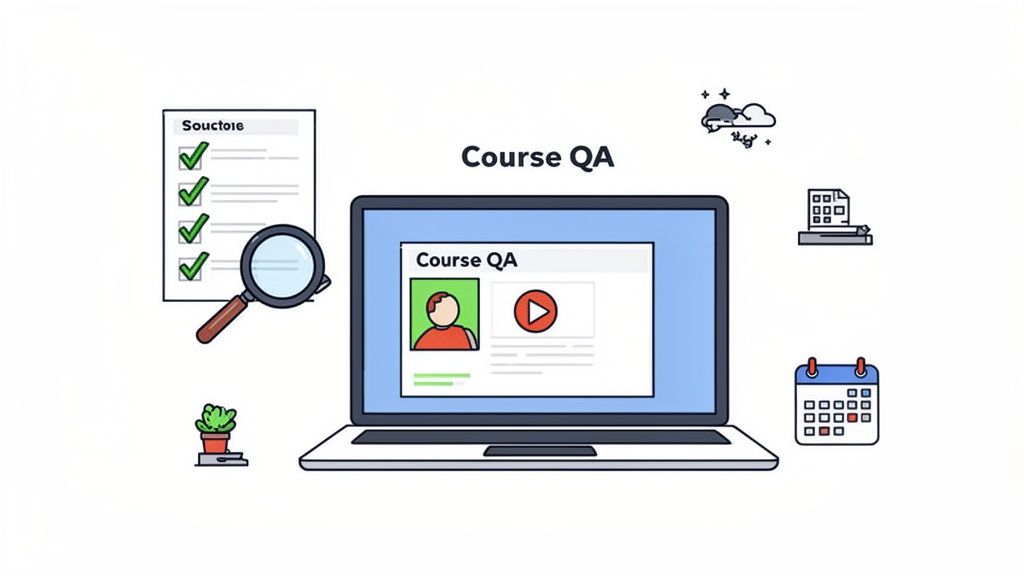
Knowing the theory behind quality assurance is a good start, but seeing it in action is where it all really clicks. QA isn't just an abstract idea; it's a practical, hands-on discipline built on clear standards, regular checks, and a genuine commitment to getting things right from the very beginning.
It's about moving away from a vague goal like "make a great product" and instead breaking down what "great" actually means into measurable, repeatable actions. This framework provides the scaffolding needed to turn good intentions into consistently reliable results.
Let's ground this in something familiar. Imagine we're building a new online course. How would a QA process work here?
Setting Clear Quality Standards
First things first, you have to define what quality actually looks like. You can't hit a target you can't see. These standards act as the yardstick for everything that follows.
For our online course, this means creating a detailed style guide and a quality checklist. This isn't just a list of suggestions; it's a set of non-negotiable rules covering things like:
- Content Accuracy: Is all information current, properly fact-checked, and citing reputable sources?
- Learner Engagement: Does every single module include at least one interactive element, like a quiz, a drag-and-drop activity, or a practical exercise?
- Accessibility: Do all videos have accurate, synchronised captions? Does all text meet web content accessibility guidelines for readability?
By setting these benchmarks upfront, everyone on the development team - from the writers to the video editors - knows exactly what's expected. It creates a shared understanding and ensures consistency across every single lesson.
Conducting Regular Process Audits
With clear standards in place, the next job is to make sure they're actually being followed. This is where process audits come in. Think of an audit as a systematic review of the workflow to catch any deviations from the established rules before they become bigger problems.
In our course development project, this might mean someone checks a random sample of video scripts against the style guide before they go into production. This simple, proactive check can catch awkward phrasing or inconsistencies early on, long before the costly and time-consuming process of filming and editing even begins.
Quality assurance isn't about blaming people for mistakes. It's about finding weaknesses in the process that allow mistakes to happen, and then strengthening that process for everyone.
This mindset shifts quality from being a personal burden to a shared, systemic strength.
Implementing Testing Frameworks
Finally, even with the best standards and processes, you have to test the final product from the user's perspective. A testing framework provides a structured approach to see how the product actually performs in the hands of the people who will use it.
For our online course, this step would involve user acceptance testing (UAT). Before launching, a small group of test students would be asked to go through the entire platform, actively looking for issues like:
- Broken links or videos that refuse to play.
- Confusing navigation that makes it hard to find the next lesson.
- Quizzes that don't calculate or display scores correctly.
This feedback loop is absolutely vital. To make sense of it all, many organisations use specialised customer feedback management software to collect, analyse, and act on these crucial insights.
This isn't just a "nice-to-have" in the Australian education space; it's critical. The local edtech sector is a massive $3.6 billion industry, yet learning outcomes have shown signs of stagnating. This gap highlights a serious need for robust QA to ensure online learners are getting credible, high-quality training. A recent UTS report digs deeper into the proposed frameworks needed to guarantee quality in Australian edtech.
Quality Assurance in Action Across Key Industries
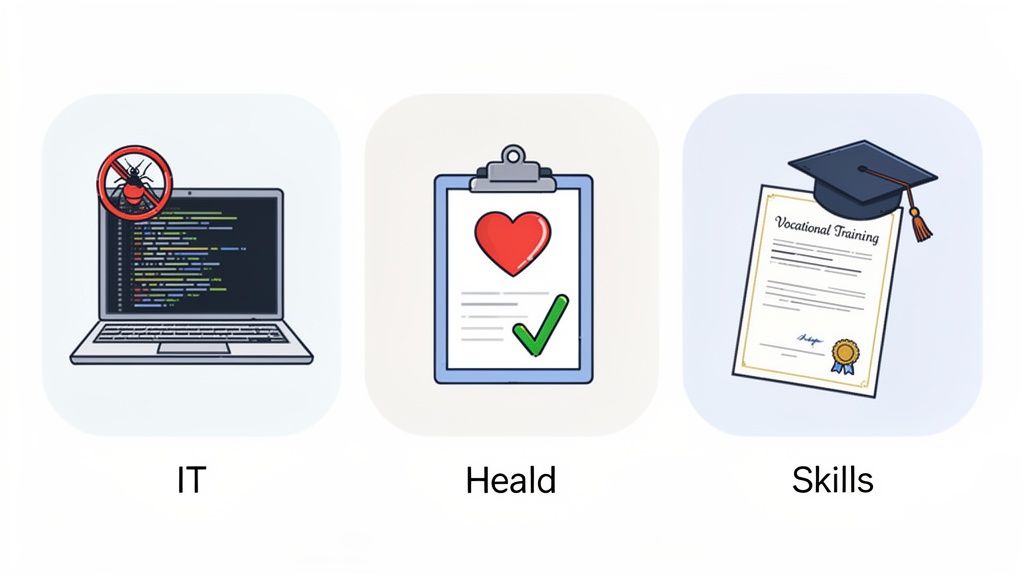
Quality assurance isn't a one-size-fits-all checklist. It's more of a flexible mindset, a framework that bends and adapts to the unique pressures and high stakes of different industries. Seeing how its core ideas are put to work to solve real problems is the best way to understand what quality assurance is all about.
From making sure a new app doesn't crash on launch day to guaranteeing a patient’s safety in a hospital, QA provides the essential scaffolding for delivering results people can count on.
Let's take a look at how this plays out across three major Australian sectors, showing how a solid grasp of QA can directly boost your career.
Assuring Reliability in Information Technology
In the fast-moving world of IT, quality assurance is the glue that holds everything together. Here, QA is a highly structured process aimed at making sure software is not just working, but also secure, dependable, and easy to use before it ever gets into a customer’s hands.
Think about a new banking app. A single glitch could expose sensitive data or block transactions, leading to a huge loss of customer trust and revenue. The entire QA process in IT is built to stop that from happening.
QA in tech typically involves a few key stages:
- Code Reviews: Developers get a second pair of eyes on each other’s code, a simple but effective way to catch logic flaws or security weak spots early on.
- Automated Testing: Special scripts are written to run thousands of checks automatically, looking for performance dips or new bugs that pop up after an update.
- User Acceptance Testing (UAT): Before the final release, a group of real users gets to try the software to confirm it actually solves their problems and isn’t a nightmare to navigate.
It’s this methodical, multi-layered approach that ensures the final product is solid, building a company’s reputation one reliable release at a time.
Upholding Standards in Healthcare and Community Services
When you move into healthcare, the stakes jump dramatically. Quality assurance can literally be a matter of life and death. In this field, QA is all about building and maintaining systems that guarantee patient safety, effective treatments, and compliance with strict regulations.
It goes far beyond simply double-checking a doctor’s work. It’s about auditing entire systems, from how patient files are managed to the sterilisation procedures for surgical tools. A hospital's QA team, for instance, might analyse medication protocols to reduce the chance of human error, directly protecting patients from harm.
In healthcare and community services, quality assurance is the ethical commitment to providing the safest and most effective care possible. It creates a culture of accountability and continuous improvement.
This focus on safety doesn't stop at the hospital doors. It’s just as vital in areas like food service, where robust QA is what prevents outbreaks of foodborne illness. Understanding these principles is a non-negotiable for anyone building a career in this space, something we cover in our guide for becoming a food safety supervisor.
Validating Skills in Vocational Training
Australia’s vocational education and training (VET) sector is another area where quality assurance is absolutely essential. Its job is to make sure every certificate and diploma is worth the paper it's printed on, meeting national benchmarks and giving graduates skills that are genuinely in demand. For a system with over 4 million enrolments a year, that’s a massive responsibility.
Strict QA processes, overseen by bodies like the National Training Quality Council, ensure that what's taught in a classroom directly matches what employers are looking for. This prevents a "skills gap" and keeps the workforce competitive.
For courses with hands-on components like Work Integrated Learning (WIL), QA frameworks are adapted to measure the quality of the placement, making sure students get valuable, real-world experience that sets them up for success. To learn more about how Australia's VET system is kept to a high standard, you can explore the official government study resources.
Building Your Career Path in Quality Assurance
Thinking about a career in quality assurance? It's a smart move. This is a field that genuinely rewards people who are precise, think critically, and prefer to get ahead of problems before they start. It's not a one-size-fits-all career, either. You can grow from hands-on roles right through to high-level strategy, making it a brilliant choice for anyone with a sharp eye for detail.
Most people get their start in an entry-level role. Positions like a QA Tester or Junior Quality Analyst are the perfect launching pad. This is where you'll get your hands dirty, running test plans, finding bugs, and learning how to document everything clearly. It's the ground floor where you build the essential habits of careful observation and solid communication.
Once you’ve got some experience under your belt, the path opens up to more specialised and strategic work.
Advancing Your QA Career
Moving up in QA means your focus starts to shift. Instead of just finding problems, you begin to think about how to prevent them from ever happening.
A QA Analyst, for example, does much more than just run tests. They dig into the processes themselves to find weak spots. They’re always asking why things are breaking and coming up with ways to fix the root cause, not just patch up the symptoms.
Take it a step further and you could become a QA Manager or a Lead Auditor. These are leadership roles where you're responsible for the entire quality system on a project or even across the whole company. You'll be mentoring teams, managing budgets, and making sure quality is baked into everything, from start to finish.
A career in quality assurance isn’t just a job; it's about becoming a guardian of excellence. You’re the one making sure the promises made to customers are kept, which builds trust and protects the company's reputation.
To climb that ladder, you'll need a specific mix of skills that employers are always looking for.
Essential Skills and Qualifications
Technical skills are important, but the best QA professionals also have a strong set of personal attributes. An almost obsessive attention to detail is a must-have, along with a knack for analytical and critical thinking. You also need to be a great communicator, able to explain complex technical problems in simple terms to colleagues who might not be tech-savvy.
To put a formal stamp on these skills, many people look to nationally recognised qualifications. While a university degree is one path, practical vocational training in IT, business, or management can give you the job-ready knowledge to hit the ground running. For example, a course like the Certified Software Tester Professional can give you the specific, in-demand skills needed for tech roles.
You can see this focus on quality in Australia’s own education sector. The government’s Quality Indicators for Learning and Teaching (QILT) initiative is a fantastic real-world example of QA. It uses surveys to measure everything from student satisfaction to graduate outcomes across universities and vocational colleges. The data often shows graduate employment rates hitting over 80% in popular fields, proving just how much a quality-assured education matters. You can learn more about how QILT helps maintain high educational standards.
A Few Common Questions About Quality Assurance
As you start wrapping your head around what quality assurance is all about, a few practical questions are bound to pop up. It’s one thing to understand the theory, but quite another to know what a career in this field actually looks like day-to-day.
Let’s get into the straightforward answers you’re looking for as you think about a future in QA.
Do I Need a Specific Degree to Work in Quality Assurance?
Not at all. While a university degree in something like computer science, engineering, or business can give you a leg up, it’s definitely not the only path into the industry. In fact, many successful QA professionals build their careers on a solid foundation of vocational qualifications and specialised certifications.
What employers really look for are practical skills and the right mindset. Things like sharp analytical thinking, a genuine eye for detail, and the ability to communicate clearly are often way more important than a specific degree. Of course, knowing the industry you're working in - whether you learned it on the job or through study - is also a huge plus.
The main thing to remember is that your ability to think critically and systematically often carries more weight than the name on your qualification. It’s your skills, not just your credentials, that will open doors.
This makes QA a fantastic career option for a lot of people, particularly if you’re looking to switch careers or just add some targeted skills to your resume.
What's the Difference Between Manual and Automated Testing?
This is a classic question, and for good reason! Both are vital parts of any modern quality assurance strategy, but they serve different purposes.
Manual Testing: Think of this as a person sitting down and using a product just like a real customer would. They click through everything, try to break it, and see how it feels to use. This approach is perfect for exploratory testing, checking user-friendliness, and handling unique scenarios that need a bit of human intuition.
Automated Testing: This is where we bring in the machines. Using special software and scripts, automated tests can run thousands of checks in a flash. It's incredibly efficient for repetitive tasks, like regression testing (making sure a new update didn’t break an old feature) or stress-testing a system to see how it performs under a heavy load.
One isn't better than the other; they're just different tools for different jobs. A truly effective QA process uses a smart mix of both to make sure all bases are covered.
How Can I Get QA Experience if I'm Just Starting Out?
Trying to break into any new field can feel like a catch-22, but there are plenty of practical ways to build experience. A great first step is to hunt for internships or entry-level roles - keep an eye out for titles like "Junior QA Tester" or "Quality Assurance Assistant."
You can also get some brilliant hands-on experience by volunteering for open-source software projects. These community-run projects are almost always looking for people to help with testing, and it's a fantastic way to learn the ropes in a real-world setting.
Don't forget that many online courses and vocational qualifications come with practical projects that you can add to a professional portfolio. This is a powerful way to show potential employers that you're proactive and have the skills to hit the ground running.
Ready to build the practical, job-ready skills for a career in quality? At Get Course Australia, we connect you with nationally recognised online courses designed for today's job market. Explore flexible, self-paced qualifications in IT, business, and more to start your journey. Find your perfect course today.
Find Your Course
Compare courses across every field we write about, and enquire in under a minute.