Online Short Courses Australia Your Career Guide
Explore online short courses Australia to find the perfect fit. Our guide covers top subjects, costs, and accredited options to help you upskill and advance.
Think of an online short course as a career power-up. It's a focused, intensive program designed to give you specific, job-ready skills in a matter of weeks or months, not years. This makes it a smart, flexible, and affordable way to get a promotion, switch careers, or simply keep your skills sharp in a fast-moving job market.
What Are Online Short Courses in Australia?

A university degree is like a long, scenic road trip - it covers a huge amount of ground over several years. An online short course, on the other hand, is the direct flight. It skips the detours and gets you right to your destination, equipped with the exact skills you need.
These are highly targeted learning programs delivered completely online. The goal isn't to give you a broad, theoretical education; it's to help you master a specific skill that you can start using at work straight away. It's a practical approach to learning that has exploded in popularity across Australia.
The Shift to Flexible Learning
The demand for education that fits around real life - work, family, and everything in between - has made online learning mainstream. It has completely replaced old-school correspondence courses as the go-to for distance education, allowing people to learn whenever and wherever it suits them. You can dive into the research from the National Centre for Student Equity in Higher Education to see just how much online delivery has grown.
This kind of flexibility is a game-changer for:
- Career climbers who want to learn a new skill like data analysis or digital marketing to land that next promotion.
- Career changers looking to dip their toes into a new industry, like IT or community services, without the commitment of a full degree.
- Anyone who needs to keep up with industry trends and show employers they are proactive about their professional development.
At its heart, the idea is simple: get the skills you need, on your terms. Online short courses remove the old barriers of time and location, opening up quality education to people everywhere, from capital cities to the outback.
A Focus on Doing, Not Just Knowing
Ultimately, an online short course in Australia is designed to close the gap between where you are and where you want to be in your career. It’s less about the piece of paper you get at the end and more about the real-world confidence and skills you gain.
Whether you're getting to grips with new software or learning the basics of project management, the focus is always on practical application. To learn more, check out our guide on the benefits of online short courses and see how they can work for you.
How a Short Course Can Accelerate Your Career

Sure, the flexibility of online short courses is great, but their real value is how they can directly shape your career path. Think of it as a targeted injection of skills - a smart investment that gives you an immediate, tangible return. It's a powerful tool for anyone serious about making a change.
Finishing a short course isn’t just about what you learn; it's about what it says about you. It shows your current (or future) boss that you’re driven, adaptable, and committed to keeping your skills sharp. That kind of initiative is often what separates a good candidate from the one who gets the job.
Gaining In-Demand Skills for Promotion
Sometimes, the only thing holding you back from that next promotion is a specific skill gap. A short course is easily the fastest way to fill it. For instance, an admin assistant who knocks over a project management certificate isn’t just an assistant anymore - they’re a budding project coordinator.
This kind of focused upskilling gives you the practical know-how to take on more senior duties. By getting a verifiable qualification in something like leadership, digital marketing, or data analysis, you’re building a rock-solid case for moving up. You’re not just asking for a promotion; you're showing you're already prepared for it.
An online short course is a direct line to the skills employers are looking for right now. It lets you add a fresh, valuable line to your resume in a matter of months, not years, giving you a real advantage.
One of the best parts is that you can often use what you learn straight away. An IT professional who finishes a course in cybersecurity fundamentals on Friday can walk into work on Monday and start spotting potential security risks. That ability to deliver immediate value makes you indispensable.
Making Your Resume Stand Out
In a crowded job market, a generic resume just doesn't cut it. Micro-credentials and professional certificates from short courses make your CV pop. They scream, "I have the specific, up-to-date skills you're looking for!"
Picture a graphic designer adding a UI/UX Design certificate to their LinkedIn profile. Suddenly, they're a contender for a whole new world of web and app design roles. It instantly makes them more versatile and attractive to tech companies.
- Verifiable Proof: Certificates are solid evidence that you can do what you say you can.
- Targeted Expertise: They signal you have specialised knowledge in a high-demand area.
- Modern Relevance: They prove your skills are current, not stuck in the past.
Pivoting to a New Industry with Confidence
Switching careers can feel daunting, but it doesn't always mean going back to uni for three years. Online short courses give you the essential knowledge and skills you need to strategically pivot your career into a completely different field.
Someone working in hospitality who wants a more meaningful role could do a Certificate III in Individual Support to move into the community services sector. It’s a low-risk, high-reward way to test the waters, get the necessary ticket to play, and start building a new professional network - all without the huge time and financial commitment of a full degree.
Popular Industries for Online Short Courses
When you're thinking about an online short course, it's smart to look beyond just what interests you and consider where Australia's job market is heading. The right course can be a direct bridge into a high-demand industry, setting you up for a career that’s not just rewarding but also stable and secure for the future.
The trick is to find that sweet spot where industry demand meets the skills you can gain from a targeted qualification. Three sectors in Australia are consistently crying out for skilled people: Information Technology, Healthcare and Community Services, and Business. Let's break down what makes each of them a great choice.
The Fast-Paced World of Information Technology
Technology is the engine room of our modern economy, and it's an industry that never stands still. Because it moves so quickly, short courses have become one of the best ways to get up-to-the-minute, relevant skills that employers need right now. They're built to be practical and hands-on, getting you job-ready from day one.
Forget a long, theoretical computer science degree. An IT short course delivers a specific, marketable skillset you can put to work immediately. A course in cybersecurity fundamentals, for instance, can be your ticket to an entry-level role protecting company data - a field that's absolutely booming.
Common pathways in IT include:
- Cybersecurity: Learning the essentials of how to shield networks and data from digital attacks.
- Web Development: Getting hands-on with coding languages like HTML, CSS, and JavaScript to build functional websites.
- IT Support: Becoming the go-to technical expert who can troubleshoot hardware, software, and network problems.
- Cloud Computing: Understanding the basics of platforms like Amazon Web Services (AWS) or Microsoft Azure, which are now vital for most businesses.
Focusing on these areas can give you a solid foothold in a dynamic industry. If this sounds like your path, exploring some popular online IT courses is a great next step to see what fits your goals.
The Heart of the Community: Healthcare and Social Assistance
It's no secret that Healthcare and Social Assistance is Australia’s largest and fastest-growing industry. With an ageing population and a greater focus on community wellbeing, the demand for compassionate, qualified support workers has never been higher. This is a field where you genuinely make a difference in people's lives every single day.
Online short courses are often the most direct way to get the nationally recognised qualifications required for these roles. They equip you with the foundational knowledge and real-world skills needed to provide quality care and support to vulnerable people in our communities.
A short course in this sector is more than a qualification; it's a doorway to a meaningful career built on empathy and human connection. It lets you join a workforce where your contribution is truly valued.
Key areas you could study include:
- Aged Care: Learning to support the elderly with their daily needs while promoting their dignity and independence.
- Disability Support: Gaining the skills to empower people with disabilities to live more fulfilling lives.
- Mental Health First Aid: Getting certified to provide that crucial initial support to someone experiencing a mental health challenge.
- Community Services: Developing a broad skillset that opens up various community-based support roles.
Driving Success in Business and Management
Every single organisation, from the local coffee shop to a massive corporation, relies on skilled professionals to manage its operations, marketing, and finances. Online short courses in business are fantastic for developing those practical, transferable skills that are valuable in almost any industry you can think of.
These courses are a perfect fit for anyone looking to step up into a leadership role, start their own business, or simply become more effective in their current job.
To help you visualise where these courses can lead, here’s a quick look at some popular fields and the careers they open up.
Popular Online Short Course Fields and Career Pathways
As you can see, a focused course can quickly translate into a specific job title. By zeroing in on a specialisation, you can build a strong foundation for a successful and versatile career in the business world.
Accredited Versus Non-Accredited Courses
Trying to figure out the world of online short courses in Australia can feel a bit like choosing a travel ticket. Some tickets get you a formal, recognised spot on a national railway network, while others are for a specialised, high-speed shuttle built for a very specific purpose. That’s pretty much the difference between accredited and non-accredited courses.
Getting your head around this is vital because it directly shapes what you can do with your qualification. One path leads to a formal, government-endorsed credential, while the other gives you sharp, practical skills without the official stamp. Neither one is inherently "better" - it all comes down to what you want to achieve.
What Is a Nationally Recognised Course?
Think of an accredited course like getting your driver's licence. It's a formal process that proves you've met a national standard. In Australia, this is called nationally recognised training. These courses are designed and assessed under strict government guidelines to make sure the quality is consistent no matter where you study.
The whole system is built on the Australian Qualifications Framework (AQF), which is the national policy for regulated qualifications. The AQF organises everything into a clear hierarchy, from a Certificate I all the way up to a Doctoral Degree.
When you finish an accredited online short course - say, a Certificate III in Individual Support or a Certificate IV in Cyber Security - you walk away with a qualification that is:
- Formally Recognised: Employers, industry bodies, and other TAFEs and universities across the country will acknowledge it.
- A Pathway to Further Study: You can often use it as a stepping stone to a higher-level certificate, diploma, or even a university degree.
- Required for Certain Jobs: Many jobs, particularly in regulated fields like healthcare, aged care, and early childhood education, legally require you to hold a specific AQF qualification.
These courses are the perfect choice if you're aiming to break into a new, regulated industry or need a formal credential that carries weight across the entire Australian job market. To really get into the nitty-gritty, check out our detailed explanation of what an accredited course means.
The Power of Non-Accredited Courses
If an accredited course is the official driver's licence, then a non-accredited course is like an advanced defensive driving workshop. It won't give you a new licence, but it will teach you incredibly valuable, specific skills that make you better at what you already do.
These courses are usually created by industry experts or private providers to fill a very specific, immediate gap in the job market.
A non-accredited course is all about pure skill acquisition. It’s built to be fast, focused, and immediately useful, giving you the exact knowledge you need to solve a problem or master a new tool without all the formal hoops to jump through.
They are ideal for people who are already working and need to upskill quickly. For example, a marketing manager might take a non-accredited course on Google Analytics 4, or a graphic designer might do a workshop on the latest AI design software.
The biggest advantages of non-accredited online short courses are:
- Speed and Focus: They get straight to the point, teaching you a specific skill in just a few hours or days.
- Relevance: They're agile. They can be updated quickly to keep up with the newest industry trends and technology.
- Lower Cost: Because they don't have the administrative overhead of formal accreditation, they're usually much more affordable.
While they don't give you a formal AQF qualification, employers still see them as a huge plus. They show you've got initiative and are committed to keeping your skills sharp, making them an excellent way to boost your resume and prove your expertise in a niche area.
How to Choose the Right Online Course
Deciding on the right online short course can feel a bit like trying to pick a restaurant in a city full of amazing options. It's exciting, but where do you even start? The secret isn't just to look at the menu - it's to figure out what you're actually hungry for first.
Taking a moment to ask the right questions before you dive in can turn a potentially overwhelming search into a clear and confident decision. It's about matching the course to you, not the other way around.
First Things First: What’s Your Destination?
Before you even glance at a course catalogue, pause and ask yourself one simple question: Why am I doing this?
Seriously, this is the most important step. Are you looking for a formal, nationally recognised qualification that can help you switch careers or get a foot in the door of a new industry? Or do you just need to get good at one specific thing - like social media marketing or project management software - to level up in your current job?
Your answer is the single biggest filter you have. It immediately points you in the right direction, helping you decide whether an accredited course or a non-accredited skills-based program is the right fit.
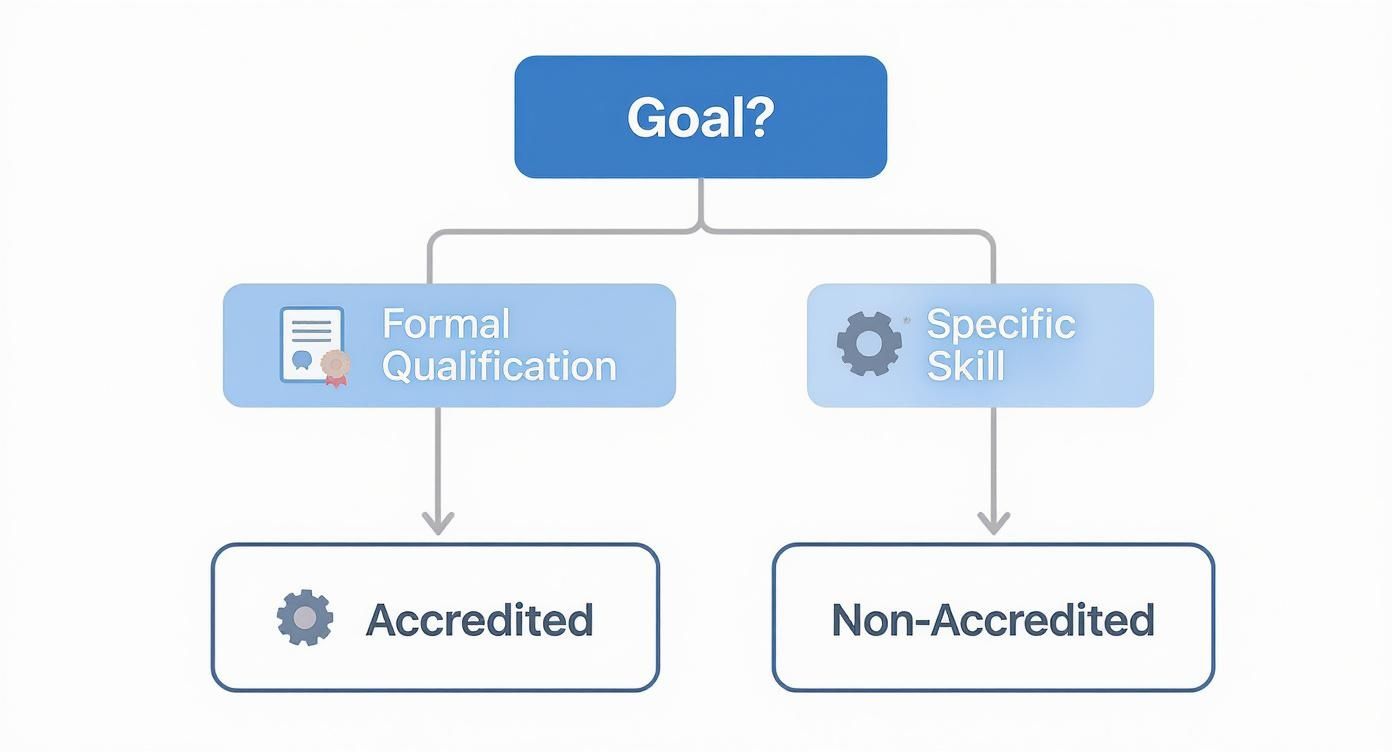
As you can see, starting with your end goal makes everything else much clearer. It’s the difference between wandering aimlessly and following a map.
Create Your Own Personal Checklist
Once you know your main objective, you can start digging into the details of specific courses. Think of this as your personal checklist for sorting the great from the not-so-great.
- How is it delivered? Is the course entirely self-paced, meaning you can log in and study whenever you have a spare moment? Or are there scheduled live classes and deadlines you need to meet? A self-paced model offers ultimate flexibility, while a structured one provides routine and real-time connection.
- What kind of support is there? This one’s a biggie. Find out how you can actually talk to a tutor when you're stuck. Is it just email, or can you get on the phone or use a live chat? Knowing you’ve got an expert in your corner when you need them makes all the difference.
- What are past students saying? Don't just rely on the testimonials on the course website. Hunt for independent reviews on places like Trustpilot or Google. Real, honest feedback from people who've already done the course gives you the inside scoop on everything from the course content to the support team.
- Who's behind the course? Do a quick search on the training provider or RTO (Registered Training Organisation). Are they a known and respected name in their field? A provider with a solid reputation is far more likely to offer a high-quality learning experience that employers will recognise.
The total cost isn’t always just the number on the price tag. Be sure to check for any hidden extras like enrolment fees, costs for materials, or charges for resubmitting an assessment. A good, transparent provider will lay all the potential costs out on the table from day one.
Getting this right is more important than ever. The Australian government sees just how crucial online short courses in Australia are for building our national workforce. A recent strategic review highlighted both the amazing opportunities and some of the challenges in this space. If you're interested in the nitty-gritty, you can discover more insights from the official ASQA report to see what the national standards look like.
Don't Forget to Check the Entry Requirements
Lastly, a quick but crucial step: always check the prerequisites before you get too attached to a course. Some of the more advanced accredited qualifications, particularly at a Certificate IV or Diploma level, might require you to have already completed a lower-level certificate or have some real-world work experience under your belt.
Confirming you meet the criteria right at the start will save you a lot of time and potential hassle. By taking this measured approach, you can confidently pick the perfect online short course that truly aligns with your ambitions and sets you up for success.
Got Questions About Online Short Courses? We’ve Got Answers.
Jumping into any kind of study, especially online, naturally comes with a few questions. Before you dive in, it’s a good idea to get your head around the practical stuff – the cost, the time, and what it all means for your career.
Let’s walk through some of the most common things people ask about online short courses in Australia. Getting these details sorted will give you the confidence to make a move that feels right for you.
What’s the Price Tag on an Online Short Course?
This is usually the first question on everyone's lips, and the honest answer is: it really depends. It’s a bit like buying a car. You wouldn't expect a small city runabout to cost the same as a heavy-duty ute built for the worksite, right? The same logic applies here.
You might find a non-accredited course on a specific skill – say, learning the ropes of a new software program or getting your head around social media ads – for just a few hundred dollars. These are designed to be quick, punchy, and affordable ways to get a specific piece of knowledge.
But if you’re looking at a nationally recognised qualification, like a Certificate IV in Cyber Security or a Diploma of Community Services, you’re making a more serious investment. These courses can start from a couple of thousand dollars and go up from there.
So, what makes the prices so different?
- Official Recognition: Nationally recognised courses have strict standards to meet for assessment and delivery, which naturally adds to the cost compared to a non-accredited workshop.
- The Subject Matter: Tech-heavy fields like IT or specialised healthcare roles often require more advanced resources and expert trainers, and the price reflects that.
- How Much Help You Get: The level of one-on-one time you get with a tutor can also influence the fee. A course with more personalised support will often have a higher price point.
It’s important to think of the cost as more than just a number on a page. It's an investment in your skills and your future paycheque. Plus, most providers have flexible payment plans to help you manage the cost without breaking the bank.
Can a Short Course Give Me a Head Start at Uni?
Yes, absolutely! This is one of the savviest ways to approach higher education. Many nationally recognised courses, especially at the Diploma level, are set up to be a direct pathway into a university degree. Think of it as building a bridge from hands-on training straight to a university campus.
This usually works through something called an articulation agreement. It’s a formal deal between a training provider and a university that says, "If you complete this Diploma with us, we guarantee you'll get credit for it in this Bachelor's degree."
For example, knocking over a Diploma of Business could slice a whole year off a three-year Bachelor of Business. Not only does that save you a massive chunk of cash on uni fees, but it also means you’re graduating and getting into the workforce a year earlier. It’s a brilliant strategy for stacking your credentials – get the job-ready skills first, then build on them with the deeper theory at uni.
Do Employers Actually Take Online Short Courses Seriously?
The short answer is a definite yes. But what they value depends entirely on what they’re looking for.
In a lot of regulated fields – like aged care, childcare, or certain trades – a nationally recognised qualification isn't just a 'nice-to-have', it's a must-have. You can't even get your foot in the door without it. In these professions, your accredited certificate is your non-negotiable ticket to entry.
In other areas, particularly in fast-paced industries like marketing or tech, employers are desperate for people with the latest, most specific skills. Having a non-accredited micro-credential on your CV or LinkedIn profile is a huge signal to them. It shows you know how to use that brand-new AI tool or you’re across the latest digital marketing trends. It screams that you’re someone who takes initiative and keeps learning – a quality every single employer is looking for right now.
Your Next Steps to Start Learning Online
Alright, you've got the lay of the land. You know what online short courses can do, from fast-tracking a promotion to helping you switch careers entirely. But turning that spark of interest into a real enrolment is where the magic happens. Let's map out a clear path forward.
The first step is smart research, not just endless scrolling. It’s easy to get lost in a sea of options, and frankly, a big part of learning to study online is knowing how to combat information overload. A solid plan will keep you focused and help you make a decision you feel great about.
Create Your Personalised Shortlist
Before you even open a browser tab, circle back to your "why." Are you chasing a nationally recognised qualification to get your foot in the door of a new industry? Or do you just need one specific skill to level up in your current role? That answer is your compass.
Use it to filter your options on course comparison sites and training provider websites. As you browse, aim to build a shortlist of just two or three strong contenders. Any more than that, and you'll find it hard to compare them properly.
- List your deal-breakers: What’s non-negotiable for you? Maybe it’s a self-paced timeline, a specific payment plan, or a start date that fits your life.
- Drill down into the course outlines: Don't just read the summary. Look at the actual units and modules. Do they teach the exact skills you’re after?
- Hunt for real reviews: Step away from the provider's own website and check out what past students are saying on Google or other independent review platforms. This is where you get the unvarnished truth.
Prepare for a Smooth Enrolment
Once you’ve landed on "the one," getting your paperwork in order will make signing up a walk in the park. Most training providers need the same handful of things to get you officially registered.
Having your documents ready to go turns enrolment from a headache into a simple formality. It’s the final tick of the box before you can officially start learning.
You'll almost certainly need:
- Proof of Identity: A driver's licence, passport, or birth certificate usually does the trick.
- Unique Student Identifier (USI): This is a must for any accredited course in Australia. If you don't have one, you can create one for free on the government's USI website.
- Evidence of Past Study: If your chosen course has prerequisites, you’ll need to have a digital copy of your certificate or academic transcript handy.
With your research done and your documents sorted, you're ready to hit that "enrol" button with total confidence.
Ready to find an online course that fits your career goals and your life? Get Course Australia helps you compare options from top providers and get enrolled without the hassle. Start exploring your options at https://getcourse.com.au.
Find Your Course
Compare courses across every field we write about, and enquire in under a minute.