Online Early Childhood Education Degrees A Complete Guide
Explore online early childhood education degrees in Australia. This guide compares programs, career paths, and costs to help you find the right course.
Australia has a real need for qualified early childhood educators, and if you've ever considered a career shaping young lives, an online early childhood education degree is one of the most accessible ways to get started. Think of this guide as your first step, showing you how online learning can open up a rewarding, in-demand career.
Why Your Early Childhood Career Starts Online

If you're passionate about how children learn and grow, there’s never been a better moment to build a career around it. Australia is in the middle of a major skills shortage in the early childhood sector, which means there’s huge demand for professionals ready to nurture the next generation.
The beauty of studying online is its flexibility. It makes a real career in this field possible for everyone, whether you're a busy parent juggling family life or someone looking for a meaningful career change.
The Growing Demand for Educators
This isn't just a small gap in the workforce—it's a critical national priority. A recent government analysis pointed to a massive shortfall of around 57,000 workers needed to meet Australia’s needs in early childhood education and care. This has rightly created a big push for more accessible training, with online courses leading the charge.
What does this shortage mean for you? It means that once you have a nationally recognised qualification, you'll be exactly who employers are looking for. Studying online lets you gain these in-demand skills on your own terms, without needing to press pause on the rest of your life.
The true value of an early childhood educator lies in their ability to create a safe, engaging, and supportive environment where children can thrive. Online degrees provide the theoretical foundation, while mandatory practical placements ensure you build the hands-on confidence needed for the classroom.
Skills You Will Gain
Don’t mistake online study for simply reading textbooks on a screen. Today's courses are built to give you practical, job-ready skills for the day-to-day realities of working with young children. Developing these skills is crucial for navigating classroom dynamics and finding insights into handling preschoolers.
You'll come away with a solid understanding of:
- Child Development: Get to know the key milestones in how children think, socialise, and grow emotionally.
- Curriculum Planning: Learn to design fun, play-based activities that align with official curriculum frameworks.
- Health and Safety: Master the essential protocols for keeping a learning environment safe and healthy for everyone.
- Communication: Build the skills to create strong, positive relationships with children, their families, and your colleagues.
Finding the right course can feel overwhelming, but platforms like Get Course make it much simpler by connecting you with top-quality providers. Our guide on the benefits of flexible online courses explains more about how this modern way of learning actually works.
Understanding Your Qualification Options
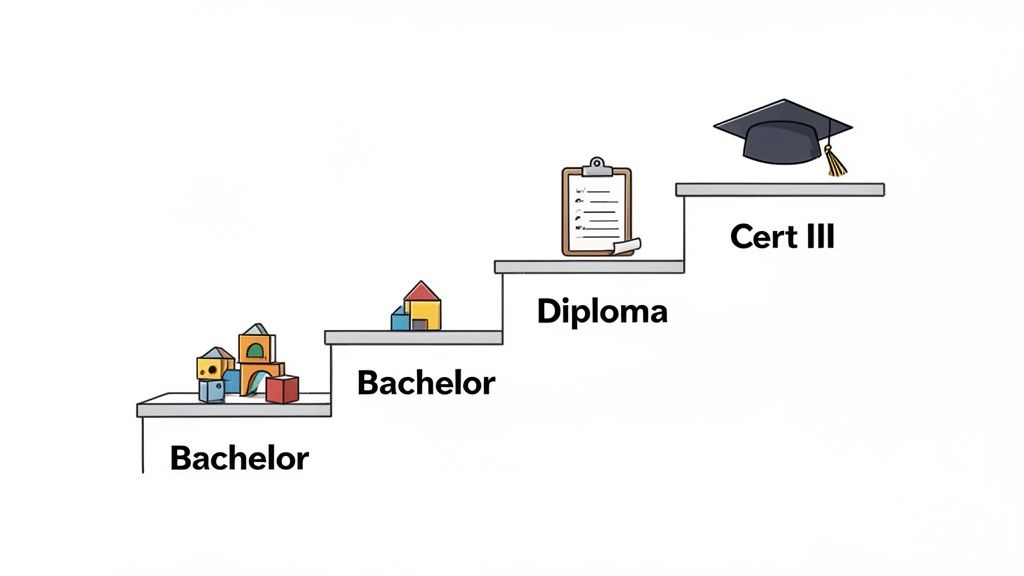
Choosing an online early childhood education course can feel a bit like looking at a career ladder. Each qualification is another step up, opening doors to new responsibilities, higher-level skills, and even leadership roles. Figuring out where each rung on that ladder leads is the first step to picking the right starting point for your own career goals.
The good news is that these qualifications are nationally recognised. This means they all meet a consistent standard of excellence set by the Australian Qualifications Framework (AQF), so your hard work is valued no matter where you are in the country.
Let's break down the main rungs on this ladder, from your very first entry into the field to becoming a fully qualified early childhood teacher.
The Foundation: Certificate III In Early Childhood Education And Care
Think of the Certificate III as your essential entry ticket into the early childhood world. This is the qualification that gives you the core, hands-on skills you need to support a child’s wellbeing, learning, and development while working under supervision. It’s the perfect launchpad if you’re new to the industry and want to turn your passion for working with kids into a real career.
Once you've got this under your belt, you're qualified to work as an Early Childhood Educator in a long day care centre, family day care, or preschool. Your day-to-day work will be all about creating fun, play-based learning activities, ensuring the environment is safe and healthy, and building those all-important positive relationships with children and their families.
A Certificate III typically focuses on:
- Providing care for babies, toddlers, and young children.
- Supporting holistic development through play and learning.
- Using an approved learning framework to guide your practice.
- Ensuring the health and safety of children.
The Leadership Step: The Diploma Of Early Childhood Education And Care
If you feel ready to take on more responsibility and maybe even lead a team, the Diploma is your next logical move. It builds directly on what you learned in the Certificate III, giving you the skills to not just implement but also design and lead the curriculum in an early childhood service. This one is really for educators with leadership ambitions.
With a Diploma, you can step into more senior positions like a Lead Educator, Room Leader, or even a Centre Director in some services. It’s the qualification that bridges the gap between hands-on care and the bigger picture of educational programming and management. If you're looking for a course designed specifically for this next step, you can explore the Access to Higher Education Diploma in Early Years Education for a deeper look.
A Diploma empowers you not just to follow a curriculum, but to create it. You’ll learn to critically reflect on your practices and lead other educators in delivering high-quality educational programs that help every child flourish.
The Teacher Level: Bachelor Of Early Childhood Education
For those aiming for the top tier of the profession and wanting to become a registered Early Childhood Teacher (ECT), a Bachelor's degree is the goal. This university-level qualification is a deep dive into pedagogy, child development theory, and advanced curriculum design. It's the highest qualification on this particular career ladder and is a requirement for teaching in preschools and kindergartens across Australia.
A Bachelor's degree opens up the widest range of career paths, including roles as an Early Childhood Teacher, educational leader, policy advisor, or centre manager. It gives you the advanced knowledge needed to confidently lead educational programs and mentor other staff. You can find out more about what this level of study involves by exploring the details of available early childhood Bachelor's degrees.
To help you see how these all fit together, here’s a simple side-by-side comparison.
Comparing Online Early Childhood Education Qualifications
Ultimately, the right online early childhood education degree really comes down to where you see yourself in the future. Whether you want to provide wonderful daily care as an educator or lead an entire learning centre as a teacher, there's a clear and flexible online pathway to help you get there.
How Online Study and Practical Placements Work
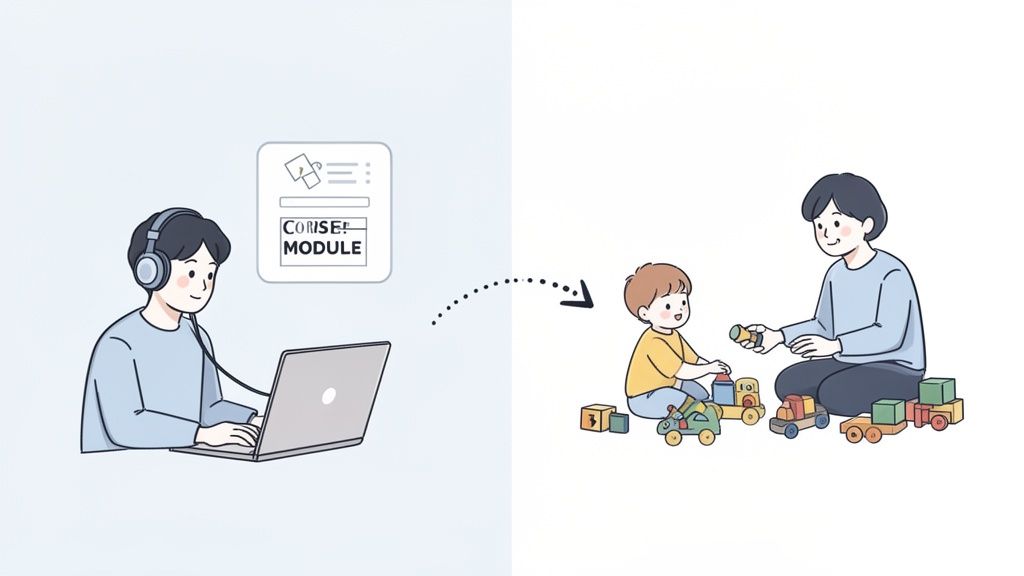
It’s the biggest question on most people’s minds when they consider online early childhood education degrees: how can you possibly learn such a hands-on job through a computer screen? It’s a fair question. After all, working with young children is about as far from a desk job as you can get.
The good news is that modern online courses have this figured out. They use a clever blended model that gives you the flexibility of online learning with the essential experience of working in a real childcare centre.
The Theory: Your Flexible Online Component
This is the part you do from your own home, on your own time. Think of it as your digital campus. All your learning materials, from video tutorials and expert readings to assignments and quizzes, are available through a central online learning portal.
This setup is a lifesaver for anyone juggling work, family, or other life commitments. There are no rigid lecture times to stick to. Instead, you work through the course content when it makes sense for you, whether that’s during a lunch break or late at night after the kids are in bed.
The Practice: Your Mandatory Work Placement
And here's the other half of the puzzle—where theory hits the playground. Every single nationally recognised early childhood qualification in Australia includes a mandatory work placement. This isn't an optional extra; it's a core requirement, whether you study online or face-to-face.
During your placement, you'll spend a set number of hours in an approved early learning centre, like a long day care or preschool. This is your chance to roll up your sleeves and put everything you've learned into practice. You'll be right there, interacting with children, assisting senior educators, and getting a feel for the rhythm and energy of a busy centre.
Work placement isn't just a box to tick at the end of your course. It's the heart of your training. It’s where you learn how to connect with children, manage a bustling room, and truly become the educator you want to be.
How Many Hours Are Required?
The time you’ll spend on placement depends on the qualification level. As you might expect, the more advanced the course, the more practical experience you’ll need to log.
Here’s a general guide to the minimum hours:
- Certificate III in Early Childhood Education and Care: Typically requires at least 160 hours. This gives you a solid foundation of practical skills for an entry-level role.
- Diploma of Early Childhood Education and Care: Often requires at least 280 hours, reflecting the higher-level skills in planning and leadership you'll be developing.
These hours are invaluable. You’ll be mentored by seasoned professionals and get a real, behind-the-scenes look at what makes a quality early learning service tick.
Finding and Arranging Your Placement
The idea of finding your own placement can feel a bit overwhelming, but you're not on your own. Any good online provider will have a dedicated team to help you navigate this.
Most TAFEs and colleges have established networks of partner centres they can connect you with. They’ll guide you through the process of finding and securing a suitable placement in your local area. Before you sign up for any course, make sure to ask about their placement support—it’s a crucial part of making your online early childhood education degree a success.
Making Sure Your Qualification Is Nationally Recognised
When you’re about to put your time, money, and energy into studying, you need to know it will pay off with a qualification that actually opens doors. In the Australian early childhood sector, this all boils down to two critical words: nationally recognised.
This isn't just some industry buzzword; it's the official seal of approval that employers and registration bodies look for. Think of it like a trade passport. A nationally recognised qualification is valid and valued in every state and territory, from Perth to Parramatta. An unaccredited course, however, might leave you with a certificate that's worthless outside the institution that issued it.
Essentially, this recognition is your guarantee that the course content, the training methods, and the final qualification all meet a strict, government-endorsed standard.
The Australian Qualifications Framework: Our National Standard
So, who sets this standard? That’s the job of the Australian Qualifications Framework (AQF). The AQF is the system that structures and defines all official qualifications in Australia, from a Certificate I right up to a PhD. It creates a clear, consistent hierarchy that everyone understands.
This framework allows an employer in Melbourne to know exactly what a Diploma-qualified educator from Brisbane can do. For a qualification to be included in the AQF, it must be delivered by a Registered Training Organisation (RTO) for vocational courses (like a Certificate III or Diploma) or an accredited university for degrees. These providers are regularly audited to make sure they're up to scratch.
Choosing a course that isn't nationally recognised is a huge gamble. You could spend months or years studying, only to discover your qualification won't get you a job, let you register as a teacher, or allow you to continue on to further study. It’s a devastating mistake to make.
What About Teacher Registration and ACECQA?
If your career ambition is to become an Early Childhood Teacher (ECT) by completing a Bachelor’s degree, there’s one more crucial body you need to know about: the Australian Children’s Education and Care Quality Authority (ACECQA).
ACECQA is the national authority that sets the quality standards for the entire sector. A key part of their role is to assess and approve early childhood teaching degrees. To become a registered teacher in any Australian state or territory, your degree must be on ACECQA's approved list. This ensures every ECT in the country has the high-level skills needed to lead a quality learning program.
How Get Course Takes the Guesswork Out of It
Trying to sort through RTOs, accreditations, and approved course lists can feel like a full-time job in itself. That’s where we come in. We’ve already done the hard yards for you.
At Get Course, we only partner with reputable, established RTOs and education providers. Every single course you find through our platform is guaranteed to be nationally recognised under the AQF.
- We Vet Every Provider: We only list courses from providers like Open Colleges and Upskilled, who have a long and trusted history of delivering quality, accredited training.
- You Get Total Confidence: You can be 100% sure that the qualification you sign up for is the real deal and will be respected by employers right across Australia.
- Focus on What Matters: It gives you the peace of mind to concentrate on your studies, knowing your hard work will result in a qualification that genuinely moves your career forward.
Choosing a course through Get Course means your investment in your future is safe. To see what a difference this makes, you can explore our full catalogue of quality-assured nationally recognised courses.
A Practical Look at Course Costs, Timelines, and Providers
Once you've zeroed in on the right qualification for your career dreams, it's time to get down to the brass tacks. The cost, the time it will take, and who you choose to study with are just as crucial as the course content itself. Getting these details right means you can find an online early childhood education degree that genuinely fits into your life, rather than forcing your life to fit around it.
It’s no surprise that the investment in your education grows with the level of qualification. While every provider sets their own fees, having a ballpark figure in mind for both the financial and time commitment is a huge help.
Typical Costs and Timeframes
The Certificate III in Early Childhood Education and Care is your fastest and most affordable ticket into the sector. Most students can knock this over in 6 to 12 months of part-time study, and you can expect the cost to be somewhere between $2,000 and $5,000. The great news is that government funding is often available for this one, which can seriously bring down the out-of-pocket expense if you’re eligible.
Moving up to the Diploma of Early Childhood Education and Care requires a bigger commitment. This course typically takes between 12 and 24 months to finish, with costs landing anywhere from $10,000 to $20,000. That higher price tag reflects the deeper skills you'll be learning, particularly around designing learning programs and stepping into leadership roles.
A Bachelor of Early Childhood Education is a full-blown university degree, so it's the biggest investment of the lot. A three-to-four-year degree will likely cost between $15,000 and $30,000, sometimes more. Thankfully, government loan schemes like HECS-HELP mean you don't have to pay upfront and can defer the cost until you're earning a solid income.
The boom in online learning has been fantastic for students. With Australia's online education market growing so rapidly—some analysts predict it could be worth AUD 12.2 billion by 2025—providers are getting more competitive. This means more flexible payment options and innovative ways to learn. You can discover more about the online education market in Australia to get a sense of how these trends can work in your favour.
Key Questions to Ask Any Provider
The sticker price is only part of the equation. A cheap course with non-existent support isn’t a bargain—it's a headache waiting to happen. Before you hand over any money, you need to ask some direct questions to make sure the provider is the right partner for you. Think of it as interviewing them for the very important job of shaping your career.
Here’s a handy checklist of what you should be asking every single online college or uni:
- What are my payment options? Do you offer interest-free plans? Can I pay in manageable instalments that work with my budget?
- What does your student support actually involve? Will I have one person I can talk to? If I email a question, how long will I be waiting for an answer? Is help available after 5 pm or on weekends?
- How do you help with work placements? Do you have existing relationships with childcare centres? What practical help do you give students to find a placement near them?
- Are all learning materials included? Or will I be hit with surprise costs for textbooks, software, or other resources down the line?
- What's your reputation like in the real world? Check out independent review sites. What are former students saying about their experience?
Choosing a provider is about more than just cost—it's about partnership. You're looking for an institution that will have your back, answer your calls, and genuinely help you succeed, from the day you enrol to the day you graduate.
Finding that sweet spot between cost, course length, and quality support is what turns your study into a smart investment. By doing a bit of digging and asking these crucial questions, you can feel truly confident in the program you choose.
Find Your Ideal Early Childhood Course With Get Course

You’ve now got a solid map of the qualifications, practical requirements, and career paths waiting for you in early childhood education. The next step is the exciting one: turning all that knowledge into action. This is where you go from just exploring your options to finding that one specific course to kickstart your career.
Deciding to build a career that shapes young lives is an incredible choice. And thanks to the flexibility of online study, this path is more open than ever, letting you gain real, job-ready skills without having to pause the rest of your life. But even with all this access, sifting through the options to find the perfect program can feel overwhelming.
That’s where Get Course comes in to make things simple.
Your Search, Simplified
Think of us as your personal course comparison tool, designed just for Australian learners. We cut through the clutter, bringing together a handpicked selection of nationally recognised courses from leading providers like Open Colleges and Upskilled.
Instead of bouncing between dozens of websites and getting lost in tabs, you can see all your best options side-by-side, right here. We’re all about transparency, so you can quickly compare the details that actually matter to you.
- Nationally Recognised Qualifications: Every single course is accredited. This is your guarantee that employers right across Australia will value your qualification.
- Flexible Payment Plans: We lay out all the information on payment options, helping you find a course that works for your budget without any nasty surprises.
- Dedicated Student Support: We connect you with providers who have a proven track record of helping online students succeed, from the day they enrol to the day they graduate.
And you are far from alone on this journey. A huge number of Australian adults are studying outside of the traditional school system. In fact, recent national data shows 2.3 million people were studying for a non-school qualification. Of those, over 44% were enrolled in higher education and another 14% were at TAFE institutions. You’re joining a massive community of learners, whether you choose a university degree or a vocational diploma. You can dig deeper into these trends by exploring education and work statistics in Australia.
Finding the right course isn't just about ticking boxes. It's about finding a provider who gets your goals and gives you the support you need to hit them. Our job is to make that connection happen as easily as possible.
Taking the Next Step With Confidence
We’re here to help you enrol feeling completely sure of your decision. Our platform gives you all the crucial information upfront, so you can make a choice that genuinely feels right for you and your future. The path to becoming a qualified early childhood educator is an exciting one, and it all starts with finding the right training partner.
Use our simple tools to filter courses by qualification level, provider, and subject. It’s the easiest way to narrow down the options and lock in your ideal online early childhood education degree. Take the next step today and explore the nationally recognised courses that can turn your passion for working with children into a rewarding, in-demand career.
Frequently Asked Questions
It’s completely normal to have a heap of questions when you’re looking into early childhood education courses. Getting clear on the details before you enrol is a smart move. Let's break down some of the most common things people ask.
Can I Get Qualified In Early Childhood Education Entirely Online?
Yes and no. You can absolutely do all the theory and coursework for your qualification 100% online. This is a massive plus, giving you the freedom to fit your studies around work, family, and everything else life throws at you.
But there’s a catch, and it’s a really important one. Every single nationally recognised course in Australia includes a mandatory practical placement. You can't get around it. This means spending a set number of hours in a real, approved early learning centre, getting your hands dirty. A good online provider will have a team dedicated to helping you find and organise this placement, making sure you get the hands-on skills to step into a job with confidence.
What Is The Difference Between An Educator And A Teacher?
This is a great question, and the main differences boil down to the qualification you hold and what you're responsible for day-to-day. An Early Childhood Educator usually has a Certificate III or a Diploma. Their focus is right there on the floor with the children—caring for them, guiding their play, and looking after their wellbeing.
An Early Childhood Teacher (ECT), on the other hand, needs a Bachelor-level university degree. ECTs bring a deeper knowledge of educational theory and child development to the table. They’re qualified to actually design, lead, and evaluate the learning programs. You'll often find them in leadership roles within a centre.
Think of it this way: an Educator is the skilled practitioner right in the thick of the daily learning journey, while the Teacher is the educational architect who designs the blueprint for that journey.
Are Online Degrees As Respected As On-Campus Degrees?
They certainly are. When it comes to the early childhood sector in Australia, employers care about one thing above all else: is your qualification nationally recognised? As long as your course comes from an accredited Registered Training Organisation (RTO) or university, the piece of paper you earn at the end has exactly the same value.
Honestly, employers are far more interested in the practical skills you can show them and the experience you picked up during your work placement. Since that hands-on component is required whether you study online or on campus, the way you studied the theory just doesn't change the value of your qualification.
How Long Does It Take To Complete An Online Course?
How long is a piece of string? The timeline really depends on the qualification level and how much time you can put in. A huge benefit of online vocational courses is that many are self-paced, so you're in the driver's seat.
As a rough guide, here's what you can expect:
- Certificate III: Many people knock this over in about 6-12 months studying part-time.
- Diploma: This is a bit more involved and usually takes between 12-24 months to complete.
- Bachelor's Degree: This is a full university qualification, so you're looking at 3-4 years of full-time study, or longer if you go part-time.
If you can dedicate a solid chunk of time to your studies each week, you might find you can finish a self-paced course even faster than the average timeframe.
Ready to turn your passion into a profession? At Get Course, we make it simple to find and compare nationally recognised online early childhood education degrees from Australia's leading providers. Explore your options and start your journey today at https://getcourse.com.au.
Find Your Course
Compare courses across every field we write about, and enquire in under a minute.