Master how to improve communication skills with quick, practical tips
Learn how to improve communication skills with actionable techniques for speaking, writing, and digital interactions - boost your workplace impact today.
If you're serious about getting better at communication, the best place to start is with the fundamentals. I'm talking about four key areas: active listening, clear verbal expression, concise writing, and understanding nonverbal cues. Nail these, and you'll have a solid foundation to build on for any situation, whether it's in the office or at home.
This guide is designed to give you practical, actionable strategies to help you build that foundation from the ground up.
Building Your Foundation for Powerful Communication
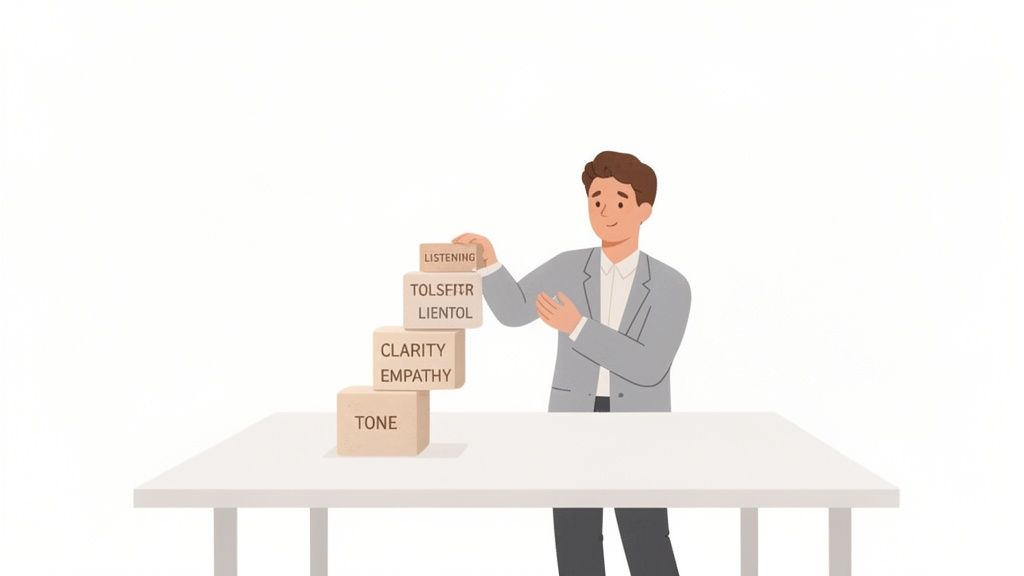
Let’s be honest—strong communication isn't just some soft skill to add to your CV; it's the engine of career growth, especially now with so many of us working in hybrid teams. It’s so much more than just being a smooth talker. Real improvement comes from a conscious effort to understand others, express your own thoughts with precision, and adapt your style to the person and the platform.
We're going to move beyond the textbook advice and get into the real-world challenges Australian professionals face. It’s all about building a complete toolkit—one that helps you truly listen, write with purpose, and navigate the unspoken rules of a Zoom call.
Why a Strong Foundation Matters
When you sharpen these abilities, you see a direct impact on your career. It doesn't matter if you're gunning for a promotion or making a complete career change. Think of this as your starting point for developing tangible skills that employers are desperate to find.
In fact, great communication is often the cornerstone of effective leadership training, where your ability to influence and motivate is everything.
Top-tier communicators aren't just born that way; they get there through deliberate practice and a healthy dose of self-awareness. It all begins with the simple realisation that communication is a two-way street. It’s just as much about receiving information as it is about sending it. If you want to dig deeper into that, it's worth exploring practical tips on how to improve listening comprehension.
The Core Pillars of Communication
To build a solid base, it's best to focus your efforts on the areas that give you the most bang for your buck. These are the pillars that support every interaction you have, from firing off a quick email to delivering a career-defining presentation.
- Active Listening: This is more than just waiting for your turn to talk. It’s about focusing intently on the message, figuring out the speaker's true intent, and giving feedback that shows you’re actually engaged.
- Clarity and Conciseness: Whether you're speaking or writing, the goal is simple: be understood. Fast. Cut the jargon, ditch the rambling sentences, and get straight to the point. Your colleagues will thank you for it.
- Empathy and Perspective: Before you respond, take a second to see things from their side. Acknowledging someone's perspective and feelings is the fastest way to build trust and get them on board with your message.
- Nonverbal Awareness: Your body language, tone of voice, and eye contact can often speak louder than your words. Paying attention to the signals you're sending—and the ones you're picking up from others—is a game-changer.
Effective communication is about connection, not just correction. It’s the ability to make someone feel heard and understood, which is the bedrock of trust and influence in any professional environment.
When you start to master these foundational skills, you’ll notice a ripple effect. Your professional relationships will strengthen, misunderstandings will become rare, and you’ll be seen as a clear-thinking, capable colleague. The advice that follows will help you turn these ideas into daily habits.
Mastering What You Say and How You Say It

Even with our inboxes and team chats constantly buzzing, the power of a real, human conversation hasn’t faded one bit. In fact, you could argue it’s more valuable than ever. Mastering what you say—and just as importantly, how you say it—is a non-negotiable part of improving your communication skills in any professional setting.
This goes way beyond just choosing the right words. It’s about the subtle dance of verbal and nonverbal cues that builds trust, prevents misunderstandings, and gets things done. Let’s skip the generic advice and get straight into practical techniques you can use in your very next conversation.
The Real Secret? Active Listening
Before you even think about what you’re going to say, you need to master the art of listening. And I don't mean the passive kind where you’re just waiting for a gap to jump in. I mean active, engaged listening, where you fully concentrate on the message and respond thoughtfully.
One of the most powerful tools in your kit is paraphrasing. Imagine a colleague has just explained a complex issue. Instead of just nodding, try saying, “Okay, so if I’m hearing you right, the main bottleneck is with the supplier, not our internal process?” This simple act does two crucial things: it confirms your understanding and makes the other person feel genuinely heard. It’s a small habit that completely changes the dynamic.
Beyond Words: What Your Body Language Screams
Your body language often says more than your words ever could. All those nonverbal cues—your posture, gestures, and eye contact—are the silent communicators that reveal what you're really thinking.
Think about a performance review. If your manager is delivering positive feedback but is slouched over, avoiding eye contact, and fidgeting, you’re not going to believe a word they say. Their nonverbal signals are screaming disinterest or discomfort. The same goes for you, whether you're in a high-stakes meeting or preparing for an interview. Our guide on 10 job interview tips that actually work touches on how confident body language can make all the difference.
Here’s a practical guide to help you become more aware of the signals you're sending and receiving in meetings, calls, and daily interactions.
Decoding Verbal and Nonverbal Signals
Becoming fluent in this 'silent language' takes practice, but the payoff is huge. You’ll build rapport faster and navigate tricky conversations with far more skill.
The most crucial element of a conversation is hearing what isn't said. By paying attention to nonverbal signals, you gain a deeper understanding of the true message and can tailor your response with greater empathy and precision.
It’s clear that face-to-face interaction still holds immense value, especially for younger generations. A UKG survey of Australian workers found that 42% of Gen Z prefer it over email, instant messaging, or video calls. That's a huge number, and it shows why these "soft skills" remain so vital.
Make Your Message Stick with Storytelling
Facts and figures are essential, but they rarely inspire action on their own. If you want your message to be memorable and persuasive, you need to wrap it in a story. We’re all wired to connect with narratives.
Instead of just presenting a slide with sales figures, tell the story behind them. "This quarter, we saw a 15% increase in regional sales. This wasn't just a number; it was because Sarah's team in Melbourne identified a gap in the local market and launched a targeted campaign that directly addressed customer feedback from last quarter."
This approach accomplishes two things instantly:
- It makes the data relatable and much easier to digest.
- It gives credit and context, turning a dry statistic into a shared achievement.
To really nail this, a dedicated focus on improving verbal communication skills can provide you with actionable strategies and practice drills. Integrating storytelling is one of the quickest ways to elevate your delivery from simply informative to truly influential.
Writing with Clarity and Impact
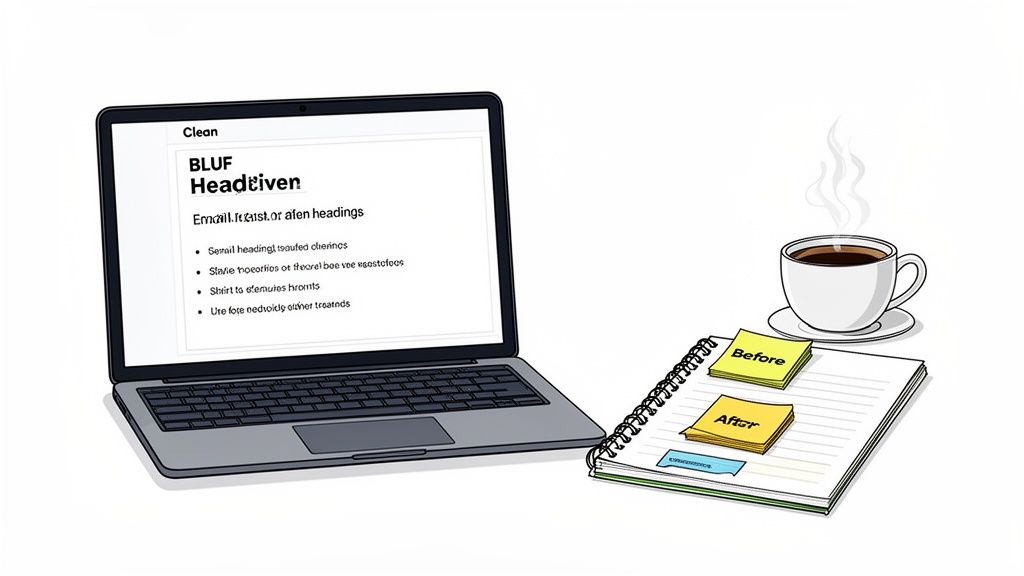
In a world of endless digital chatter and overflowing inboxes, your writing often makes the first impression for you. Every email, report, and Slack message you send is quietly shaping your professional reputation. That's why strong written communication isn't just a 'nice-to-have' skill anymore—it's a fundamental part of building credibility and getting things done.
This isn’t about becoming a literary genius or getting bogged down in complex grammar. It's about being strategic. It’s about crafting messages that are clear, concise, and impossible to ignore, ensuring your key points land with precision every time.
Lead with the Bottom Line
Let's be honest, nobody has time to decipher long-winded emails to find the main point. The single most powerful change you can make to your professional writing is to adopt the BLUF method—Bottom Line Up Front. It’s a beautifully simple principle from the military: put your most important information or your key request right in the first sentence.
Instead of slowly building up to your point, just lead with it. This instantly frames the message and lets the reader know exactly why you’re writing. Everything else that follows simply adds context, detail, or supporting evidence.
It’s a real game-changer. Take a look:
Before (Wandering Introduction)
"Hi team,
Just circling back on our discussion from last week's project sync. I've had a chance to review the latest client feedback and have also cross-referenced the project timeline. I’ve identified a few potential issues."
After (BLUF Approach)
"Hi team,
We need to push the project deadline back by one week. The latest client feedback requires significant changes that impact our original timeline. I've detailed the specific points below."
See the difference? The second example is immediately clear and actionable. It gets straight to the point and respects everyone's time.
Structure for Scannability
People rarely read work documents word-for-word. They scan. Your job is to make your writing as easy to scan as possible. Dense paragraphs are the enemy of clear communication.
You need to break up your writing with formatting that guides the reader’s eye. This isn't just about making it look pretty; it’s about making your information digestible and your key takeaways obvious.
- Keep paragraphs short. Aim for three sentences, max. This creates white space and makes your writing feel less intimidating.
- Use bullet points. They're your best friend for lists, action items, or key findings.
- Write descriptive headings. In a longer email or document, subheadings let readers jump straight to the parts that matter most to them.
Good writing is an act of empathy. It anticipates the reader's questions, respects their limited time, and presents information in the most accessible way possible, ensuring the message is not just sent, but truly received.
By structuring your writing for a quick scan, you dramatically increase the chances that your message will be fully understood and acted upon.
Choose Your Tone Deliberately
The words you choose have the power to build bridges or create friction. The tone of your message—the attitude it conveys—can completely change how it's received. An email that comes across as demanding or accusatory can shut down collaboration, even if you didn't mean it that way.
Before you hit send, always give your message a quick re-read from the other person's perspective. Ask yourself:
- Could any of this be taken the wrong way?
- Does this sound collaborative or confrontational?
- Is my language clear and positive?
For example, shifting from a slightly passive-aggressive phrase to direct, collaborative language makes a world of difference.
- Instead of: "It's not clear why the report wasn't submitted on time."
- Try: "Could you give me an update on the report? Let me know if you're facing any roadblocks I can help with."
That small shift transforms a potential accusation into a supportive inquiry, fostering a much more positive and productive conversation.
Mastering these writing skills is crucial, much like knowing how to write a cover letter that actually gets you noticed. Both require clarity, purpose, and an understanding of your audience. By writing with impact, you not only improve your communication but also build a reputation as a clear, effective, and influential professional.
Navigating Modern Digital Communication

The shift to remote and hybrid work has completely rewritten the rulebook for professional interaction. Our days are now a constant blend of video calls, instant messages, and shared documents, each with its own unspoken etiquette. Getting this right isn't just a tech skill anymore—it's a core part of being seen as a capable and adaptable professional.
Knowing how to project confidence on camera, write a clear message in Teams, or build rapport without a physical handshake are now fundamental skills. This isn't just theory; it's the new reality for working professionals right across Australia.
In fact, the demand for these interpersonal skills has skyrocketed. CSIRO's detailed jobs market research into over 12 million Australian job ads found that remote jobs are 1.2 times more likely to demand strong communication skills compared to traditional face-to-face roles.
Projecting Professionalism on Video Calls
On a video call, your on-screen presence is your new body language. A dodgy connection or a messy background can easily undermine your message before you’ve even said a word. It pays to treat your video setup with the same care you’d give your professional wardrobe.
Let's start with the basics. A stable internet connection is non-negotiable. Good lighting is a close second. Natural light from a window in front of you is perfect, but even a simple ring light can stop you from looking like you’re in witness protection.
Next up, your background. A clean, uncluttered space is always the best bet. If your home office is also a storage room, a professional virtual background is a great plan B. Lastly, get that camera up to eye level. Stacking a few books under your laptop is a ridiculously simple fix that stops you from looking down at people, which can come across as dismissive.
Here are a few more pro tips to polish your on-screen presence:
- Mute by default: Make it a reflex to hit mute the moment you're not speaking. It cuts out distracting background noise and shows respect for the person talking.
- Look at the camera: This feels weird at first, but when you’re speaking, try to look directly into the camera lens, not at the other person’s face on the screen. It creates the illusion of direct eye contact and builds a much stronger connection.
- Manage interruptions: The dog barks, the delivery guy rings the bell. It happens. A quick, calm, "Apologies for that interruption" is all you need. We're all human, and acknowledging it gracefully is far better than pretending it didn't happen.
Mastering the Art of Team Chat
Platforms like Slack and Microsoft Teams are brilliant for quick questions and getting things done. They can also be a minefield of misinterpretation. Without tone of voice and body language, a simple message can easily land the wrong way.
The goal is to be clear, concise, and considerate. Before you hit send in a group channel, take a second. Is this message necessary? Is this the right forum for it? Try to avoid one-word replies like "Okay" or "Thanks" that just add noise. A quick thumbs-up emoji reaction is a much cleaner way to show you’ve seen something.
Think of your digital communication as an extension of your professional brand. Every message, email, and video call contributes to how you are perceived by your colleagues. Strive for clarity, empathy, and professionalism in every interaction.
Speaking of emojis, they can be a huge help in adding a bit of tone and preventing your messages from sounding blunt. Just use them wisely. A simple smiley can soften a direct request, but a string of random ones will just confuse people. Get a feel for your team’s culture and, when in doubt, keep it professional.
Building Rapport from a Distance
One of the toughest parts of remote work is building those genuine connections that used to happen naturally by the coffee machine. Now, you have to be much more deliberate about it.
Make a point of ensuring not all your interactions are about work tasks. Schedule quick, informal video catch-ups with colleagues just to see how they're doing. Kick off meetings with a couple of minutes of non-work chat—ask about their weekend or a hobby they’re into.
These small, consistent efforts are what build the social fabric of a team. They create a foundation of trust and make it much easier to work together effectively, especially when you need to have those more difficult conversations. By adapting your communication for each digital channel, you’re showing that you're a thoughtful and effective communicator, no matter where you're working from.
Creating Your Personal Improvement Plan
Real, lasting progress in your communication skills doesn't happen by accident. It's the result of a deliberate, structured plan, not just a vague idea of 'getting better'. Knowing you want to improve is a great start, but building a practical roadmap is what turns that ambition into tangible results. This is all about creating a personal development framework that actually works for you and your career goals.
It all kicks off with a bit of honest self-reflection. Before you can map out where you’re going, you need a clear, unfiltered picture of where you are right now. This isn’t about beating yourself up; it's about identifying your genuine strengths and pinpointing the areas that will give you the most bang for your buck when you improve them.
Start with an Honest Self-Assessment
Take a moment to think back over your recent interactions at work. Cast your mind over the meetings, emails, and one-on-one chats you've had in the past month.
Ask yourself a few pointed questions:
- Where do I feel most comfortable? Is it when I'm writing a detailed report, presenting to a small, familiar group, or just having a casual chat with a new colleague?
- When do I feel my confidence dip? Is it when I have to give tricky feedback, handle a tense conversation, or speak up in a big meeting where all eyes are on me?
- What have people told me? Have managers or teammates ever commented on my communication style, either good or bad?
- Where have things gone wrong? Can I trace a recent project delay or team friction back to a confusing email or an unclear conversation?
This kind of honest stocktake is the foundation for a plan that's genuinely tailored to you.
The journey to becoming a better communicator starts with self-awareness. You can't fix what you don't acknowledge. Taking the time to really understand your personal communication patterns is the most important first step you can take.
Set Meaningful SMART Goals
Once you have a clearer idea of what to focus on, you can ditch the fuzzy goal of "I want to be a better communicator." It's time to get specific by setting SMART goals: Specific, Measurable, Achievable, Relevant, and Time-bound.
This simple framework is brilliant because it turns a wish into an actual action plan.
For example, instead of saying, "I'll work on my presentation skills," a SMART goal looks more like this:
"I will volunteer to present our team's weekly update once this month (Specific). Afterwards, I’ll ask my manager for one specific piece of feedback on my delivery (Measurable). This is a pretty low-stakes way to practise speaking in front of people I know (Achievable). Getting better at this is crucial for my goal of leading projects down the track (Relevant). I'll have this done by the end of the quarter (Time-bound)."
See the difference? This approach gives you a clear target and a way to know if you've actually hit it.
The Overlooked Art of Seeking Feedback
Here’s a hard truth: you can’t see your own blind spots. The single fastest way to grow is to actively seek out and gracefully accept constructive feedback from people you trust. It can feel a bit daunting, but it’s one of the most powerful tools you have.
The trick is to make it easy for others to give you honest, useful input. Don't just ask a vague question like, "How was my presentation?" That puts people on the spot. Go for something more specific instead.
Try using prompts like these:
- "What was the clearest point I made in my presentation, and which part was maybe a bit confusing?"
- "In that email I sent earlier, was my main request immediately obvious?"
- "During that difficult conversation we had, how did my tone come across to you?"
When you get the feedback, your only job is to listen and say thank you. Fight that natural urge to get defensive or explain yourself. Just take it on board. Not only will you get invaluable insights, but you’ll also build a reputation as someone who is mature, coachable, and serious about their own development.
This commitment to continuous improvement isn't just a personal strategy; it's what drives progress in large organisations too. For example, in the Australian Public Service (APS), a dedicated focus on communication has led to measurable gains, with their overall Communication Index score rising from 68 in 2023 to 69 in 2024. This small but steady increase shows that a planned, consistent effort really does pay off. You can read more about these communication benchmarks in the State of the Service Report.
Your Top Communication Questions, Answered
Knowing the theory is one thing, but putting it into practice—especially when you're under pressure—is a whole different ball game. It’s normal to have questions about the nitty-gritty of improving your communication skills.
This section tackles some of the most common hurdles people face. Think of it as a practical cheat sheet for those moments you get stuck and need a clear, actionable way forward.
How Can I Practise If I Work Remotely?
Working from home isn't a barrier to improving your communication; it's actually a fantastic training ground. Without the easy back-and-forth of the office, every message and video call becomes a deliberate act, giving you the perfect chance to hone your skills.
A simple place to start is by volunteering to write the meeting summary. This forces you to listen actively for key decisions and action points, then practise summing them up with absolute clarity for the rest of the team.
You could also make a point of being more active in your team's chat channels. Instead of just dropping an emoji, set a small goal to ask one thoughtful, open-ended question each day. It’s a small habit that sharpens your ability to kickstart meaningful conversations.
"The best way to get better at remote communication is through small, consistent actions. Deliberate habits, like clarifying a point in chat or summarising a call, build much stronger communication muscles than a single, high-stakes presentation ever could."
Don't overlook the power of mentoring. Offering to guide a new starter forces you to break down complex ideas into simple, easy-to-digest terms—a masterclass in clear communication. These low-stakes, everyday actions are where real improvement happens.
What's the Fastest Way to Become a Better Public Speaker?
The real secret to becoming a more confident public speaker isn't some magic trick. It's all about consistent, low-stakes practice that slowly desensitises you to the anxiety of speaking in front of others.
Start really small. In your next team meeting, aim to make just one valuable comment. It doesn't have to be a game-changing idea—it could be a simple question to clarify a point or a supportive comment that builds on what someone else has said.
Here's another great technique: grab your phone and use the voice recorder. Pick a work-related topic you know inside and out and just try explaining it out loud for 60 seconds. Listen back, and you'll instantly notice filler words like "um" and "ah" or nervous ticks you didn't even know you had.
Most importantly, shift your focus from "performing perfectly" to "delivering value." When you genuinely want to help your audience understand something, your delivery becomes more natural and engaging. Passion for your topic will always outshine a flawless but robotic delivery.
How Do I Handle Difficult Conversations?
Navigating a tough conversation or giving constructive feedback is one of the most challenging—and valuable—skills you can build. Success really comes down to two things: preparation and empathy. Just winging it is a recipe for defensiveness and misunderstanding.
Before you even think about starting the chat, get absolutely clear on the specific issue and what a good outcome looks like. Frame your points using "I" statements to own your perspective without pointing fingers. For instance, say "I was concerned about the project timeline when I saw the draft" instead of "You were late with the draft."
When giving feedback, a simple model like the Situation-Behaviour-Impact (SBI) framework can be a lifesaver. It keeps things objective and factual.
- Situation: "In this morning's client meeting..."
- Behaviour: "...when the client asked about our progress, you interrupted me to answer."
- Impact: "...I felt it undermined our united front and made it seem like we weren't on the same page."
Finally, the most crucial part is to listen—truly listen—to their side of the story without jumping in. The goal isn't to win an argument; it's to find common ground and a constructive way forward, together.
Ready to turn these skills into a recognised qualification? Get Course Australia is an online education marketplace that connects you with flexible, job-ready courses from Australia's leading providers. Whether you're upskilling for a promotion or exploring a new career, find the right course to build your confidence and achieve your goals. Discover your next step at https://getcourse.com.au.
Find Your Course
Compare courses across every field we write about, and enquire in under a minute.