How to become an aged care worker in Australia
Learn how to become an aged care worker in Australia: essential steps, training options, and job prospects.
Starting a career as an aged care worker in Australia is a truly rewarding journey, and it all begins with getting the right qualification. The most common starting point is the Certificate III in Individual Support (Ageing). From there, you'll move into a hands-on work placement, clear a few mandatory background checks, and you’ll be ready to start applying for jobs where you can make a genuine difference.
Why a Career in Aged Care Matters Now
Deciding to work in aged care is so much more than just a job choice. It’s a commitment to supporting some of the most respected members of our communities. This role is built on a foundation of compassion, patience, and a real desire to improve someone’s quality of life. It’s not just about helping with daily tasks; it’s about providing companionship, upholding dignity, and showing respect to older Australians.
The human connection you build is powerful. You become a familiar, trusted face in someone's daily routine, helping them stay independent and engaged with the world around them. For many in this field, the work offers a deep sense of purpose that you just don't find in a typical nine-to-five.
A Sector with Urgent Demand
Beyond the personal satisfaction, the aged care sector offers something that's becoming increasingly rare: solid job security. Australia is currently experiencing a critical shortage of skilled care workers. In fact, recent government data shows a massive gap, with an estimated 35,000 additional aged care workers needed in this financial year alone. You can find out more about this crucial workforce demand and what it means for the industry.
This isn’t just a passing trend, either. The need for qualified carers is set to grow significantly over the coming years, which means your skills will be highly valued for a long time. It’s a stable and secure foundation for building a meaningful career.
This flow chart breaks down the core stages of the journey into a simple, visual guide.
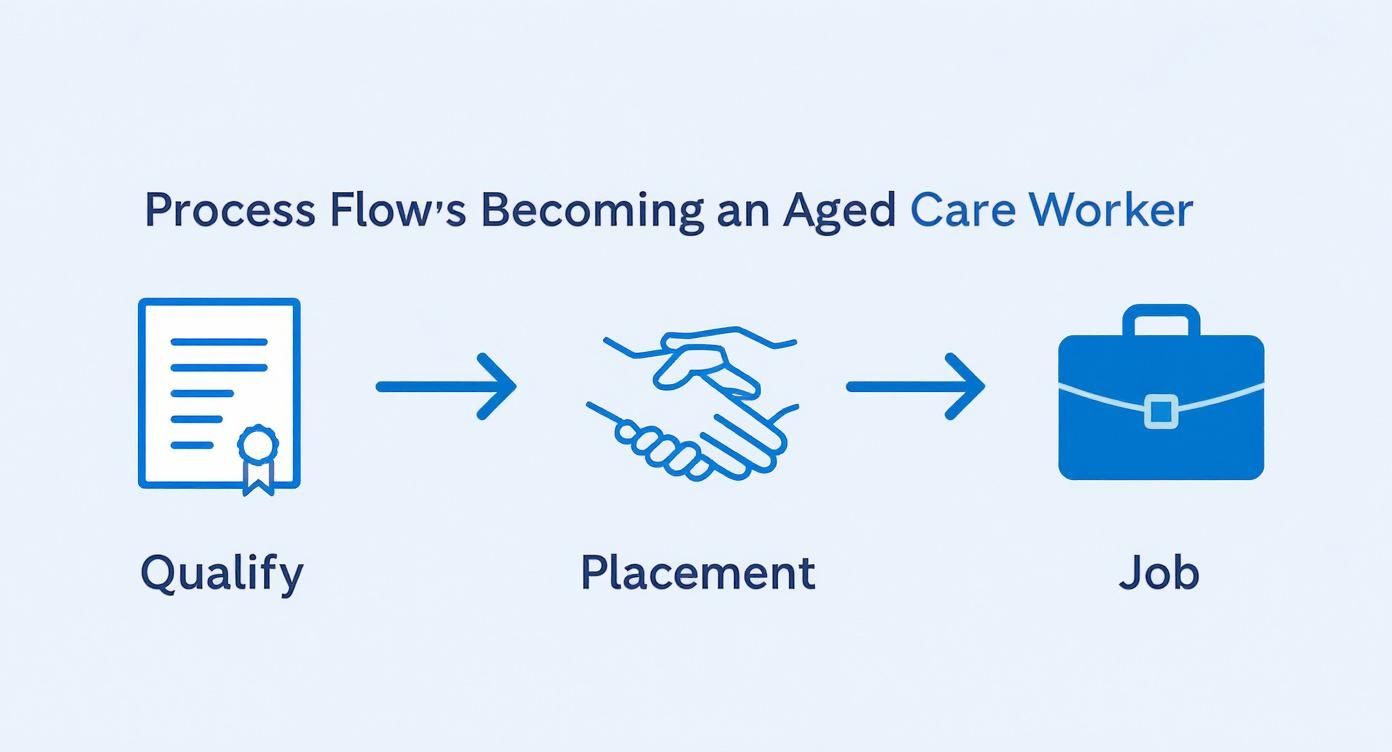
As you can see, the path is clear: get your qualification, put your skills into practice, and then step into a rewarding role where you’re truly needed.
To give you a clearer picture, here is a quick summary of the key stages to start your career, with estimated timeframes to help you plan your journey.
Your Aged Care Career Roadmap
This roadmap provides a great overview, but remember that your own timeline might vary slightly depending on your personal circumstances and study choices.
The Qualities of a Great Carer
While the formal qualification is non-negotiable, the very best aged care workers also bring a special set of personal qualities to the job. These are the traits that help you connect with residents and clients on a human level, allowing you to provide truly outstanding care.
Some of the most important qualities are:
- Empathy: The ability to understand and share in the feelings of others is the heart of compassionate care.
- Patience: Working with older adults, some of whom may face cognitive or physical challenges, calls for a calm, unhurried, and patient mindset.
- Resilience: The role can be emotionally tough at times. Being able to manage stress and bounce back is key to a long and happy career in this field.
- Strong Communication Skills: You'll need to be an active listener and a clear communicator with clients, their families, and your healthcare colleagues. We dive deeper into this in our essential guide to the roles and responsibilities of an aged care worker.
This career is perfect for people who aren't just looking for a paycheque, but for a vocation. It’s for those who find real satisfaction in helping others, who believe in treating every person with dignity, and who want their work to have a direct, positive impact every single day.
If you're thinking about specialising down the track, getting familiar with different care approaches like person-centered dementia care can give you an edge and improve the support you provide.
Now, let's walk through each step of the process so you have everything you need to get started.
Choosing The Right Aged Care Qualification

Before you can step into a role as an aged care worker in Australia, you need to get the right qualification under your belt. The industry gold standard, and really your ticket into the sector, is the Certificate III in Individual Support (Ageing). This course is specifically built to arm you with the hands-on skills and foundational knowledge needed for providing quality, person-centred care.
Think of it less as a piece of paper and more as your practical toolkit. It’s designed to build your confidence and competence, so you can walk into the job ready to handle the daily realities with both skill and genuine compassion.
This isn’t just about theory. The curriculum is carefully structured to prepare you for the real-world situations you’ll face every day, whether you end up in a residential facility or providing support in someone's home.
What You Will Actually Learn
The Certificate III in Individual Support (Ageing) is a comprehensive program that covers a lot of ground to make sure you're job-ready from day one. It’s not just about learning what to do, but understanding the why behind your actions, which is the key to providing truly thoughtful care.
Some of the core units you’ll dive into include:
- Providing Individualised Support: This is where you learn how to develop and follow care plans that truly reflect a person's unique needs, what they like, and their personal goals.
- Safe Work Practices: You’ll get hands-on with crucial manual handling techniques to help clients with mobility safely. It also covers the non-negotiable infection control procedures that protect you and the people you care for.
- Supporting Independence and Wellbeing: A huge part of this job is empowering older adults. This unit focuses on practical ways to promote their physical and emotional wellbeing so they can live as independently as possible.
- Communicating and Working in Health Services: Learn how to speak respectfully and clearly with clients, their families, and other health professionals. You’ll also get to grips with the specifics of working within Australia’s health and community services system.
- Recognising Healthy Body Systems: Having a solid, basic understanding of anatomy and physiology is vital. It helps you notice when a client's health might be changing so you can report it accurately.
Many courses also let you choose specialised electives, like supporting people who are living with dementia or providing palliative care. This gives you a chance to start focusing on areas you're passionate about. For a more detailed breakdown, check out our complete guide to the Individual Support course.
Finding The Right Study Mode For Your Life
One of the great things about this qualification is its flexibility. Training providers know that everyone's life looks different, so they offer a few ways to get it done.
Online/Self-Paced Study
This is a go-to for anyone juggling a job, kids, or other commitments. You can study from home and fit your learning around your own schedule.
On-Campus/Classroom Learning
If you learn best with structure and face-to-face chats, on-campus study gives you that classic classroom feel with direct access to your trainers and classmates.
Blended/Hybrid Model
This approach gives you the best of both worlds. You'll do your theory online but come to campus for regular hands-on practical workshops.
Choosing how you study is a big decision. Be honest with yourself about your learning style. Do you have the self-discipline for online study, or do you thrive on in-person interaction? Getting this right will make the whole experience more effective and a lot more enjoyable.
How To Choose A Quality Training Provider
Let's be clear: not all Registered Training Organisations (RTOs) are the same. Picking a reputable provider is absolutely critical to getting the high-quality education you need to succeed. Before enrolling anywhere, you need to do a bit of detective work.
A good RTO will be transparent and helpful from the moment you first get in touch. They should be able to clearly explain their course structure, how they handle placements, and who their trainers are.
When you're comparing providers, make sure you ask these questions:
- "What support do you offer for finding a practical placement?" A top-tier RTO won't just leave you to fend for yourself. They'll have strong industry connections and a dedicated team to help you land your mandatory work placement.
- "Who are the trainers and what is their industry experience?" You want to be taught by people who have actually worked in aged care. Their real-world stories and insights are priceless compared to someone just reading from a textbook.
- "What are the all-inclusive costs?" Get a crystal-clear breakdown of every single fee—tuition, materials, any admin charges. You don't want any nasty surprises down the track.
Asking these questions will give you a much better feel for the quality of the provider and help you invest your time and money wisely.
Getting Your Checks and Placement Sorted

Finishing your coursework is a fantastic feeling, but it's not the final step. Before you can work with residents, you’ll need to tick off a few mandatory checks and complete a practical work placement. These aren't just boxes to tick; they're vital for protecting vulnerable people and making sure you’re truly ready for the role.
This is where the rubber meets the road. It’s your opportunity to apply everything you've learned, build your confidence, and see what a day in the life of a care worker really looks like. Getting these things sorted out quickly and efficiently makes your move from student to paid professional a whole lot smoother.
The Must-Have Background Checks
To work in aged care in Australia, you absolutely have to show you're a person of good character. This means getting a couple of non-negotiable clearances.
You'll need two main checks:
- National Police Check (NPC): This is standard for any role where you're in a position of trust. It outlines any disclosable criminal history you might have in Australia. You can apply for one through your state police or an accredited online agency.
- NDIS Worker Screening Check: Because many older Australians in care are also NDIS participants, this has become a common requirement. It's a more thorough screening that assesses any potential risk to people with a disability.
My advice? Get onto these checks as soon as you enrol. Processing times can be unpredictable—sometimes it’s a few days, other times it can be several weeks. Don't let paperwork hold you back from starting your placement.
Keeping Up with Vaccination Requirements
Protecting the health of older, often frail, residents is a top priority. This means you'll need to be up-to-date with your immunisations. The requirements can differ slightly between employers, but you can almost guarantee you'll need proof of your annual flu vaccination.
COVID-19 vaccinations also became mandatory for the industry. While the specific rules can change with public health advice, it's vital to check what’s currently required by both the government and your specific workplace. Your training provider will give you a list of everything you need.
Nailing Your Work Placement
Your practical work placement is hands-down the most crucial part of your training. This is where you’ll spend a minimum of 120 hours in a real aged care home, putting all that theory into practice. It’s your time to shine, and honestly, it’s often where you’ll land your first job.
A good Registered Training Organisation (RTO) will have connections with local facilities and a placement coordinator to help you out. But don't just wait for them. Being proactive makes a world of difference. Research homes in your area, give them a call, and express your interest. That kind of initiative is exactly what employers want to see.
My biggest tip: Treat your placement like a 120-hour job interview. From the moment you walk in, your attitude, your work ethic, and how you interact with people are being noted by potential managers.
To really stand out and make a great impression, focus on these things:
- Be Early, Be Ready: Aim to arrive 10-15 minutes before your shift starts. Be in your uniform, neat and tidy, and ready to get the handover from the previous shift.
- Ask Good Questions: It’s okay not to know everything, but show you’re thinking. Instead of "What do I do?", try "I saw you used that technique to help Mrs. Jones stand up. Could you show me why that's the best way for her?"
- Take Safe Initiative: In quieter moments, don't just stand around. Ask if you can help restock supplies, fold laundry, or simply sit and chat with a resident who looks a bit lonely. Just be sure to always stay within your responsibilities and check with a staff member if you’re unsure.
- Connect with Everyone: It's not just about the residents. Learn the names of the nurses, the other carers, the kitchen staff, and the cleaners. Offer to lend a hand and show you’re a genuine team player.
When you prove you're reliable, compassionate, and truly eager to be there, you're not just passing a course requirement—you're building a professional reputation that will open doors for you.
It's Time to Land Your First Aged Care Job
You've done the hard yards. The study is complete, your placement hours are logged, and all your checks are in order. Now for the exciting part—turning all that effort into your first paid role in aged care.
This is where you pull everything together. You need to show a potential employer that you're not just another person with a certificate. You're the right person for their team, someone who is compassionate, reliable, and genuinely wants to make a difference.
A lot of people I talk to worry that their background in retail or hospitality isn't relevant. That couldn't be further from the truth. Those jobs have given you a goldmine of transferable skills that are desperately needed in the care sector. You just need to know how to talk about them.
Your CV: Making the Right First Impression
Think of your CV as your handshake. It needs to immediately communicate that you're a capable, aspiring aged care worker. A generic resume listing your old job duties just won't cut it here. You have to reframe your experience through an aged care lens.
So, instead of just saying you have "customer service skills," dig a bit deeper. What does that actually mean in a care context?
- Communication & Empathy: Talk about that time you patiently helped an older shopper who was confused or distressed. That’s empathy in action. It shows you know how to connect with people on a human level, which is the absolute core of aged care.
- Time Management & Prioritisation: Remember those frantic Saturday shifts in the café, juggling six different orders at once? That’s proof you can handle the busy, often unpredictable rhythm of a care facility.
- Problem-Solving: What about that time you de-escalated a tense situation with an unhappy customer? That shows you have the composure and resilience to manage challenging behaviours with grace—a skill that is highly valued.
And your practical placement? That's your golden ticket. Give it prime real estate on your CV. Don’t just state that you completed 120 hours. Get specific. Detail the tasks you performed, like assisting residents with personal care, using hoists for mobility support, or leading a small group in an afternoon activity. This is concrete proof you can do the job.
Nailing the Aged Care Interview
The interview is where you bring that CV to life. Employers aren't just ticking boxes; they're looking for genuine warmth and a practical, problem-solving mindset. You can bet they'll throw a few behavioural questions your way to see how you think on your feet.
The best tool for this is the STAR method. It's a simple way to structure your answers and give real-world examples of your skills.
- Situation: Set the scene.
- Task: Explain what you needed to achieve.
- Action: Describe the steps you took.
- Result: Share the positive outcome.
Let’s put it into practice with a classic interview question.
Question: "Tell me about a time you had to handle a difficult person."
Situation: "When I was working in retail, a regular elderly customer became quite upset because we’d run out of her favourite brand of tea. She was getting flustered and raising her voice."
Task: "My main goal wasn't just to tell her it was out of stock. It was to calm her down, find a solution, and make sure she felt heard and respected."
Action: "I invited her to a quieter part of the store, away from the busy aisle. I just listened for a moment, letting her express her frustration, and I made sure to validate how disappointing that must be. Then, I walked with her back to the tea section, suggested a similar brand I thought she might like, and even checked the stock system to let her know exactly when her favourite would be back in."
Result: "She calmed down almost instantly, thanked me for taking the time, and actually bought the alternative to try. She left the store feeling like a valued person, not a problem, and she kept coming back."
See how much more powerful that is than just saying, "I have good communication skills"? It provides solid evidence.
Thinking on Your Feet: Scenario Questions
You'll also get hit with hypothetical scenarios designed to test your understanding of duty of care and your critical thinking.
A common one is: "What would you do if a resident refused their morning shower or medication?"
A great answer shows you can balance a resident's right to choose with your professional responsibilities. Something like this would work well:
- Respect and Re-approach: "First, I would never force them. I'd respect their decision, give them a bit of space, and maybe come back in 15 or 20 minutes with a friendly chat and a cup of tea to see if they feel differently."
- Look for the 'Why': "I'd also gently try to find out if there's a reason behind the refusal. Are they feeling unwell? Are they in pain? Maybe they're just not a 'morning person'. Understanding the cause is the first step to finding a solution."
- Report and Document: "If they still refuse, I would follow our facility's policy to the letter. That means immediately informing the supervising Registered Nurse and documenting the refusal and my actions clearly in the resident's file."
An answer like this shows you’re not just following a script. It proves you understand the delicate balance of dignity, choice, and safety that is so crucial in aged care. Walking into that interview room prepared with these strategies will give you the confidence to show them you’re exactly who they’re looking for.
Costs, Funding, and Your Career Path in Aged Care

Starting a career in aged care is a big decision, and it’s smart to think about the financial commitment and what your future in the industry could look like. It’s not just about landing that first job; it’s about setting yourself up for a long, rewarding career where you can really grow and make a difference.
So, let's talk numbers and then explore the exciting places this career can take you.
What’s the Initial Investment?
Your main outlay will be the tuition for a Certificate III in Individual Support (Ageing). The cost can vary quite a bit, typically falling somewhere between $1,500 and $4,000. Why the big range? It often comes down to the training provider’s reputation, the quality of their practical placement support, and whether you study online or in a classroom.
On top of the course fees, you’ll need to factor in a few other essentials:
- National Police Check: This usually sets you back between $40 and $60.
- NDIS Worker Screening Check: Expect to pay around $80 to $120, depending on your state.
- Vaccinations: The cost here varies. Your best bet is to chat with your GP for a schedule and pricing.
- Uniform: Some RTOs might include a basic uniform, but you may need to buy your own scrubs or polo shirts for placement, which could add another $50 to $100 to the list.
It can feel like a lot, but the good news is you might not have to fund it all yourself.
How to Get Your Qualification Funded
Thankfully, Australia has several funding programs to make vocational training more affordable, especially for an in-demand field like aged care. It’s absolutely worth investigating these, as they can seriously reduce your out-of-pocket costs.
State-based government subsidies are your first port of call. Programs like JobTrainer or Skills Checkpoint can cover a huge chunk of your course fees if you’re eligible. The criteria usually revolve around your age, residency, or employment status.
Another great option is a VET Student Loan. This is a government loan that pays for your tuition, and you only begin to pay it back once you start earning over a certain amount. It’s a brilliant way to get qualified now without the immediate financial stress. Make sure you ask your chosen Registered Training Organisation (RTO) what funding they support.
Don't let the initial cost deter you. A quality qualification is an investment in a secure and growing career field. Exploring every available subsidy and loan option is a smart first step towards becoming an aged care worker.
Your Career Path: Looking Beyond Day One
Think of your Certificate III as the key that opens the door to the aged care sector. Once you're in, a whole world of opportunity awaits. This isn't a dead-end job; it’s an industry with clear, fulfilling pathways for anyone wanting to advance their skills and take on more leadership.
Most people start as a personal care worker—they make up about 48% of the residential aged care workforce. With the highest demand in New South Wales (31%) and Victoria (24%), there are plenty of entry-level positions.
After you've gained some hands-on experience, you can start thinking about what’s next. You might want to specialise in a certain area or step up into a leadership role. Many employers are also focused on good staff retention strategies in the healthcare industry, which means they're invested in helping good people grow.
Your career doesn't have to stand still. Here’s a quick look at where your Certificate III could take you with a bit more study and experience.
Aged Care Career Progression Paths
Each step forward brings new challenges and greater responsibility, not to mention a bump in pay and job satisfaction. You might discover a passion for dementia support, palliative care, or even facility management.
The need for skilled, compassionate, and experienced aged care professionals is only going to grow. By planning ahead, you can build a career that’s not just emotionally rewarding but professionally and financially secure too. To get a better sense of what's possible, check out the diverse https://getcourse.com.au/blog/opportunities-in-aged-care-career.
Common Questions About Working in Aged Care
You’ve read the roadmap, but it's completely normal to still have a few questions buzzing around. Making a career change is a big deal, and you want to be sure you know what you’re getting into. Let's tackle some of the most common queries I hear from people thinking about starting a career in aged care.
Think of this as the frank, honest chat you'd have with someone who's been there.
How Long Does It Really Take to Become an Aged Care Worker?
This is probably the most practical question of all, and the answer really hinges on how you choose to study. To be realistic, from the day you enrol to your first day on the job, you’re probably looking at a window of about 6 to 12 months.
Here’s a quick breakdown of how that time adds up:
- The Course Itself: A Certificate III in Individual Support (Ageing) can be knocked over in around six months if you're hitting the books full-time. But if you’re juggling family, work, or other commitments and go for a self-paced online option, it’s more likely to take you closer to a year.
- Your Work Placement: The mandatory 120 hours of hands-on placement is usually done in a single block. This can take anywhere from three to six weeks, depending on the facility's schedule and your availability.
- The Paperwork: Don't forget the essential checks! Your police check and NDIS clearance can take a few days or sometimes a few weeks. My advice? Get these applications in as early as you possibly can to avoid delays.
When you add it all together, that 6-12 month timeframe is a pretty solid and achievable estimate for most people.
What Are the Toughest Parts of This Job?
I think it's crucial to be upfront about the realities of the role. Being an aged care worker is one of the most rewarding things you can do, but it definitely comes with its challenges—both emotionally and physically.
The emotional side of things can be tough. You form genuine bonds with the people you care for, so facing their declining health and eventual loss is a very real part of the job. Building your own emotional resilience is something you work on every day, allowing you to process grief while continuing to be a rock for your other residents.
Physically, you’ll be on your feet for most of your shift, and there's a fair bit of manual handling involved, like helping residents move safely. You’ll also learn to manage challenging behaviours, especially from those living with dementia. The key skills here are learning de-escalation techniques and, most importantly, not taking things personally.
Let me be clear: this isn't to scare you off. It's about being prepared. For the right person, the immense joy you get from making someone’s day, sharing a laugh, or offering comfort when it's needed most will always outweigh the difficult moments.
Can I Get a Job Without a Certificate III?
For a hands-on, direct care role, the simple answer is no. The Certificate III in Individual Support (Ageing) is the industry-standard qualification across Australia. It’s the non-negotiable ticket that proves to employers you have the fundamental skills to look after older people safely and respectfully.
Think about it—this course covers the absolute essentials, from infection control and manual handling to providing dignified personal care. Without it, you’d be a risk to residents and the facility.
That said, there are other vital jobs in an aged care home that don't require that specific certificate. You could find work in the kitchen, laundry, or as a cleaner or maintenance person. These roles are the backbone of the facility, they just don't involve the direct, personal care of residents.
What Personal Qualities Make a Great Aged Care Worker?
Patience and a caring nature are a given, but what really makes someone excel in this field? From my experience, it’s a few deeper qualities that allow you to truly connect with people and thrive in the environment.
- You're an Observer: You have to be a bit of a detective. You’ll learn to pick up on the subtle shifts in a resident's mood, appetite, or skin integrity that might hint at a bigger problem.
- You Have a Resilient Sense of Humour: This is so important. Being able to find a moment of lightness or share a genuine laugh is a powerful tool for building relationships and coping with the daily stresses.
- You're Rock-Solid Reliable: Residents depend on you. Your team depends on you. Being on time, every time, and doing what you say you’ll do is how you build the trust that’s at the very heart of good care.
- You're a True Team Player: Aged care is a team sport. You’ll be working side-by-side with nurses, other carers, and allied health professionals. The best care happens when everyone communicates openly and supports each other, no egos involved.
Ready to take the next step and find a course that fits your life? At Get Course Australia, we specialise in connecting people with flexible, nationally recognised qualifications from Australia’s top providers. Start your journey today by exploring your study options. Find the right aged care course for you.
Find Your Course
Compare courses across every field we write about, and enquire in under a minute.