How to Become a Pharmacy Assistant: A Clear Path to Career Success
Discover how to become a pharmacy assistant with practical courses, essential skills, and steps to start a rewarding healthcare career in Australia.
Thinking about a career as a pharmacy assistant in Australia? You’re in the right place. The good news is that the pathway is quite accessible. It really boils down to getting a nationally recognised qualification, like a Certificate III in Community Pharmacy, and pairing it with fantastic customer service and practical skills.
Let's walk through exactly what that looks like.
Your Path to Becoming a Pharmacy Assistant

Starting out as a pharmacy assistant puts you right at the centre of community healthcare. It's an incredibly rewarding role and a great fit whether you're fresh out of school, changing careers, or just looking for meaningful work in a stable industry. You’ll often be the first person a customer speaks to, offering support and product advice under the guidance of a qualified pharmacist.
No two days are ever quite the same. One minute you could be handling stock and setting up displays, and the next you're helping a customer find the right over-the-counter remedy for a cold. You're a crucial part of the team that keeps the pharmacy running smoothly.
Why Now Is a Great Time to Start
The demand for skilled pharmacy assistants is on the rise right across Australia, and that's not just a hunch. The numbers tell a clear story. The workforce currently sits at around 42,100 people, with the industry adding about 2,100 new jobs every year.
That’s a 5.1% annual growth rate, which is much stronger than what you'd see in many other retail or healthcare support fields. This growth really speaks to how vital pharmacy assistants are, especially as Australia's healthcare demands evolve. You can dive deeper into these figures by checking out various industry reports on workforce trends.
This consistent growth means more job opportunities and better security for anyone with the right qualifications. It’s more than just a job; it’s a solid entry point into the wider healthcare world.
What Does This Career Pathway Involve?
To really do well in this role, you need a good mix of technical know-how and genuine people skills. Your journey will involve some formal training to get your head around medications and pharmacy operations, but you’ll also need to build up your practical abilities in customer service and admin.
To give you a clearer picture, here's a quick overview of the typical journey.
Pharmacy Assistant Career Pathway at a Glance
This table breaks down the main stages, giving you a quick reference for what to expect on your path to becoming a pharmacy assistant.
Following these steps ensures you're building the right skills in the right order, so you can step into the job market feeling prepared and confident.
Key takeaway: It's not just about ticking off qualifications. It’s about becoming a competent, trusted member of a healthcare team who makes a real difference in people's lives every day.
Choosing the Right Pharmacy Assistant Course
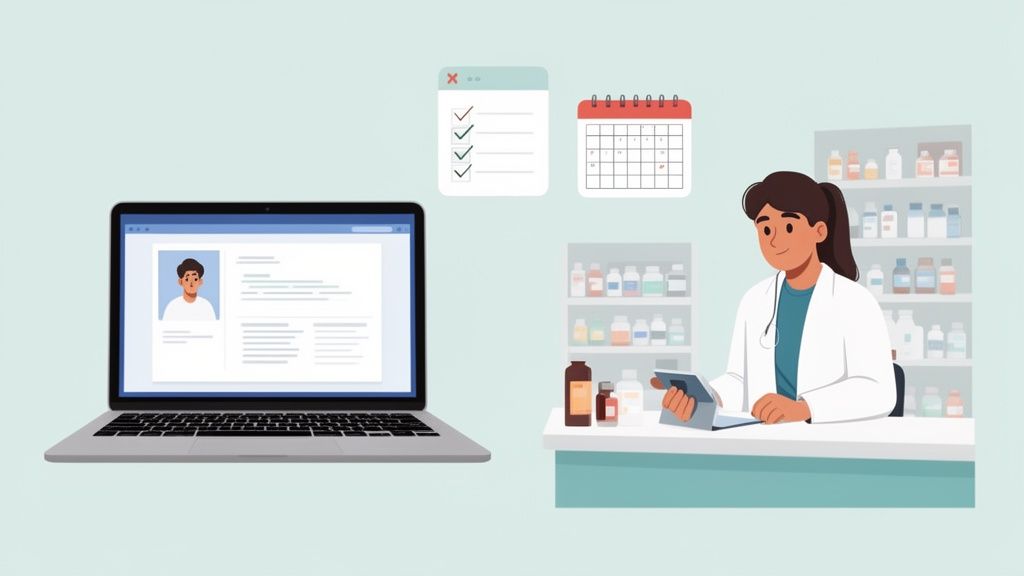
This is the big one. Picking the right qualification is probably the most crucial step you'll take on this path. For anyone serious about a career as a pharmacy assistant in Australia, the gold standard that employers look for is a Certificate III in Community Pharmacy.
Think of this qualification as your ticket to getting behind the counter and doing meaningful work. It’s what separates a retail assistant who happens to work in a pharmacy from a skilled pharmacy assistant who is an integral part of the healthcare team. The right course sets you up not just to land a job, but to actually thrive in it.
What You Will Actually Learn in a Certificate III
A quality Certificate III course is far more than just textbook theory; it’s built around what you’ll be doing every single day. The curriculum is designed to reflect real-world pharmacy tasks, so you don’t just learn the rules, you understand why they’re so important for patient safety.
So, what skills will you actually walk away with?
- Medicine Know-How: You'll learn to identify different medicines, especially Schedule 2 (S2 - Pharmacy Medicine) and Schedule 3 (S3 - Pharmacist Only Medicine), and master the strict rules around supplying them to customers.
- Real Customer Care: This isn't your average retail chat. The course teaches you how to communicate effectively and sensitively with people about their health, and critically, when to refer them straight to the pharmacist.
- Dispensary Support Skills: You’ll get comfortable supporting the pharmacist by preparing prescriptions for their final check, keeping accurate records, and managing the dispensary stock.
- Smart Inventory Management: A huge part of the job! You'll learn the ins and outs of ordering, receiving, and maintaining stock to make sure the pharmacy runs efficiently and products are stored correctly.
These skills are directly tied to the responsibilities you’ll be given, making you a confident and capable team member right from the get-go.
Online Study vs. a Traineeship: Which Is for You?
Once you’ve settled on the qualification, you need to decide how you’ll get it. The two main pathways are studying online or doing a traineeship. Each has its own pros and cons, and the best fit really depends on your life and how you learn best.
An online course gives you ultimate flexibility. If you're juggling another job, family commitments, or live a bit further out, online learning lets you mould your study schedule to your life. You can log in and tackle modules whenever it suits you. It definitely requires a good dose of self-discipline, but you’re in the driver’s seat.
A traineeship, on the other hand, is a blend of formal learning and paid work. You get a job in a pharmacy and complete your certificate on-site, learning from seasoned professionals every day. This is a brilliant choice if you’re a hands-on learner and want to earn while you learn. Applying your new knowledge immediately helps it stick.
Choosing between online study and a traineeship comes down to what works for you. Think about your finances, your preferred learning style, and the time you can realistically set aside each week. Both routes lead to the same nationally recognised qualification.
Making the Final Decision
When you're comparing your options, the timeline and cost will naturally play a big part. Online courses generally take between 6 to 12 months to complete, with fees often paid upfront or via a payment plan. Traineeships can be a bit longer, usually 12 to 24 months, but the major bonus is that you’re earning a wage the entire time.
Whatever you choose, just make sure the provider is a Registered Training Organisation (RTO). This is non-negotiable, as it guarantees your qualification is recognised across Australia and meets the high standards of the industry. Taking some time to explore the different types of pharmacy technician courses and assistant qualifications will give you a much clearer view of all the possibilities out there.
Ultimately, the best course is the one that gets you excited about your future career and fits into the reality of your life.
Building Skills That Employers Actually Want

While a Certificate III in Community Pharmacy gets your foot in the door, it’s the practical, real-world skills you bring to the table that will really catch a pharmacy manager’s eye. Your qualification proves you have the foundational knowledge, but it's your ability to handle a busy pharmacy floor with confidence that lands you the job.
Think about it from their perspective. They need someone who can not only manage a prescription queue with precision but also help a flustered parent find the right cough medicine for their child. It's a role that demands a unique blend of technical accuracy and genuine human connection.
Mastering the Essential Soft Skills
You can't overstate the importance of soft skills. In a pharmacy, you're on the front line of community health, and these abilities are what build trust and make customers feel cared for. No software can replace a reassuring smile or a patient explanation.
Here are the core people skills you’ll need to sharpen:
- Exceptional Communication: This isn't just about being friendly. It's about explaining product information clearly, actively listening to a customer's concerns, and, crucially, knowing when to escalate a query to the pharmacist.
- Deep Empathy and Patience: People often come to the pharmacy when they're feeling vulnerable or unwell. A little empathy and patience go a long way in turning a stressful experience into a positive one.
- Attention to Detail: In a pharmacy setting, there’s no room for error. From double-checking medication labels to confirming a customer’s address, a sharp eye for detail is non-negotiable.
A pharmacy assistant’s role is incredibly accessible, making it an excellent entry point into the healthcare industry for jobseekers and career changers. Women make up 82% of the workforce, and with a median age of just 27, it’s a dynamic and youthful field. You can discover more insights about these workforce demographics to see how the role is structured.
Developing Your Technical Know-How
Alongside those crucial people skills, you’ll need a solid grasp of the technical nuts and bolts of pharmacy operations. This is where the knowledge from your course work meets the real world.
One of the biggest technical hurdles is getting comfortable with pharmacy software. Most pharmacies in Australia rely on specific dispensary programs like Dispense or Fred NXT Dispense. You'll definitely get on-the-job training, but mentioning you have some familiarity with these systems during an interview can give you a serious advantage.
You'll also need to be confident with:
- Understanding Medication Schedules: Knowing the difference between an S2 (Pharmacy Medicine) and an S3 (Pharmacist Only Medicine) is day-one knowledge. You must be able to apply the correct sales protocols without hesitation.
- Inventory Management: A big part of the job is ordering, receiving, and organising stock. Accuracy here is key to preventing shortages and ensuring all products are stored correctly.
- Processing Prescriptions: While the pharmacist has the final say, you’ll be preparing prescriptions, printing labels, and updating patient records—all of which require precision.
Gaining Hands-On Experience
Learning the theory is one thing, but putting it into practice is where you really start to grow. If your course includes a work placement, treat every day like a job interview. It’s your golden opportunity to showcase your skills and make a lasting impression on a potential employer.
What if your course is online and doesn't offer a placement? Don't panic. You can still be proactive. Look into volunteering at a community health clinic, or simply lean into your existing retail experience. If you’ve handled customer service, managed a till, and dealt with stock, those are highly transferable skills.
Make sure you highlight them on your resume. Show that you already understand the vital role pharmacy assistants play in patient care and you'll prove you're ready to contribute from day one.
Getting to Grips with Pharmacy Rules and Regulations
Working in a pharmacy is a whole different world from standard retail. You're stepping into a professional healthcare environment where strict rules and standards are the bedrock of everything you do. These aren't just bureaucratic hurdles; they're the essential framework that ensures every single patient gets safe, high-quality care.
For a pharmacy assistant, getting your head around this is just as important as knowing the difference between brands of cough medicine. Think of these regulations as the pharmacy's operating system—they quietly guide every task, from greeting a customer to handling a prescription.
How the QCPP Shapes Your Day-to-Day Role
You'll quickly become familiar with the Quality Care Pharmacy Program (QCPP). This is the national accreditation program that pretty much all community pharmacies in Australia follow. It's a seal of quality, letting the public know the pharmacy meets strict standards for service, safety, and professional practice.
So, what does this mean for you? The QCPP guidelines directly impact your daily tasks. They set out clear protocols for things like:
- Supplying medicines: You'll learn the strict procedures for handling Schedule 2 (S2) and Schedule 3 (S3) medications, which are available from pharmacies only.
- Patient counselling: A huge part of the job is knowing your limits. QCPP helps define when a customer's query absolutely must be handed over to the pharmacist.
- Storing stock: Ensuring medicines are kept at the right temperature and in the right conditions isn't just about being tidy—it's critical for making sure they work properly.
These aren't just friendly suggestions; they're non-negotiable rules for the entire pharmacy team.
At the end of the day, pharmacy is all about trust. Patients trust that you're following every single protocol to protect their health and keep their information private. Following these regulations is how you build and maintain that trust.
Understanding Your Ethical and Legal Duties
Beyond the QCPP framework, your role carries some serious ethical and legal weight. Patient confidentiality is a big one. You'll be handling sensitive health information daily, and you have a legal duty to guard that privacy with your life. A casual comment about a customer's medication outside of work is more than just unprofessional—it's a major breach of privacy laws.
Handling S2 and S3 medicines also comes with specific legal responsibilities. Your training will cover the precise questions you need to ask to ensure these products are being supplied safely and for the right reasons. This is one of the key skills that elevates a pharmacy assistant above a typical retail assistant.
It's also wise to get across the basics of chemical safety, as you'll be handling various substances. This practical guide to chemical safety in the workplace is a great starting point, covering things like Safety Data Sheets (SDS) and when to use Personal Protective Equipment (PPE).
The Checks and Clearances You'll Need
To maintain these high standards of trust and safety, you’ll need to complete a few background checks before you start. This is standard procedure for any role in healthcare and is all about protecting the public.
A National Police Check is almost always a non-negotiable. Pharmacies need this assurance because you’ll be working with vulnerable people and have access to restricted medicines.
It's a huge responsibility, especially when you consider that pharmacy assistants make up 50% of Australia’s entire community pharmacy workforce. With around 35,174 assistants employed back in 2021, the integrity of every single person is vital. As pharmacies take on more community health responsibilities, this role only becomes more important. You can learn more about the growing scope of this workforce by checking out the latest industry reports.
How to Land Your First Pharmacy Assistant Job
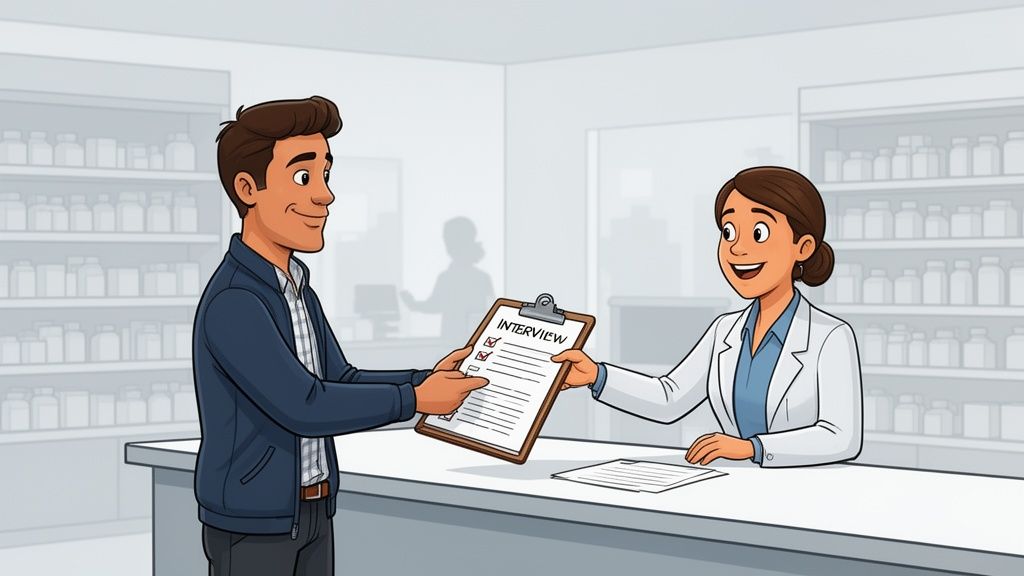
You’ve done the hard yards with your training and have the skills—now it’s time to land that job. This is where we shift from learning the theory to mastering the art of the job hunt. It’s not about just firing off applications; it’s about strategically positioning yourself as the perfect fit for a pharmacy’s specific team and community.
Let's walk through how to build an application that gets you noticed and prepare for an interview that seals the deal. We'll focus on practical tips for translating your existing experience, even if it’s from retail or hospitality, into exactly what a hiring manager is looking for.
Creating a Resume That Gets Noticed
Think of your resume as the first handshake. It needs to be professional, clear, and instantly show a pharmacy manager why you’re worth talking to. This is especially true if you’re coming from another industry.
Don't just list what you did. You need to translate your previous duties into pharmacy-relevant achievements.
- Customer Service Excellence: Instead of "helped customers," reframe it. Try something like, "Resolved customer queries with empathy, resulting in a 15% increase in positive feedback." This proves you grasp the importance of patient-centred care.
- Attention to Detail: Did you handle a till or manage stock? Frame it as, "Maintained 100% accuracy in cash handling and stocktake processes." This speaks directly to the precision and trust required in a pharmacy setting.
- Team Collaboration: Show you're a team player. Highlighting something like, "Collaborated with a team of five to achieve daily sales targets," demonstrates you can slot right into an existing pharmacy team.
Your cover letter is where your personality comes through. This is your chance to connect your skills with a genuine passion for community health. Show you've done your homework by mentioning something specific about the pharmacy—perhaps their focus on local engagement or a particular health service they champion.
Nailing the Pharmacy Assistant Interview
An interview invitation means you’re on the right track. Now, preparation is everything. This is your opportunity to show them who you are beyond the resume—your personality, your understanding of the role, and your enthusiasm for the job. Pharmacy managers aren’t just hiring for technical skills; they want a reliable, compassionate person for their team.
They'll likely ask a mix of behavioural questions and on-the-spot scenarios. Think about how you’d handle common situations.
- Scenario Question: "A customer is upset because their prescription isn't ready. What do you do?" This is a test of your empathy and problem-solving skills. A solid answer involves actively listening, apologising for the delay, explaining you'll check with the pharmacist immediately, and offering them a seat while they wait.
- Behavioural Question: "Tell me about a time you had to handle a difficult customer." Structure your answer using the STAR method (Situation, Task, Action, Result). It’s a clean way to explain what happened and focus on the positive outcome you achieved.
To get a head start, it’s a great idea to review some essential healthcare interview questions and answers for more examples.
Making a Lasting Impression
Being prepared goes beyond having your answers ready. Do a bit of research on the pharmacy before you go in. What kind of community does it serve? Does it offer specialised services like vaccination clinics or support for aged care facilities?
Knowing these details lets you ask intelligent questions that show you're genuinely interested.
Instead of only asking about pay or hours, try asking questions like these:
- What does a typical day look like for a pharmacy assistant here?
- What are the biggest challenges the team is currently facing?
- Are there opportunities for ongoing training and professional development?
Asking thoughtful questions shows you’re not just looking for any job—you're looking for the right one. It presents you as a proactive candidate who is ready to contribute from day one. Walk in prepared, and you'll walk out confident you've made a great impression.
Exploring Your Pharmacy Career Path
Landing that first pharmacy assistant job is a brilliant start, but it’s really just the beginning. Think of it as your foundation in the dynamic world of Australian healthcare. This isn't a dead-end job; it’s a launchpad for a whole range of specialised and rewarding roles.
Many assistants find they love the community pharmacy environment and choose to specialise right there. You might find your calling in the dispensary, becoming the expert who keeps everything running smoothly for the pharmacist. Or maybe you'll excel in inventory management, taking ownership of stock control and supplier relationships to keep the business efficient.
Advancing to a Pharmacy Technician Role
After getting some solid experience under your belt, a popular and logical next step is moving into a pharmacy technician role. This usually means completing a Certificate IV in Community Pharmacy (Dispensary).
As a technician, you'll take on much more responsibility. You'll be involved in compounding medications and handling complex dispensary tasks, all under the direct supervision of a pharmacist. It’s a definite step up in terms of both responsibility and your pay packet.
Leadership and Further Education Opportunities
If you've got a knack for managing people and the business side of things, a retail leadership role could be perfect for you. Experienced pharmacy assistants are often the first choice for positions like front-of-shop manager or retail coordinator. These roles put you in charge of team performance, sales, and the day-to-day running of the store.
And the skills you build aren't just limited to the pharmacy. For some, working as an assistant provides a real taste of the healthcare industry and inspires them to go all the way and study to become a pharmacist.
Think of your Certificate III as your first step on a ladder. Each year of experience adds another rung, and further qualifications like a Certificate IV can elevate you to new professional heights, unlocking more senior roles and greater earning potential.
No matter which direction you head, starting as a pharmacy assistant gives you an incredible, ground-level view of how community healthcare really works. To see what qualifications can help shape your future, you can explore the full range of pharmacy assistance courses available. This role is so much more than just a job—it’s a gateway to a stable and fulfilling career where you can keep learning and growing for years.
Got Questions? Let's Get Them Answered
It’s only natural to have a few questions when you’re thinking about a new career path. To help clear things up, I’ve put together some straight answers to the most common queries I hear from people looking to become a pharmacy assistant.
How Much Can I Realistically Earn?
When you're just starting out as a full-time pharmacy assistant in Australia, you can generally expect to bring in between $45,000 and $55,000 a year.
Of course, this can shift depending on where you are, whether you're in a local community pharmacy or a larger hospital setting, and the experience you bring to the table. As you gain more experience or step up to a Certificate IV, your pay packet will grow accordingly.
How Long Until I’m Actually Qualified?
The fastest and most common route is the Certificate III in Community Pharmacy. If you study online, you could be qualified in as little as 6 to 12 months.
If you go down the traineeship path—where you’re working in a pharmacy while you study—it naturally takes a bit longer. You’d be looking at around 12 to 24 months to complete your qualification this way.
One of the best things about this career is how quickly you can get started. You can be fully qualified and ready for a job in less than a year, which means you can start earning and building real-world skills without spending years studying.
Is a Pharmacy Assistant Just Another Name for a Pharmacy Technician?
That's a common mix-up, but no, they're two very different roles. It’s best to think of them as a clear career pathway.
- A Pharmacy Assistant is your first stop. You'll be the face of the pharmacy, handling customer service, managing the front-of-shop, keeping stock in order, and helping with over-the-counter medicines (S2s and S3s) under supervision.
- A Pharmacy Technician is a more senior role. It requires more training—usually a Certificate IV—and comes with more responsibility in the dispensary, like compounding medications and prepping prescriptions for the pharmacist's final check.
Do I Really Need to Have Worked in a Pharmacy Before?
Not at all. While having pharmacy experience is great, it's definitely not a must-have. I’ve seen so many fantastic pharmacy assistants come from retail or hospitality backgrounds.
What really matters are your transferable skills. Make sure your resume shines a light on your ability to:
- Handle customer questions with empathy and professionalism.
- Manage cash and EFTPOS transactions accurately.
- Be a reliable part of a team.
Employers absolutely love seeing these skills because it tells them you already know how to look after people. The course will teach you the specific pharmacy knowledge, but that customer-first attitude is something you bring with you.
Ready to take the next step in your career? At Get Course Australia, we make it easy to find and enrol in nationally recognised pharmacy assistant courses online. Discover flexible, self-paced qualifications that fit around your life. Explore your options and start your journey today by visiting https://getcourse.com.au.
Find Your Course
Compare courses across every field we write about, and enquire in under a minute.