Your Guide to Automotive Technician Courses in Australia
Explore top automotive technician courses in Australia. This guide covers qualifications, online study, costs, and career paths to become a mechanic.
Getting qualified as an automotive technician is your ticket to a hands-on, in-demand trade. A formal qualification, like the Certificate III in Light Vehicle Mechanical Technology, is the industry-standard starting point, giving you the skills to diagnose, fix, and service the cars we all rely on every day.
Why an Automotive Career Is a Smart Move Today

Let's look at the numbers. Australia has over 21 million registered vehicles on its roads, and every single one needs maintenance and repair. That creates a massive, ongoing demand for skilled technicians. Think of it this way: these professionals are the doctors for our cars, and their expertise is essential to keeping Australia moving safely.
This isn't just about finding a job—it's about building a future-proof career. The industry is facing a major skills shortage, which means workshops are desperate for qualified people. This puts you in a fantastic position, offering real job security and clear pathways to advance from a junior mechanic to a master tech or even a workshop manager.
Your Roadmap to a Thriving Trade
Jumping into an automotive trade opens up a world of opportunity. It’s a field where you get to blend practical problem-solving with some seriously cool technology, so the work is never boring. A nationally recognised qualification is your roadmap to success, giving you the exact skills and knowledge that bosses are looking for.
Here’s why this is such a great path to take right now:
- You're in Demand: Workshops across the country are actively hiring. Having the right certificate gives you a huge head start.
- It's a High-Tech Field: Forget the old image of a 'grease monkey'. Today’s cars are packed with computers and complex electronics. You’ll be a highly skilled technician, not just a mechanic.
- Room to Specialise: The industry is constantly changing, opening up exciting specialisations. As this great resource on electric vehicle technician training shows, new technologies are creating completely new career paths.
An automotive qualification isn't just about learning to fix cars—it's about becoming a skilled problem-solver in a high-tech industry. It’s a career that rewards continuous learning and provides a stable foundation for professional growth.
Flexible Learning for a Modern Career
The days of trade training being a rigid, years-long apprenticeship straight out of high school are long gone. Today's automotive courses are built for modern life, offering flexible, blended learning. You can often study the theory components online in your own time and then complete the hands-on training in scheduled blocks.
This new approach makes a trade career accessible to almost anyone, whether you're changing careers or juggling family commitments. For example, many courses delve into the complex electrical systems that power modern vehicles, a skill you can explore further by learning how to become an automotive electrician.
Consider this guide your map to it all. We'll walk you through the course options, what you can expect to earn, and how to get started on your journey to a rewarding new profession.
Decoding Your Qualification Options
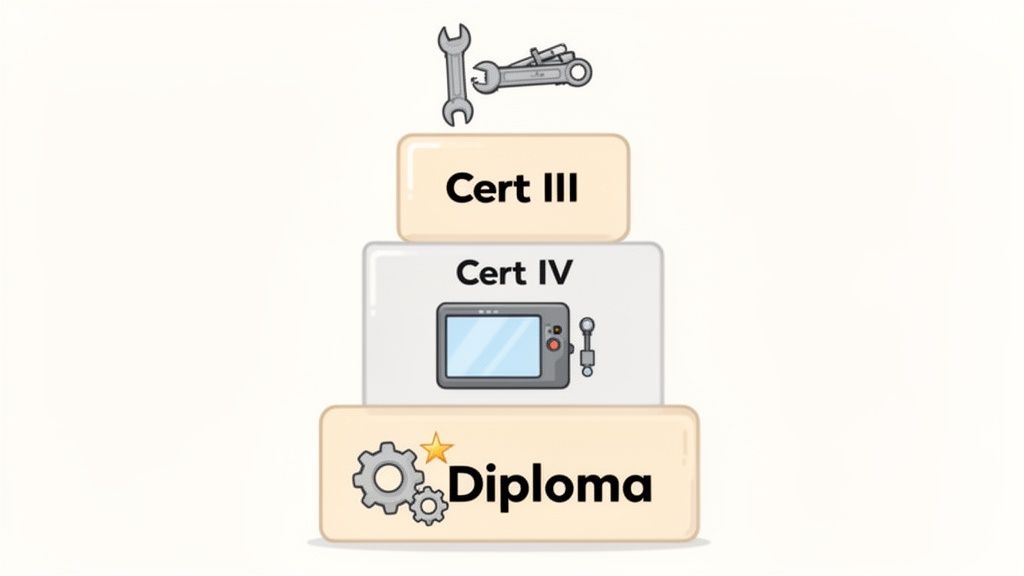
Jumping into the world of automotive qualifications can feel a bit like staring at a complex engine for the first time. You see a lot of parts—certificates, diplomas, different course codes—and it's not always clear where to start. The trick is to see each qualification as a specific tool you're adding to your career toolkit.
Let’s break it down with a simple analogy.
A Certificate III is your essential wrench and socket set. It's the must-have, foundational qualification that gets you in the door and lets you work professionally as a light vehicle mechanic anywhere in Australia. It gives you all the core, hands-on skills to get the job done properly.
Stepping up to a Certificate IV is like adding a high-tech diagnostic scanner to your kit. It builds on what you already know, letting you pinpoint and solve more complex issues or specialise in a niche area like performance tuning.
Then there’s the Diploma. Think of this as your workshop management software. It’s for those looking to lead a team, run the front office, or become a master diagnostic technician.
To get a clearer picture, this table lays out the main differences.
Automotive Qualification Levels at a Glance
Each level is a stepping stone to the next, building your skills and opening up new career doors along the way. For a deeper dive, check out our guide on the difference between diploma and certificate courses in Australia.
Certificate III: The Bedrock of Your Career
If you're serious about becoming a qualified automotive technician, the Certificate III in Light Vehicle Mechanical Technology (AUR30620) is where it all begins. This is the industry-standard ticket to play, the qualification employers expect to see, and the heart of any mechanical apprenticeship. It's all about making you job-ready.
Completing this course means you can confidently handle the day-to-day tasks that keep a workshop humming. But it’s not just about oil changes and tyre rotations. You’ll learn to diagnose and repair the complex systems inside modern vehicles.
This foundational course gets you hands-on with a huge range of practical skills, such as how to:
- Diagnose and repair engine management systems, from fuel injection to ignition.
- Service and fix braking, steering, and suspension systems to keep vehicles safe on the road.
- Work on crucial drivelines and transmission systems.
- Test and repair basic automotive electrical circuits and components.
- Carry out logbook servicing and spot potential faults before they turn into major headaches.
A Certificate III isn’t just about learning a list of tasks; it’s about understanding how a vehicle’s mechanical and electrical systems all work together. It trains you to think like a true technician—a systematic problem-solver who can trace a fault from a weird noise right back to its source.
Why This Qualification Matters Right Now
There has never been a better time to get qualified. The Australian automotive industry is booming, with the number of service workshops growing by a massive 11.5% between 2021 and 2023. That’s nearly 3,000 new businesses that all need skilled technicians.
This rapid growth has created a huge skills gap. Right now, 47% of workshops report having job vacancies they can’t fill. Add to that the fact that Australia’s vehicle fleet grows by about 400,000 cars each year, and you can see why the demand for qualified mechanics is only going to increase.
By starting with a Certificate III, you’re not just training for a job—you're stepping into a high-demand industry that is actively searching for people with your exact skills. It’s the first and most important step toward a stable, rewarding career with plenty of room to grow.
How Online and Blended Learning Actually Works
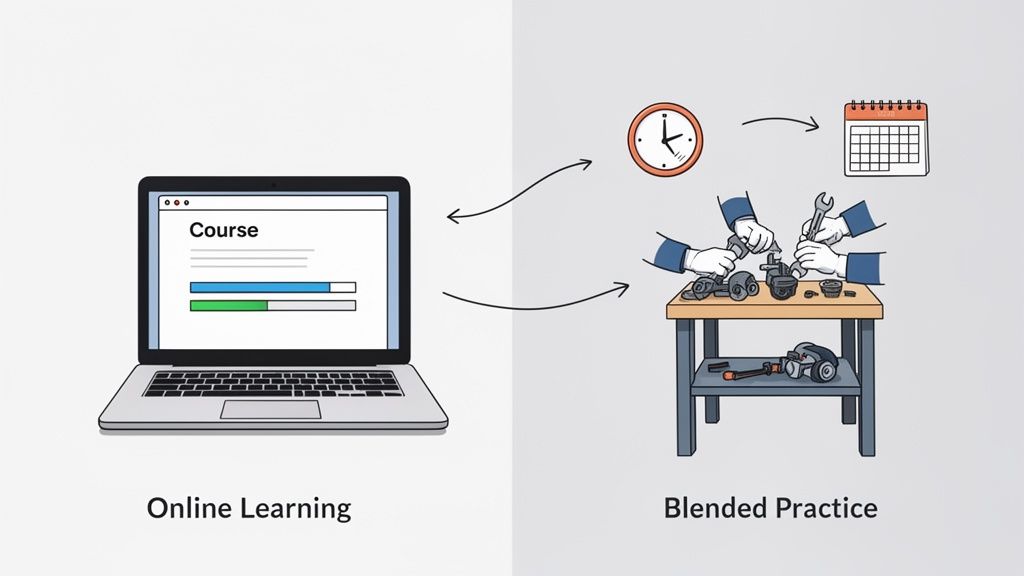
A lot of people think you can only learn a trade like auto mechanics in a noisy, grease-covered workshop. And while you absolutely need that hands-on experience, modern automotive technician courses have cleverly split the learning process into two parts to fit into today's world.
This method is called blended learning, and it gives you the best of both worlds. You get the flexibility of online study for the theory, combined with essential hands-on practice. It’s a model built for real life, letting you get your head around the complex stuff from home before you even touch a spanner.
Think of it like a pilot in training. They spend countless hours in a simulator, learning the controls, procedures, and emergency responses before they ever step into a real cockpit. That's exactly how blended learning works for mechanics.
The Online Theory Component
The first part of your training is all done online. This is where you build that crucial bedrock of knowledge that separates a true professional from a hobbyist. Forget just reading dry textbooks on a screen; it's way more engaging than that.
These online classrooms are loaded with interactive tools to help it all make sense. You’ll be working with:
- Video Demonstrations: Watch seasoned pros pull apart engine systems, explain electrical circuits, and walk you through diagnostic procedures step-by-step.
- Interactive Simulations: Get your hands on virtual tools to work on digital engines. It's a risk-free way to see how different parts fit and work together.
- Self-Paced Modules: You’re in control of your schedule. You can study late at night after the kids are in bed or during your lunch break, making it work around your life.
This is where you master the "why" behind every task. You’ll dig into everything from workplace safety laws to the complex physics of a modern gearbox. This theory is what lets you diagnose a tricky problem logically instead of just taking a wild guess. If you're new to this approach, you can learn more about how blended learning courses are designed to help people succeed.
The Practical Hands-On Component
Once you’ve got the theory down, it’s time to get your hands dirty. This is the second, non-negotiable part of the blended model. No one becomes a great mechanic without real-world practice, and this is where all that knowledge turns into genuine skill.
Your practical training usually happens in one of two ways:
- Workplace-Based Training: If you’re already working as an apprentice or trainee, you’ll complete your practical hours right there on the job, guided by a qualified mentor. Your online lessons directly back up the work you're doing every day.
- Practical Blocks: For other students, the training provider will schedule intensive, focused workshop sessions. These "blocks" let you dive deep into practical skills for a set period in a proper, fully-equipped facility.
This two-part structure is the secret sauce of modern trade training. It ensures you have the deep theoretical knowledge needed for today's complex vehicles, plus the essential, real-world skills to be confident and job-ready from day one.
This flexible model makes getting a trade qualification more achievable than ever. You don’t have to worry about attending a TAFE or campus five days a week, which opens up this fantastic career path to so many more people. You get the convenience of learning on your terms and the critical hands-on experience that employers are looking for.
Mapping Your Career Path After Graduation
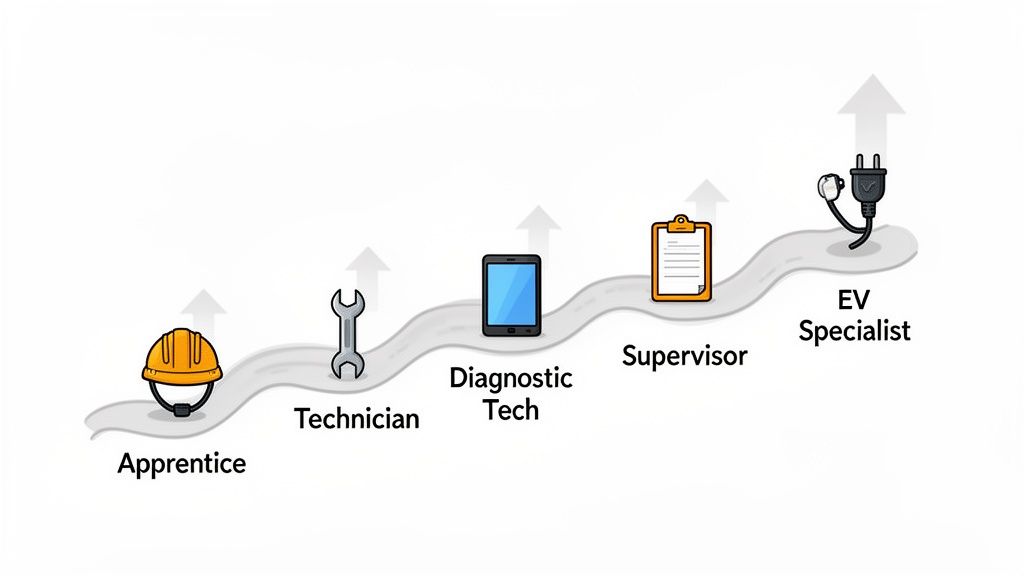
Graduating from your automotive technician course is a bit like being handed the keys to a brand-new car—the real question is, where are you going to drive it? Your Certificate III is much more than a piece of paper; it’s your ticket into a massive industry with roles that go far beyond what you might expect.
This qualification throws open the doors to a world of opportunity. It’s your chance to turn a genuine passion for vehicles into a stable, rewarding, and long-term profession. The journey kicks off with your first qualified role and can lead anywhere from workshop management and high-level specialisation to even owning your own business one day.
Your Career in a High-Demand Industry
One of the biggest wins for any new graduate is stepping into an industry that’s crying out for your skills. Australia is facing a serious shortage of qualified automotive technicians, which puts you in a fantastic position when you start looking for work.
It's not just talk; the national data backs it up. Technician roles are consistently listed among the hardest for employers to fill. A 2023 report revealed that the average fill rate for auto jobs was a shocking 39%, well below the official line for an occupation being "in shortage." For anyone thinking about starting an automotive course, this means your chances of landing an apprenticeship and a great first job are incredibly high.
This demand isn't a short-term trend, either. It creates a solid foundation for your entire career, ensuring your skills will be valued for many years to come.
Beyond the Workshop Floor: Potential Roles
Your first gig will likely be as a Light Vehicle Technician, where you'll get your hands dirty putting all those new skills into practice. But that's just the beginning. With a bit of experience and some extra training, your career can branch out in some seriously cool directions.
- Diagnostic Technician: Love solving a good puzzle? This is the role for you. Diagnostic techs are the detectives of the workshop, using advanced tools and deep knowledge to track down complex faults that have everyone else stumped.
- Workshop Supervisor or Foreman: If you’re a natural leader and have a knack for organisation, moving into a supervisor role is a great path. You'll manage the workflow, mentor other technicians, and make sure the whole workshop runs like a well-oiled machine.
- EV or Hybrid Specialist: With the entire automotive world shifting towards electric power, specialists in this field are in hot demand. This path involves upskilling to work safely and expertly on high-voltage batteries and electric drivetrains.
- Performance Tuning Specialist: For those with a need for speed, a career in performance tuning lets you modify engines, suspension, and electronics to squeeze every last drop of power out of a vehicle.
Your Certificate III is the starting line, not the finish line. The automotive industry rewards continuous learning, allowing you to build on your foundational skills and carve out a niche that aligns perfectly with your interests and strengths.
And for those who dream really big, learning how to become an F1 mechanic can be the ultimate inspiration. While it's an incredibly competitive field, it shows just how far a career on the tools can take you.
Understanding Your Earning Potential
As you build up your experience and expertise, your salary as an automotive technician will grow right alongside it. While pay packets can vary depending on where you are and who you work for, there’s a clear upward trend as you climb the career ladder.
Here’s a snapshot of the kind of salary progression you can expect in the Australian auto industry.
Potential Automotive Career Paths and Salary Ranges
This table provides a general guide to different job roles and their average salary ranges, showing how further qualifications and experience can impact your earnings.
As you can see, these figures show a clear financial reason to keep learning. By investing in further training like a Certificate IV or a Diploma, you don’t just expand your skillset—you significantly boost your long-term earning capacity. Your career is a journey, and each step forward brings new challenges and bigger rewards.
How to Choose and Enrol in the Right Course
Picking the right automotive technician course is a bit like choosing the perfect diagnostic tool for a tricky engine problem. It needs to be reliable, fit for the job, and a smart investment that pays off down the track. With so many providers out there, knowing what to look for can turn a confusing decision into a clear path forward.
Let's walk through the essential checklist for finding your ideal course and then break down the simple steps to get yourself enrolled and on your way.
What to Look for in a Quality Course
Not all courses are built the same. To make sure your qualification is worth the paper it’s printed on and respected by employers across Australia, you need to check a few key things.
Think of this as your pre-purchase inspection before you commit.
National Recognition: This is the big one. The course must be delivered by a Registered Training Organisation (RTO). This is your guarantee that the qualification is nationally recognised and meets strict government quality standards. No RTO, no deal.
Flexible Delivery Modes: Life is busy. Look for providers that offer a blended learning model. This combination of online theory and hands-on workshop sessions is perfect for juggling study with a job or family commitments.
Transparent Costs and Payment Plans: A good provider is upfront about all the costs involved. Even better, they'll offer flexible payment plans, letting you pay in smaller, manageable weekly or fortnightly instalments instead of a massive lump sum.
Positive Student Reviews: What are past students saying? Jump onto sites like Trustpilot and read some real-world reviews. This gives you an honest look into the learning experience and the level of support you can expect.
Choosing a course isn't just about the qualification. It's about finding a training partner that gets your learning style, respects your budget, and is genuinely invested in your career goals. Always prioritise RTOs with flexible payment options to make your education affordable and stress-free.
The Enrolment Process Step-by-Step
Found a course that looks like a winner? Great! The enrolment process is usually pretty straightforward. It’s designed to make sure you're a good fit for the program and have everything you need to succeed. While every RTO has its own way of doing things, the journey generally looks like this.
Make an Enquiry: This is your first move. Hop on the provider's website or give them a call. A course advisor will get in touch to chat about your goals, answer your questions, and give you the full rundown on the course structure, costs, and payment options.
Fill Out the Enrolment Form: After your chat, you’ll get an enrolment form. This is just to collect your basic details, confirm you’re eligible, and officially kick off your application.
The LLN Check: Don't let the name scare you. Most RTOs will ask you to do a quick Language, Literacy, and Numeracy (LLN) assessment. It’s not a pass-or-fail test. It’s simply a tool to see if you have the reading and maths skills needed to keep up with the coursework, and it helps the provider know if you might need a bit of extra support.
Lock in Your Payment Plan: Now you sort out the finances. You’ll work with the provider to set up a payment schedule that fits your budget, breaking down the total course fee into easy-to-manage instalments.
Get Your Confirmation and Start Learning: Once all the paperwork is processed, you’ll get an official confirmation of enrolment. This will include your login details for the online student portal, an orientation schedule, and everything else you need to hit the ground running.
Following these steps takes the mystery out of enrolling. It feels less like a mountain of paperwork and more like the exciting first step towards a new career. By carefully checking out your provider and understanding the enrolment journey, you can get started with total confidence.
Got Questions? Here Are Your Answers
Taking the plunge into a new career always brings up a few questions. When it comes to becoming a mechanic, a few queries pop up time and time again. To make sure you’ve got all the info you need before you commit, we’ve put together some straight answers to the most common questions we hear.
Think of this as your final check-over before you get started on the workshop floor.
Do I Need to Buy My Own Tools to Start a Course?
This is a big one for anyone just starting out, and the answer is refreshingly simple: no, you don't need a professional toolkit to begin your studies.
For the theory part of your course, all you’ll need is a computer and an internet connection. When it comes time for the hands-on practical work, the Registered Training Organisation (RTO) or your workplace (if you’re an apprentice) will have all the tools and equipment you need to use.
Of course, you'll be expected to build your own toolkit as you progress in your career, but there’s no pressure to make a massive investment upfront. Most tool suppliers even offer solid apprentice discounts on starter kits, making it much easier to get yourself set up as you learn and earn.
Can I Really Become a Qualified Mechanic Online?
Yes, you absolutely can, but it’s important to understand how it works. Reputable automotive courses use what’s called a "blended learning" model, which has become the gold standard for flexible trade training in Australia.
This means you get to complete all the theory modules online, studying at a pace that suits you. This is where you dig into the 'why' behind the work—learning about engine principles, diagnostic theory, and crucial safety protocols. The flexibility of online study is fantastic because you can fit it around your job or family commitments.
But—and this is the important part—to become a fully qualified technician, you must also log a set number of practical hours in a real or simulated workshop. This is where you roll up your sleeves and apply all that theory, developing the hands-on skills that employers are looking for.
So, while online learning is a huge and convenient part of your qualification, it’s always paired with essential, in-person practical training. This hybrid approach ensures you graduate as a competent, confident, and completely job-ready technician with a nationally recognised qualification.
What’s the Cost and Are Payment Plans an Option?
Course fees for automotive qualifications can vary quite a bit, depending on the provider, the level of the certificate, and any government funding you might be eligible for in your state. As a rough guide, a Certificate III can range anywhere from a few thousand to over ten thousand dollars.
The good news is that you almost never have to find that kind of money all at once. The vast majority of quality training providers offer flexible payment plans.
This is a real game-changer. Instead of being hit with a huge upfront fee, you can break the total cost down into manageable weekly or fortnightly instalments. It’s a smart way to invest in your future without putting your current finances under major stress.
How Long Does a Certificate III Automotive Course Take?
There’s no single, fixed timeline here—it really depends on the study model you choose and how quickly you move through the content.
For a traditional, full-time apprentice, the journey to getting qualified usually takes between three and four years. That path combines on-the-job training with scheduled blocks of formal learning.
However, for students in more flexible, self-paced programs that blend online theory with practical workshop blocks, the timeframe is often shorter. For these courses, you’re typically looking at anywhere between 12 and 24 months.
While you can control the pace of your online learning, completing your mandatory practical hours is the other key factor that determines your overall timeline. Your training provider will give you a clear schedule when you enrol, so you’ll know exactly what to expect.
What’s the Difference Between a Mechanic and a Technician?
Great question. While most people use the terms interchangeably, there’s a growing distinction within the industry.
Think of it like this: a traditional "mechanic" is the person you picture getting their hands dirty with the physical repair of mechanical parts—things like brakes, suspension, and engine components.
The term "technician," on the other hand, reflects the modern reality of the trade. Today's cars are essentially computers on wheels, packed with complex sensors, wiring, and software. An automotive technician does everything a mechanic does, but they also have deep expertise in using advanced diagnostic tools to find and fix tricky electronic and software-based issues.
At the end of the day, any professional working on modern vehicles needs to be both. A great technician has fantastic mechanical skills and the high-tech knowledge to work on today’s cars. The courses you'll enrol in are designed to give you this complete, future-proof skillset.
Ready to stop wondering and start doing? At Get Course, we make it simple to find and compare nationally recognised automotive technician courses from Australia's leading providers. Explore flexible, online learning options with payment plans designed to fit your life. Find your perfect course and start your journey to a rewarding new career today. Visit us at https://getcourse.com.au.
Find Your Course
Compare courses across every field we write about, and enquire in under a minute.